** What’s Up: October 2022 Skywatching Tips from NASA – NASA JPL
What are some skywatching highlights in October 2022? Enjoy giant planets Jupiter and Saturn all night throughout the month. Then watch as Mars begins its retrograde motion, moving westward each night instead of eastward, for the next few months. Finally, check out the Orionid meteors overnight on Oct. 20.
0:00 Intro 0:11 Evenings with Jupiter & Saturn 0:37 Mars’ retrograde motion 2:07 Orionid meteor shower 3:04 October Moon phases
Additional information about topics covered in this episode of What’s Up, along with still images from the video, and the video transcript, are available at https://solarsystem.nasa.gov/skywatch…
Crisp, clear October nights are full of celestial showpieces. Find Pegasus, the flying horse of Greek myth, to pinpoint dense globular star clusters and galaxies, and keep watching for space-based views of M15, NGC 7331, and the Andromeda Galaxy.
What’s in the night sky tonight? Get ready for Mars opposition, make the most of Uranus (and prepare for a lunar occultation at the end of the year), observe Neptune following its September opposition, see Jupiter’s Galilean moons, take in the Orionid meteor shower and admire the Summer Triangle asterism.
Our monthly Sky Tour #astronomy #podcast provides an informative and entertaining 10-minute guided tour of the nighttime sky. Listen to the October episode and give #Jupiter a really close look, learn what #Andromeda and #Pegasus have in common, circle around the pole #star #Polaris, and watch for #meteors shed by #Halley’s #Comet
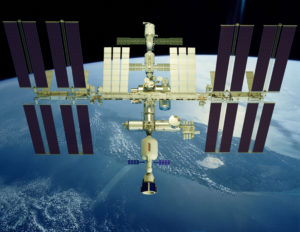
Here is the latest episode in NASA’s Space to Ground weekly report on activities related to the International Space Station:
** Expedition 67/68 International Space Station Change of Command Ceremony – Sept. 28, 2022 – NASA Video
Aboard the International Space Station, Roscosmos cosmonaut Oleg Artemyev handed over command of the International Space Station to ESA (European Space Agency) astronaut Samantha Cristoforetti during a change of command ceremony September 28. Farwell remarks also took place ahead of Crew-4 undocking and splashdown following their six-month mission aboard the orbital outpost. Cristoforetti and Artemyev are in the midst of long duration missions living and working aboard the microgravity laboratory to advance scientific knowledge and demonstrate new technologies for future human and robotic exploration missions.
** Expedition 67 International Space Station Flyover of Hurricane Ian – Sept. 26, 2022 – NASA Video
The International Space Station passed approximately 260 statute miles overhead Hurricane Ian at approximately 3 p.m. EDT Monday, Sept. 26, 2022. External cameras on the orbiting laboratory captured views of the storm as it gained strength south of Cuba while moving toward the north-northwest. The storm is expected to intensify before approaching the west coast of Florida on Wednesday into Thursday. NASA managers met Monday morning and made the decision to roll the Artemis I Space Launch System rocket and Orion spacecraft back to the Vehicle Assembly Building after additional data gathered overnight did not show improving expected conditions for the Kennedy Space Center area. The decision allows time for employees to address the needs of their families and protect the integrated rocket and spacecraft system.
** Expedition 67 International Space Station Flyover of Hurricane Ian – Sept. 28, 2022 – NASA Video
The International Space Station flew 260 miles over Hurricane Ian at 3:05 p.m. EDT Wednesday, Sept. 28, 2022. External cameras on the orbiting laboratory captured views of the storm as it made landfall in Florida near Fort Myers, Florida with winds of 155 miles an hour as it moved to the northeast across the Florida peninsula.
** Expedition 68 International Space Station Flyover of Tropical Storm Ian – Sept. 29, 2022 – NASA Video
The International Space Station flew 260 miles over Tropical Storm Ian at 2:10 p.m. EDT Thursday, Sept. 29, 2022. External cameras on the orbiting laboratory captured views of the storm as it began to move off of the east coast of Florida. Ian made landfall near Fort Myers, Florida Wednesday packing winds of 155 miles an hour as it moved to the northeast across the Florida peninsula.
Aboard the International Space Station, NASA Expedition 67 Flight Engineers Kjell Lindgren, Bob Hines and Jessica Watkins, as well as ESA (European Space Agency) Flight Engineer Samantha Cristoforetti, answered questions about life and work on the orbiting laboratory, as well as all the exciting reasons to work at NASA during an in-flight event August 22, 2022 with NASA interns calling from the Mission Control Center at NASA’s Johnson Space Center in Houston. The four crew members are in the midst of a science mission living and working aboard the microgravity laboratory to advance scientific knowledge and demonstrate new technologies for future human and robotic exploration missions as part of NASA’s Moon and Mars exploration approach, including lunar missions through NASA’s Artemis program.
** NLRA 2023-1 Technology Advancement and Applied Research Leveraging the ISS National Lab – ISS National Lab – YouTube
On September 27, 2022, the ISS National Lab held a webinar to provide further background on NLRA 2023-1 and to answer any questions.
NASA astronauts Josh Cassada and Nicole Mann, JAXA astronaut Koichi Wakata and Roscosmos cosmonaut Anna Kikina are scheduled to launch to the International Space Station no earlier than Oct. 3, 2022. Learn more about SpaceX Crew-5: https://www.space.com/nasa-spacex-cre…
** Soyuz carrying 3 cosmonauts undocks from space station for return trip – VideoFromSpace
A Soyuz spacecraft carrying cosmonauts Oleg Artemyev, Denis Matveev, and Sergey Korsakov undocked from the International Space Station at 3:34 a.m. EDT on Sept. 29, 2022. They landed a few hours later in Kazakhstan at 6:57 a.m. (4:57 p.m. Kazakhstan time). Full Story: https://www.space.com/soyuz-ms21-cosm…
A Soyuz spacecraft carrying cosmonauts Oleg Artemyev, Denis Matveev, and Sergey Korsakov landed in Kazakhstan at 6:57 a.m. (4:57 p.m. Kazakhstan time) on Sept. 29, 2022. They undocked from the International Space Station about 3 hours earlier. Full Story: https://www.space.com/soyuz-ms21-cosm…
Timelapse video made during ESA astronaut Samantha Cristoforetti’s second mission to the International Space Station, “Minerva”. Samantha shared this video on social media with the caption: “Teamwork makes the dream work! Our oxygen generation system and our life support rack had to swap places … and we needed all hands on deck! Wasn’t quite as fast in real time, but it all fit in the end!”
** Footage Shows Chinese Astronauts Conducting Key Scientific Experiments in Space Station –CCTV Video News Agency
The China Manned Space Agency on Thursday released video footage showing the intricate in-orbital work of three Chinese astronauts aboard the country’s space station Tiangong, including the testing of a special science glovebox which allows a safe space for conducting key science experiments.
The three astronauts, Chen Dong, Liu Yang, and Cai Xuzhe, blasted off in June to embark on a record-breaking six-month mission aimed at completing the final construction phase of China’s Tiangong space station by the end of 2022.
Currently, live views from the ISS are streaming from an external camera mounted on the ISS module called Node 2. Node 2 is located on the forward part of the ISS. The camera is looking forward at an angle so that the International Docking Adapter 2 (IDA2) is visible. If the Node 2 camera is not available due to operational considerations for a longer period of time, a continuous loop of recorded HDEV imagery will be displayed. The loop will have “Previously Recorded” on the image to distinguish it from the live stream from the Node 2 camera. After HDEV stopped sending any data on July 18, 2019, it was declared, on August 22, 2019, to have reached its end of life. Thank You to all who shared in experiencing and using the HDEV views of Earth from the ISS to make HDEV so much more than a Technology Demonstration Payload!
1. Tuesday, Sept. 27, 2022; 7 pm PST (9 pm CST, 10 pm EST): We welcome Sarah Scoles. Sara is a science and space journalist. We will talk with her about science, space and Starship plus much more.
2. Hotel Mars – Wednesday, Sept. 28, 2022; 1:00 pm PST (3:00 pm CST, 4:00 pm EST): TBD. Check the Upcoming Show Menu at www.thespaceshow.com for updates on scheduling.
3. Friday, Sept.30, 2022; 9:30-11 am PST (11:30 am-1 pm CST, 12:30-2 pm EST): We welcome Dr. Konrad Szocik. Our guest will discuss his recent paper, “Bioethical Issues in Human Modification for Protection against the Effects of Space Radiation“.
4. Sunday, Oct.2, 2022; 12-1:30 pm PST (2-3:30 pm CST, 3-4:30 pm EST): We welcome Holly Melear. Holly talks about her organization Steam-Space Education.
Some recent shows:
** Sunday, Sept.25.2022 – Leonard David “was back with us for a wide ranging discussion on multiple topics that are in the space news today“.
** Friday, Sept.23.2022 – Grant Blaisdell “introduced us to Copernic Space which is about decentralizing ownership of space assets and creating a Web3 technology base operation for buying and selling commercial space assets“.
Here is the latest episode in NASA’s Space to Ground weekly report on activities related to the International Space Station:
** Blastoff! Russia launches NASA astronaut and two cosmonauts to space station – VideoFromSpace
A Soyuz rocket launched NASA astronaut Frank Rubio and Roscosmos cosmonauts Sergey Prokopyev and Dmitri Petelin from the Baikonur Cosmodrome in Kazakhstan on Sept. 21, 2022. Full Story: https://www.space.com/soyuz-ms22-inte…
** Soyuz docks to space station with NASA astronaut and 2 cosmonauts aboard – VideoFromSpace
NASA astronaut Frank Rubio and Roscosmos cosmonauts Sergey Prokopyev and Dmitri Petelin arrived at the International Space Station aboard a Russian Soyuz spacecraft on Sept. 21, 2022. Watch the launch: https://www.space.com/soyuz-ms22-inte…
** Large trash bag jettisoned from Space Station using ‘new capability‘ – VideoFromSpace
ESA astronaut Samantha Cristoforetti delivered video of a new trash disposal technique on the International Space Station. The “big trash bag was jettisoned from a depressurized airlock on the station & it burned up harmlessly in the Earth’s atmosphere,” according to a twitter post from Cristoforetti. Learn about the space station’s Bishop airlock: https://www.space.com/nanoracks-bisho…
** Expedition 67 Space Station Crew Answers Texas High School Student Questions – Sept. 22, 2022 – NASA Video
Aboard the International Space Station, NASA Expedition 67 Flight Engineers Kjell Lindgren and Bob Hines answered pre-recorded questions about life and work on the orbiting laboratory during an in-flight event Sept. 22 with students at the Sam Houston Math, Science, and Technology Center in Houston. Lindgren and Hines are in the midst of a science mission living and working aboard the microgravity laboratory to advance scientific knowledge and demonstrate new technologies for future human and robotic exploration missions as part of NASA’s Moon and Mars exploration approach, including lunar missions through NASA’s Artemis program.
Chinese astronauts Cai Xuzhe and Chen Dong completed the Shenzhou-14 crew’s second extravehicular activities (EVA) outside the Tiangong space station on Sept. 17, 2022. They installed “extravehicular assistance handles and the extended pump set of the load circuits,” according to China Central Television. Full Story: https://www.space.com/chinese-astrona…
Currently, live views from the ISS are streaming from an external camera mounted on the ISS module called Node 2. Node 2 is located on the forward part of the ISS. The camera is looking forward at an angle so that the International Docking Adapter 2 (IDA2) is visible. If the Node 2 camera is not available due to operational considerations for a longer period of time, a continuous loop of recorded HDEV imagery will be displayed. The loop will have “Previously Recorded” on the image to distinguish it from the live stream from the Node 2 camera. After HDEV stopped sending any data on July 18, 2019, it was declared, on August 22, 2019, to have reached its end of life. Thank You to all who shared in experiencing and using the HDEV views of Earth from the ISS to make HDEV so much more than a Technology Demonstration Payload!
This shows a still image of the supermassive black hole Sagittarius A*, as seen by the Event Horizon Collaboration (EHT), with an artist’s illustration indicating where the modelling of the ALMA data predicts the hot spot to be and its orbit around the black hole. Credits: ESO
Using the Atacama Large Millimeter/submillimeter Array (ALMA), astronomers have spotted signs of a ‘hot spot’ orbiting Sagittarius A*, the black hole at the centre of our galaxy. The finding helps us better understand the enigmatic and dynamic environment of our supermassive black hole.
“We think we’re looking at a hot bubble of gas zipping around Sagittarius A* on an orbit similar in size to that of the planet Mercury, but making a full loop in just around 70 minutes. This requires a mind blowing velocity of about 30% of the speed of light!”
says Maciek Wielgus of the Max Planck Institute for Radio Astronomy in Bonn, Germany, who led the study published today in Astronomy & Astrophysics.
The observations were made with ALMA in the Chilean Andes — a radio telescope co-owned by the European Southern Observatory (ESO) — during a campaign by the Event Horizon Telescope (EHT) Collaboration to image black holes. In April 2017 the EHT linked together eight existing radio telescopes worldwide, including ALMA, resulting in the recently released first ever image of Sagittarius A*. To calibrate the EHT data, Wielgus and his colleagues, who are members of the EHT Collaboration, used ALMA data recorded simultaneously with the EHT observations of Sagittarius A*. To the team’s surprise, there were more clues to the nature of the black hole hidden in the ALMA-only measurements.
By chance, some of the observations were done shortly after a burst or flare of X-ray energy was emitted from the centre of our galaxy, which was spotted by NASA’s Chandra Space Telescope. These kinds of flares, previously observed with X-ray and infrared telescopes, are thought to be associated with so-called ‘hot spots’, hot gas bubbles that orbit very fast and close to the black hole.
“What is really new and interesting is that such flares were so far only clearly present in X-ray and infrared observations of Sagittarius A*. Here we see for the first time a very strong indication that orbiting hot spots are also present in radio observations,”
says Wielgus, who is also affiliated with the Nicolaus Copernicus Astronomical Centre, Poland and the Black Hole Initiative at Harvard University, USA.
“Perhaps these hot spots detected at infrared wavelengths are a manifestation of the same physical phenomenon: as infrared-emitting hot spots cool down, they become visible at longer wavelengths, like the ones observed by ALMA and the EHT,”
adds Jesse Vos, a PhD student at Radboud University, the Netherlands, who was also involved in this study.
The flares were long thought to originate from magnetic interactions in the very hot gas orbiting very close to Sagittarius A*, and the new findings support this idea.
“Now we find strong evidence for a magnetic origin of these flares and our observations give us a clue about the geometry of the process. The new data are extremely helpful for building a theoretical interpretation of these events,”
says co-author Monika Mościbrodzka from Radboud University.
This visible light wide-field view shows the rich star clouds in the constellation of Sagittarius (the Archer) in the direction of the centre of our Milky Way galaxy. The entire image is filled with vast numbers of stars — but far more remain hidden behind clouds of dust and are only revealed in infrared images. This view was created from photographs in red and blue light and form part of the Digitized Sky Survey 2. The field of view is approximately 3.5 degrees x 3.6 degrees. Credits: ESO
ALMA allows astronomers to study polarised radio emission from Sagittarius A*, which can be used to unveil the black hole’s magnetic field. The team used these observations together with theoretical models to learn more about the formation of the hot spot and the environment it is embedded in, including the magnetic field around Sagittarius A*. Their research provides stronger constraints on the shape of this magnetic field than previous observations, helping astronomers uncover the nature of our black hole and its surroundings.
The observations confirm some of the previous discoveries made by the GRAVITY instrument at ESO’s Very Large Telescope (VLT), which observes in the infrared. The data from GRAVITY and ALMA both suggest the flare originates in a clump of gas swirling around the black hole at about 30% of the speed of light in a clockwise direction in the sky, with the orbit of the hot spot being nearly face-on.
“In the future we should be able to track hot spots across frequencies using coordinated multiwavelength observations with both GRAVITY and ALMA — the success of such an endeavour would be a true milestone for our understanding of the physics of flares in the Galactic centre,”
says Ivan Marti-Vidal of the University of València in Spain, co-author of the study.
The team is also hoping to be able to directly observe the orbiting gas clumps with the EHT, to probe ever closer to the black hole and learn more about it.
“Hopefully, one day, we will be comfortable saying that we ‘know’ what is going on in Sagittarius A*,”
Wielgus concludes.
This image shows the Atacama Large Millimeter/submillimeter Array (ALMA) looking up at the Milky Way as well as the location of Sagittarius A*, the supermassive black hole at our galactic centre. Highlighted in the box is the image of Sagittarius A* taken by the Event Horizon Telescope (EHT) Collaboration. Located in the Atacama Desert in Chile, ALMA is the most sensitive of all the observatories in the EHT array, and ESO is a co-owner of ALMA on behalf of its European Member States. Credits: ESO