Videos: “Space to Ground” ISS report + Soyuz launch + Atlas V launch

Here is the latest Space To Ground report from NASA on activities related to the Int. Space Station:

Lots of other space activities in the past week or so. A Soyuz spacecraft with three new crewmembers for the ISS (Soyuz Commander Oleg Novitskiy of Roscosmos and Flight Engineers Peggy Whitson of NASA and Thomas Pesquet of the European Space Agency) arrived at the station today following their launch on Thursday from Kazakhstan: New Trio Arrives to Join Expedition 50 Crew | Space Station

Here is a video of the launch of the Soyuz:

[ Update: Here are videos of the arrival of the Soyuz at the ISS and of the Soyuz crew coming into the station:

]

Today there was also a launch of an Atlas V rocket from Cape Canaveral with the new generation weather satellite GOES-R:

Update: There was also a launch on Nov. 17th of an Arianespace Ariane V rocket from the Guiana Space Centre  near Kourou in French Guiana with 4 Galileo navigation satellites:

Artist Lia Halloran renders the Messier sky objects anew

Artist Lia Halloran has created a set of works based on the celestial objects cataloged by astronomer Charles Messier in the 18th Century. The exhibition Deep Sky Companion is on display currently at Caltech: Art Inspired by Astronomy on Display at Caltech | Caltech 

Halloran created paintings of Messier’s objects with blue ink on semi-transparent drafting film. These were then contact-printed onto photographic paper and cut into circles evocative of the view through a telescope. Prints of each of the 110 Messier objects are displayed on the geometrically skewed lobby walls and stairwells of the Cahill building, which was designed by architect Thom Mayne. Several of the original blue-ink paintings are displayed on the stairway landings.

[]
M106, 2013 – Lia Halloran

[]
M27, 2013 – Lia Halloran

Halloran also has a collection called Your Body Is A Space That Sees 

… historical imagery and narratives to trace contributions of women in astronomy since antiquity. The of series of large scale cyanotype prints will interpret a fragmented history and represent a female-centric astronomical catalog of craters, comets, galaxies and nebula drawing from narrative, imagery and historical accounts of Hypatia of Alexandria, Caroline Herschel, Helen Sawyer Hogg, and a group of women at Harvard in the late 1800’s known as Pickering’s Harem or the Harvard Computers. 

Cyanotypes are printed from painted negatives that are based on the objects and narratives that were connected to these early astronomers. This process mimics early astronomical glass plates moving between transparent surfaces to a photograph without the use of a camera.

[]
From the collection “Your Body is a Space that  Sees” – Lia Halloran

Check out Halloran’s other space inspired works in her online gallery.

The Universe in a Sphere

[ Update: The original Kickstarter failed but they relaunched it and quickly exceeded their new goal: The Universe in a Sphere (Relaunch) by Clemens — Kickstarter.]

Clemens Steffin has a Kickstarter to help fund production and sales of glass spheres he designed that contain white dots representing galaxies of the supercluster to which our Milky Way belongs: The Universe in a Sphere by Clemens — Kickstarter

Laniakea, that is the name of the supercluster of galaxies we are part of. This tremendous structure can now be yours.

I made this 3,1″ glass-sphere with 600.000 tiny dots, each representing an entire galaxy. I decided to make a Kickstarter campaign, where I try to collect a large amount of people who want to buy such a sphere to make the production affordable. Now I write you to ask, if you are interested in reselling these spheres? They will cost 30€ each, if you buy ten of them and 40€ for a single one. The campaign only runs until the 27th November and if there are enough buyers, the spheres will be produced. The campaign is already funded to 40% and I got a lot of positive feedback. 

Kickstarter: Project Blue aims to see exoplanets at Alpha Centauri with low cost space observatory

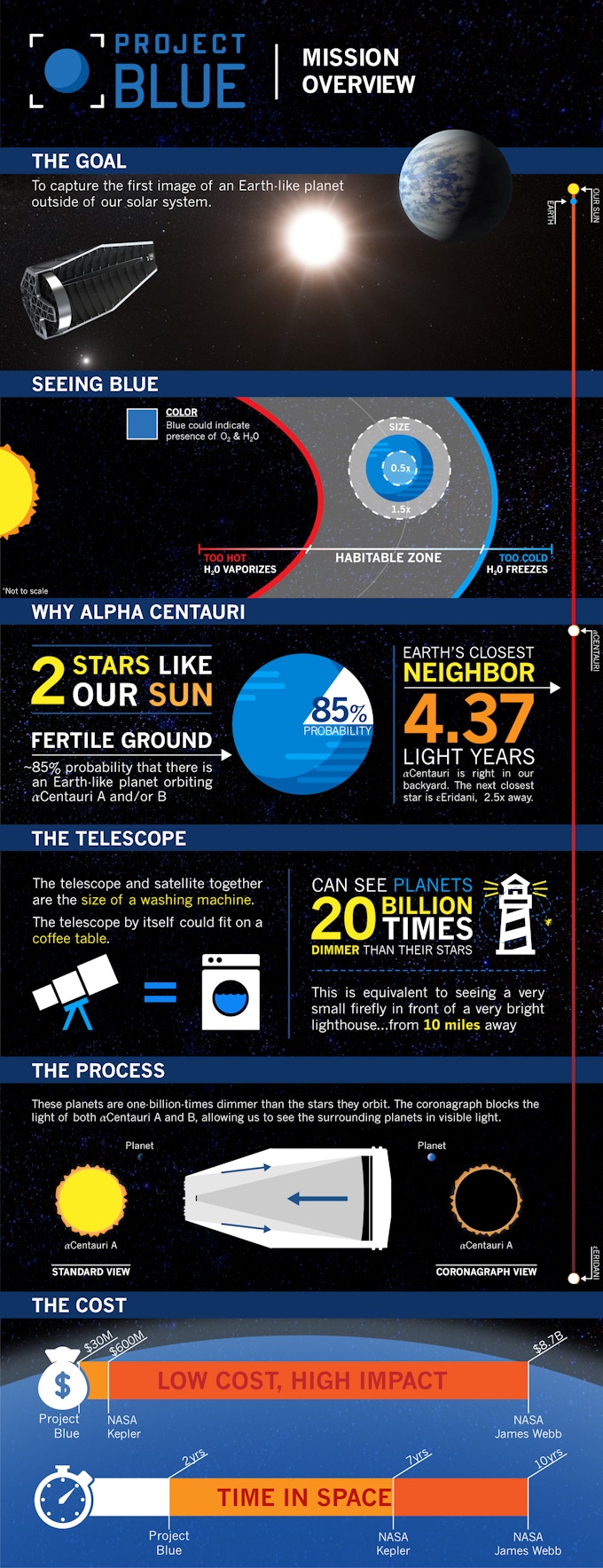
Project Blue intends to develop a small, low cost space telescope that looks continually at our nearest neighboring star system, Alpha Centauri, and try to directly image any planets orbiting it. A coronagraph will be used to block the otherwise blinding glare of the stars.

The project has opened a Kickstarter campaign to raise $1M to fund the initial design study for the system, which is expected eventually to cost around $30M.

… we need your help. This isn’t a traditional space mission. Within astrophysics, NASA has traditionally funded projects with a much broader scope, like Kepler and Hubble, rather than a project like ours that is focused on a single target. So we started this campaign with the belief that together, people all over the world could push the boundaries of discovery in space, and possibly achieve one of the greatest milestones of human exploration.

With the formation of Project Blue, we brought together the technical experts who can build and launch this telescope: scientists from organizations like BoldlyGo Institute, Mission Centaur, the SETI Institute, and the University of Massachusetts Lowell. And now we’re asking for your support to get involved, and make Project Blue a reality.

Here is a video about the project:

From the website:

Project Blue is a new science initiative to capture the first photograph of a potential Earth-like planet orbiting another Sun-like star. The mission aims to launch a lightweight space telescope to directly image exoplanets around Earth’s nearest star system, Alpha Centauri A and B. With a budget the fraction of the cost of a mid-size astrophysics mission, and a planned launch by the end of the decade, this venture represents an ambitious leap forward in low-cost, high-impact space exploration. Through active collaboration between research institutions, universities, private industry and citizens, Project Blue seeks to make space exploration a participatory, collective endeavor and inspire millions worldwide to engage in scientific inquiry.


More at Project Blue kicks off planet-hunting campaign – Alan Boyle/Geekwire –

The plan is to build a telescope to stare at those two closely paired stars over the course of two years. Because they’re so close to us in astronomical terms — a mere 4.37 light-years, or 26 trillion miles — it would be possible to get a direct image of any potentially habitable planets using a telescope that has a 20-inch-wide (0.5-meter-wide) mirror, Morse said.

What’s more, the telescope would be able to analyze the light reflected by those planets. That could tell scientists what their atmospheres are made of. If the planet shines with the right shade of blue, that would suggest it’s an alien Earth.

Here is an infographic (larger version):

Project Blue Infographic


Everyone can participate in space