Blue jets and red sprites observed from the ISS

Blue and red lightning bolts shooting upwards from high altitude clouds have been observed from the International Space Station and recorded on video: Blue jets studied from Space Station – ESA
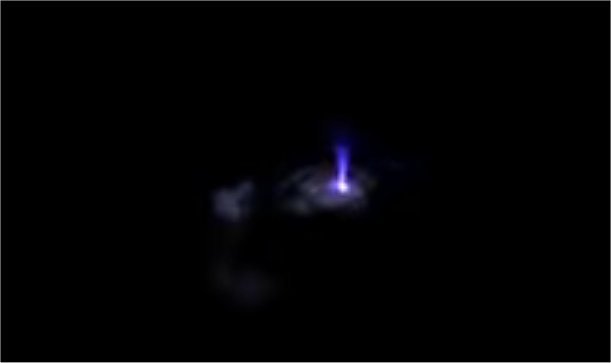
Screen capture from video of blue jet of lightning as seen from the ISS.

For years, their existence has been debated: elusive electrical discharges in the upper atmosphere that sport names such as red sprites, blue jets, pixies and elves. Reported by pilots, they are difficult to study as they occur above thunderstorms.

ESA astronaut Andreas Mogensen during his mission on the International Space Station in 2015 was asked to take pictures over thunderstorms with the most sensitive camera on the orbiting outpost to look for these brief features.

Denmark’s National Space Institute has now published the results, confirming many kilometre-wide blue flashes around 18 km altitude, including a pulsating blue jet reaching 40 km. A video recorded by Andreas as he flew over the Bay of Bengal at 28 800 km/h on the Station shows the electrical phenomena clearly – a first of its kind.

The Station’s low orbit makes it an ideal platform from which to observe and study these unusual electrical atmospheric phenomena. In the video below,

ESA astronaut Andreas Mogensen explains the phenomena he filmed over India from the International Space Station’s Cupola observatory in September 2015 during his postflight tour at ESA’s technical heart ESTEC in The Netherlands.

The film shows lightning illuminating clouds and recently discovered phenomena called blue jets and Red Sprites.

As part of his 10-day mission Andreas performed an experiment called Thor after the god of thunder, lightning and storms in Nordic mythology. Initiated by the Technical University of Denmark, Thor had Andreas test a new thundercloud imaging system that looks at the electrification of lighting.

Researchers are particularly interested in newly-discovered lights that occur in the upper atmosphere during thunderstorms called red sprites, blue jets and elves. Sprites last 20 milliseconds at most, and to capture them on camera is a real challenge. They received their name because of their elusive nature. Blue jets are found up to 50 km altitude with Red Sprites occurring between 60-80 km altitude.

Andreas received the coordinates of a few possible thunderstorms together with the times and instructions on which lens, filter and camera settings to use.

Some of the most violent electric discharges are very difficult to capture from the ground because the atmosphere blocks radiation. Apart from covering all the main thunderstorm regions, the International Space Station brings scientists as close as possible to the electric phenomena. Its great vantage point has the lowest orbit available for observation at around 400 km altitude – imaging satellites mostly operate at 800 km.

Read more about Andreas’s iriss mission: http://www.esa.int/iriss

====

Space podcasts – latest selection

Here is sampling of recent space related podcasts:

** The Space Show/John Batchelor Show – Wed, 02/01/2017 – 15:30 | John Batchelor, Dr. David Livingston
Diane Turnshek discusses Mars City Design, an “innovation platform for creating cities on Mars”, and the Mars City Design Competition, which just closed its entry period.

** The Space Show – Mon, 02/06/2017 – 14:00
Dr. Philip Metzger, a planetary scientist at the University of Central Florida, talked about the development of space on a very large scale.

** The Space Show – Tue, 02/07/2017 – 19:00
Dr. Pascal Lee talked about “Mars simulations & expeditions, the Moon, budgets, SETI, space policy and much more”.

** Earth Microbes! Welcome to Mars | The Planetary Society
“University of Arkansas grad student Rebecca Mickol and her team have demonstrated that some Earth bacteria can survive in the extremely thin atmosphere of Mars. Could Martian bacteria thrive under the same conditions? Jason Davis looks at the Mars vs. moon debate among some space explorers. Bill Nye says former NASA Administrator Charles Bolden is concerned about at least one area of activity conducted by the agency. Mat visits during Bruce Betts’ live astronomy class for this week’s What’s Up.”

** Space Policy Edition #9 – Congress Plots New Space Legislation Amid Trump’s Tumultuous First Two Weeks | The Planetary Society
“It’s still too early to say where the Trump Administration will take NASA, but there are a few hints. Congress is not waiting. Casey, Jason and Mat review a draft of the space agency’s authorization bill and a separate act that asks NASA to lay out its plans for humans to reach Mars.”

** The Final Countdown at Saturn | The Planetary Society
“Planetary Radio’s most frequent guest, Project Scientist Linda Spilker, returns with another update on the Cassini mission that is approaching its grand finale. Senior editor Emily Lakdawalla has a special announcement. Humans on Mars by 2033? Bill Nye sees a glimmer of hope. Our solar system’s biggest volcano is on the Red Planet. How big? Bruce and Mat share some dimensions on What’s Up.”

** John Batchelor Show – Apprehension for Curiosity’s Drill.
Bob Zimmerman gives an update on the Curiosity rover on Mars.

** Episode 95: DOWNLINK–Emory Stagmer — The Orbital Mechanics
“We finally got VAXHeadroom on the show! Emory is a spacecraft designer for Northrop-Grumman. While he normally designs software, he’s also the author of the world’s only reaction sphere control theory. Also, SpaceX has a new launch pad almost ready to go.”

Emory [Stagmar] testing his reaction sphere design on a parabolic flight. 

====

Images of dunes and gullies on a Mars crater wall

The Mars Reconnaissance Orbiter sends a terrific view of dunes and gullies formed on a crater wall on the Red Planet:

The Contrasting Colors of Crater Dunes and Gullies 

Gullies are relatively common features in the steep slopes of crater walls, possibly formed by dry debris flows, movement of carbon dioxide frost, or perhaps the melting of ground ice.

This example shows a section of crater wall from the rocky crater rim at the far left of the image, down to the dark dusty dunes on the crater floor in the bottom right. (North is to the left.) The rock of the crater walls shows up deep orange, and the sandy deposits on the crater floor and the base of the crater walls appear blue. The sand isn’t really blue; the different colors in this image represent different material compositions.

The gullies in this image have two main sections: a scalloped alcove at the top of the gully (left/center), and defined channel sections further down the crater wall (right/center). Material from the alcove will have traveled down the channel to the crater floor. This normally forms a third section to a typical gully, a debris fan. Fans commonly visible at the base of gullies are not obvious in this example however, as the wind blown sediments (blue) have covered the crater floor after gully formation.

The University of Arizona, Tucson, operates HiRISE, which was built by Ball Aerospace & Technologies Corp., Boulder, Colo. NASA’s Jet Propulsion Laboratory, a division of Caltech in Pasadena, California, manages the Mars Reconnaissance Orbiter Project for NASA’s Science Mission Directorate, Washington.

Hi-Rise raw image. Click for larger version

====

Videos: The SSI High Frontier Concept + Gerard K. O’Neill – “The Vision Uncut”

Here is a video overview of the Space Studies Institute (SSI) and the High Frontier vision that the institute aims to fulfill:

The late Gerard K. O’Neill was a professor of physics at Princeton, a proponent of large in-space habitats for human expansion into the solar system, and a founder of SSI. In this video he lays out his vision for the High Frontier:

Space Nation Astronaut Program – train for a chance to go to space

The Space Nation Astronaut Program aims to involve the public in space flight. Their first initiative is a space flight training app for cell phones with

which people all around the world can compete in challenges to gain a deeper understanding of space exploration and the science and technology behind human spaceflight. Candidates earn points by completing tasks and advance through multiple merit levels to earn the ultimate mission: a trip to space.

The trip to space will be on a suborbital rocket vehicle.

The Finland base project is a collaboration of four companies – Cohu Experience, Axiom Space (commercial space station builder), Fun Academy, and Edge of Space (high alt balloons) – who plan “to create concrete ways to make space travel dreams possible for everyone”.

A crowd-funding campaign has raised over 2,350,000 euros in just the first few days. Here is a video outlining the Space Nation plan:

More at Finnish company raising funds for astronaut training competition – SpaceNews.com

Everyone can participate in space