Here is a video of the NASA panel discussion of the findings by an international team of the TRAPPIST-1 star system with 7 earth sized exoplanets (see earlier posting here).
The briefing participants included:
Thomas Zurbuchen, associate administrator of the Science Mission Directorate at NASA Headquarters in Washington
Michael Gillon, astronomer at the University of Liege in Belgium
Sean Carey, manager of NASA’s Spitzer Science Center at Caltech/IPAC, Pasadena, California
Nikole Lewis, astronomer at the Space Telescope Science Institute in Baltimore
Sara Seager, professor of planetary science and physics at Massachusetts Institute of Technology, Cambridge
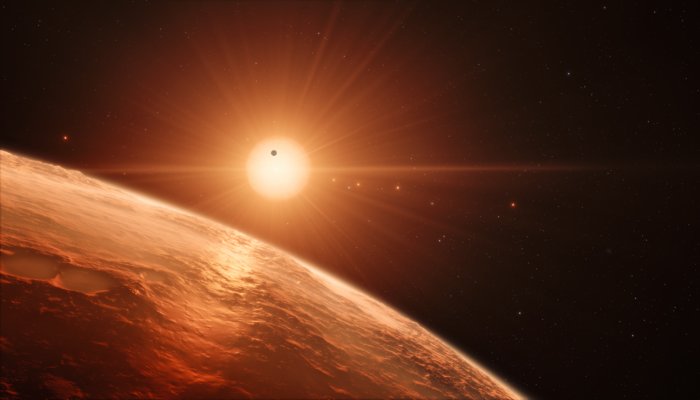
This artist’s impression shows the view from the surface of one of the planets in the TRAPPIST-1 system. At least seven planets orbit this ultra cool dwarf star 40 light-years from Earth and they are all roughly the same size as the Earth. They are at the right distances from their star for liquid water to exist on the surfaces of several of them. This artist’s impression is based on the known physical parameters for the planets and stars seen, and uses a vast database of objects in the Universe. [Full size image]Astronomers have found a system of seven Earth-sized planets just 40 light-years away. Using ground and space telescopes, including ESO’s Very Large Telescope, the planets were all detected as they passed in front of their parent star, the ultracool dwarf star known as TRAPPIST-1. According to the paper appearing today in the journal Nature, three of the planets lie in the habitable zone and could harbour oceans of water on their surfaces, increasing the possibility that the star system could play host to life. This system has both the largest number of Earth-sized planets yet found and the largest number of worlds that could support liquid water on their surfaces.
Astronomers using the TRAPPIST–South telescope at ESO’s La Silla Observatory, the Very Large Telescope (VLT) at Paranal and the NASA Spitzer Space Telescope, as well as other telescopes around the world [1], have now confirmed the existence of at least seven small planets orbiting the cool red dwarf star TRAPPIST-1[2]. All the planets, labelled TRAPPIST-1b, c, d, e, f, g and h in order of increasing distance from their parent star, have sizes similar to Earth [3].
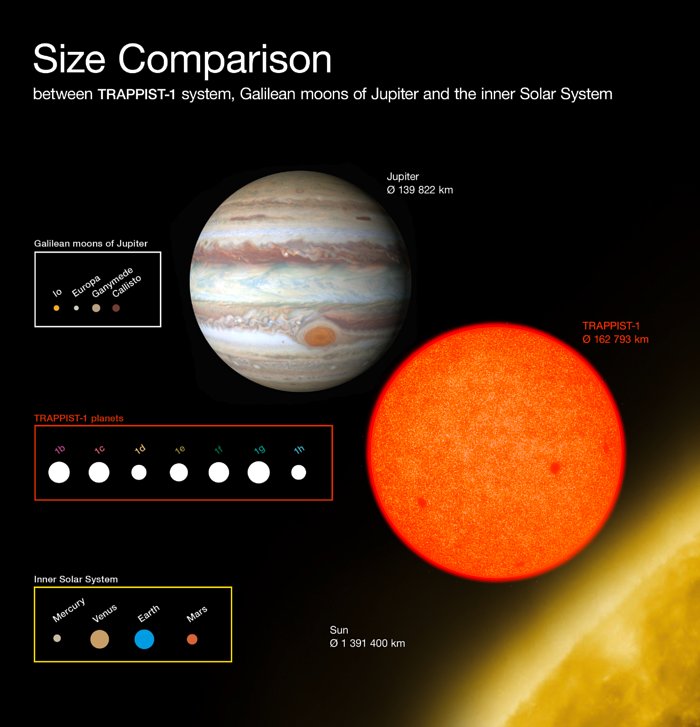
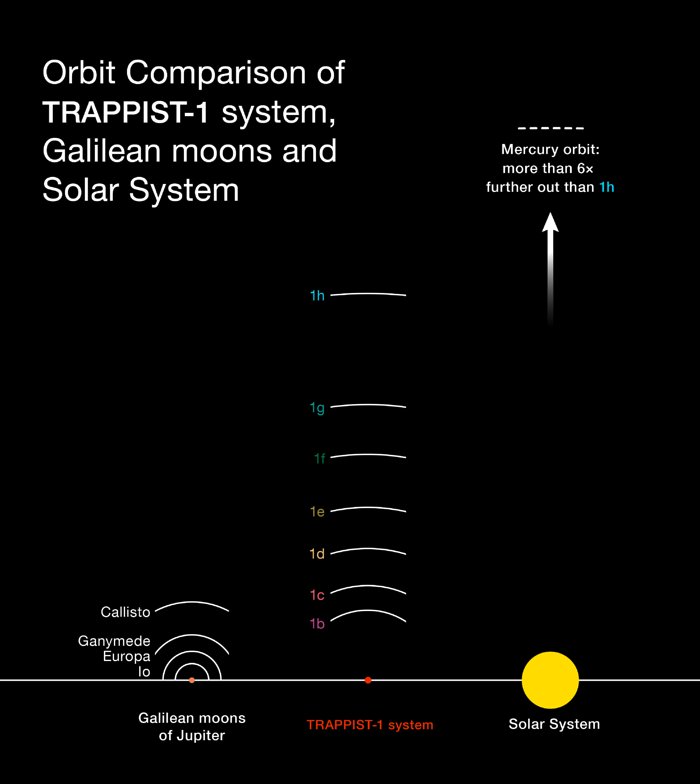
This diagram compares the sizes of the newly-discovered planets around the faint red star TRAPPIST-1 with the Galilean moons of Jupiter and the inner Solar System. All the planets found around TRAPPIST-1 are of similar size to the Earth. [Full size image.]Dips in the star’s light output caused by each of the seven planets passing in front of it — events known as transits — allowed the astronomers to infer information about their sizes, compositions and orbits [4]. They found that at least the inner six planets are comparable in both size and temperature to the Earth.
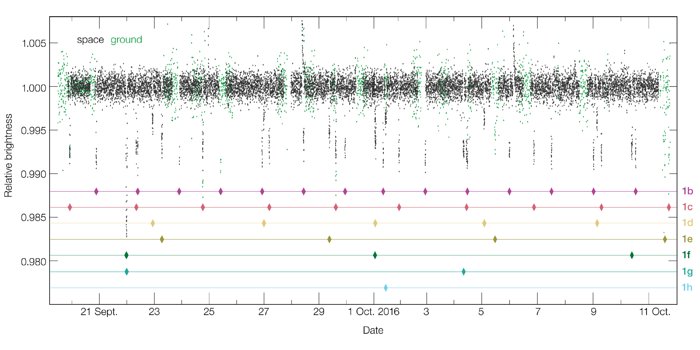
This diagram shows the changing brightness of the ultra cool dwarf star TRAPPIST-1 over a period of 20 days in September and October 2016 as measured by NASA’s Spitzer Space Telescope and many other telescopes on the ground. On many occasions the brightness of the star drops for a short period and then returns to normal. These events, called transits, are due to one or more of the star’s seven planets passing in front of the star and blocking some of its light. The lower part of the diagram shows which of the system’s planets are responsible for the transits. [Full size image]
Lead author Michaël Gillon of the STAR Institute at the University of Liège in Belgium is delighted by the findings:
“This is an amazing planetary system — not only because we have found so many planets, but because they are all surprisingly similar in size to the Earth!”
With just 8% the mass of the Sun, TRAPPIST-1 is very small in stellar terms — only marginally bigger than the planet Jupiter — and though nearby in the constellation Aquarius (The Water Carrier), it appears very dim. Astronomers expected that such dwarf stars might host many Earth-sized planets in tight orbits, making them promising targets in the hunt for extraterrestrial life, but TRAPPIST-1 is the first such system to be found.
Co-author Amaury Triaud expands:
“The energy output from dwarf stars like TRAPPIST-1 is much weaker than that of our Sun. Planets would need to be in far closer orbits than we see in the Solar System if there is to be surface water. Fortunately, it seems that this kind of compact configuration is just what we see around TRAPPIST-1!”
The team determined that all the planets in the system are similar in size to Earth and Venus in the Solar System, or slightly smaller. The density measurements suggest that at least the innermost six are probably rocky in composition.
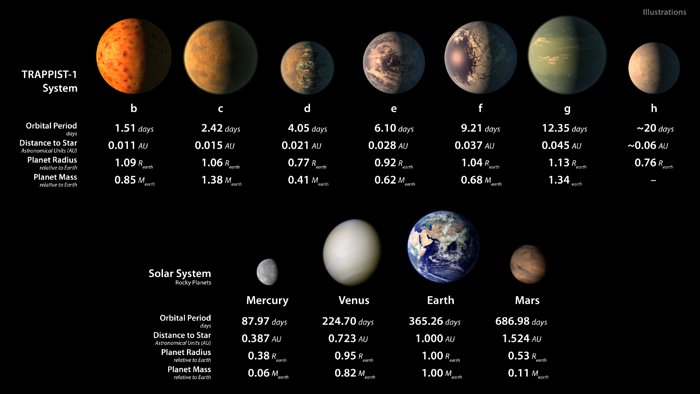
This infographic displays some artist’s illustrations of how the seven planets orbiting TRAPPIST-1 might appear — including the possible presence of water oceans — alongside some images of the rocky planets in our Solar System. Information about the size and orbital periods of all the planets is also provided for comparison; the TRAPPIST-1 planets are all approximately Earth-sized. [Full sized image]The planetary orbits are not much larger than that of Jupiter’s Galilean moon system, and much smaller than the orbit of Mercury in the Solar System. However, TRAPPIST-1’s small size and low temperature mean that the energy input to its planets is similar to that received by the inner planets in our Solar System; TRAPPIST-1c, d and f receive similar amounts of energy to Venus, Earth and Mars, respectively.
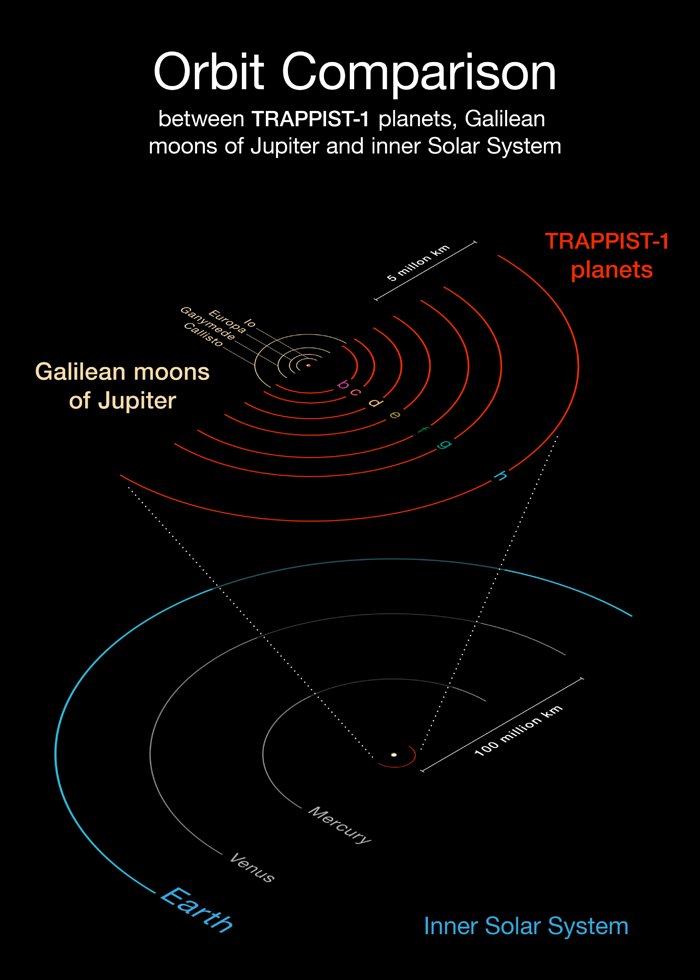
This diagram compares the orbits of the newly-discovered planets around the faint red star TRAPPIST-1 with the Galilean moons of Jupiter and the inner Solar System. All the planets found around TRAPPIST-1 orbit much closer to their star than Mercury is to the Sun, but as their star is far fainter, they are exposed to similar levels of irradiation as Venus, Earth and Mars in the Solar System. [Full size image ]All seven planets discovered in the system could potentially have liquid water on their surfaces, though their orbital distances make some of them more likely candidates than others. Climate models suggest the innermost planets, TRAPPIST-1b, c and d, are probably too hot to support liquid water, except maybe on a small fraction of their surfaces. The orbital distance of the system’s outermost planet, TRAPPIST-1h, is unconfirmed, though it is likely to be too distant and cold to harbour liquid water — assuming no alternative heating processes are occurring [5]. TRAPPIST-1e, f, and g, however, represent the holy grail for planet-hunting astronomers, as they orbit in the star’s habitable zone and could host oceans of surface water [6].
This diagram compares the orbits of the newly-discovered planets around the faint red star TRAPPIST-1 with the Galilean moons of Jupiter and the inner Solar System. All the planets found around TRAPPIST-1 orbit much closer to their star than Mercury is to the Sun, but as their star is far fainter, they are exposed to similar levels of irradiation as Venus, Earth and Mars in the Solar System. [Full size image]These new discoveries make the TRAPPIST-1 system a very important target for future study. The NASA/ESA Hubble Space Telescope is already being used to search for atmospheres around the planets and team member Emmanuël Jehin is excited about the future possibilities:
This video takes the viewer on a quick trip from Earth, past the Moon and far beyond. We finally arrive at the faint red ultracool dwarf star TRAPPIST-1, which has a remarkable seven planets orbiting it, all having sizes similar to the Earth.
The stars in the animation are accurately positioned as in reality. The tiny ultracool dwarf TRAPPIST-1 is so dim that it would remain invisible to the naked eye until the imaginary traveller gets very close, when its seven orbiting planets can also be seen.
The artist’s impression in this video is based on the known physical parameters for the planets and stars seen, and uses a vast database of objects in the Universe. Credit: ESO/L. Calçada/spaceengine.org
[2] TRAPPIST–South (the TRAnsiting Planets and PlanetesImals Small Telescope–South) is a Belgian 0.6-metre robotic telescope operated from the University of Liège and based at ESO’s La Silla Observatory in Chile. It spends much of its time monitoring the light from around 60 of the nearest ultracool dwarf stars and brown dwarfs (“stars” which are not quite massive enough to initiate sustained nuclear fusion in their cores), looking for evidence of planetary transits. TRAPPIST–South, along with its twin TRAPPIST–North, are the forerunners to the SPECULOOS system, which is currently being installed at ESO’s Paranal Observatory.
[3] In early 2016, a team of astronomers, also led by Michaël Gillon announced the discovery of three planets orbiting TRAPPIST-1. They intensified their follow-up observations of the system mainly because of a remarkable triple transit that they observed with the HAWK-I instrument on the VLT. This transit showed clearly that at least one other unknown planet was orbiting the star. And that historic light curve shows for the first time three temperate Earth-sized planets, two of them in the habitable zone, passing in front of their star at the same time!
[4] This is one of the main methods that astronomers use to identify the presence of a planet around a star. They look at the light coming from the star to see if some of the light is blocked as the planet passes in front of its host star on the line of sight to Earth — it transits the star, as astronomers say. As the planet orbits around its star, we expect to see regular small dips in the light coming from the star as the planet moves in front of it.
[5] Such processes could include tidal heating, whereby the gravitational pull of TRAPPIST-1 causes the planet to repeatedly deform, leading to inner frictional forces and the generation of heat. This process drives the active volcanism on Jupiter’s moon Io. If TRAPPIST-1h has also retained a primordial hydrogen-rich atmosphere, the rate of heat loss could be very low.
[6] This discovery also represents the largest known chain of exoplanets orbiting in near-resonance with each other. The astronomers carefully measured how long it takes for each planet in the system to complete one orbit around TRAPPIST-1 — known as the revolution period — and then calculated the ratio of each planet’s period and that of its next more distant neighbour. The innermost six TRAPPIST-1 planets have period ratios with their neighbours that are very close to simple ratios, such as 5:3 or 3:2. This means that the planets most likely formed together further from their star, and have since moved inwards into their current configuration. If so, they could be low-density and volatile-rich worlds, suggesting an icy surface and/or an atmosphere.
The touch tablet computer display for the blind is one of those devices that I was sure must already exist in our high-tech world but in fact it does not. However, BLITAB® of Austria is not only bringing one to market but at a reasonable price, something that is fairly uncommon for such aids for the handicapped: This $500 Tablet Brings Words to Blind Users’ Fingertips – Technology Review
BLITAB describes the device as follows:
BLITAB® is the World’s first tactile tablet for blind and visually impaired people. BLITAB® is a next curve Braille device for Braille reading and writing that displays one whole page Braille text at once, without any mechanical elements. It is like an e-book which instead of using a screen displays small physical bubbles. For the first time our users can have an overview of a whole document. The new developed technology used in the BLITAB® tablet provides an opportunity for an affordable, 100x better solution, disrupting a market that has no innovations in the last 40 years.
We developed a multi-line Braille tablet that delivers real-time content to people with visual impairments. BLITAB® offers completely new user experience for Braille and non-Braille readers via touch navigation, text-to-speech output and Perkins-style keyboard application. It allows a direct converting of any text file into Braille from USB sticks, Internet and obtaining information via NFC tags. BLITAB® is not just a tablet, it is a platform for all existing and future software applications for blind readers. So we do not compete, we integrate and collaborate.
We bring back Tim Dodd the Everyday Astronaut to talk about Science, Technology Engineering, Art and Math as well as how he works to inspire youth.
In space news:
Planet (not Labs anymore) Satellite deployments – https://www.youtube.com/watch?v=5IE1Q… List of Landing Sites for Next Mars Rover Narrowed Small Satellite Rocket Booster Arrives at New Zealand’s First Launch Site Group Effort Finds More Than 100 Exoplanet CubeCab looking to launch small sats NRO Payload Mounted For West Coast Launch
TMRO is viewer supported:
TMRO:Space is a crowd funded show. If you like this episode consider contributing to help us to continue to improve. Head over to http://www.patreon.com/tmro for information, goals and reward levels. Don’t forget to check out our SpacePod campaign as well over at http://www.patreon.com/spacepod
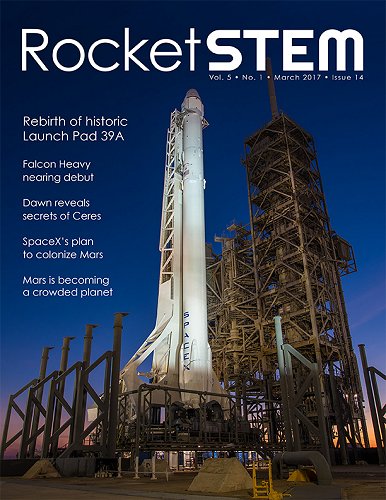
We’re launching another issue of RocketSTEM to celebrate the start of our organization’s fifth year. While half a decade has been quite a journey for us, it is nothing compared to the 50-plus-year history of Kennedy Space Center’s Launch Complex 39A. From racing the Russians to the Moon during the Apollo program, through the construction of the International Space Station during the Space Shuttle program, and now the most recent launch of the Falcon 9 rocket by SpaceX, the world-famous launch pad has quite a story to tell. Speaking of SpaceX, the private space firm is also preparing to launch its biggest ever rocket – the Falcon Heavy – from Pad 39A later this year. But the company’s founder, Elon Musk, is already laying the groundwork for an even bigger rocket – the Interplanetary Transport System – that will allow humanity to colonize Mars and explore even further out into the solar system. In the meantime, a fleet of orbiters and rovers from three space agencies are busy checking out the Red Planet, while NASA’s Dawn spacecraft has been been analyzing a dwarf planet named Ceres.
All that – and more – in this issue of RocketSTEM magazine.
And, as always, every issue remains free to read online or download as a PDF.
TABLE OF CONTENTS
Exploring Mars – Eight rovers and orbiters from three space agencies are at the Red Planet.
Helo, Mars! – Learn to compute flight data for the proposed Mars Helicopter Scout.
Historic Pad 39A – The launch pad has been America’s gateway to space for five decades.
Falcon Heavy – SpaceX is gearing up to debut its new rocket later this year.
SpaceX goes bigger – The Interplanetary Transport System may open up the solar system to exploration.
Dawn’s harvest – Spacecraft has been revealing secrets of Ceres, a dwarf planet.