Cassini: Propellers in Saturn’s rings and a hexagon on its north pole

The Cassini spacecraft returns more amazing pictures of the Saturn system:

Cassini Targets a Propeller in Saturn’s A Ring 

NASA’s Cassini spacecraft captured these remarkable views of a propeller feature in Saturn’s A ring on Feb. 21, 2017. These are the sharpest images taken of a propeller so far, and show an unprecedented level of detail. The propeller is nicknamed “Santos-Dumont,” after the pioneering Brazilian-French aviator.

This observation was Cassini’s first targeted flyby of a propeller. The views show the object from vantage points on opposite sides of the rings. The top image looks toward the rings’ sunlit side, while the bottom image shows the unilluminated side, where sunlight filters through the backlit ring.

The two images presented as figure A are reprojected at the same scale (0.13 mile or 207 meters per pixel) in order to facilitate comparison. The original images, which have slightly different scales, are also provided here, without reprojection, as figure B; the sunlit-side image is at left, while the unlit-side image is at right.

The original images, which have slightly different scales, are seen here without reproduction; the sunlit-side image is at left, while the unlit-side image is at right. › Full image

Cassini scientists have been tracking the orbit of this object for the past decade, tracing the effect that the ring has upon it. Now, as Cassini has moved in close to the ring as part of its ring-grazing orbits, it was able to obtain this extreme close-up view of the propeller, enabling researchers to examine its effects on the ring. These views, and others like them, will inform models and studies in new ways going forward.

Like a frosted window, Saturn’s rings look different depending on whether they are seen fully sunlit or backlit. On the lit side, the rings look darker where there is less material to reflect sunlight. On the unlit side, some regions look darker because there is less material, but other regions look dark because there is so much material that the ring becomes opaque.

Observing the same propeller on both the lit and unlit sides allows scientists to gather richer information about how the moonlet affects the ring. For example, in the unlit-side view, the broad, dark band through the middle of the propeller seems to be a combination of both empty and opaque regions.

The propeller’s central moonlet would only be a couple of pixels across in these images, and may not actually be resolved here. The lit-side image shows that a bright, narrow band of material connects the moonlet directly to the larger ring, in agreement with dynamical models. That same thin band of material may also be obscuring the moonlet from view.

Lengthwise along the propeller is a gap in the ring that the moonlet has pried open. The gap appears dark on both the lit and unlit sides. Flanking the gap near the moonlet are regions of enhanced density, which appear bright on the lit side and more mottled on the unlit side.

One benefit of the high resolution of these images is that, for the first time, wavy edges are clearly visible in the gap. These waves are also expected from dynamical models, and they emphasize that the gap must be sharp-edged. Furthermore, the distance between the wave crests tells scientists the width of the gap (1.2 miles or 2 kilometers), which in turn reveals the mass of the central moonlet. From these measurements, Cassini imaging scientists deduce that the moonlet’s mass is comparable to that of a snowball about 0.6 mile (1 kilometer) wide.

For the original images (figure B), the lit-side image has a scale of 0.33 mile (530 meters) per pixel in the radial (or outward from Saturn) direction and 0.44 mile (710 meters) per pixel in the azimuthal (or around Saturn) direction. The different scales are the result of Cassini’s vantage point being off to the side of the propeller, rather than directly above it. The unlit-side image has a scale of 0.25 (410 meters) per pixel in both directions.

In order to preserve its original level of detail, the image has not been cleaned of bright blemishes due to cosmic rays and to charged particle radiation from Saturn.

The Cassini mission is a cooperative project of NASA, ESA (the European Space Agency) and the Italian Space Agency. The Jet Propulsion Laboratory, a division of the California Institute of Technology in Pasadena, manages the mission for NASA’s Science Mission Directorate, Washington. The Cassini orbiter and its two onboard cameras were designed, developed and assembled at JPL. The imaging operations center is based at the Space Science Institute in Boulder, Colorado.

For more information about the Cassini-Huygens mission visit saturn.jpl.nasa.gov and www.nasa.gov/cassini. The Cassini imaging team homepage is at ciclops.org.

====

At the Center 

Saturn’s North Pole

The north pole of Saturn sits at the center of its own domain. Around it swirl the clouds, driven by the fast winds of Saturn. Beyond that orbits Saturn’s retinue of moons and the countless small particles that form the ring.

Although the poles of Saturn are at the center of all of this motion, not everything travels around them in circles. Some of the jet-stream patterns, such as the hexagon-shaped pattern seen here, have wavy, uneven shapes. The moons as well have orbits that are elliptical, some quite far from circular.

This view looks toward the sunlit side of the rings from about 26 degrees above the ring plane. The image was taken with the Cassini spacecraft wide-angle camera on Dec. 2, 2016 using a spectral filter which preferentially admits wavelengths of near-infrared light centered at 890 nanometers.

The view was acquired at a distance of approximately 619,000 miles (996,000 kilometers) from Saturn. Image scale is 37 miles (60 kilometers) per pixel.

The Cassini mission is a cooperative project of NASA, ESA (the European Space Agency) and the Italian Space Agency. The Jet Propulsion Laboratory, a division of the California Institute of Technology in Pasadena, manages the mission for NASA’s Science Mission Directorate, Washington. The Cassini orbiter and its two onboard cameras were designed, developed and assembled at JPL. The imaging operations center is based at the Space Science Institute in Boulder, Colorado.

For more information about the Cassini-Huygens mission visit saturn.jpl.nasa.gov and www.nasa.gov/cassini. The Cassini imaging team homepage is at ciclops.org.

====
Sci-Tech: Boston Dynamic’s “Handle” robot uses two legs with wheels for max mobility

More video from Boston Dynamics of their amazing two-wheeled bi-ped robot: Boston Dynamics’ New Rolling, Leaping Robot Is an Evolutionary Marvel | WIRED (See also this earlier posting.)

Handle is a research robot that stands 6.5 ft tall, travels at 9 mph and jumps 4​ ​feet vertically. ​It uses electric power to operate both electric and hydraulic actuators, with a range of about 15 miles on one battery charge. ​​​Handle uses many of the same dynamics, balance and mobile manipulation principles​ found in the quadruped and biped robots we build, but with only about 10 actuated joints, it is significantly less complex. Wheels are efficient on flat surfaces while legs can go almost anywhere: by combining wheels and legs Handle can have the best of both worlds.

Videos: “What’s Up for March 2017” – Night sky highlights

NASA JPL describes what to look for in the night sky in the coming month:

This month the moon hides red Aldebaran, Venus and Mercury show their phases. Find more astronomy information and events in your area by visiting https://nightsky.jpl.nasa.gov/

The Hubble Space Telescope offers its own night sky highlights report:

Backyard stargazers get a monthly guide to the northern hemisphere’s skywatching events with “Tonight’s Sky.” The March equinox still grants plenty of dark nighttime skies for planet-hunting.

ESO: Very Large Telescope gets a sharper view of an edge on galaxy

The latest report from ESO (European Southern Observatory):

A Galaxy on the Edge

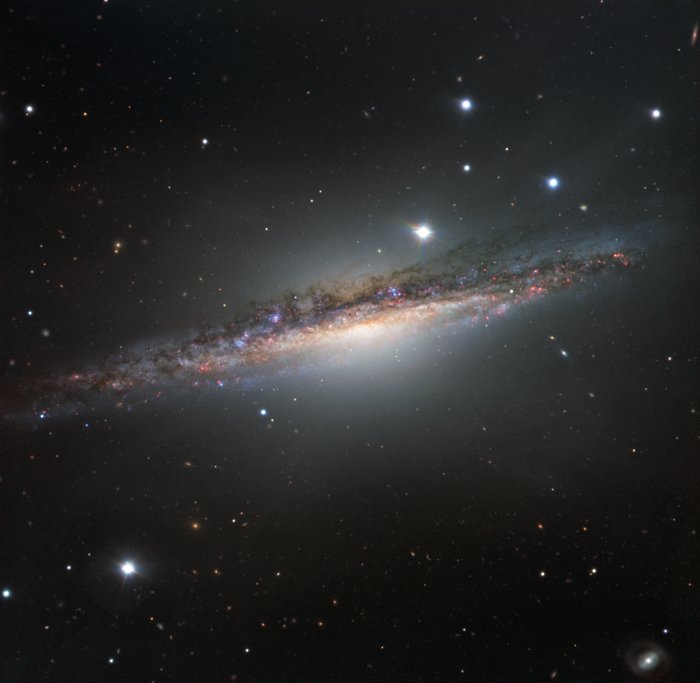
This colourful stripe of stars, gas, and dust is actually a spiral galaxy named NGC 1055. Captured here by ESO’s Very Large Telescope (VLT), this big galaxy is thought to be up to 15 percent larger in diameter than the Milky Way. NGC 1055 appears to lack the whirling arms characteristic of a spiral, as it is seen edge-on. However, it displays odd twists in its structure that were probably caused by an interaction with a large neighbouring galaxy.

This colourful image from ESO’s Very Large Telescope shows NGC 1055 in the constellation of Cetus (The Sea Monster).  This large galaxy is thought to be up to 15 percent larger in diameter than the Milky Way. NGC 1055 appears to lack the whirling arms characteristic of a spiral, as it is seen edge-on. However, it displays odd twists in its structure that were probably caused by an interaction with a large neighbouring galaxy. [Larger image.]
Spiral galaxies throughout the Universe take on all manner of orientations with respect to Earth. We see some from above (as it were) or “face-on” — a good example of this being the whirlpool-shaped galaxy NGC 1232. Such orientations reveal a galaxy’s flowing arms and bright core in beautiful detail, but make it difficult to get any sense of a three-dimensional shape.

A new image from ESO’s Very Large Telescope gives a very detailed view of the edge-on galaxy NGC 1055. This ESOcast Light takes a quick look at this image and explains what it shows.

We see other galaxies, such as NGC 3521, at angles. While these tilted objects begin to reveal the three-dimensional structure within their spiral arms, fully understanding the overall shape of a spiral galaxy requires an edge-on view — such as this one of NGC 1055.

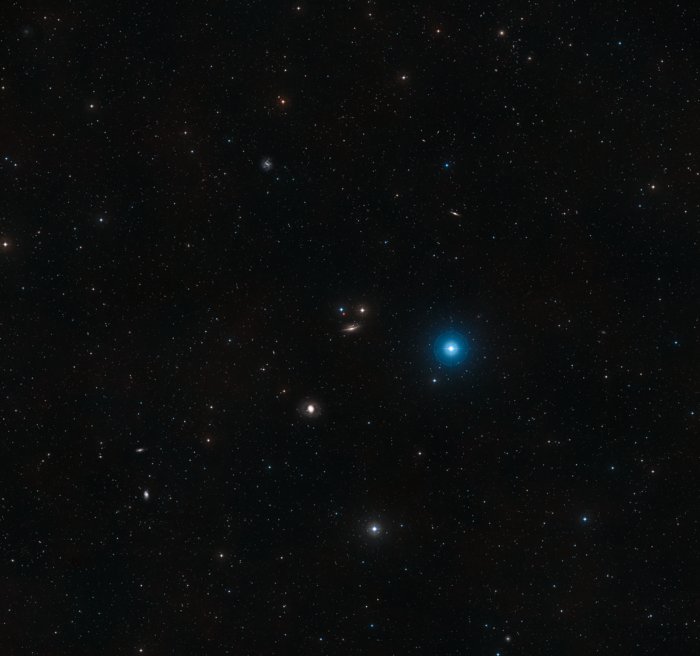
This rich wide-field view captures not only the edge-on galaxy NGC 1055 at the centre but also the bright galaxy NGC 1068 (also known as Messier 77, it is an active galaxy with a huge black hole at its centre) to its lower-left, the fainter galaxy NGC 1032 to the upper right and the barred spiral galaxy NGC 1073 to the upper left. In addition, much closer to home, the bright naked-eye blue star Delta Ceti appears at the right of centre. This picture was created from images in the Digitized Sky Survey 2. [Larger images.]
When seen edge-on, it is possible to get an overall view of how stars — both new patches of starbirth and older populations — are distributed throughout a galaxy, and the “heights” of the relatively flat disc and the star-loaded core become easier to measure. Material stretches away from the blinding brightness of the galactic plane itself, becoming more clearly observable against the darker background of the cosmos.

Such a perspective also allows astronomers to study the overall shape of a galaxy’s extended disc, and to study its properties. One example of this is warping, which is something we see in NGC 1055. The galaxy has regions of peculiar twisting and disarray in its disc, likely caused by interactions with the nearby galaxy Messier 77 (eso0319) [1]. This warping is visible here; NGC 1055’s disc is slightly bent and appears to wave across the core.

This video sequence takes the viewer deep into the faint constellation of Cetus (The Sea Monster) and finishes on a new and very detailed view of the edge-on galaxy NGC 1055 from ESO’s Very Large Telescope in northern Chile. Credit: ESO/Digitized Sky Survey 2/A. Fujii. Music: Astral Electronic

NGC 1055 is located approximately 55 million light-years away in the constellation of Cetus (The Sea Monster). This image was obtained using the FOcal Reducer and low dispersion Spectrograph 2 (FORS2) instrument mounted on Unit Telescope 1 (Antu) of the VLT, located at ESO’s Paranal Observatory in Chile. It hails from ESO’s Cosmic Gems programme, an outreach initiative that produces images of interesting, intriguing or visually attractive objects using ESO telescopes for the purposes of education and outreach.

Notes
[1] Messier 77, also known as NGC 1068, has a very brilliant central region powered by a supermassive black hole. It is one of the nearest examples of what astronomers call active galaxies.

Video: Curiosity rover captures Dust Devils in action

The winds on Mars may never be as forceful as depicted in The Martian but they can certainly pick up dust and move it across the ground as seen in these video clips of Dust Devils: Martian Winds Carve Mountains, Move Dust, Raise Dust – NASA JPL

On recent summer afternoons on Mars, navigation cameras aboard NASA’s Curiosity Mars rover observed several whirlwinds carrying Martian dust across Gale Crater. Dust devils result from sunshine warming the ground, prompting convective rising of air. All the dust devils were seen in a southward direction from the rover. Timing is accelerated and contrast has been modified to make frame-to-frame changes easier to see.

For more information, read the full article at https://www.jpl.nasa.gov/news/news.ph…

Everyone can participate in space