Video: GOES-16 images lightning flashes

The new GOES-16 weather satellite has many instruments for monitoring and studying events and processes happening in earth’s atmosphere. One of these instruments is specialized to detect and record lightning flashes.

Flashy First Images Arrive from NOAA’s GOES-16 Lightning Mapper
Satellite’s instrument will help forecasters pinpoint severe storms sooner

Detecting and predicting lightning just got a lot easier. The first images from a new instrument onboard NOAA’s GOES-16 satellite are giving NOAA National Weather Service forecasters richer information about lightning that will help them alert the public to dangerous weather.

The first lightning detector in a geostationary orbit, the Geostationary Lightning Mapper (GLM), is transmitting data never before available to forecasters. The mapper continually looks for lightning flashes in the Western Hemisphere, so forecasters know when a storm is forming, intensifying and becoming more dangerous. Rapid increases of lightning are a signal that a storm is strengthening quickly and could produce severe weather.

During heavy rain, GLM data will show when thunderstorms are stalled or if they are gathering strength. When combined with radar and other satellite data, GLM data may help forecasters anticipate severe weather and issue flood and flash flood warnings sooner. In dry areas, especially in the western United States, information from the instrument will help forecasters, and ultimately firefighters, identify areas prone to wildfires sparked by lightning.
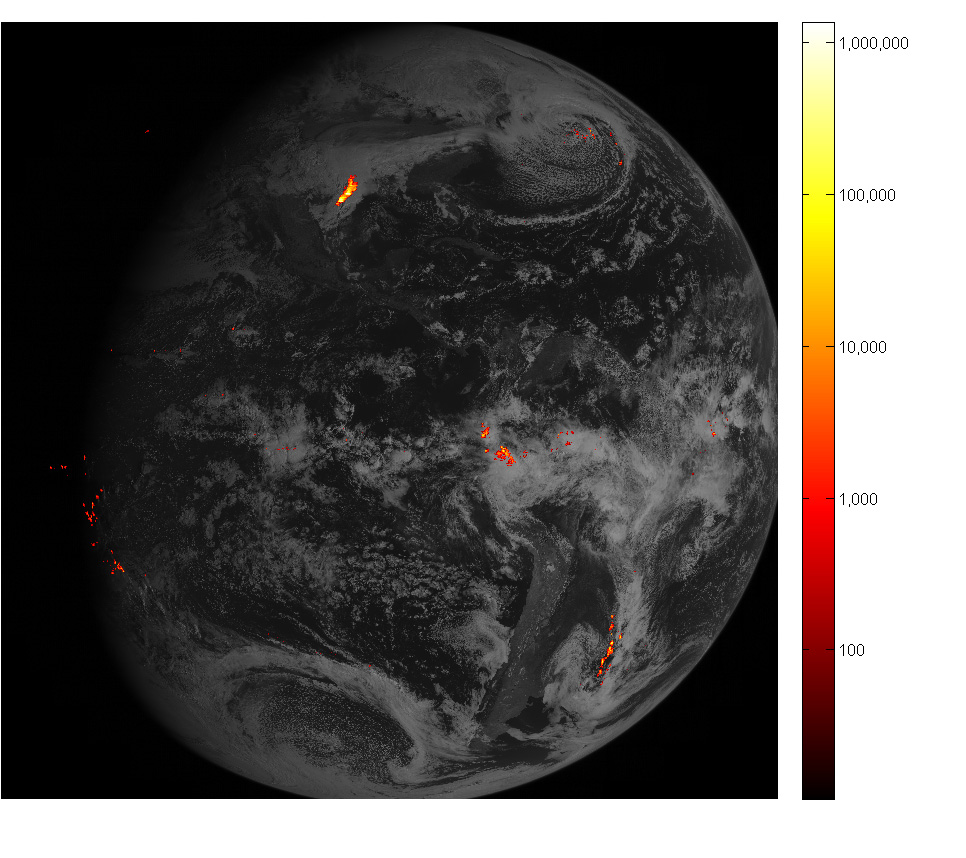
This image shows lightning data captured on February 14, 2017 over the course of an hour and displayed over an image of the Western Hemisphere from the Advanced Baseline Imager on GOES-16. Brighter colors indicate more lightning energy was recorded; color bar units are the calculated kilowatt-hours of total optical emissions from lightning. The brightest storm system is located over the Gulf Coast of Texas, the same storm system in the accompanying video.

Accurate tracking of lightning and thunderstorms over the oceans, too distant for land-based radar and sometimes difficult to see with satellites, will support safe navigation for aviators and mariners.

The new mapper also detects in-cloud lightning, which often occurs five to 10 minutes or more before potentially deadly cloud-to-ground strikes. This means more precious time for forecasters to alert those involved in outdoor activities of the developing threat.

Learn more about GOES-16 and all its exciting possibilities for weather forecasting improvements by visiting the GOES-16 website & to download the MP4 video click here.

===

These two GOES-16 video don’t come from the lightning mapper but they do highlight the sharp resolution of the satellite’s storm imaging:

====

Dawn identifies the age of the bright spot on Ceres

Data from the Dawn probe orbiting the dwarf planet Ceres in the asteroid belt has led to the age of the unusual bright white feature on the surface:

Dawn Identifies Age of Ceres’ Brightest Area 

The bright spots in the center of Occator Crater on Ceres are shown in enhanced color in this view from NASA’s Dawn spacecraft. Image Credit: NASA/JPL-Caltech/UCLA/MPS/DLR/IDA/PSI/LPI › Full image and caption

The bright central area of Ceres’ Occator Crater, known as Cerealia Facula, is approximately 30 million years younger than the crater in which it lies, according to a new study in the Astronomical Journal. Scientists used data from NASA’s Dawn spacecraft to analyze Occator’s central dome in detail, concluding that this intriguing bright feature on the dwarf planet is only about 4 million years old — quite recent in terms of geological history.

Researchers led by Andreas Nathues at the Max Planck Institute for Solar System Research (MPS) in Gottingen, Germany, analyzed data from two instruments on board NASA’s Dawn spacecraft: the framing camera, and the visible and infrared mapping spectrometer.

The new study supports earlier interpretations from the Dawn team that this reflective material — comprising the brightest area on all of Ceres — is made of carbonate salts, although it did not confirm a particular type of carbonate previously identified. The secondary, smaller bright areas of Occator, called Vinalia Faculae, are comprised of a mixture of carbonates and dark material, the study authors wrote.

New evidence also suggests that Occator’s bright dome likely rose in a process that took place over a long period of time, rather than forming in a single event. They believe the initial trigger was the impact that dug out the crater itself, causing briny liquid to rise closer to the surface. Water and dissolved gases, such as carbon dioxide and methane, came up and created a vent system. These rising gases also could have forced carbonate-rich materials to ascend toward the surface. During this period, the bright material would have erupted through fractures, eventually forming the dome that we see today.

See also the report: Cryovolcanism on Dwarf Planet Ceres | Max Planck Institute for Solar System Research

The spacecraft is currently on its way to a high-altitude orbit of 12,400 miles (20,000 kilometers), and to a different orbital plane. In late spring, Dawn will view Ceres in “opposition,” with the sun directly behind the spacecraft. By measuring details of the brightness of the salt deposits in this new geometry, scientists may gain even more insights into these captivating bright areas.

The Dawn mission is managed by JPL for NASA’s Science Mission Directorate in Washington. Dawn is a project of the directorate’s Discovery Program, managed by NASA’s Marshall Space Flight Center in Huntsville, Alabama. UCLA is responsible for overall Dawn mission science. Orbital ATK Inc., in Dulles, Virginia, designed and built the spacecraft. The German Aerospace Center, Max Planck Institute for Solar System Research, Italian Space Agency and Italian National Astrophysical Institute are international partners on the mission team. For a complete list of mission participants, visit: http://dawn.jpl.nasa.gov/mission

More information about Dawn is available at the following sites:


Video: “Space to Ground” ISS report for Mar.10.2017

A new report from NASA on activities aboard the International Space Station:

Cassini reveals odd shape of Saturn’s moon Pan

The Cassini probe at Saturn continues to return fabulous images. The latest photos show closeups of the tiny moon Pan:

Cassini Reveals Strange Shape of Saturn’s Moon Pan 

Cassini Reveals Strange Shape of Saturn’s Moon Pan . This raw, unprocessed image of Saturn’s moon Pan was taken on March 7, 2017 by NASA’s Cassini spacecraft. Larger view

These raw, unprocessed images of Saturn’s tiny moon, Pan, were taken on March 7, 2017, by NASA’s Cassini spacecraft. The flyby had a close-approach distance of 24,572 kilometers (15,268 miles).

Another view of Saturn’s moon Pan. Larger view.

These images are the closest images ever taken of Pan and will help to characterize its shape and geology.

Additional raw images from Cassini are available at: https://saturn.jpl.nasa.gov/galleries/raw-images

Another view of Pan. Larger view.

The Cassini-Huygens mission is a cooperative project of NASA, ESA (European Space Agency) and the Italian Space Agency. NASA’s Jet Propulsion Laboratory in Pasadena, California, manages the mission for the agency’s Science Mission Directorate in Washington. The Cassini imaging operations center is based at the Space Science Institute in Boulder, Colorado. Caltech in Pasadena manages JPL for NASA.

For more information about Cassini, visit:


Video: Blue Origin’s New Glenn rocket

Blue Origin, the space company owned by Jeff Bezos of Amazon.com, released a video animation this week showing the New Glenn rocket, which they will start building next year at a factory currently in construction at Cape Canaveral. First flights are expected in 2020:

The first stage of the New Glenn will land on a ship platform and be reused up to 100 times.

The company also announced contracts with Eutelsat and OneWeb for satellites launches.

Jeff Bezos has been a space enthusiasts since he was a kid and is determined to see large scale human settlement of space.


====

Everyone can participate in space