The Philip K. Dick Science Fiction Film Festival
Announces Fifth Anniversary Event Over 100 Film Screenings, Premieres and Events Will Be Held May 25-30, 2017 — Festival Launches New Special Guest Panel Series PKD Talks: Conversations with Luminaries, Visionaries and Mavericks —
(New York City, N.Y.) April 13, 2017 — The Philip K. Dick Science Fiction Film Festival has announced the full lineup for its fifth annual event from May 25-30, 2017. This year’s anniversary program will spotlight over 100 films, exclusive premieres, discussions, virtual reality demonstrations and celebratory gatherings as the festival continues its everlasting tribute to the master of science fiction, Philip K. Dick.
For the past five years, The Philip K. Dick Science Fiction Film Festival has exhibited quality independent sci-fi for audiences who crave new innovative pathways of expression. The festival supports freethinking filmmakers equipped with the knowledge of our world, brave enough to see beyond the barriers of existence and who give to an art form that unites the masses.
Daniel Abella, the founder and director of the festival, enthused about this year’s milestone event and the high-caliber official selections.
“I am very excited to present this year’s fifth annual festival in our home of New York City. The lineup includes films from throughout the world and represents talent across all backgrounds and beliefs.” Abella added, “Science fiction continues to entertain but also inform us about current and future trends and it is our mission to bring together likeminded people tied by a common purpose to remain human in a world of progressive dehumanization.”
While praising the works and prophecies of the festival’s namesake, Abella said,
“Philip K. Dick’s message is that in spite of forces marshaled against the human spirit, both political and technological, humanity can prevail if we find the will and determination to pave a better future. This festival represents his voice.”
Here is a report on the NASA Student Launch competition, which includes middle school through college level teams, which took place last week. (I included videos posted by some of the teams.)
After a day of rocket launches during the 2017 Student Launch, NASA announced the challenge’s preliminary winners April 8 at an awards ceremony hosted by Orbital ATK Aerospace Group of Promontory, Utah, at the U.S. Space & Rocket Center in Huntsville, Alabama.
Fifty middle and high school, college and university teams from 23 states launched their student-built rockets at Bragg Farms in Toney, Alabama, near NASA’s Marshall Space Flight Center.
Participating in the Student Launch challenge, student teams demonstrated advanced aerospace and engineering skills as they launched their rockets to an altitude of 1 mile, deployed an automated parachute system and landed the rocket safely for reuse.
The University of Notre Dame won the 2017 Student Launch Altitude Award in the college division with an altitude of 5,286 feet, only 6 feet above challenge’s 1-mile goal. Notre Dame’s launch was the closest to the goal in Student Launch’s 17-year history. Credits: NASA/MSFC/Fred Deaton
The event was the culmination of eight months of work for students, during which the teams built and tested their rockets and completed a series of technical reviews mirroring criteria in NASA’s engineering design lifecycle and safety protocol.
Now in its 17th year, Student Launch included a visit from NASA astronaut Kate Rubins, a member of the International Space Station’s Expedition 48/49 crew; a behind-the-scenes tour of Marshall facilities; and a rocket fair, where students showcased their rocket designs to NASA team members, corporate sponsor Orbital ATK and the public.
Fifty student teams competed in NASA’s Student Launch April 8, near the agency’s Marshall Space Flight Center. Teams from 23 states launched their student-built rockets from Bragg Farms in Toney, Alabama. [Larger image] Credits: NASA/MSFC/Charles BeasonMarshall’s Academic Affairs Office manages Student Launch, to further NASA’s major education goal of attracting and encouraging students to pursue degrees and careers in the STEM fields of science, technology, engineering and mathematics. NASA’s Office of Education and Human Exploration and Operations Mission Directorate, as well as Orbital ATK’s Propulsion Systems Division and the Huntsville chapter of the National Space Club, provide funding and leadership for the initiative.
2017 Student Launch Preliminary Award Winners
Best Vehicle Design Award, presented to the team with the most creative, innovative and safety-conscious overall rocket design: University of Louisville, Kentucky
Safety Award, presented to the team that most successfully maximized safety and science value in their design: Cornell University, Ithaca, New York
Project Review Award: presented to the team with the best combination of written reviews and formal presentations: Cornell University
Education Engagement Award, presented to the team that best informed others about rocketry and other space-related topics: Vanderbilt University, Nashville, Tennessee
Altitude Award (College Division), presented to the college or university team that came closest the target altitude of 5,280 feet (one mile) above ground level: University of Notre Dame, Notre Dame, Indiana — 5,286 feet
Altitude Award (Middle/High School Division), presented to the middle or high school team that came closest the target altitude of 5,280 feet (1 mile) above ground level: Krueger Middle School, San Antonio, Texas — 5,325 feet
Payload Design Award, presented to the team with the most creative, and innovative payload design while maximizing safety and science value: Vanderbilt University
Best Website Award (College Division), presented to the college or university team with the best, most efficient website: Auburn University, Alabama
Best Website Award (Middle/High School Division), presented to the middle or high school team with the best, most efficient website: American Institute of Aeronautics and Astronautics of Orange County, Irvine, California
Rocket Fair Display Award (College Division), presented to the college or university team that is judged by their peers to have had the best display at the Student Launch Rocket Fair: Vanderbilt University
Rocket Fair Display Award (Middle/High School Division), presented to the middle or high school team that is judged by their peers to have had the best display at the Student Launch Rocket Fair: McKinney High School, Texas
Best Looking Rocket Award (College Division), presented to the college or university team that is judged by their peers to have had the best looking rocket: Iowa State University, Ames, Iowa
Best Looking Rocket Award (Middle/High School Division), presented to the middle or high school team that is judged by their peers to have had the best looking rocket: Engineering and Technologies Academy at Roosevelt School, San Antonio, Texas
Team Spirit Award (College Division), presented to the college or university team that is judged by their peers to have had the best team spirit on launch day: U.S. Naval Academy, Annapolis, Maryland
Team Spirit (Middle/High School Division), presented to the middle or high school team that is judged by their peers to have had the best team spirit on launch day: Engineering and Technologies Academy at Roosevelt School
Judges’ Choice Award, presented to the middle or high school team that is selected by a secret panel of judges to have had the most creative payload, best design and workmanship of their rocket and best engagement with the rocket fair crowd. This includes a $2,000 prize from the National Space Club: Northern Illinois Home School Association, Montgomery, Illinois
The overall winners of Student Launch will be announced in early May, as the final calculations are still under review for accuracy. This will include the first- through third-place teams, as well as the rookie award winner, with the first-place winner receiving a $5,000 prize from sponsor Orbital ATK and the second-place winner receiving a $2,500 prize from the National Space Club.
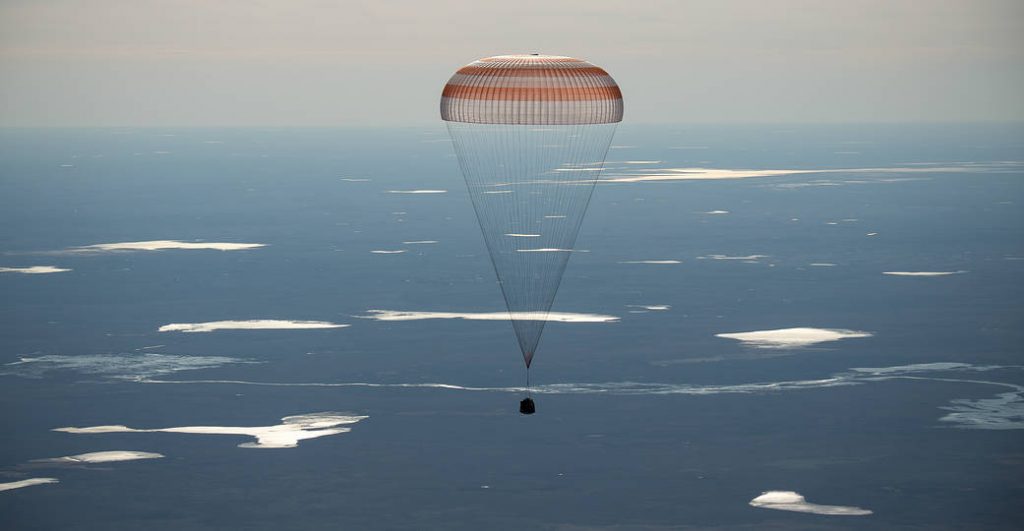
The Soyuz MS-02 spacecraft is seen as it lands with Expedition 50 Commander Shane Kimbrough of NASA and Flight Engineers Sergey Ryzhikov and Andrey Borisenko of Roscosmos near the town of Zhezkazgan, Kazakhstan on Monday, April 10, 2017 (Kazakh time). Kimbrough, Ryzhikov, and Borisenko are returning after 173 days in space where they served as members of the Expedition 49 and 50 crews onboard the International Space Station. Photo Credit: (NASA/Bill Ingalls)
On Monday, two Russian cosmonauts and a US astronaut returned to earth from the ISS in a Soyuz capsule:
Expedition 50 Commander Shane Kimbrough of NASA and Soyuz Commander Sergey Ryzhikov and Flight Engineer Andrey Borisenko of Roscosmos landed safely near the town of Dzhezkazgan, Kazakhstan April 10 after bidding farewell to their colleagues on the complex and undocking their Soyuz MS-02 spacecraft from the Poisk Module on the International Space Station. The trio spent 173 days in space conducting research and operational work in support of the station.
Here is a longer video with more scenes of the departure from the ISS and the descent and landing:
2. Tuesday, April 11, 2017: 7-8:30 pm PDT, 10-11:30 pm EDT, 9-10:30 pm CDT: We welcome back Dr. John Hunter regarding his Green Launch program along with delivering DNA to the Karman line..
3. Friday, April 14, 2016: 9:30-11 am PDT, 12:30-2 pm EDT, 11:30 am – 1:00 pm CDT: We welcome back Tracey Knutson KNUTSON. Tracey specializes in informed consent agreements and requirements.
4. Sunday, April 16, 2017: 12-1:30 pm DST (3-4:30 pm EDT, 2-3:30 pm CDT): We welcome back Al Globus for updates on his work with free space settlements.





 .
.