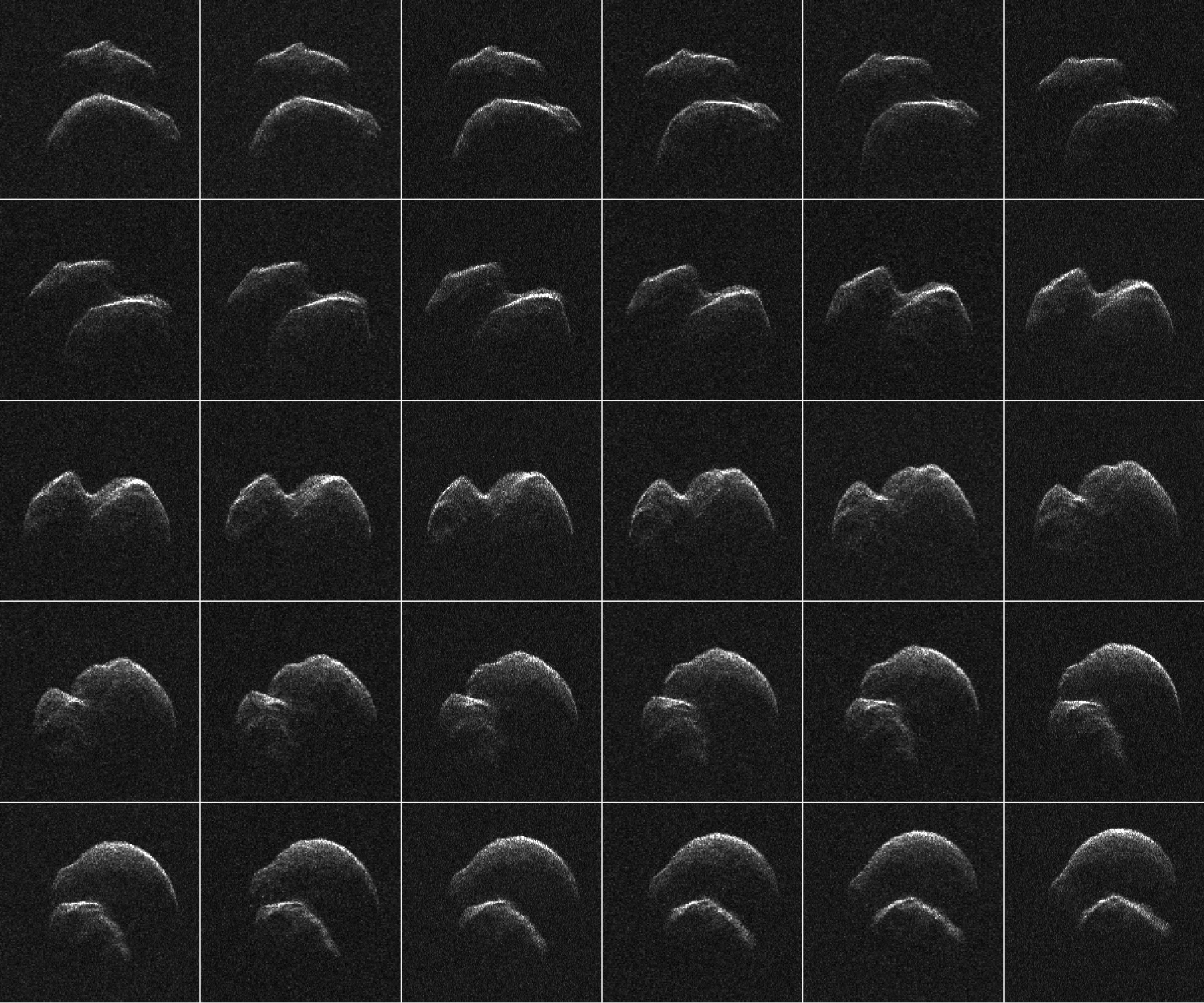
Radar images of asteroid 2014 JO25 were obtained in the early morning hours on Tuesday, with NASA’s 70-meter (230-foot) antenna at the Goldstone Deep Space Communications Complex in California. The images reveal a peanut-shaped asteroid that rotates about once every five hours. The images have resolutions as fine as 25 feet (7.5 meters) per pixel.
This composite of 30 images of asteroid 2014 JO25 was generated with radar data collected using NASA’s Goldstone Solar System Radar in California’s Mojave Desert. Credits: NASA/JPL-Caltech/GSSR
Asteroid 2014 JO25 was discovered in May 2014 by astronomers at the Catalina Sky Survey near Tucson, Arizona — a project of NASA’s Near-Earth Objects Observations Program in collaboration with the University of Arizona. The asteroid will fly safely past Earth on Wednesday at a distance of about 1.1 million miles (1.8 million kilometers), or about 4.6 times the distance from Earth to the moon. The encounter is the closest the object will have come to Earth in 400 years and will be its closest approach for at least the next 500 years.
“The asteroid has a contact binary structure – two lobes connected by a neck-like region,” said Shantanu Naidu, a scientist from NASA’s Jet Propulsion Laboratory in Pasadena, California, who led the Goldstone observations. “The images show flat facets, concavities and angular topography.”
The largest of the asteroid’s two lobes is estimated to be 2,000 feet (620 meters) across. Radar observations of the asteroid also have been conducted at the National Science Foundation’s Arecibo Observatory in Puerto Rico. Additional radar observations are being conducted at both Goldstone and Arecibo on April 19 20, and 21, and could provide images with even higher resolution.
Radar has been used to observe hundreds of asteroids. When these small, natural remnants of the formation of the solar system pass relatively close to Earth, deep space radar is a powerful technique for studying their sizes, shapes, rotation, surface features, and roughness, and for more precise determination of their orbital path.
NASA’s Jet Propulsion Laboratory, Pasadena, California, manages and operates NASA’s Deep Space Network, including the Goldstone Solar System Radar, and hosts the Center for Near-Earth Object Studies for NASA’s Near-Earth Object Observations Program within the agency’s Science Mission Directorate.
More information about asteroids and near-Earth objects can be found at:
An exoplanet orbiting a red dwarf star 40 light-years from Earth may be the new holder of the title “best place to look for signs of life beyond the Solar System”. Using ESO’s HARPS instrument at La Silla, and other telescopes around the world, an international team of astronomers discovered a “super-Earth” orbiting in the habitable zone around the faint star LHS 1140. This world is a little larger and much more massive than the Earth and has likely retained most of its atmosphere. This, along with the fact that it passes in front of its parent stars as it orbits, makes it one of the most exciting future targets for atmospheric studies. The results will appear in the 20 April 2017 issue of the journal Nature.
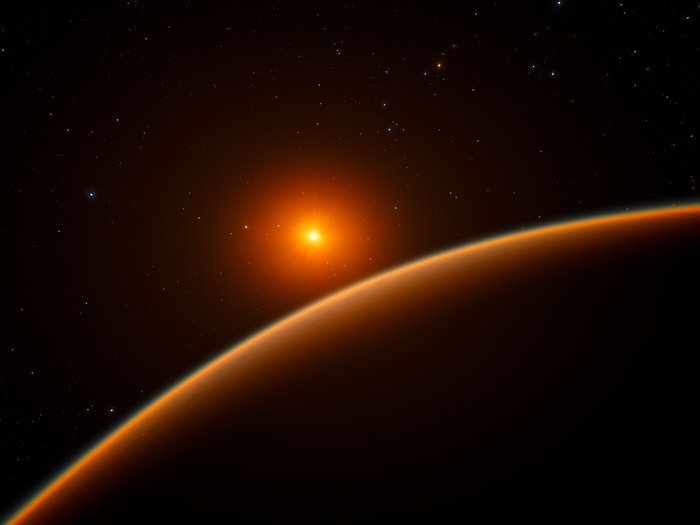
This artist’s impression shows the exoplanet LHS 1140b, which orbits a red dwarf star 40 light-years from Earth and may be the new holder of the title “best place to look for signs of life beyond the Solar System”. Using ESO’s HARPS instrument at La Silla, and other telescopes around the world, an international team of astronomers discovered this super-Earth orbiting in the habitable zone around the faint star LHS 1140. This world is a little larger and much more massive than the Earth and has likely retained most of its atmosphere. [Larger version.]The newly discovered super-Earth LHS 1140b orbits in the habitable zone around a faint red dwarf star, named LHS 1140, in the constellation of Cetus (The Sea Monster) [1]. Red dwarfs are much smaller and cooler than the Sun and, although LHS 1140b is ten times closer to its star than the Earth is to the Sun, it only receives about half as much sunlight from its star as the Earth and lies in the middle of the habitable zone. The orbit is seen almost edge-on from Earth and as the exoplanet passes in front of the star once per orbit it blocks a little of its light every 25 days.
“This is the most exciting exoplanet I’ve seen in the past decade,” said lead author Jason Dittmann of the Harvard-Smithsonian Center for Astrophysics (Cambridge, USA). “We could hardly hope for a better target to perform one of the biggest quests in science — searching for evidence of life beyond Earth.”
“The present conditions of the red dwarf are particularly favourable — LHS 1140 spins more slowly and emits less high-energy radiation than other similar low-mass stars,” explains team member Nicola Astudillo-Defru from Geneva Observatory, Switzerland [2].
For life as we know it to exist, a planet must have liquid surface water and retain an atmosphere. When red dwarf stars are young, they are known to emit radiation that can be damaging for the atmospheres of the planets that orbit them. In this case, the planet’s large size means that a magma ocean could have existed on its surface for millions of years. This seething ocean of lava could feed steam into the atmosphere long after the star has calmed to its current, steady glow, replenishing the planet with water.
This artist’s impression video shows an imaginary trip to the exoplanet LHS 1140b, which orbits a red dwarf star 40 light-years from Earth and may be the new holder of the title “best place to look for signs of life beyond the Solar System”. Using ESO’s HARPS instrument at La Silla, and other telescopes around the world, an international team of astronomers discovered this super-Earth orbiting in the habitable zone around the faint star LHS 1140. This world is a little larger and much more massive than the Earth and has likely retained most of its atmosphere. Credit: ESO/spaceengine.org
The discovery was initially made with the MEarth facility, which detected the first telltale, characteristic dips in light as the exoplanet passed in front of the star. ESO’s HARPS instrument, the High Accuracy Radial velocity Planet Searcher, then made crucial follow-up observations which confirmed the presence of the super-Earth. HARPS also helped pin down the orbital period and allowed the exoplanet’s mass and density to be deduced [3].
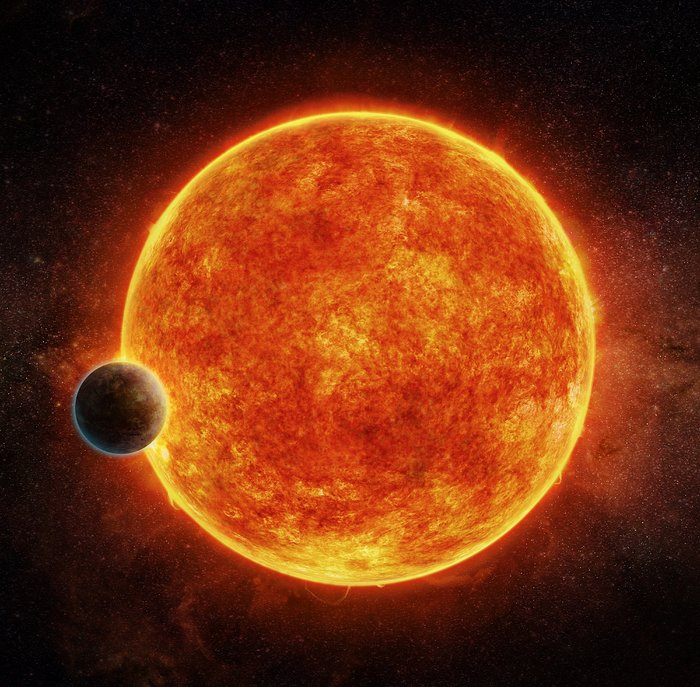
This planet is located in the liquid water habitable zone surrounding its host star, a small, faint red star named LHS 1140. The planet weighs about 6.6 times the mass of Earth and is shown passing in front of LHS 1140. Depicted in blue is the atmosphere the planet may have retained. [Larger versions]The astronomers estimate the age of the planet to be at least five billion years. They also deduced that it has a diameter 1.4 times larger than the Earth — almost 18 000 kilometres. But with a mass around seven times greater than the Earth, and hence a much higher density, it implies that the exoplanet is probably made of rock with a dense iron core.
This super-Earth may be the best candidate yet for future observations to study and characterise its atmosphere, if one exists. Two of the European members of the team, Xavier Delfosse and Xavier Bonfils both at the CNRS and IPAG in Grenoble, France, conclude:
“The LHS 1140 system might prove to be an even more important target for the future characterisation of planets in the habitable zone than Proxima b or TRAPPIST-1. This has been a remarkable year for exoplanet discoveries!” [4,5].
In particular, observations coming up soon with the NASA/ESA Hubble Space Telescope will be able to assess exactly how much high-energy radiation is showered upon LHS 1140b, so that its capacity to support life can be further constrained.
Further into the future — when new telescopes like ESO’s Extremely Large Telescope are operating — it is likely that we will be able to make detailed observations of the atmospheres of exoplanets, and LHS 1140b is an exceptional candidate for such studies.
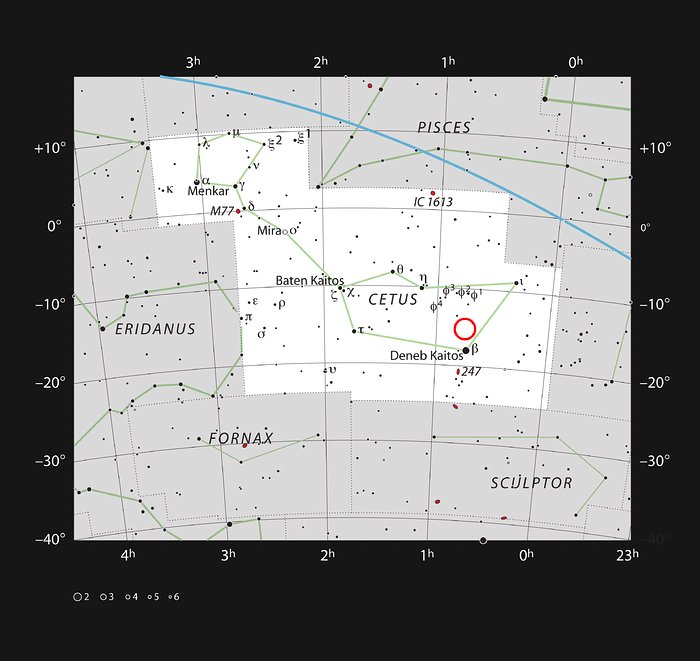
This chart shows the location of the faint red star LHS 1140 in the faint constellation of Cetus (The Sea Monster). This star is orbited by a super-Earth exoplanet called LHS 1140b, which may be best place to look for signs of life beyond the Solar System. [Larger versions]Notes
[1] The habitable zone is defined by the range of orbits around a star, for which a planet possesses the appropriate temperature needed for liquid water to exist on the planet’s surface.
[2] Although the planet is located in the zone in which life as we know it could potentially exist, it probably did not enter this region until approximately forty million years after the formation of the red dwarf star. During this phase, the exoplanet would have been subjected to the active and volatile past of its host star. A young red dwarf can easily strip away the water from the atmosphere of a planet forming within its vicinity, leading to a runaway greenhouse effect similar to that on Venus.
[3] This effort enabled other transit events to be detected by MEarth so that the astronomers could nail down the detection of the exoplanet once and for all.
[4] The planet around Proxima Centauri (eso1629) is much closer to Earth, but it probably does not transit its star, making it very difficult to determine whether it holds an atmosphere.
[5] Unlike the TRAPPIST-1 system (eso1706), no other exoplanets around LHS 1140 have been found. Multi-planet systems are thought to be common around red dwarfs, so it is possible that additional exoplanets have gone undetected so far because they are too small.
Natalya Bailey the Founder & CEO of Accion Systems joins us to talk about their very small yet incredibly powerful take on Ion thrusters. As these get closer to their theoretical maximum thrust, just a couple of the tiny units could perform all of the ISS station keeping needs! Or even send humans to Mars!
Space news topics:
* Potential habitability in Europa and Enceladus * Update on French Guiana Blockade * Atlas V aims for Tuesday Cygnus launch * NASA presents Deep Space Gateway and more SLS missions * Mars InSight seismometer passes major test
TMRO is viewer supported:
TMRO:Space is a crowd funded show. If you like this episode consider contributing to help us to continue to improve. Head over to http://www.patreon.com/tmro for information, goals and reward levels.
The Australian TV program ABC Stargazing Live with Brian Cox recently challenged its viewers to become citizen exoplanet finders. They succeeded within a couple of days in finding four “Super Earth” planets each about twice the size of earth.
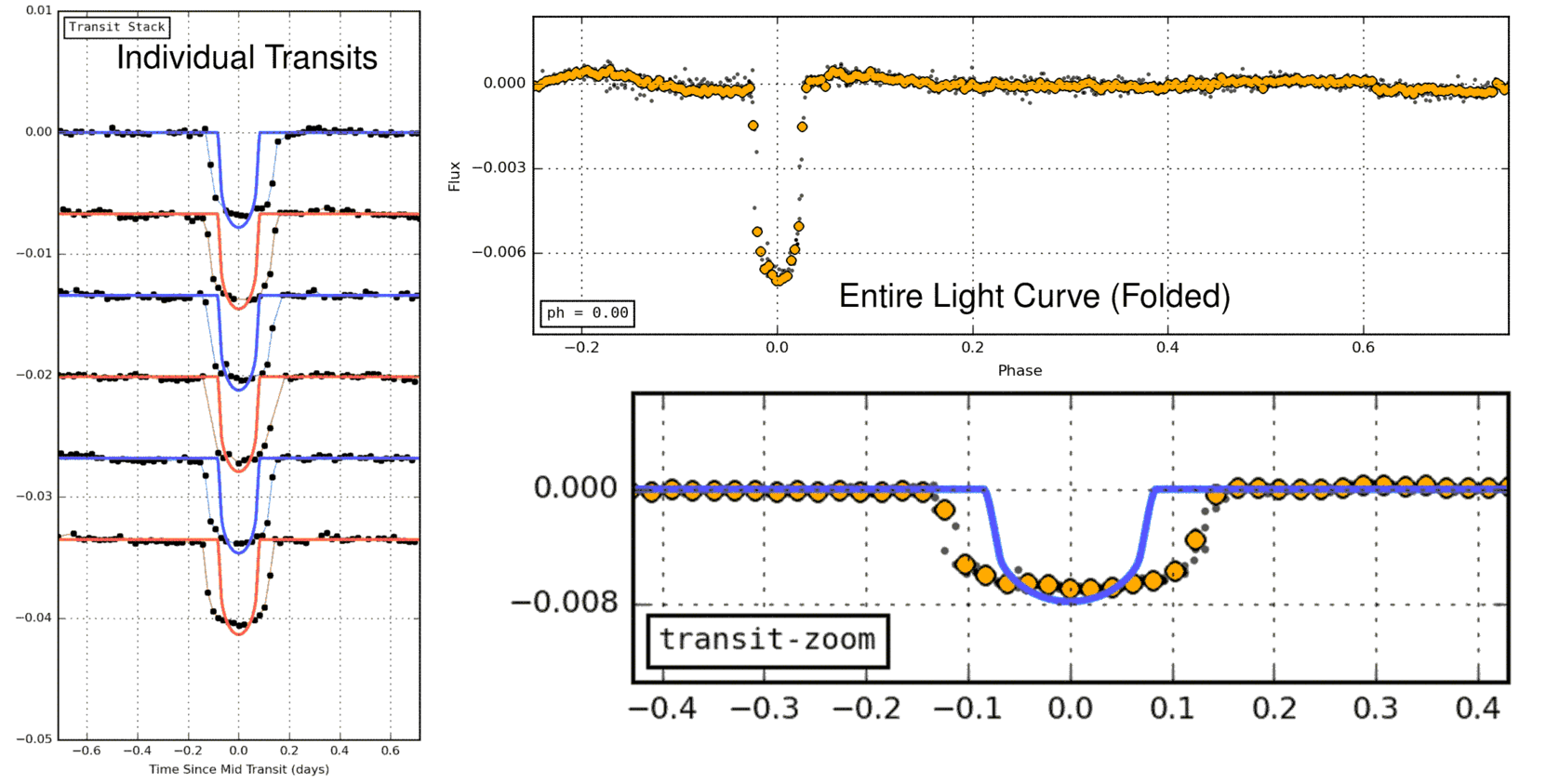
Kepler observes thousands of stars and records the stars’ brightness for long continuous periods. If a star’s planet comes between the line of sight with the earth, a dip in the star’s brightness can be seen in the data.
The width and depth of the drop in the light and the frequency of the dips provides clues to the size of the planet and its orbital period and distance from its star.
While the above diagrams are very clean and unambiguous, most real data is noisy and messy. Human’s are still much better than computer algorithms in spotting structures and unexpected features in such data and that is why citizen science volunteers can provide very useful services for the pro scientists who are collecting the data, especially when there are huge amounts of such data.
In this case, the dips of four planets were seen in the light output of a star in the Aquarius constellation 600 light years from earth. This video provides more details about these exoplanets:
David says the shows this week are canceled “due to medical leave for dental surgery. See website newsletter & Upcoming Shows menu for suggested oldies”.
Sunday, April 23, 2017: 12-1:30 PM DST (3-4:30 PM EDT, 2-3:30 PM CDT): Please check the website newsletter and upcoming show menu for details for this program. If I can return, we will have an Open Lines discussion. If I am still on medical leave, I will let you know.