Videos of a dozen or so presentations at last week’s Mars Society conference are now available in the The Mars Society YouTube channel. (There are also videos with the complete daily live streams from the conference as in the earlier post.) Here is a sampling of the talks:
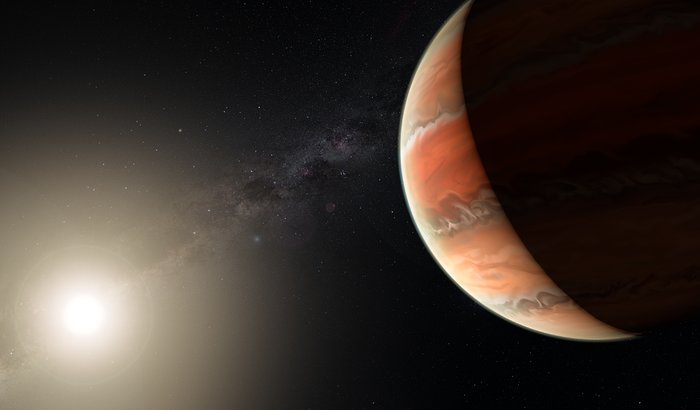
An artist’s impression showing the exoplanet WASP-19b, in which atmosphere astronomers detected titanium oxide for the first time. In large enough quantities, titanium oxide can prevent heat from entering or escaping an atmosphere, leading to a thermal inversion — the temperature is higher in the upper atmosphere and lower further down, the opposite of the normal situation. [Larger images.]Astronomers using ESO’s Very Large Telescope have detected titanium oxide in an exoplanet atmosphere for the first time. This discovery around the hot-Jupiter planet WASP-19b exploited the power of the FORS2 instrument. It provides unique information about the chemical composition and the temperature and pressure structure of the atmosphere of this unusual and very hot world. The results appear today in the journal Nature.
Astronomers using ESO’s Very Large Telescope have detected titanium oxide in an exoplanet atmosphere for the first time. This discovery around the hot-Jupiter planet WASP-19b exploited the power of the FORS2 instrument. It provides unique information about the chemical composition and the temperature and pressure structure of the atmosphere of this unusual and very hot world. The video is available in 4K UHD.
A team of astronomers led by Elyar Sedaghati, an ESO fellow and recent graduate of TU Berlin, has examined the atmosphere of the exoplanet WASP-19b in greater detail than ever before. This remarkable planet has about the same mass as Jupiter, but is so close to its parent star that it completes an orbit in just 19 hours and its atmosphere is estimated to have a temperature of about 2000 degrees Celsius.
Artist impression of the light passing through the atmosphere of the extrasolar planet WASP-19b. Astronomers detected titanium oxide, together with water and traces of sodium, in the atmosphere of the hot-Jupiter planet WASP-19b. Part of the stellar light is absorbed in the atmosphere by these molecules, while other parts get scattered or go through almost unchanged. Credit: ESO/M. Kornmesser
As WASP-19b passes in front of its parent star, some of the starlight passes through the planet’s atmosphere and leaves subtle fingerprints in the light that eventually reaches Earth. By using the FORS2 instrument on the Very Large Telescope the team was able to carefully analyse this light and deduce that the atmosphere contained small amounts of titanium oxide, water and traces of sodium, alongside a strongly scattering global haze.
“Detecting such molecules is, however, no simple feat,” explains Elyar Sedaghati, who spent 2 years as ESO student to work on this project. “Not only do we need data of exceptional quality, but we also need to perform a sophisticated analysis. We used an algorithm that explores many millions of spectra spanning a wide range of chemical compositions, temperatures, and cloud or haze properties in order to draw our conclusions.”
Titanium oxide is rarely seen on Earth. It is known to exist in the atmospheres of cool stars. In the atmospheres of hot planets like WASP-19b, it acts as a heat absorber. If present in large enough quantities, these molecules prevent heat from entering or escaping through the atmosphere, leading to a thermal inversion — the temperature is higher in the upper atmosphere and lower further down, the opposite of the normal situation. Ozone plays a similar role in Earth’s atmosphere, where it causes inversion in the stratosphere.
“The presence of titanium oxide in the atmosphere of WASP-19b can have substantial effects on the atmospheric temperature structure and circulation.” explains Ryan MacDonald, another team member and an astronomer at Cambridge University, United Kingdom. “To be able to examine exoplanets at this level of detail is promising and very exciting.” adds Nikku Madhusudhan from Cambridge University who oversaw the theoretical interpretation of the observations.
The astronomers collected observations of WASP-19b over a period of more than one year. By measuring the relative variations in the planet’s radius at different wavelengths of light that passed through the exoplanet’s atmosphere and comparing the observations to atmospheric models, they could extrapolate different properties, such as the chemical content, of the exoplanet’s atmosphere.
This new information about the presence of metal oxides like titanium oxide and other substances will allow much better modeling of exoplanet atmospheres. Looking to the future, once astronomers are able to observe atmospheres of possibly habitable planets, the improved models will give them a much better idea of how to interpret those observations.
“This important discovery is the outcome of a refurbishment of the FORS2 instrument that was done exactly for this purpose,” adds team member Henri Boffin, from ESO, who led the refurbishment project. “Since then, FORS2 has become the best instrument to perform this kind of study from the ground.”
To mark the 40 years of the flights of the two Voyager spacecraft through the solar system and into interstellar space, NASA held an event with several of the scientists involved in the project to discuss what it has accomplished:
This segment with William Shatner is about public messages transmitted to Voyager 1:
From the caption:
On Sept. 5, 2017—the 40th anniversary of Voyager 1’s launch—NASA revealed the winning #MessageToVoyager and beamed it into space. “Message to Voyager” is a social media campaign inspired by the messages of goodwill carried on the Golden Record aboard each Voyager spacecraft.
NASA invited the public to submit short, uplifting messages to the Voyager 1 spacecraft and all that lies beyond it. These messages were a maximum of 60 characters and were tagged #MessageToVoyager. NASA tracked more than 30,000 submissions. The Voyager team together with JPL and NASA headquarters selected their 10 favorites, which were then put to a public vote. The winning message was sent into interstellar space by a command that originated from the Deep Space Network (DSN) mission control at NASA’s Jet Propulsion Laboratory with help from the original Captain Kirk, actor William Shatner; Tracy Drain, Juno mission deputy chief engineer; Jeff Berner, DSN chief engineer; and Annabel Kennedy, DSN command engineer.
Our generation has a unique opportunity to discover Earthlike planets around other stars, and Project Blue could make this breakthrough. We’re creating detailed plans for the spacecraft, and we want you to be a part of advancing our mission to the Launchpad!
We believe a sister Earth could exist not too far from the place we call home and, thanks to recent breakthroughs, the technology now exists to find out. We at Project Blue aim to search the Alpha Centauri system for planets like Earth, and we want your help to launch our engineering design effort, like creating blueprints for a house before construction begins. We are looking to raise $175,000 to complete this engineering phase and to establish our industry partnerships. And we want to get you involved in the mission right at the start so that, together, we can all take a bold leap into shaping humanity’s future!
The observatory would be much smaller, and much cheaper, than the Hubble or similar big science spacecraft:
Project Blue is a space telescope mission that seeks to find and photograph a habitable world, another Earthlike planet where life can potentially thrive. Our goal is simple — to build & launch a telescope so powerful it can detect a blue planet in the nearby Alpha Centauri star system. Thanks to recent technological innovations, our telescope is small enough to fit on a coffee table, but powerful enough to pick up a planet over a billion times dimmer than its star — from four light years away! With this telescope we aim to take the first ever optical image of a potentially habitable exoplanet, and the team hopes that the results will show a ‘pale blue dot’ similar to the famous photo of Earth taken by the Voyager probe.
With sufficient public support, the spacecraft could go into orbit by 2023:
Stewart Money author of, “Here be Dragons: The Rise of SpaceX & the Journey to Mars” joins us to talk about the history of SpaceX and some projects you may not have known of. Interview segment starts at 24:40
Space news topics discussed:
1:41 – Ariane V Launch Abort 4:53 – Falcon 9 Launch with X37-B 8:51 – Asteroid Florence Zips Past Earth 15:04 – Bridenstine nominated for NASA Admin, and why that could be bad 19:54 – Boron Found on Mars
TMRO is viewer supported:
TMRO:Space is a crowd funded show. If you like this episode consider contributing to help us to continue to improve. Head over to http://www.patreon.com/tmrofor information plus our all new goals and reward levels