We have a surprise round table this week: what lessons can we learn from the moon before heading off to Mars? Benjamin, Jared, Mike and Cariann talk about the advantages of going to the moon again before first setting foot on Mars. Segment starts at 23:05
Launches and news topics covered:
Launches: 1:57 – Proton Launch of Amazonas 5 4:24 – Soyuz Launch of Expedition 53
Space News: 8:31 – Cassini End-of-Mission 12:26 – New Horizons Extended Mission 16:47 – Unexpected Solar Flares
TMRO is viewer supported:
TMRO:Space is a crowd funded show. If you like this episode consider contributing to help us to continue to improve. Head over to http://www.patreon.com/tmro for information plus our all new goals and reward levels
A thrilling epoch in the exploration of our solar system came to a close today, as NASA’s Cassini spacecraft made a fateful plunge into the atmosphere of Saturn, ending its 13-year tour of the ringed planet.
“This is the final chapter of an amazing mission, but it’s also a new beginning,” said Thomas Zurbuchen, associate administrator for NASA’s Science Mission Directorate at NASA Headquarters in Washington. “Cassini’s discovery of ocean worlds at Titan and Enceladus changed everything, shaking our views to the core about surprising places to search for potential life beyond Earth.”
Telemetry received during the plunge indicates that, as expected, Cassini entered Saturn’s atmosphere with its thrusters firing to maintain stability, as it sent back a unique final set of science observations. Loss of contact with the Cassini spacecraft occurred at 4:55 a.m. PDT (7:55 a.m. EDT), with the signal received by NASA’s Deep Space Network antenna complex in Canberra, Australia.
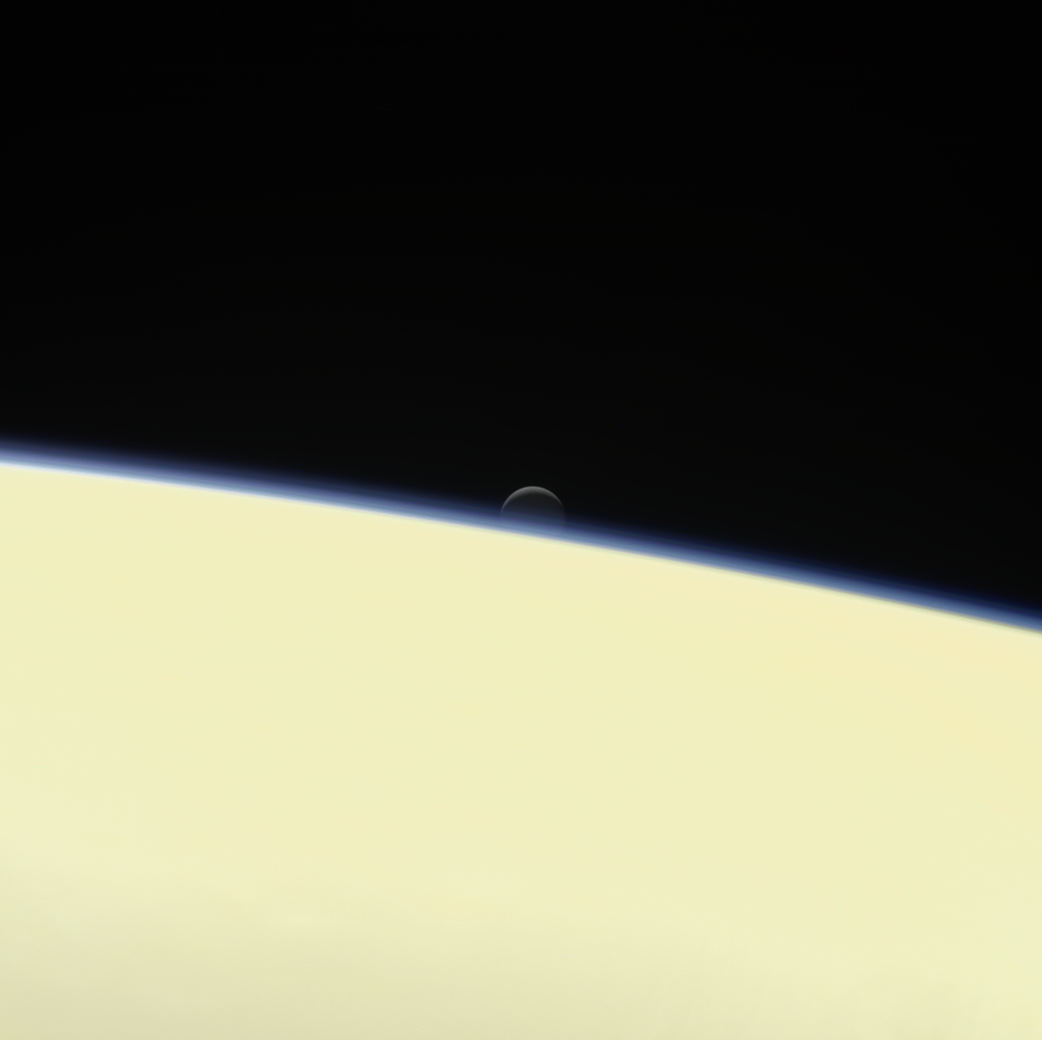
Saturn’s active, ocean-bearing moon Enceladus sinks behind the giant planet in a farewell portrait from NASA’s Cassini spacecraft. Credits: NASA/JPL-Caltech/Space Science Institute
“It’s a bittersweet, but fond, farewell to a mission that leaves behind an incredible wealth of discoveries that have changed our view of Saturn and our solar system, and will continue to shape future missions and research,”
said Michael Watkins, director of NASA’s Jet Propulsion Laboratory in Pasadena, California, which manages the Cassini mission for the agency. JPL also designed, developed and assembled the spacecraft.
Cassini program manager at JPL, Earl Maize, left, and spacecraft operations team manager for the Cassini mission at Saturn, Julie Webster, right, embrace after the Cassini spacecraft plunged into Saturn, Friday, Sept. 15, 2017 at NASA’s Jet Propulsion Laboratory in Pasadena, California. Since its arrival in 2004, the Cassini-Huygens mission has been a discovery machine, revolutionizing our knowledge of the Saturn system and captivating us with data and images never before obtained with such detail and clarity. On Sept. 15, 2017, operators will deliberately plunge the spacecraft into Saturn, as Cassini gathered science until the end. The “plunge” ensures Saturn’s moons will remain pristine for future exploration. During Cassini’s final days, mission team members from all around the world gathered at NASA’s Jet Propulsion Laboratory, Pasadena, California, to celebrate the achievements of this historic mission. Photo Credit: (NASA/Joel Kowsky)
Cassini’s plunge brings to a close a series of 22 weekly “Grand Finale” dives between Saturn and its rings, a feat never before attempted by any spacecraft.
“The Cassini operations team did an absolutely stellar job guiding the spacecraft to its noble end,” said Earl Maize, Cassini project manager at JPL. “From designing the trajectory seven years ago, to navigating through the 22 nail-biting plunges between Saturn and its rings, this is a crack shot group of scientists and engineers that scripted a fitting end to a great mission. What a way to go. Truly a blaze of glory.”
As planned, data from eight of Cassini’s science instruments was beamed back to Earth. Mission scientists will examine the spacecraft’s final observations in the coming weeks for new insights about Saturn, including hints about the planet’s formation and evolution, and processes occurring in its atmosphere.
“Things never will be quite the same for those of us on the Cassini team now that the spacecraft is no longer flying,” said Linda Spilker, Cassini project scientist at JPL. “But, we take comfort knowing that every time we look up at Saturn in the night sky, part of Cassini will be there, too.”
Cassini launched in 1997 from Cape Canaveral Air Force Station in Florida and arrived at Saturn in 2004. NASA extended its mission twice – first for two years, and then for seven more. The second mission extension provided dozens of flybys of the planet’s icy moons, using the spacecraft’s remaining rocket propellant along the way. Cassini finished its tour of the Saturn system with its Grand Finale, capped by Friday’s intentional plunge into the planet to ensure Saturn’s moons – particularly Enceladus, with its subsurface ocean and signs of hydrothermal activity – remain pristine for future exploration.
While the Cassini spacecraft is gone, its enormous collection of data about Saturn – the giant planet, its magnetosphere, rings and moons – will continue to yield new discoveries for decades to come.
“Cassini may be gone, but its scientific bounty will keep us occupied for many years,” Spilker said. “We’ve only scratched the surface of what we can learn from the mountain of data it has sent back over its lifetime.”
The Cassini-Huygens mission is a cooperative project of NASA, ESA (European Space Agency) and the Italian Space Agency. JPL, a division of Caltech in Pasadena, manages the mission for NASA’s Science Mission Directorate in Washington.
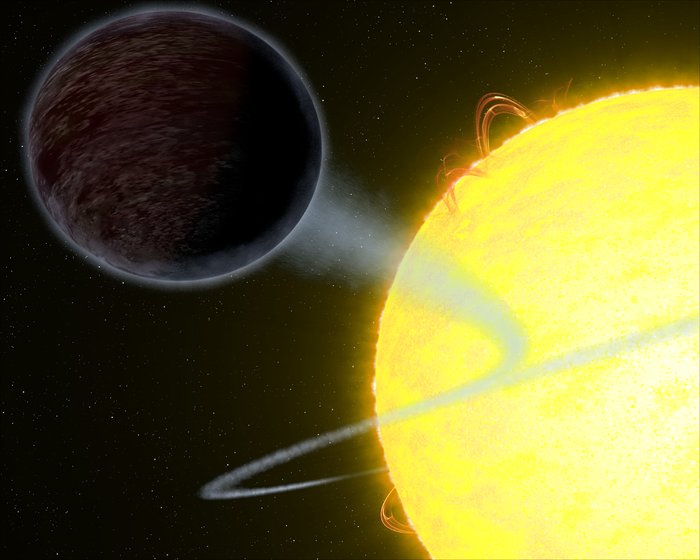
This artist’s impression shows the exoplanet WASP-12b — an alien world as black as fresh asphalt, orbiting a star like our Sun. Scientists were able to measure its albedo: the amount of light the planet reflects. The results showed that the planet is extremely dark at optical wavelengths. [Larger image]
Astronomers have discovered that the well-studied exoplanet WASP-12b reflects almost no light, making it appear essentially pitch black. This discovery sheds new light on the atmospheric composition of the planet and also refutes previous hypotheses about WASP-12b’s atmosphere. The results are also in stark contrast to observations of another similarly sized exoplanet.
Using the Space Telescope Imaging Spectrograph (STIS) on the NASA/ESA Hubble Space Telescope, an international team led by astronomers at McGill University, Canada, and the University of Exeter, UK, have measured how much light the exoplanet WASP-12b reflects — its albedo — in order to learn more about the composition of its atmosphere [1].
The results were surprising, explains lead author Taylor Bell, a Master’s student in astronomy at McGill University who is affiliated with the Institute for Research on Exoplanets:
“The measured albedo of WASP-12b is 0.064 at most. This is an extremely low value, making the planet darker than fresh asphalt!”
This makes WASP-12b two times less reflective than our Moon which has an albedo of 0.12 [2]. Bell adds:
“The low albedo shows we still have a lot to learn about WASP-12b and other similar exoplanets.”
WASP-12b orbits the Sun-like star WASP-12A, about 1400 light-years away, and since its discovery in 2008 it has become one of the best studied exoplanets (opo1354, opo1015, opo1436, heic1524). With a radius almost twice that of Jupiter and a year of just over one Earth day, WASP-12b is categorised as a hot Jupiter. Because it is so close to its parent star, the gravitational pull of the star has stretched WASP-12b into an egg shape and raised the surface temperature of its daylight side to 2600 degrees Celsius.
The high temperature is also the most likely explanation for WASP-12b’s low albedo.
“There are other hot Jupiters that have been found to be remarkably black, but they are much cooler than WASP-12b. For those planets, it is suggested that things like clouds and alkali metals are the reason for the absorption of light, but those don’t work for WASP-12b because it is so incredibly hot,” explains Bell.
The daylight side of WASP-12b is so hot that clouds cannot form and alkali metals are ionised. It is even hot enough to break up hydrogen molecules into atomic hydrogen which causes the atmosphere to act more like the atmosphere of a low-mass star than like a planetary atmosphere. This leads to the low albedo of the exoplanet.
To measure the albedo of WASP-12b the scientists observed the exoplanet in October 2016 during an eclipse, when the planet was near full phase and passed behind its host star for a time. This is the best method to determine the albedo of an exoplanet, as it involves directly measuring the amount of light being reflected. However, this technique requires a precision ten times greater than traditional transit observations. Using Hubble’s Space Telescope Imaging Spectrograph the scientists were able to measure the albedo of WASP-12b at several different wavelengths.
“After we measured the albedo we compared it to spectral models of previously suggested atmospheric models of WASP-12b”, explains Nikolay Nikolov (University of Exeter, UK), co-author of the study. “We found that the data match neither of the two currently proposed models.”[3].
The new data indicate that the WASP-12b atmosphere is composed of atomic hydrogen and helium.
WASP-12b is only the second planet to have spectrally resolved albedo measurements, the first being HD 189733b, another hot Jupiter. The data gathered by Bell and his team allowed them to determine whether the planet reflects more light towards the blue or the red end of the spectrum. While the results for HD 189733b suggest that the exoplanet has a deep blue colour (heic1312), WASP-12b, on the other hand, is not reflecting light at any wavelength. WASP-12b does, however, emit light because of its high temperature, giving it a red hue similar to a hot glowing metal.
“The fact that the first two exoplanets with measured spectral albedo exhibit significant differences demonstrates the importance of these types of spectral observations and highlights the great diversity among hot Jupiters,” concludes Bell.
Notes
[1] The team measured the optical geometric albedo of WASP-12b, which measures the light that is scattered back towards the source of light, and can have values above 1. This is in contrast to the Bond albedo, which describes the total amount of energy reflected across all wavelengths and always falls in the range of 0 to 1.
[2] Earth has an average optical geometric albedo of about 0.37. Enceladus, an icy moon of Saturn, has an albedo of 1.4, the highest known albedo of any celestial body in the Solar System.
[3] One proposed model was an aluminum-oxide atmosphere with Mie scattering while the other was a cloud-free atmosphere with Rayleigh scattering.
NASA’s Cassini spacecraft is on final approach to Saturn, following confirmation by mission navigators that it is on course to dive into the planet’s atmosphere on Friday, Sept. 15.
Cassini is ending its 13-year tour of the Saturn system with an intentional plunge into the planet to ensure Saturn’s moons – in particular Enceladus, with its subsurface ocean and signs of hydrothermal activity – remain pristine for future exploration. The spacecraft’s fateful dive is the final beat in the mission’s Grand Finale, 22 weekly dives, which began in late April, through the gap between Saturn and its rings. No spacecraft has ever ventured so close to the planet before.
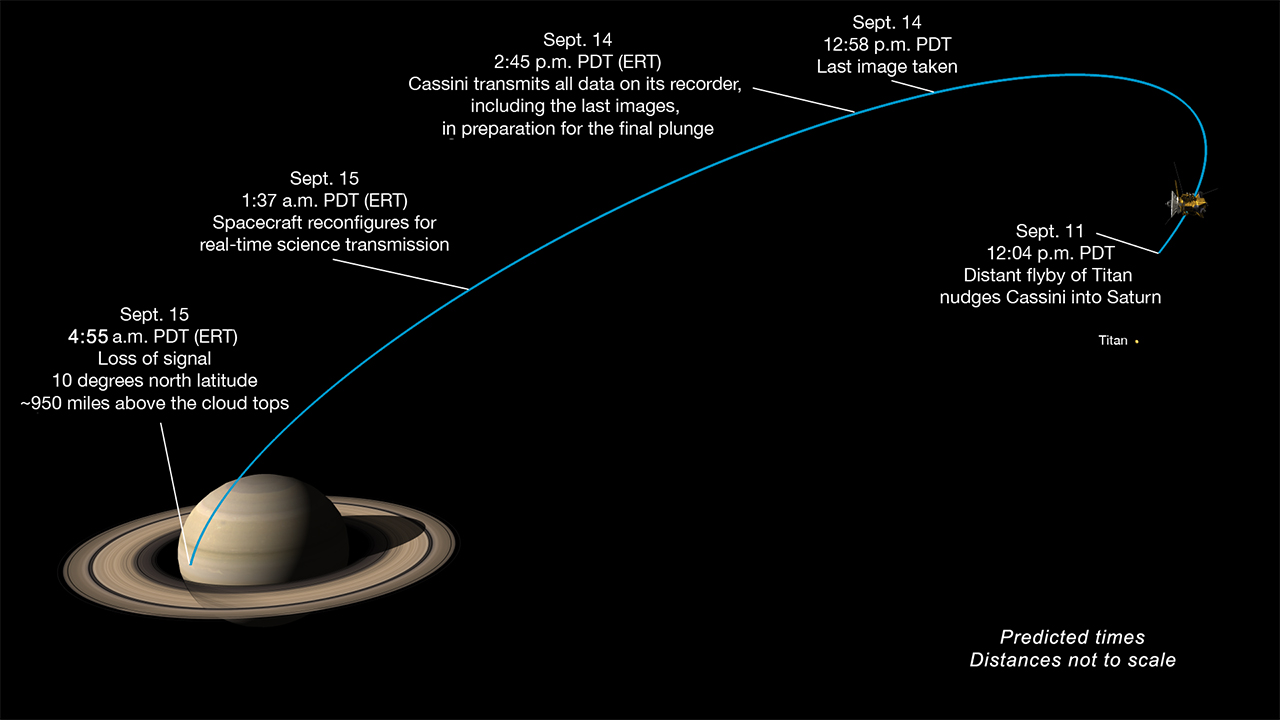
Milestones in Cassini’s final dive toward Saturn.
The mission’s final calculations predict loss of contact with the Cassini spacecraft will take place on Sept. 15 at 7:55 a.m. EDT (4:55 a.m. PDT). Cassini will enter Saturn’s atmosphere approximately one minute earlier, at an altitude of about 1,190 miles (1,915 kilometers) above the planet’s estimated cloud tops (the altitude where the air pressure is 1-bar, equivalent to sea level on Earth). During its dive into the atmosphere, the spacecraft’s speed will be approximately 70,000 miles (113,000 kilometers) per hour. The final plunge will take place on the day side of Saturn, near local noon, with the spacecraft entering the atmosphere around 10 degrees north latitude.
When Cassini first begins to encounter Saturn’s atmosphere, the spacecraft’s attitude control thrusters will begin firing in short bursts to work against the thin gas and keep Cassini’s saucer-shaped high-gain antenna pointed at Earth to relay the mission’s precious final data. As the atmosphere thickens, the thrusters will be forced to ramp up their activity, going from 10 percent of their capacity to 100 percent in the span of about a minute. Once they are firing at full capacity, the thrusters can do no more to keep Cassini stably pointed, and the spacecraft will begin to tumble.
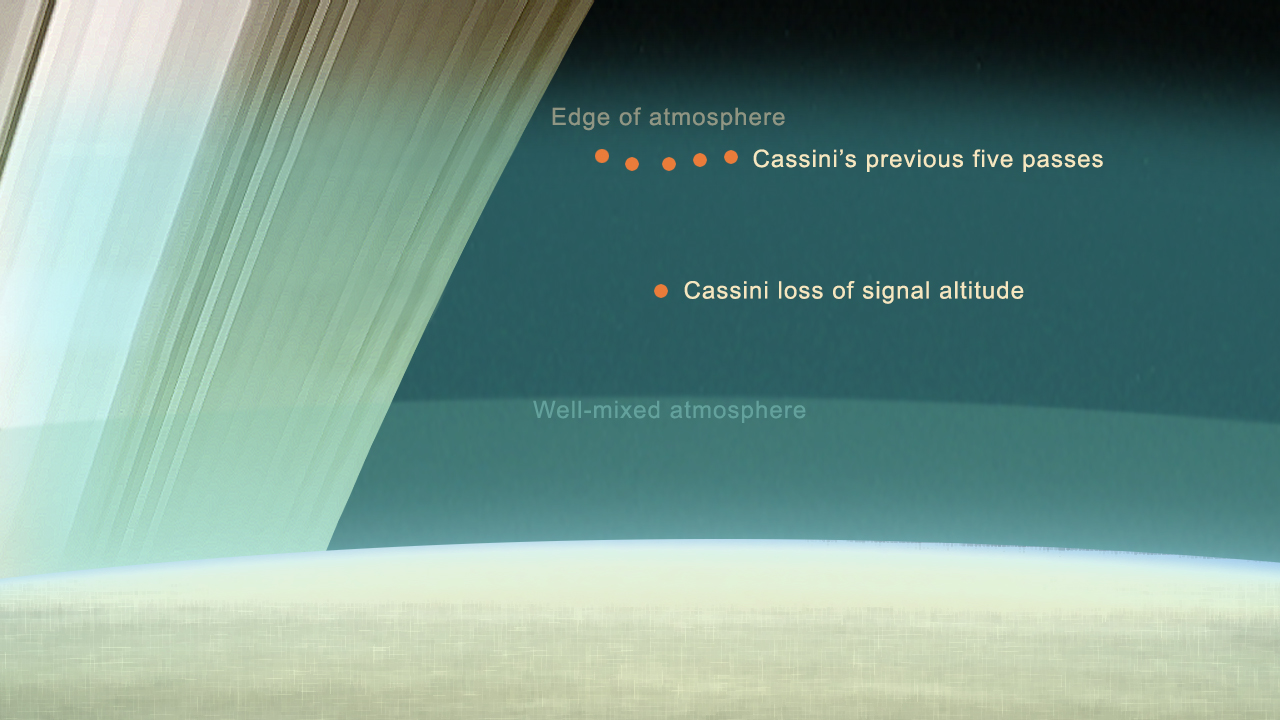
Graphic showing the relative altitudes of Cassini’s final five passes through Saturn’s upper atmosphere, compared to the depth it reaches upon loss of communication with Earth. Credits: NASA/JPL-Caltech
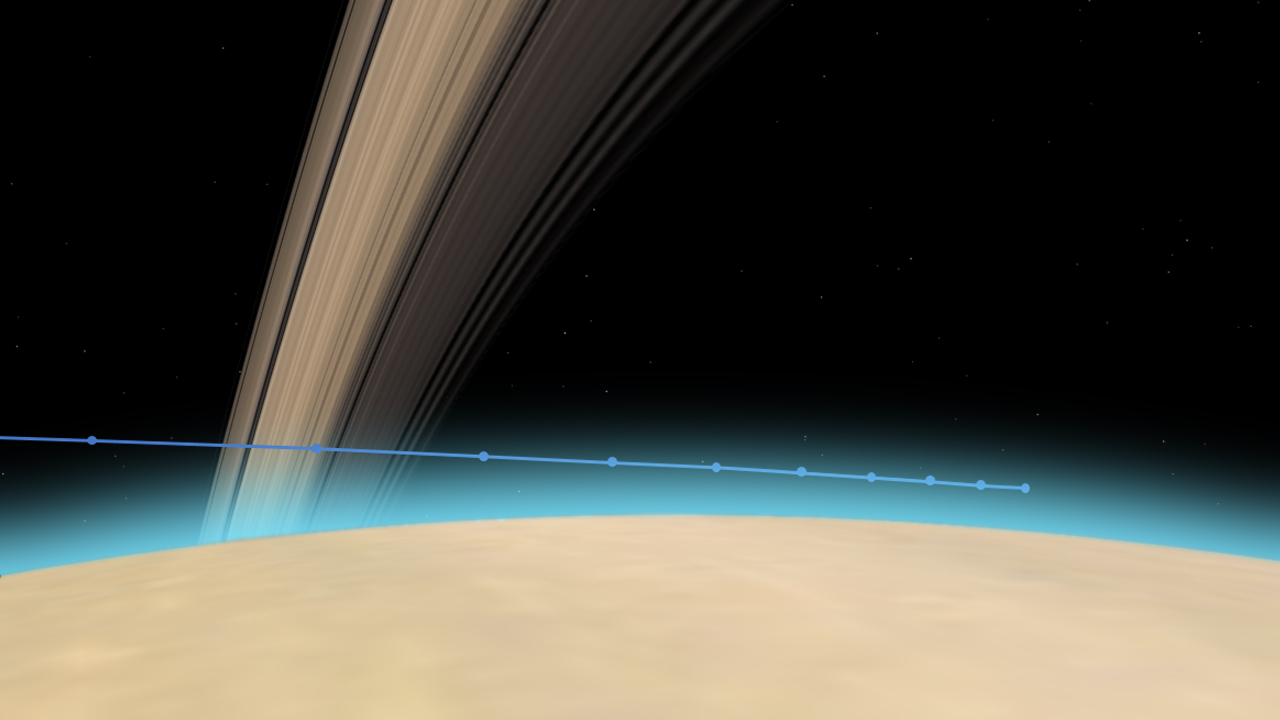
When the antenna points just a few fractions of a degree away from Earth, communications will be severed permanently. The predicted altitude for loss of signal is approximately 930 miles (1,500 kilometers) above Saturn’s cloud tops. From that point, the spacecraft will begin to burn up like a meteor. Within about 30 seconds following loss of signal, the spacecraft will begin to come apart; within a couple of minutes, all remnants of the spacecraft are expected to be completely consumed in the atmosphere of Saturn.
Due to the travel time for radio signals from Saturn, which changes as both Earth and the ringed planet travel around the Sun, events currently take place there 83 minutes before they are observed on Earth. This means that, although the spacecraft will begin to tumble and go out of communication at 6:31 a.m. EDT (3:31 a.m. PDT) at Saturn, the signal from that event will not be received at Earth until 83 minutes later.
“The spacecraft’s final signal will be like an echo. It will radiate across the solar system for nearly an hour and a half after Cassini itself has gone,” said Earl Maize, Cassini project manager at NASA’s Jet Propulsion Laboratory (JPL) in Pasadena, California. “Even though we’ll know that, at Saturn, Cassini has already met its fate, its mission isn’t truly over for us on Earth as long as we’re still receiving its signal.”
Cassini’s last transmissions will be received by antennas at NASA’s Deep Space Network complex in Canberra, Australia.
Cassini is set to make groundbreaking scientific observations of Saturn, using eight of its 12 science instruments. All of the mission’s magnetosphere and plasma science instruments, plus the spacecraft’s radio science system, and its infrared and ultraviolet spectrometers will collect data during the final plunge.
Cassini’s path into Saturn’s upper atmosphere, with tick marks every 10 seconds. Credits: NASA/JPL-Caltech
Chief among the observations being made as Cassini dives into Saturn are those of the Ion and Neutral Mass Spectrometer (INMS). The instrument will directly sample the composition and structure of the atmosphere, which cannot be done from orbit. The spacecraft will be oriented so that INMS is pointed in the direction of motion, to allow it the best possible access to oncoming atmospheric gases.
For the next couple of days, as Saturn looms ever larger, Cassini expects to take a last look around the Saturn system, snapping a few final images of the planet, features in its rings, and the moons Enceladus and Titan. The final set of views from Cassini’s imaging cameras is scheduled to be taken and transmitted to Earth on Thursday, Sept. 14. If all goes as planned, images will be posted to the Cassini mission website beginning around 11 p.m. EDT (8 p.m. PDT). The unprocessed images will be available at: https://saturn.jpl.nasa.gov/galleries/raw-images
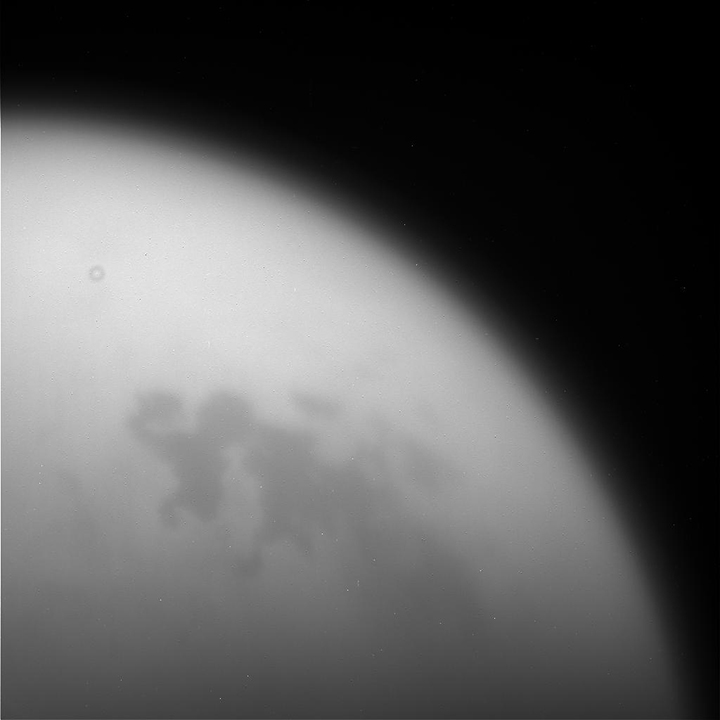
This unprocessed image of Titan was taken by NASA’s Cassini spacecraft during the mission’s final, distant flyby on Sept. 11, 2017. Credits: NASA/JPL-Caltech/Space Science Institute
Live mission commentary and video from JPL Mission Control will air on NASA Television and the agency’s website from 7 to 8:30 a.m. EDT (4 a.m. to 5:30 a.m. PDT) on Sept. 15. A post-mission news briefing from JPL is currently scheduled for 9:30 a.m. EDT (6:30 a.m. PDT), also on NASA TV.
A new NASA e-book, The Saturn System Through the Eyes of Cassini, showcasing compelling images and key science discoveries from the mission, is available for free download in multiple formats at: https://www.nasa.gov/ebooks
An online toolkit of information and resources about Cassini’s Grand Finale and final plunge into Saturn is available at: https://saturn.jpl.nasa.gov/grandfinale
Follow the Cassini spacecraft’s plunge on social media using #GrandFinale, or visit:
The Cassini-Huygens mission is a cooperative project of NASA, ESA (European Space Agency) and the Italian Space Agency. JPL, a division of Caltech in Pasadena, manages the mission for NASA’s Science Mission Directorate, Washington. JPL designed, developed and assembled the Cassini orbiter.