Here is this week’s Space to Ground report from NASA about activities related to the International Space Station:
Here is a nice little physics demo by ISS crew member Randy Bresnik:
Watch NASA astronaut Randy Bresnik demonstrate Newton’s Second Law of Motion on the International Space Station by applying a force to objects of different mass. Do you see the differences in acceleration?
Here are highlights of last week’s departure, undocking, and landing in Kazakhstan of a Soyuz spacecraft with three ISS crew members:
The Soyuz MS-06 spacecraft hatch was closed at 19:58 UTC, on 27 February 2018. International Space Station Expedition 53-54 crew members, Flight Engineers Mark Vande Hei and Joe Acaba of NASA and Alexander Misurkin of Roscosmos started their journey home at 23:08UTC, when the Soyuz MS-06 spacecraft undocked from the International Space Station. The Soyuz MS-06 spacecraft landed in Kazakhstan at 02:31 UTC on 28 February 2018.
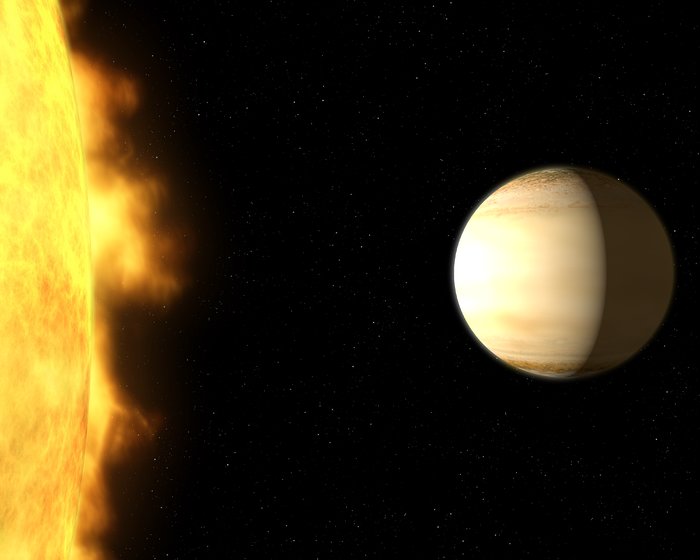
An international team of scientists has used the NASA/ESA Hubble Space Telescope to study the atmosphere of the hot exoplanet WASP-39b. By combining this new data with older data they created the most complete study yet of an exoplanet atmosphere. The atmospheric composition of WASP-39b hints that the formation processes of exoplanets can be very different from those of our own Solar System giants.
A team of British and American astronomers used data from several telescopes on the ground and in space — among them the NASA/ESA Hubble Space Telescope — to study the atmosphere of the hot, bloated, Saturn-mass exoplanet WASP-39b, about 700 light-years from Earth. The analysis of the spectrum showed a large amount of water in the exoplanet’s atmosphere — three times more than in Saturn’s atmosphere. WASP-39b is eight times closer to its parent star, WASP-39, than Mercury is to the Sun and it takes only four days to complete an orbit. [Larger image]Investigating exoplanet atmospheres can provide new insight into how and where planets form around a star.
“We need to look outward to help us understand our own Solar System,”
explains lead investigator Hannah Wakeford from the University of Exeter in the UK and the Space Telescope Science Institute in the USA.
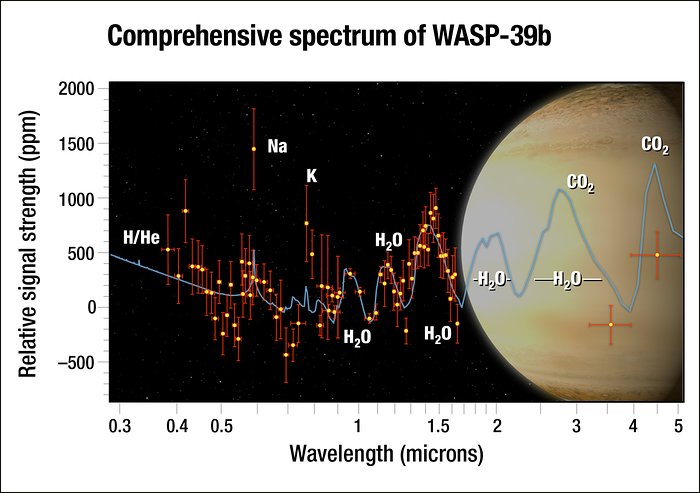
Therefore the British-American team combined the capabilities of the NASA/ESA Hubble Space Telescope with those of other ground- and space-based telescopes for a detailed study of the exoplanet WASP-39b. They have produced the most complete spectrum of an exoplanet’s atmosphere possible with present-day technology [1].
WASP-39b is orbiting a Sun-like star, about 700 light-years from Earth. The exoplanet is classified as a “Hot-Saturn”, reflecting both its mass being similar to the planet Saturn in our own Solar System and its proximity to its parent star. This study found that the two planets, despite having a similar mass, are profoundly different in many ways. Not only is WASP-39b not known to have a ring system, it also has a puffy atmosphere that is free of high-altitude clouds. This characteristic allowed Hubble to peer deep into its atmosphere.
Using the NASA/ESA Hubble Space Telescopes as well as data gathered by other telescopes in space and on the ground astronomers have analysed the atmosphere of the exoplanet WASP-39b. It is the most complete spectrum of an exoplanet’s atmosphere possible with present-day technology. By dissecting starlight filtering through the planet’s atmosphere into its component colours, the team found clear evidence for water vapour. Although the researchers predicted they would see water, they were surprised by how much water they found — three times as much as Saturn has. This suggests that the planet formed farther out from the star, where it was bombarded by icy material. [Larger image]By dissecting starlight filtering through the planet’s atmosphere [2] the team found clear evidence for atmospheric water vapour. In fact, WASP-39b has three times as much water as Saturn does. Although the researchers had predicted they would see water vapour, they were surprised by the amount that they found. This surprise, combined with the water abundance allowed to infer the presence of large amount of heavier elements in the atmosphere. This in turn suggests that the planet was bombarded by a lot of icy material which gathered in its atmosphere. This kind of bombardment would only be possible if WASP-39b formed much further away from its host star than it is right now.
“WASP-39b shows exoplanets are full of surprises and can have very different compositions than those of our Solar System,”
says co-author David Sing from the University of Exeter, UK.
The analysis of the atmospheric composition and the current position of the planet indicate that WASP-39b most likely underwent an interesting inward migration, making an epic journey across its planetary system.
“Exoplanets are showing us that planet formation is more complicated and more confusing than we thought it was. And that’s fantastic!”,
adds Wakeford.
Having made its incredible inward journey WASP-39b is now eight times closer to its parent star, WASP-39, than Mercury is to the Sun and it takes only four days to complete an orbit. The planet is also tidally locked, meaning it always shows the same side to its star. Wakeford and her team measured the temperature of WASP-39b to be a scorching 750 degrees Celsius. Although only one side of the planet faces its parent star, powerful winds transport heat from the bright side around the planet, keeping the dark side almost as hot.
“Hopefully this diversity we see in exoplanets will help us figure out all the different ways a planet can form and evolve,”
explains David Sing.
Looking ahead, the team wants to use the NASA/ESA/CSA James Webb Space Telescope — scheduled to launch in 2019 — to capture an even more complete spectrum of the atmosphere of WASP-39b. James Webb will be able to collect data about the planet’s atmospheric carbon, which absorbs light of longer wavelengths than Hubble can see [3]. Wakeford concludes:
“By calculating the amount of carbon and oxygen in the atmosphere, we can learn even more about where and how this planet formed.”
Notes
[1] Data used to produce the full spectrum was also collected by NASA’s Spitzer Space Telescope and ESO’s Very Large Telescope. In addition older data from Hubble were used.
[2] When starlight passes through the atmosphere of an exoplanet, it interacts with the atoms and molecules in it. This leaves a weak fingerprint of the atmosphere in the spectrum of the star. Certain peaks and troughs in the resulting spectrum correspond to specific atoms and molecules, allowing scientists to see exactly what gases make up the atmosphere.
[3] Given the large amount of heavy elements in WASP-39b’s atmosphere, Wakeford and her team predict that carbon dioxide will be the dominant form of carbon. This could be measured at a wavelength of 4.5 micrometres with James Webb’s NIRSpec instrument. Such follow-up investigations would allow further constraints to be placed on the ratio of carbon to oxygen, and on the metallicity of WASP-39b’s atmosphere.
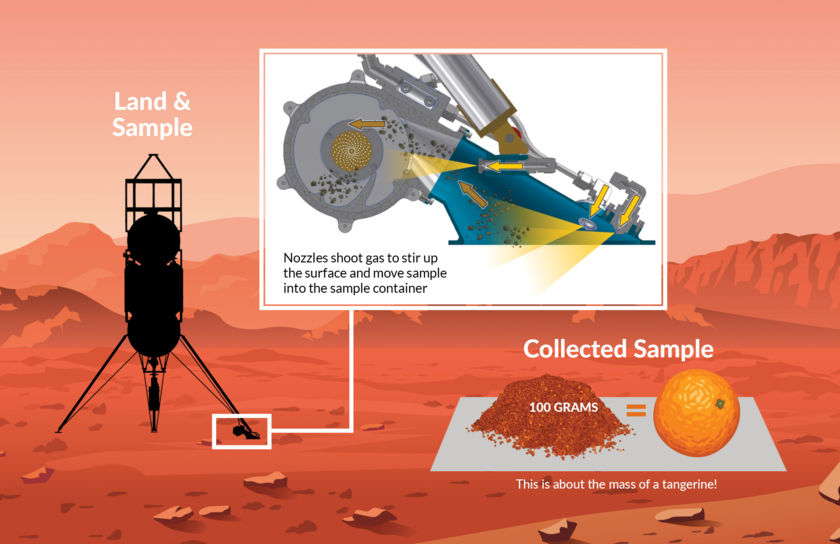
The goal is to design, build, and demonstrate a low cost system for gathering a sample of material from the surface of a planet or moon. They plan to attach a prototype version to a Masten vertical-takeoff and landing rocket vehicle and do a demo mission in California.
… Enter PlanetVac—short for Planetary Vacuum—a project by Honeybee Robotics sponsored by The Planetary Society. In 2013, we helped fund a successful test of this next-generation system in the lab, and in May, we’re taking it out for a test flight on a rocket called Xodiac. Xodiac, built by Masten Space Systems, takes off and lands vertically in California’s Mojave Desert. This allows space hardware developers to test new equipment and make sure prototypes can survive the stresses of a rocket launch and landing—all without actually flying to space. Our May Xodiac test will give PlanetVac a bigger challenge than the lab and represent the next step in qualifying it for full-fledged space missions.
PLANETVAC SAMPLE COLLECTION: Attached to a lander leg, PlanetVac collects a surface sample by using an inert gas to move regolith into the sample container.
A short report from NASA JPL with the latest news from Mars:
And this longer video shows a talk by Troy Hudson of JPL about NASA’s Mars InSight Mission, which is scheduled to launch in May of this year and land on Mars in November. Hudson focused on using Insight’s sensors to investigate the interior of Mars: