1. Monday, April 23, 2018; 2-3:30 pm PDT (4-5:30 pm CDT, 5-6:30 pm EDT): We welcome back Dr. James Schwartz to continue discussing his body of work regarding human spaceflight exploration and more.
2. Tuesday, April 24, 2018: 7-8:30 pm PDT; 9-10:30 pm CDT; 10-11:30 pm EDT: We welcome Tom Risen, Aerospace America journalist for a discussion on many important news topics, the recently concluded Space Symposium, and the NASA Administrator hearing which he attended.
3. Wednesday, April 25, 2018: Hotel Mars. See Upcoming Show Menu and the website newsletter for details. Hotel Mars is pre-recorded by John Batchelor. It is archived on The Space Show site after John posts it on his website.
4. Friday, April 27, 2018; 9:30 am -11 am PDT, (12:30 -2 pm EDT; 11:30 AM-1 pm CDT): This will be an Orbital ATK program about the Air Force EELV program and their new rocket, OmegaA Rocket Program.
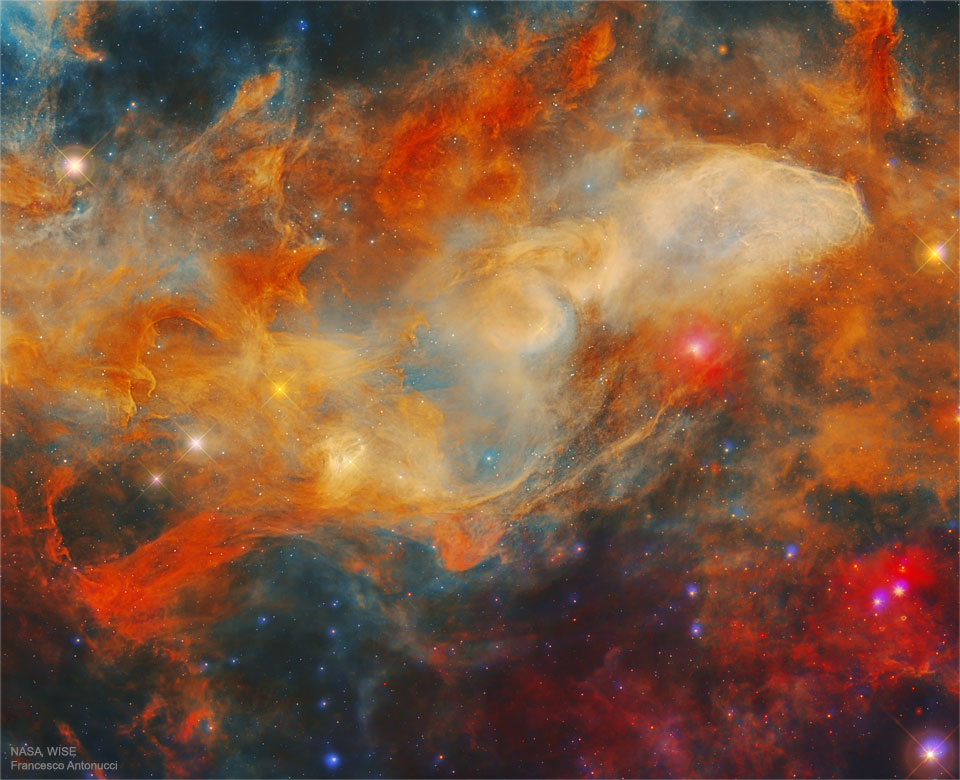
“The Blue Horsehead Nebula in Infrared”. Image Credit: WISE, IRSA, NASA; Processing & Copyright : Francesco Antonucci
Note that processing of an infrared image allows for considerable freedom in how the final rendering appears. In this case, it was rendered with great artistry by Mr. Antonucci.
From the caption:
The Blue Horsehead Nebula looks quite different in infrared light. In visible light, the reflecting dust of the nebula appears blue and shaped like a horse’s head. In infrared light, however, a complex labyrinth of filaments, caverns, and cocoons of glowing dust and gas emerges, making it hard to even identify the equine icon. The featured image of the nebula was created in three infrared colors (R=22, G=12, B=4.6 microns) from data taken by NASA’s orbiting Wide Field Infrared Survey Explorer (WISE) spacecraft. The nebula is cataloged as IC 4592 and spans about 40 light years, lying about 400 light years away toward the constellation Scorpius along the plane of our Milky Way Galaxy. IC 4592 is fainter but covers an angularly greater region than the better known Horsehead Nebula of Orion. The star that predominantly illuminates and heats the dust is Nu Scorpii, visible as the yellow star left of center.
‘Even if you’re a tough person you can’t avoid becoming a child again…’
In this video composed of time-lapse imagery recorded from the International Space Station, four veteran astronauts – Helen Sharman, Michael Barratt, Jean-François Clervoy and Daniel Tani – describe the singular, life-changing experience of looking down at Earth. In providing context for these images of our planet (the station orbits Earth every 92 minutes, for instance) and trying to find words for the profound sense of wonder that has come to be known as ‘the overview effect’, the astronauts strive valiantly to share their rarified perspective, giving us just a glimmer of an experience that many people think is just around the corner for a much greater number of us.
** An intro to how NASA can help researchers get their experiments to the ISS and to communicate what they are doing to other researchers and the general public: ISS R&T Opportunities | NASA:
Your science is heading to space, now let’s make sure you get the most from it. We have a team of communicators who are ready to take your science and share it with the world, sparking potential collaboration and new opportunities. See how we take the information you provide to feed stories, videos, social media, and other communications efforts across NASA’s highly visible platforms. Your science has a story. Help us share it.
** NASA’s Launch Services Program arranges for the agency’s uncrewed spacecraft to fly on commercial rockets. In this video, Tim Dunn of LSP talks about this week’s TESS launch on a Falcon 9 (see earlier posting) and about other spacecraft launches this year:
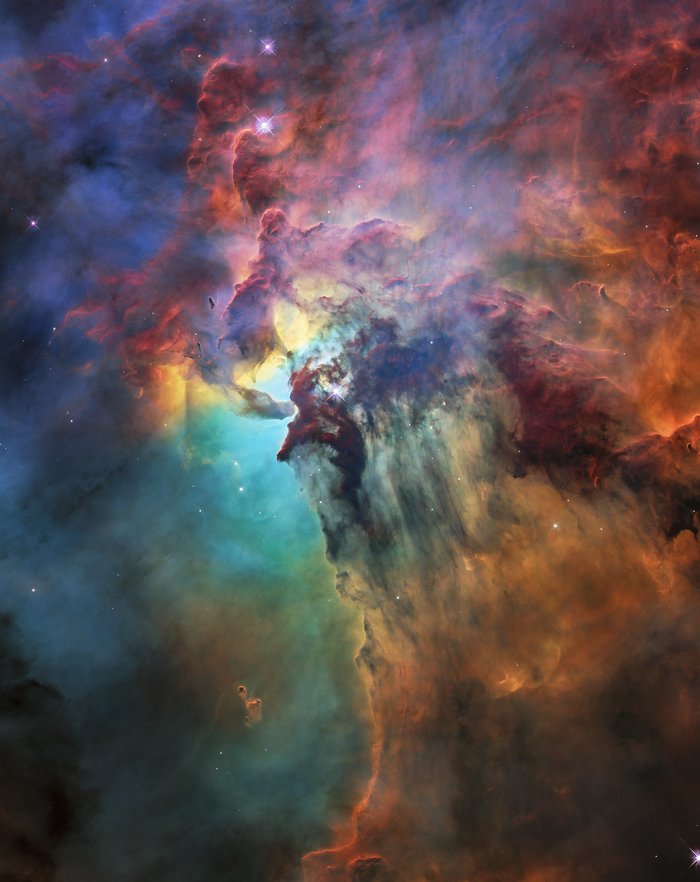
To celebrate its 28th anniversary in space the NASA/ESA Hubble Space Telescope took this amazing and colourful image of the Lagoon Nebula. The whole nebula, about 4000 light-years away, is an incredible 55 light-years wide and 20 light-years tall. This image shows only a small part of this turbulent star-formation region, about four light-years across. This stunning nebula was first catalogued in 1654 by the Italian astronomer Giovanni Battista Hodierna, who sought to record nebulous objects in the night sky so they would not be mistaken for comets. Since Hodierna’s observations, the Lagoon Nebula has been photographed and analysed by many telescopes and astronomers all over the world. The observations were taken by Hubble’s Wide Field Camera 3 between 12 February and 18 February 2018. [Larger versions]
This colourful cloud of glowing interstellar gas is just a tiny part of the Lagoon Nebula, a vast stellar nursery. This nebula is a region full of intense activity, with fierce winds from hot stars, swirling chimneys of gas, and energetic star formation all embedded within a hazy labyrinth of gas and dust. Hubble used both its optical and infrared instruments to study the nebula, which was observed to celebrate Hubble’s 28th anniversary.
Since its launch on 24 April 1990, the NASA/ESA Hubble Space Telescope has revolutionised almost every area of observational astronomy. It has offered a new view of the Universe and has reached and surpassed all expectations for a remarkable 28 years. To celebrate Hubble’s legacy and the long international partnership that makes it possible, each year ESA and NASA celebrate the telescope’s birthday with a spectacular new image. This year’s anniversary image features an object that has already been observed several times in the past: the Lagoon Nebula.
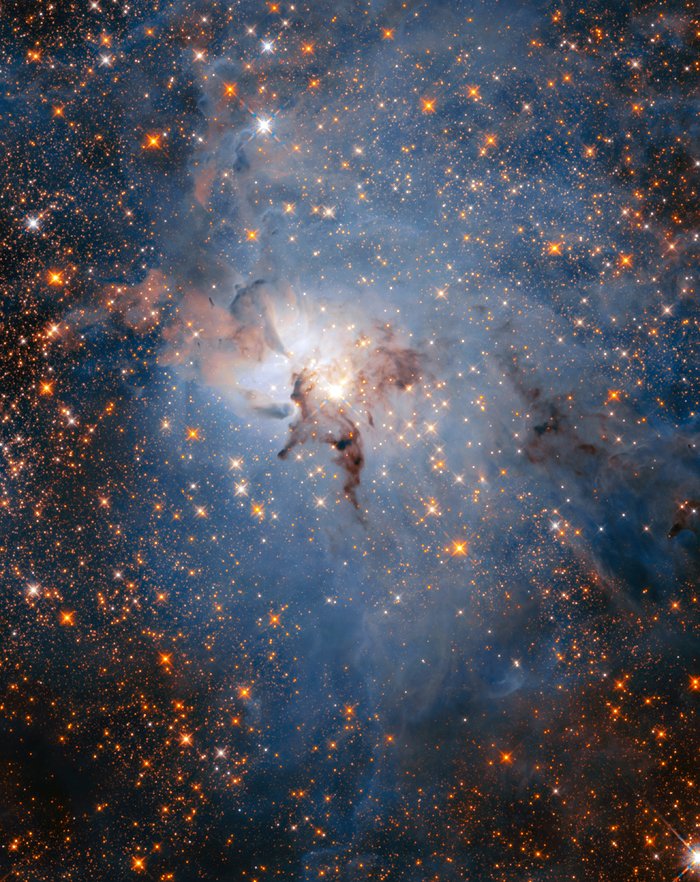
To celebrate its 28th anniversary in space the NASA/ESA Hubble Space Telescope took this amazing and colourful image of the Lagoon Nebula. Using its infrared capabilities, the telescope was able to peer through the thick clouds of dust and gas. The most obvious difference between Hubble’s infrared and visible images of this region is the abundance of stars that fill the field of view in the infrared. Most of them are more distant, background stars located behind the nebula. However, some of them are young stars within the Lagoon Nebula itself. [Larger images]The Lagoon Nebula is a colossal object 55 light-year wide and 20 light-years tall. Even though it is about 4000 light-years away from Earth, it is three times larger in the sky than the full Moon. It is even visible to the naked eye in clear, dark skies. Since it is relatively huge on the night sky, Hubble is only able to capture a small fraction of the total nebula. This image is only about four light-years across, but it shows stunning details.
The inspiration for this nebula’s name may not be immediately obvious in this image. It becomes clearer only in a wider field of view, when the broad, lagoon-shaped dust lane that crosses the glowing gas of the nebula can be made out. This new image, however, depicts a scene at the very heart of the nebula.
Like many stellar nurseries, the nebula boasts many large, hot stars. Their ultraviolet radiation ionises the surrounding gas, causing it to shine brightly and sculpting it into ghostly and other-worldly shapes. The bright star embedded in dark clouds at the centre of the image is Herschel 36. Its radiation sculpts the surrounding cloud by blowing some of the gas away, creating dense and less dense regions.
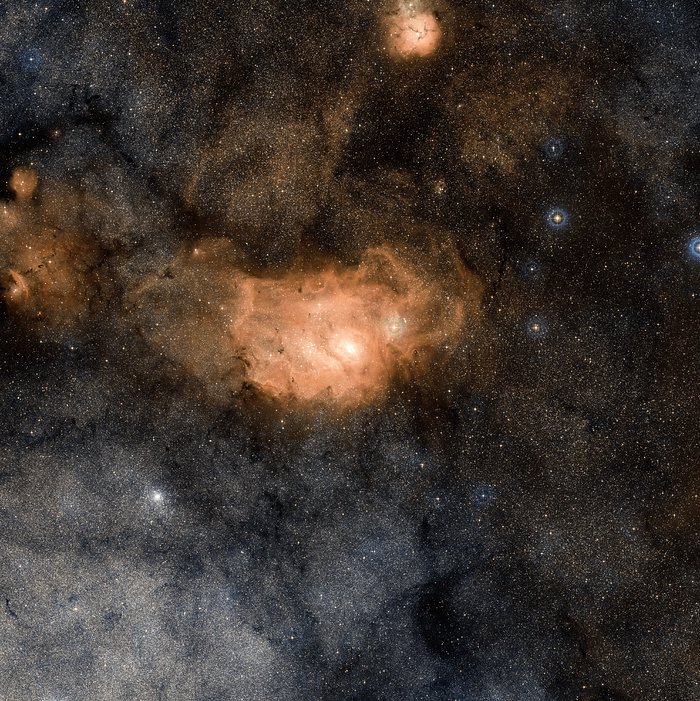
This image from the Digitized Sky Survey shows the area around the Lagoon Nebula, otherwise known as Messier 8. This nebula is filled with intense winds from hot stars, churning funnels of gas, and energetic star formation, all embedded within an intricate haze of gas and pitch-dark dust. [ Larger images ]Among the sculptures created by Herschel 36 are two interstellar twisters — eerie, rope-like structures that each measure half a light-year in length. These features are quite similar to their namesakes on Earth — they are thought to be wrapped into their funnel-like shapes by temperature differences between the hot surfaces and cold interiors of the clouds. At some point in the future, these clouds will collapse under their own weight and give birth to a new generation of stars.
Hubble observed the Lagoon Nebula not only in visible light but also at infrared wavelengths. While the observations in the optical allow astronomers to study the gas in full detail, the infrared light cuts through the obscuring patches of dust and gas, revealing the more intricate structures underneath and the young stars hiding within it. Only by combining optical and infrared data can astronomers paint a complete picture of the ongoing processes in the nebula.