This week’s episode of NASA’s Space to Ground report on activities related to the International Space Station:
====
This week’s episode of NASA’s Space to Ground report on activities related to the International Space Station:
====
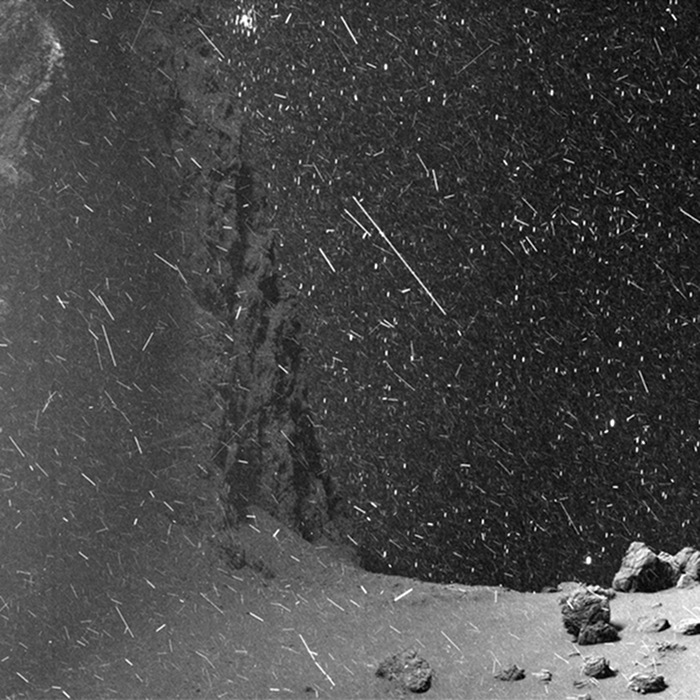
In 2014 the European Space Agency’s Rosetta probe went into orbit around Comet 67P/Churyumov–Gerasimenko and spent a couple of years studying it. Jacint Roger Perez combined a series of 33 images made during a 25 minute period as the probe flew about 13 kilometers from the comet and the resulting time lapse creates the dramatic scene below:
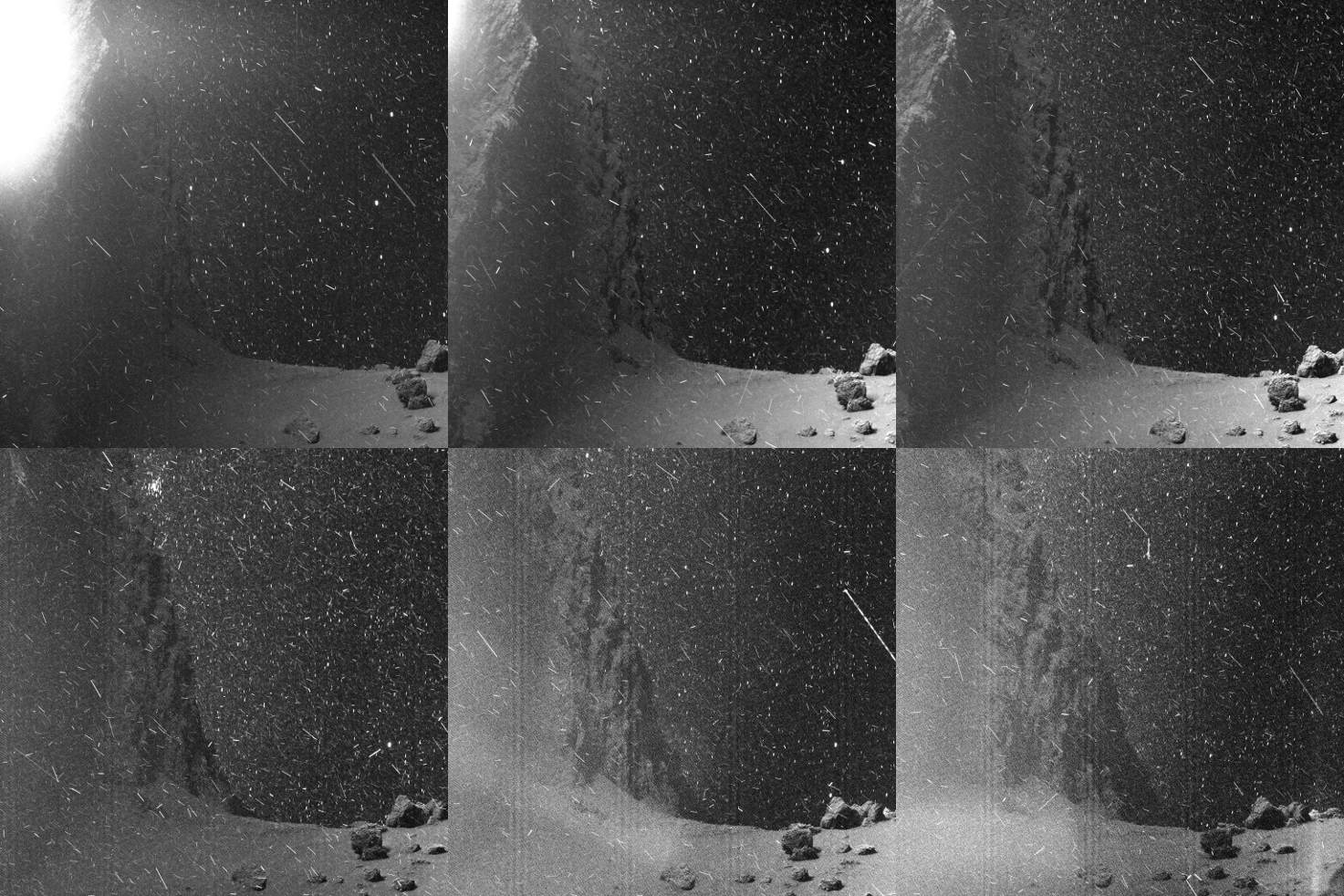
Although it looks like a blizzard, the white dots and streaks are a mix of stars in the dark background plus dust and ice particles, as well as radiation going through the imager. The comet’s surface at the time was stirred up from the heat of the sun.
More about the animation and the Rossetta mission:
====
The latest report from ESO (European Southern Observatory);
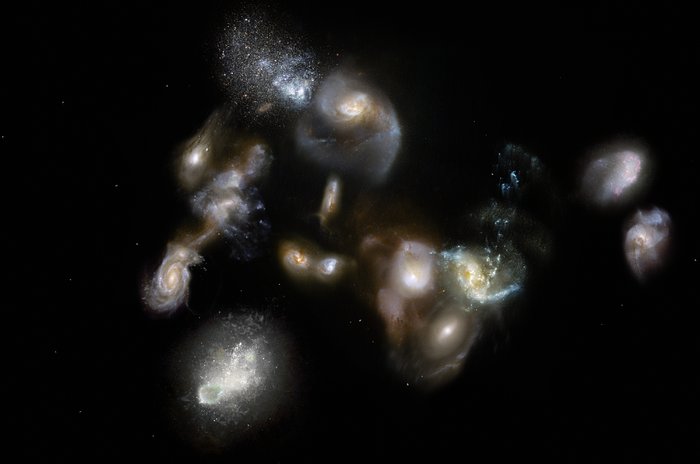
The ALMA and APEX telescopes have peered deep into space — back to the time when the Universe was one tenth of its current age — and witnessed the beginnings of gargantuan cosmic pileups: the impending collisions of young, starburst galaxies. Astronomers thought that these events occurred around three billion years after the Big Bang, so they were surprised when the new observations revealed them happening when the Universe was only half that age! These ancient systems of galaxies are thought to be building the most massive structures in the known Universe: galaxy clusters.
Using the Atacama Large Millimeter/submillimeter Array (ALMA) and the Atacama Pathfinder Experiment (APEX), two international teams of scientists led by Tim Miller from Dalhousie University in Canada and Yale University in the US and Iván Oteo from the University of Edinburgh, United Kingdom, have uncovered startlingly dense concentrations of galaxies that are poised to merge, forming the cores of what will eventually become colossal galaxy clusters.
Peering 90% of the way across the observable Universe, the Miller team observed a galaxy protocluster named SPT2349-56. The light from this object began travelling to us when the Universe was about a tenth of its current age.
The individual galaxies in this dense cosmic pileup are starburst galaxies and the concentration of vigorous star formation in such a compact region makes this by far the most active region ever observed in the young Universe. Thousands of stars are born there every year, compared to just one in our own Milky Way.
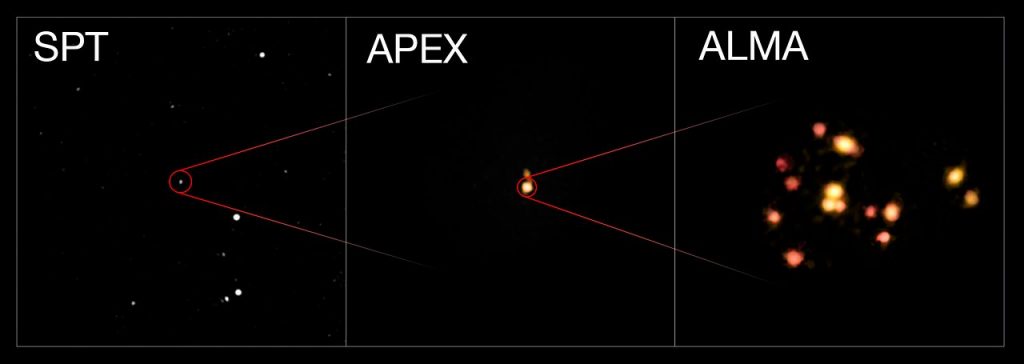
The Oteo team discovered a similar megamerger formed by ten dusty star-forming galaxies, nicknamed a “dusty red core” because of its very red colour, by combining observations from ALMA and the APEX.
Iván Oteo explains why these objects are unexpected:
“The lifetime of dusty starbursts is thought to be relatively short, because they consume their gas at an extraordinary rate. At any time, in any corner of the Universe, these galaxies are usually in the minority. So, finding numerous dusty starbursts shining at the same time like this is very puzzling, and something that we still need to understand.”
These forming galaxy clusters were first spotted as faint smudges of light, using the South Pole Telescope and the Herschel Space Observatory. Subsequent ALMA and APEX observations showed that they had unusual structure and confirmed that their light originated much earlier than expected — only 1.5 billion years after the Big Bang.
The new high-resolution ALMA observations finally revealed that the two faint glows are not single objects, but are actually composed of fourteen and ten individual massive galaxies respectively, each within a radius comparable to the distance between the Milky Way and the neighbouring Magellanic Clouds.
“These discoveries by ALMA are only the tip of the iceberg. Additional observations with the APEX telescope show that the real number of star-forming galaxies is likely even three times higher. Ongoing observations with the MUSE instrument on ESO’s VLT are also identifying additional galaxies,”
comments Carlos De Breuck, ESO astronomer.
Current theoretical and computer models suggest that protoclusters as massive as these should have taken much longer to evolve. By using data from ALMA, with its superior resolution and sensitivity, as input to sophisticated computer simulations, the researchers are able to study cluster formation less than 1.5 billion years after the Big Bang.
“How this assembly of galaxies got so big so fast is a mystery. It wasn’t built up gradually over billions of years, as astronomers might expect. This discovery provides a great opportunity to study how massive galaxies came together to build enormous galaxy clusters,”
says Tim Miller, a PhD candidate at Yale University and lead author of one of the papers.
====
Universe Today hosts the latest Carnival of Space.
The Mars Generation is sponsoring a competition and activities event for students and educators called Train Like A Martian Challenge:
Join Us For Our 3rd Annual #TrainLikeAMartian Challenge
May 14-18, 2018
Sign up now and join us for our third annual #TrainLikeAMartian event! We expect that the event will be a blast! Anyone can join including individuals, students, teachers, schools, sports teams, community organizations and anyone who wants to get involved. For educator resources to plan for the event please click here.
What is the #TrainLikeAMartian challenge? The #TrainLikeAMartian Challenge is a week of fun activities that brings awareness to the importance of science, technology, engineering, arts, and math (STEAM) education, space exploration, and physical fitness to students and adults around the world! This is a chance to have fun, spread an important message, and have a opportunity to win some cool space and STEM prizes May 14-18, 2018!
Daily prizes include: TMG magnets, TMG logo patches, TMG stickers, Astronaut Abby patches, TMG coloring books and more! We will hold multiple random drawings of all entries each day of the event May 14-May 18, 2018.
Grand prizes include:
Arckit A180 The Architectural Model Design Tool (4 lucky winners) $170.00 Value: The Arckit 180 provides everything you need to design and build your own impressive model structures up to 180 sq.m (1,937 sq.ft) to scale, including adhesive sheets to add realistic building finishes. There are no set instructions – just follow your imagination!
Lottie Doll Supreme Play Package (1 lucky winner): 1 Star Gazer doll,1 Muddy Puddles doll, and 1 Wildlife Photography doll, 1 Doll Treehouse, and 1 Astro Adventure Suit.
1 Lottie Doll of Winner’s Choice plus 1 Astro Adventure Suit (3 lucky winners)
Grand prize drawing will be after the event. Winners will be chosen by random drawing of all entries throughout the event.
Constellation Community Challenge: Our event sponsors: United Launch Services (ULA), Lottie Dolls, Arckit, Indulge Sweets, Aerojet Rocketdyne and Classform.com have joined forces to offer a $10,000 matching challenge grant to our community. Please help us earn this $10,000 challenge grant by becoming part of our constellation community by donating today! Every donation up to $10,000 is matched 100%! Donate now here!
All donations through May 18, 2018 will be doubled up to $10,000! Click here for details.
This means we have the potential to raise $20,000 for The Mars Generation programs including sending students who lack financial resources to Space Camp! Donating is not required to participate in the challenge, but for every $25 donated you will receive on entry into the daily and grand prize drawings. Click here to donate.
Want to earn special rewards? Become a fundraiser for The Mars Generation Train Like A Martian challenge for a chance to earn exclusive rewards. Scroll to the bottom fo the page for all fundraising rewards. Fundraising is not required to participate in the challenge.
====
Continue to the Train Like A Martian Challenge website for more details about the competition including how to enter…
See also Train Like A Martian Challenge For Classrooms and Schools.