ESO: VLT captures first confirmed image of a planet forming

A new report from ESO (European Southern Observatory):

First Confirmed Image of Newborn Planet Caught with ESO’s VLT
Spectrum reveals cloudy atmosphere
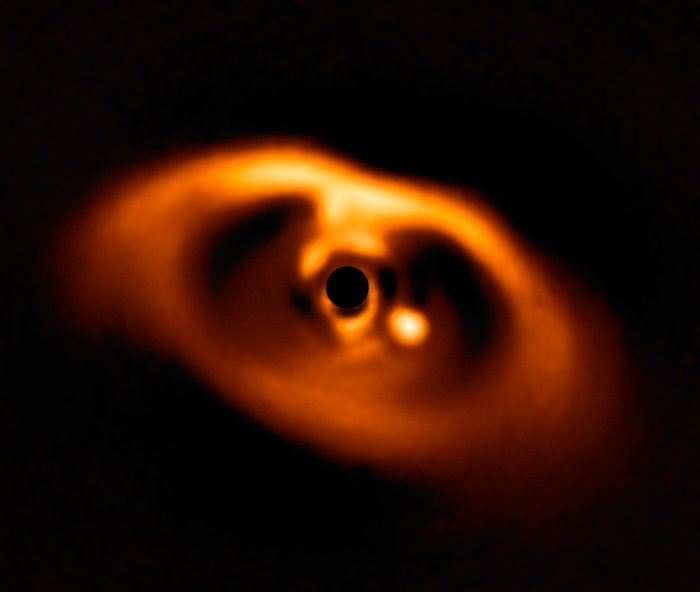
This spectacular image from the SPHERE instrument on ESO’s Very Large Telescope is the first clear image of a planet caught in the very act of formation around the dwarf star PDS 70. The planet stands clearly out, visible as a bright point to the right of the centre of the image, which is blacked out by the coronagraph mask used to block the blinding light of the central star. [Higher-res images]
SPHERE, a planet-hunting instrument on ESO’s Very Large Telescope, has captured the first confirmed image of a planet caught in the act of forming in the dusty disc surrounding a young star. The young planet is carving a path through the primordial disc of gas and dust around the very young star PDS 70. The data suggest that the planet’s atmosphere is cloudy.

Astronomers led by a group at the Max Planck Institute for Astronomy in Heidelberg, Germany have captured a spectacular snapshot of planetary formation around the young dwarf star PDS 70. By using the SPHERE instrument on ESO’s Very Large Telescope (VLT) — one of the most powerful planet-hunting instruments in existence — the international team has made the first robust detection of a young planet, named PDS 70b, cleaving a path through the planet-forming material surrounding the young star [1].

The SPHERE instrument also enabled the team to measure the brightness of the planet at different wavelengths, which allowed properties of its atmosphere to be deduced.

The planet stands out very clearly in the new observations, visible as a bright point to the right of the blackened centre of the image. It is located roughly three billion kilometres from the central star, roughly equivalent to the distance between Uranus and the Sun. The analysis shows that PDS 70b is a giant gas planet with a mass a few times that of Jupiter. The planet’s surface has a temperature of around 1000°C, making it much hotter than any planet in our own Solar System.
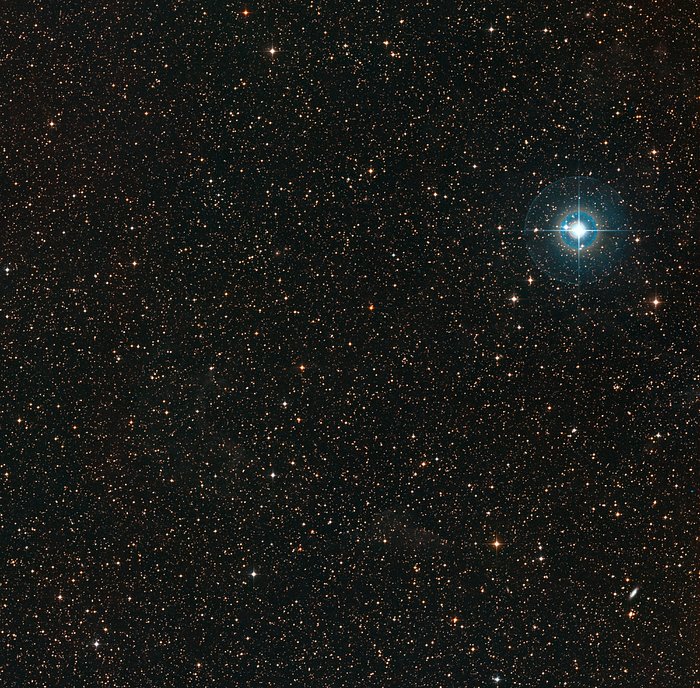
This colourful image shows the sky around the faint orange dwarf star PDS 70 (in the middle of the image). The bright blue star to the right is χ Centauri. [Larger images]
The dark region at the centre of the image is due to a coronagraph, a mask which blocks the blinding light of the central star and allows astronomers to detect its much fainter disc and planetary companion. Without this mask, the faint light from the planet would be utterly overwhelmed by the intense brightness of PDS 70.

“These discs around young stars are the birthplaces of planets, but so far only a handful of observations have detected hints of baby planets in them,” explains Miriam Keppler, who lead the team behind the discovery of PDS 70’s still-forming planet. “The problem is that until now, most of these planet candidates could just have been features in the disc.”

The discovery of PDS 70’s young companion is an exciting scientific result that has already merited further investigation. A second team, involving many of the same astronomers as the discovery team, including Keppler, has in the past months followed up the initial observations to investigate PDS 70’s fledgling planetary companion in more detail. They not only made the spectacularly clear image of the planet shown here, but were even able to obtain a spectrum of the planet. Analysis of this spectrum indicated that its atmosphere is cloudy.

PDS 70’s planetary companion has sculpted a transition disc — a protoplanetary disc with a giant “hole” in the centre. These inner gaps have been known about for decades and it has been speculated that they were produced by disc-planet interaction. Now we can see the planet for the first time.

“Keppler’s results give us a new window onto the complex and poorly-understood early stages of planetary evolution,” comments André Müller, leader of the second team to investigate the young planet. “We needed to observe a planet in a young star’s disc to really understand the processes behind planet formation.”

By determining the planet’s atmospheric and physical properties, the astronomers are able to test theoretical models of planet formation.

This glimpse of the dust-shrouded birth of a planet was only possible thanks to the impressive technological capabilities of ESO’s SPHERE instrument, which studies exoplanets and discs around nearby stars using a technique known as high-contrast imaging — a challenging feat. Even when blocking the light from a star with a coronagraph, SPHERE still has to use cleverly devised observing strategies and data processing techniques to filter out the signal of the faint planetary companions around bright young stars [2] at multiple wavelengths and epochs.

Thomas Henning, director at the Max Planck Institute for Astronomy and leader of the teams, summarises the scientific adventure:

“After more than a decade of enormous efforts to build this high-tech machine, now SPHERE enables us to reap the harvest with the discovery of baby planets!”

Notes
[1] The disc and planet images and the planet’s spectrum have been captured in the course of the two survey programmes called SHINE (SpHere INfrared survey for Exoplanets) and DISK (sphere survey for circumstellar DISK). SHINE aims to image 600 young nearby stars in the near-infrared using SPHERE’s high contrast and high angular resolution to discover and characterise new exoplanets and planetary systems. DISK explores known, young planetary systems and their circumstellar discs to study the initial conditions of planetary formation and the evolution of planetary architectures.

[2] In order to tease out the weak signal of the planet next to the bright star, astronomers use a sophisticated method that benefits from the Earth’s rotation. In this observing mode, SPHERE continuously takes images of the star over a period of several hours, while keeping the instrument as stable as possible. As a consequence, the planet appears to slowly rotate, changing its location on the image with respect to the stellar halo. Using elaborate numerical algorithms, the individual images are then combined in such a way that all parts of the image that appear not to move during the observation, such as the signal from the star itself, are filtered. This leaves only those that do apparently move — making the planet visible.

====
 

Videos: Night sky highlights for July 2018

A preview of the night sky in July from NASA JPL: What’s Up for July 2018 – YouTube

And from the Hubble Space Telescope Institute:

=====


Audio: Recent space podcasts – SpaceX, Freeman Dyson, wormholes, Martian dust storms, and more

Here is a selection of recent space related audio webcasts starting with Bob Zimmerman on the John Batchelor radio show. Be sure to support Bob with his annual fund-raising campaign now underway.

Check out Bob’s periodic updates on what is happening with the Mars rovers and with the Sun, e.g.

** Mat Kaplan of the Planetary Society’s radio program recently had a fascinating interview with Freeman Dyson, a theoretical physicist, mathematician and all around deep thinker: A Conversation with Freeman Dyson | The Planetary Society

** University of Washington physics professor emeritus Dr. John Cramer talked with David Livingston this week about interstellar propulsion schemes, wormholes for getting around the universe, connecting quantum mechanics and general relativity, and many other fun topics in a manner that a non-scientist can follow: The Space Show – Mon, 06/25/2018 – 14:00

** Dr. Anita Sengupta is an aerospace engineer who led many projects at NASA JPL, including the Cold Atom Laboratory on the ISS, and is now working on development of a Hyperloop transport system. She spoke with David on Friday : The Space Show – Fri, 06/29/2018 – 09:00 

** The latest episode of the Talking Space Podcast covered several topics including Opportunity rover enduring the massive dust storm on Mars, the SpaceX CRS-15 cargo mission to the ISS, and recent launches by China, Japan, and Russa : Episode 1005: #SaveOppy?

** More about the dust-up on Mars at the WeMartians program: 44 – Ashes to Ashes, Clay to Dust (feat. Mark Lemmon) – WeMartians Podcast

There’s a serious Global Dust Storm happening right now on Mars. Several regional storms have kicked up a tremendous amount of dust into the skies, blocking out the sun and jeopardizing the Opportunity rover’s safety. But despite the threat, this is a great chance to do some science on Mars weather. Jake is joined by Space Science Institute’s Mark Lemmon to discuss these storms formation and what we’re learning from them.

** Anthony Colangelo discusses the implications of SpaceX winning a major USAF launch contract for the Falcon Heavy rocket: Episode T+86: Falcon Heavy Wins AFSPC-52 – Main Engine Cut Off

====


Videos: “Space to Ground” ISS report + SpaceX Falcon 9 launches a Dragon to the ISS

Here is the latest Space to Ground report from NASA about activities related to the International Space Station:

These videos show more highlights of this morning’s SpaceX launch of a Cargo Dragon to the ISS on a Falcon 9 rocket:

A brief overview of science and technology payloads going to the ISS on the Dragon:

And a longer briefing held on Thursday about the science/tech payloads:

====


Asteroid Day to include live webcast from Luxembourg + Hayabusa2 arrives at asteroid Ryugu

Asteroid Day is this Saturday, June 30th. See the earlier posting here about this global campaign to raise awareness of the threat of asteroid impacts. Check if one of the many events planned for Asteroid day around the world is near where you live. See also updates at Asteroid Day ☄ (@AsteroidDay) | Twitter.

Here are some additional items relevant to the campaign:

** There will be a 48 hour live webcast sponsored by the European Space Agency: Asteroid Day live from Luxembourg – ESA

The world’s first 48-hour webcast about asteroids and their place in space will begin at 12:00 CEST, on Friday, 29 June 2018. Kicking off this exciting event, physicist, science advocate and former rock star Brian Cox will host the first 6-hour segment live from Luxembourg.

Brian will be joined by asteroid scientists, astronauts, rock stars and experts from around the world all in the name of Asteroid Day – the annual UN-endorsed global campaign to raise awareness about asteroids, and the risks and opportunities that they bring.

Asteroid Day takes place each year on 30 June, commemorating the 1908 Tunguska airburst over Siberia, the biggest impact event in recorded history. Since its inception, ESA has long supported the Asteroid Day initiative and plays a leading role in the global hunt for risky near-Earth objects that might one day cross our path.

** This week’s episode of the Planetary Society‘s radio program was devoted to asteroids: It’s Asteroid Week with NASA’s Planetary Defense Officer | The Planetary Society

** The Society has also opened a Kickstarter campaign called Kick Asteroid! 

The Planetary Society is excited to partner with space artist and designer, Thomas Romer, and backers around the world to create Kick Asteroid—a colorful graphic poster that will illustrate the effect of past catastrophic impacts, and methods to deflect future asteroid threats. Compelling and scientifically accurate art will be created for posters and other “merch” that backers can use in their everyday lives to spread the word about planetary defense. 

Asteroid and comet impacts, while not common, are very real threats. By backing this project, you can help spread the word about asteroid defense. You will be doing your part to protect the people of Earth from a devastating impact.

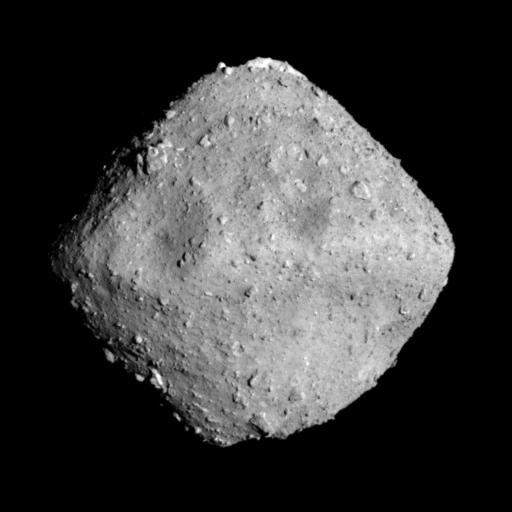
** Appropriately enough, the Japanese space agency’s Hayabusa2 probe arrived this week at the asteroid Ryugu after a three and a half year voyage from earth: Hayabusa2 Rendezvous with Ryugu – JAXA

On June 27, 2018, JAXA operated Hayabusa2 chemical propulsion thrusters for the spacecraft’s orbit control.*

The confirmation of the Hayabusa2 rendezvous made at 9:35 a.m. (Japan Standard Time, JST) is based on the following data analyses;

  • ・The thruster operation of Hayabusa2 occurred nominally
  • ・The distance between Hayabusa2 and Ryugu is approximately 20 kilometers
  • ・Hayabusa2 is able to maintain a constant distance to asteroid Ryugu
  • ・The status of Hayabusa2 is normal

The probe will spend a year and half studying the diamond shaped asteroid and four small landers will be deployed onto the surface. In addition, the probe will grab a sample of the surface and return it to earth in December 2020.

A comparison of Ryugu to other asteroids visited by space probes: Hayabusa2 arrived at Ryugu, so I can make comparisons of asteroid scales! | The Planetary Society.

====


Everyone can participate in space