[ Update 2: The Stratos III lifted off on Wednesday evening but disintegrated after 20 seconds into the flight.: Stratos III Failure | DARE
Last night, we launched our Stratos III rocket attempting to break the European altitude record. The procedures took all night and finally around 3:30 in the morning the rocket lifted off successfully. Then, 20 seconds into the flight the rocket disintegrated. The pieces landed in the ocean within the safety zone. Together with INTA (Instituto Nacional de Técnica Aeroespacial), the operator of the launch base, we’re now investigating the anomaly and the cause of the failure.
Unfortunately, we have cancelled the launch window for today. Although the weather was suitable for launch in the early afternoon, the weather balloon data obtained in the evening showed winds at higher altitudes are much stronger than predicted. This led to margins on wind becoming smaller than expected, making a launch today not possible.
As we abort the launch relatively early in the evening (T-2:50 hours), the crew still has sufficient time for a good sleep. This way we can ensure Stratos III is fully ready for the new attempt scheduled tomorrow, the 25th of July. Thanks a lot for all the enthusiastic and inspiring comments on social media. Lets all take a good night sleep and prepare for breaking boundaries tomorrow!
]
The Dutch university student rocket team DARE today is streaming video of their preparations in southern Spain for an attempt to launch today the Stratos III. They hope the rocket will reach over 30 kilometers in altitude and break the European student altitude record.
The Stratos III rocket, built by students from Delft University of Technology, will fly this week. On Tuesday 24th July starting at 15:00, the student rocketry team called DARE will have their first attempt to launch their rocket into the upper layers of the atmosphere. In addition to that, they want to break the European altitude record for a student built rocket, which currently stands at 32.3km. All parts, including the motor of the rocket, were developed by the students. This launch will bring the students one step closer to their ultimate goal: to be the first student team, worldwide, to reach space.
The rocket uses a hybrid motor with a liquid oxidizer and solid fuel. More from the press release:
Delft Aerospace Rocket Engineering, or DARE, is the student rocketry team who has designed, built and will launch the rocket. This society of students was created in 2001 and in the past 17 years, DARE has had multiple big launch attempts; the Stratos I in 2009, reaching an altitude of 12.5km and the Stratos II in 2015, reaching an altitude of 21.5km. Both broke the then-current European altitude record. The record was lost to a German student team in 2016. “There is a new space-race between our team and other student teams from Europe and the United States”, says team member Martin Olde.
Launching from Spain: The launch is planned for 24 July 2018 with back up launch attempts on 25, 26 and 27 July. The launch attempt will take place in the evening, however, delays due to wind, fishing boats or technical problems could delay the attempt.
“In order to safely launch the rocket, an area the size of the province of Friesland needs to be kept free from boats and other forms of traffic. Safety is of utmost importance, but it does make it very exciting”, says team manager Jesse Hummel.
Once Again – Candle Wax and Coffee Sweetener: Stratos III is comparable to its predecessor – the Stratos II from 2015. It is 8 metres long with the largest component being the propulsion system, which was designed by the students themselves. The propellant is the interesting mixture of laughing gas with candle wax, coffee sweetener and aluminum powder. This “rocket fuel” is also self-made by the students and will eventually deliver 2500 kg of force, resulting in the rocket reaching a speed of 3 times the speed of sound, or more than 3600 km/hr. Above the propulsion system, in the nosecone of the rocket, sits a scientific experiment, four cameras and the flight computer. After a flight of just over 10 minutes, the nosecone attached to a parachute will splash down in the sea.
Stratos III will be carrying a payload from the Dutch Aeronautical and Aerospace Centre (NLR). NLR has made a prototype flight computer for the SMILE project, which will be tested during the flight. SMILE is a European project to develop and make a small satellite launcher for Europe. With a great increase in the launching of small satellites, the EU would like to become a big player in this market. The payload will take measurements during the flight with the aim to develop a better flight computer in the future.
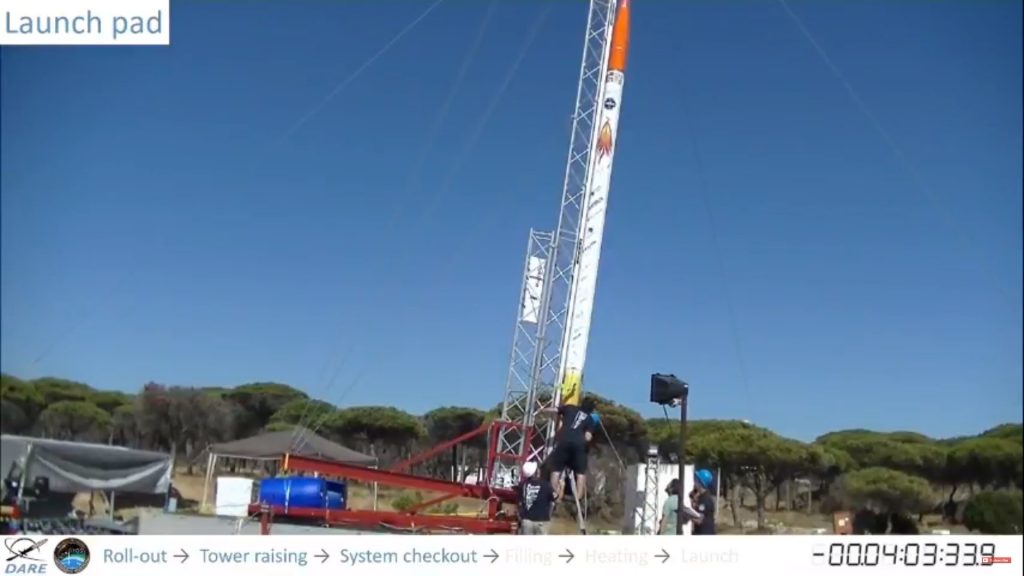
Stratos III on the launch rail at the El Arenosillo launch site in the south of Spain. July 24, 2018.
Meanwhile, the non-profit volunteer Danish organization Copenhagen Suborbitals is preparing for a launch attempt this Saturday of the liquid bi-propellant Nexø II rocket. The rocket will launch from a platform towed out into the Baltic Sea near the coast of the Danish island Bornholm.
All systems are GO – we are currently aiming for launch on July 28th between 8AM and 11AM UTC. Next GO/NOGO is Monday July 23th where we evaluate the weather forecast.
Here is the latest video update:
The organization is following a step-by-step development process towards eventually launching a person on a suborbital rocket across the 100 km border to space.
The Nexø II rocket will be the most advanced rocket build and launched by CS so far. The Nexø rocket class is a technology demonstrator in advance of building the significantly bigger Spica rocket that will take our astronaut to space. Thus, Nexø is an important part of the Spica roadmap and the technology developed and used in the Nexø class will be used in the Spica rocket.
The rocket is their most sophisticated yet:
Just as Nexø I the Nexø II rocket is powered by our own BPM5 engine providing a nominal thrust of 5000 N running on ethanol and liquid oxygen. It has a body diameter of 300 mm, a total length of 6.7 m and a dry weight of about 178 kg. With a target filling ratio of 85% propellants it will carry 114 kg propellants for a Gross Lift-Off Weight (GLOW) of 292 kg.
“Artist’s impression of the Jupiter-size extrasolar planet, HD 189733b, being eclipsed by its parent star. Credits: ESA, NASA, M. Kornmesser (ESA/Hubble), and STScI” – Universe Today
1. Monday, July 23, 2018; 2-3:30 pm PDT (4-5:30 pm CDT, 5-6:30 pm EDT): We welcome back Tory Bruno, CEO of United Launch Alliance (ULA).
2. Tuesday, July 24, 2018: 7-8:30 pm PDT; 9-10:30 pm CDT; 10-11:30 pm EDT: We welcome back John Bucknell with an update on his nuclear propulsion system.
3. Wednesday, July 25, 2018: Hotel Mars. See Upcoming Show Menu and the website newsletter for details. Hotel Mars is pre-recorded by John Batchelor. It is archived on The Space Show site after John posts it on his website.
4. Friday, July 27, 2018; 9:30 AM-11 am PDT, (12:30 -2 pm EDT; 11:30 am -1 pm CDT): We welcome back Dr. Gil Levin with updates regarding his famous Viking Mars Lander life experiment.
5. Sunday, July 29, 2018: 12-1:30 pm PDT; 2-3:30 pm CDT; 3-4:30 pm EDT. WELCOME TO OPEN LINES. First time callers welcome, the topics you want to discuss. All space, STEM, STEAM and science calls welcome.