Satellites image fires, lava flows, and heatwaves in US and Europe

Here is a sampling of satellite images of recent events in the US and Europe:

** Fires in California: US weather satellites view wildfires in California: Geostationary Operational Environmental Satellite (GOES) 16 and 17: Monitoring storm systems and California’s wildfires | WHNT.com

More about satellite imaging of the US West Coast fires from space at NASA Satellite Sees Fires Up and Down U.S. West Coast | NASA.

** Volcano lava flows in Hawaii: NASA satellite captures lava destruction from Kilauea volcano – CNET
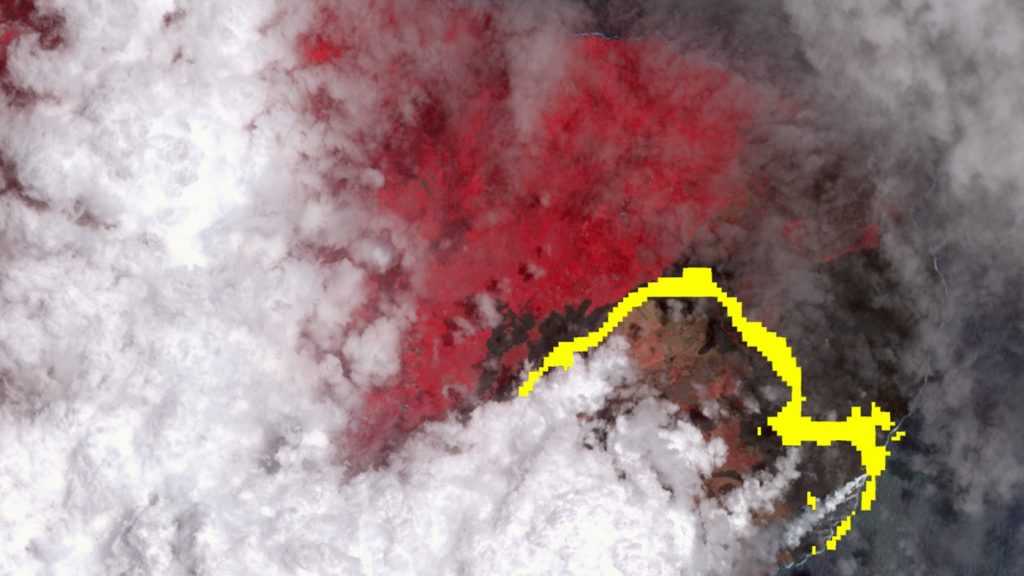
Lava from Hawaii’s Kilauea Volcano flowing to the Pacific Ocean, imaged July 25 by NASA’s Advanced Spaceborne Thermal Emission and Reflection (ASTER) instrument. Vegetation shown in red, clouds in white and lava in yellow. Credit: NASA/METI/AIST/Japan Space Systems/U.S./Japan ASTER Science Team
› Full image and caption

Another image from Satellite View of Kilauea Eruption – NASA JPL:
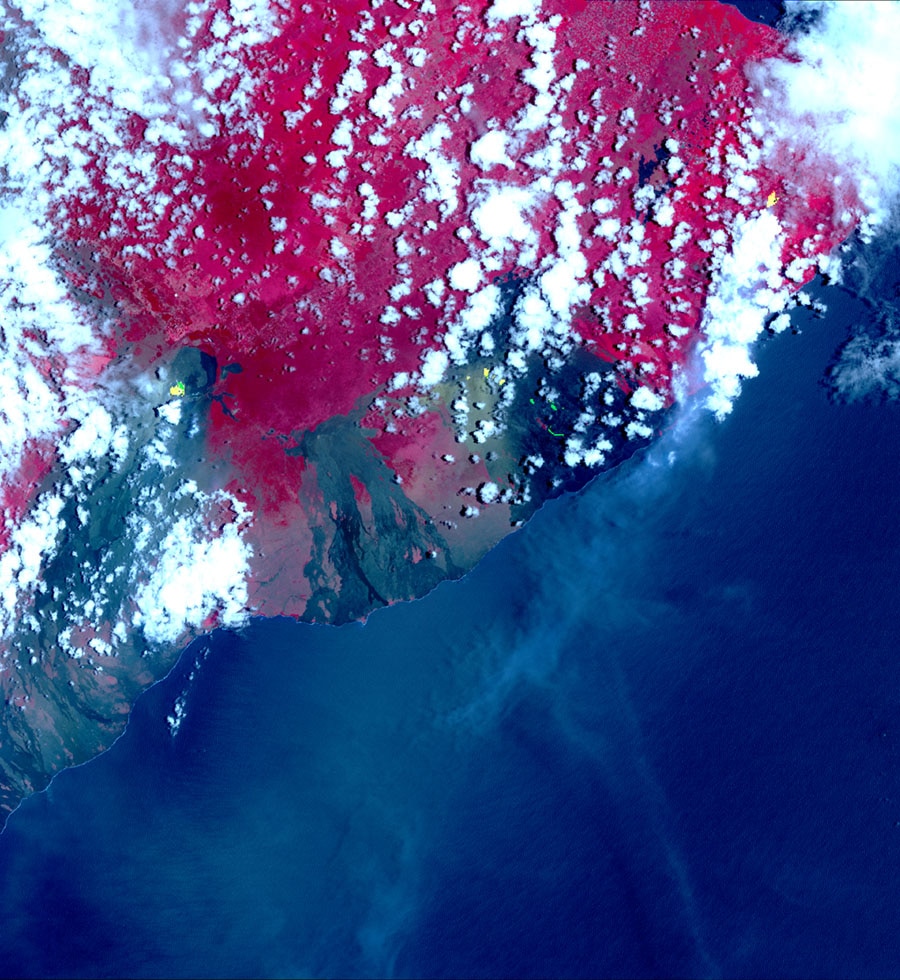
This image from NASA’s Advanced Spaceborne Thermal Emission and Reflection Radiometer (ASTER) instrument on NASA’s Terra spacecraft show recent eruptions of Kilauea volcano on the island of Hawaii (the Big Island). Following days of increased seismic activity, Kilauea erupted May 3, 2018, and triggered a number of additional fissure eruptions along the East Rift Zone. The eruptions and high level of sulfur dioxide gas (SO2) prompted evacuations in the area, including the Leilani Estates subdivision near the town of Pahoa. The ASTER images, acquired on May 6, 2018, show different aspects of the eruption. A color composite depicts vegetation in red, and old lava flows in black and gray. Superimposed on the image in yellow are hotspots detected on the thermal infrared bands. The easternmost hot spots show the newly formed fissures and the lava flow spilling to the northwest. Continue...

** Fires in Greece: DigitalGlobe shows images of the sites in Greece where wildfires hit suddenly.

This article includes side by side views with sliders to compare before and after the fires: Satellite images show the intensity of the flames that devastated coastal Greece — Quartz

** Europe’s summer heatwave:

As this year’s heatwave continues, the Copernicus Sentinel-3 mission reveals once again how the colour of our vegetation has changed in just one month. These two images cover the same area: part of Ireland, the UK, the Netherlands, Belgium, part of Germany and part of France, but the difference between them couldn’t be more striking. The first, captured on 28 June 2018, is predominantly green, depicting healthy vegetation. The second, captured on 25 July 2018, however, is mainly brown, showing just how much the vegetation has changed owing to the long hot dry spell Europe has been enduring over the last weeks.

These two images were captured by Sentinel-3’s ocean and land colour instrument. See also similar captures over Germany, Denmark and Sweden: European drought.

====

The Space Show this week – July.30.2018

The guests and topics of discussion on The Space Show this week:

1. Monday, July 30, 2018; 2-3:30 pm PDT (4-5:30 pm CDT, 5-6:30 pm EDT): We welcome Libby Jackson,  the Human Spaceflight and Microgravity Program Manager for the UK Space Agency and author of Galaxy Girls: 50 Amazing Stories of Women in Space.

2. Tuesday, July 31, 2018: 7-8:30 pm PDT; 9-10:30 pm CDT; 10-11:30 pm EDT: We welcome back Dr. Pat Patterson who will talk with us about the great SmallSat Conference for 2018.

3. Wednesday, August 1, 2018: Hotel Mars. See Upcoming Show Menu and the website newsletter for details. Hotel Mars is pre-recorded by John Batchelor. It is archived on The Space Show site after John posts it on his website.

4. Friday, August 3, 2018; 9:30 am -11 am PDT, (12:30 -2 pm EDT; 11:30 am -1 pm CDT): We welcome back Dr. Thais Russomano,  CEO and Scientific Director of InnovaSpace, which aims “to open up the world of Space and the Space Life Sciences to broaden and enable participation in this unique area, where Space becomes a platform for social, cultural and scientific development”.  She is editor of the new book, Into Space: A Journey of How Humans Adapt and Live in Microgravity.

5. Sunday, August 5, 2018: 12-1:30 pm PDT; 2-3:30 pm CDT; 3-4:30 pm EDT. TBD

See also:
* The Space Show on Vimeo – webinar videos
* The Space Show’s Blog – summaries of interviews.
* The Space Show Classroom Blog – tutorial programs

The Space Show is a project of the One Giant Leap Foundation.

The Space Show - David Livingston
David Livingston


Video trailers: “The First” – Hulu TV series with Sean Penn + “First Man” – Film with Ryan Gosling

The First is a new Hulu original series starring Sean Penn about the first human mission to Mars. It will premier on September 14th. Here is the trailer:

From the caption:

The First is created by Beau Willimon (House of Cards) and stars Sean Penn. Set in the near future (2030), this groundbreaking story explores the challenges of taking the first steps towards Mars. Viewers will get an intimate look at the dedicated characters trying to reach the unknown while dealing with the psychological and physical toll it takes to achieve the impossible.

===

July 20, 2019 will be the 50th anniversary of the first time a human set foot on another celestial body. A start on the coming year of tributes and remembrances will be the movie First Man, starring Ryan Gosling as Neil Armstrong. It is currently set to open on October 12th. Here is a trailer:

From the caption:

On the heels of their six-time Academy Award®-winning smash, La La Land, Oscar®-winning director Damien Chazelle and star Ryan Gosling reteam for Universal Pictures’ First Man, the riveting story of NASA’s mission to land a man on the moon, focusing on Neil Armstrong and the years 1961-1969. A visceral, first-person account, based on the book by James R. Hansen, the movie will explore the sacrifices and the cost—on Armstrong and on the nation—of one of the most dangerous missions in history.

Written by Academy Award® winner Josh Singer (Spotlight), the drama is produced by Wyck Godfrey & Marty Bowen (The Twilight Saga, The Fault in Our Stars) through their Temple Hill Entertainment banner, alongside Chazelle and Gosling. Isaac Klausner (The Fault in Our Stars) executive produces. DreamWorks Pictures co-finances the film.

====


Videos: “Space to Ground” report on the ISS – July.27.2018

Here is this week’s Space to Ground report from NASA on the latest happenings regarding the  International Space Station:

NASA Adminstrator Jim Bridenstine talks with astronauts Joe Acaba and Mark Vande Hei who have lived on the ISS. He included “questions from the agency’s social media followers”:

====


Video: Virgin Galactic VSS Unity rocketplane reaches 52 km on third powered flight

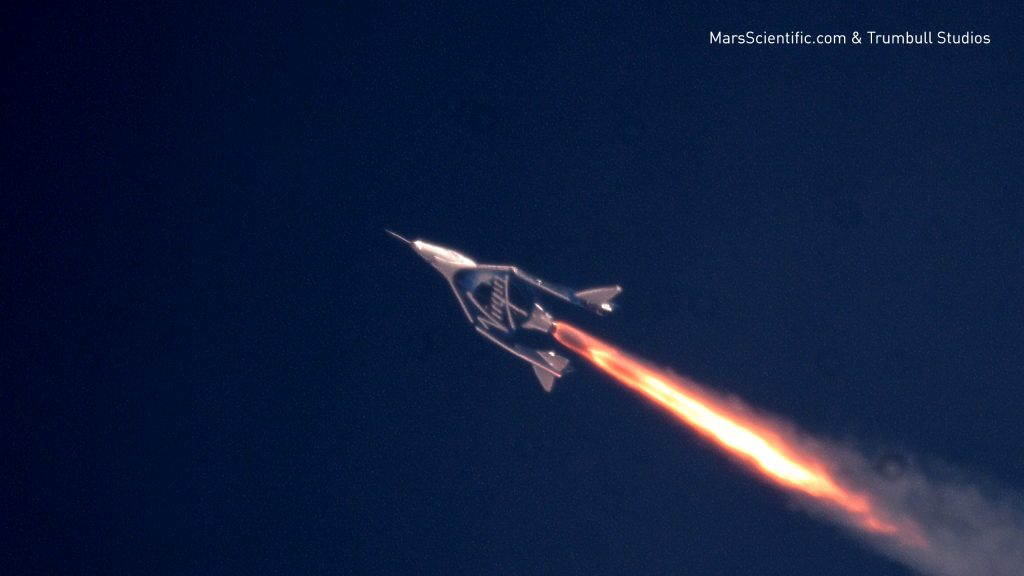
On Thursday, the Virgin Galactic‘s VSS Unity rocketplane reached Mach 2.47 in speed and 52 kilometers in altitude on the vehicle’s third test flight with the hybrid motor firing. This video shows highlights of the test:

If the program continues to make steady progress, the vehicle should cross the border of space this year,  perhaps within two or three more test flights. (Whether VG will define the 100 km Kármán line as the threshold to space or the USAF’s 80 km, has not been clarified yet.) Then sometime in 2019 they could begin taking six paying passengers at a time to space on a regular basis. Currently about 700 people are holding tickets for flights on Virgin Galactic SpaceShipTwo vehicles. The current ticket price is $250,000.

Blue Origin is on roughly the same time schedule with the New Shepard vertically launched system. New Shepard vehicles have reached over 100 km eight times on test flights since 2015 but without anyone on board. Unity, on the other hand, always has two pilots and will carry up to six passengers. The six passengers on a New Shepard will ride without pilots and instead rely on autonomous control.

Virgin Galactic posted the following statement about this week’s test:

Into the Mesosphere at Mach 2.4

Virgin Galactic’s Third Powered Flight on July 26th 2018

Virgin Galactic test pilots broke Mach 2 this morning, as VSS Unity took her third rocket-powered supersonic outing in less than four months. After a clean release from carrier aircraft VMS Eve at 46,500 ft, pilots Dave Mackay and Mike “Sooch” Masucci lit the spaceship’s rocket motor, before pulling up into a near vertical climb and powering towards the black sky at 2.47 times the speed of sound.

The planned 42 seconds rocket burn took pilots and spaceship through the Stratosphere and, at an apogee of 170,800 ft [52 km], into the Mesosphere for the first time. This region, often referred to by scientists as the “Ignorosphere”, is an under-studied atmospheric layer because it is above the range of balloon flight, and in the future is an area we can help the research community explore further.

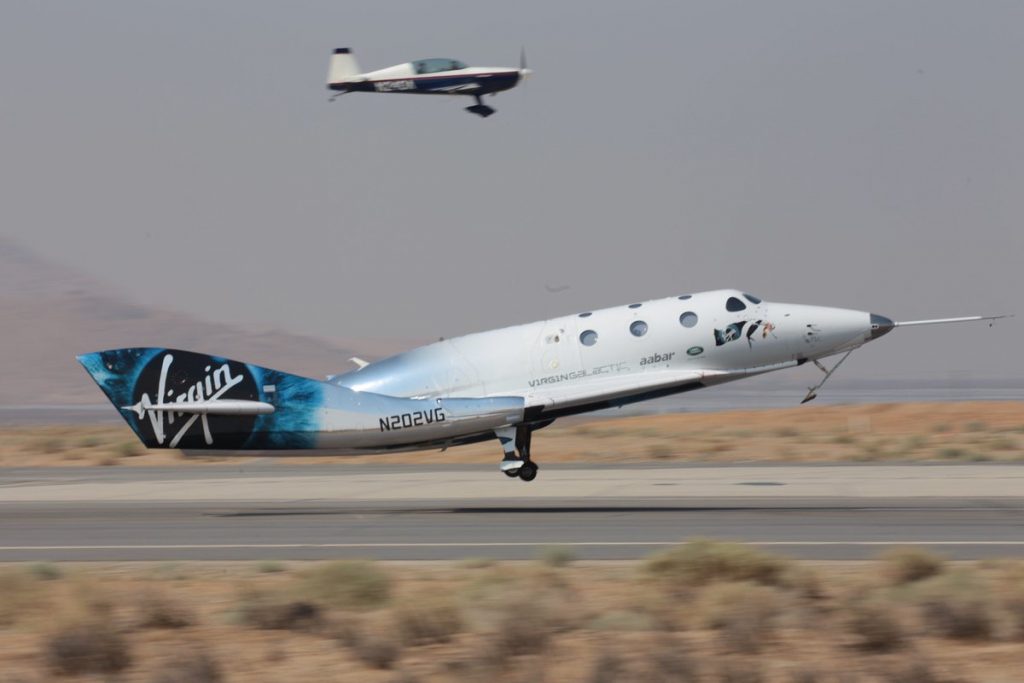
After a safe landing back at Mojave Air and Space Port, Chief Pilot Dave Mackay summed up the experience:

“It was a thrill from start to finish. Unity’s rocket motor performed magnificently again and Sooch pulled off a smooth landing. This was a new altitude record for both of us in the cockpit, not to mention our mannequin in the back, and the views of Earth from the black sky were magnificent.”

Sooch added:

“Having been a U2 pilot and done a lot of high altitude work, or what I thought was high altitude work, the view from 170,000 ft was just totally amazing. The flight was exciting and frankly beautiful. We were able to complete a large number of test points which will give us good insight as we progress to our goal of commercial service.”

Every time VSS Unity is tested on the ground, or in the skies, we gain invaluable experience and fresh data. This continuously improves our modelling and helps us optimise objectives and test points as we progressively expand the flight envelope. Today’s test, among other things, gathered more data on supersonic aerodynamics as well as thermal dynamics.

VSS Unity lands after its third powered flight.

As it has been on previous flights, Unity’s cabin was equipped to gather data vital to the future safety and experience of our astronaut customers. These cabin analysis systems record a host of parameters that are designed to help us further understand the environment inside the cabin during powered flight – temperatures, pressures, humidity, acoustics, thermal response, vibration, acceleration and even radiation.

The carrier aircraft, VMS Eve, was piloted today by Todd Ericson and Kelly Latimer.

Congratulations to everyone at Virgin Galactic and The Spaceship Company today for achieving another significant step towards commercial service. With VSS Unity, VMS Eve and the pilots safely back on the ground, we will now analyze the post-flight data as we plan and prepare for our next flight.

For downloadable assets from today’s flight please visit our Press FTP.

Everyone can participate in space