ESO: ALMA spots red giant engulfing companion star

The latest report from the European Southern Observatory (ESO):

ALMA catches beautiful outcome of stellar fight

This new ALMA image shows the outcome of a stellar fight: a complex and stunning gas environment surrounding the binary HD101584. The colours represent speed, going from blue — gas moving the fastest towards us — to red — gas moving the fastest away from us. Jets, almost along the line of sight, propel the material in blue and red. The stars in the binary are located at the single bright dot at the centre of the ring-like structure shown in green, which is moving with the same velocity as the system as a whole along the line of sight. Astronomers believe this ring has its origin in the material ejected as the lower mass star in the binary spiralled towards its red-giant partner. Click for larger images

Astronomers using the Atacama Large Millimeter/submillimeter Array (ALMA), in which ESO is a partner, have spotted a peculiar gas cloud that resulted from a confrontation between two stars. One star grew so large it engulfed the other which, in turn, spiralled towards its partner provoking it into shedding its outer layers.

Like humans, stars change with age and ultimately die. For the Sun and stars like it, this change will take it through a phase where, having burned all the hydrogen in its core, it swells up into a large and bright red-giant star. Eventually, the dying Sun will lose its outer layers, leaving behind its core: a hot and dense star called a white dwarf.

“The star system HD101584 is special in the sense that this ‘death process’ was terminated prematurely and dramatically as a nearby low-mass companion star was engulfed by the giant,”

said Hans Olofsson of the Chalmers University of Technology, Sweden, who led a recent study, published in Astronomy & Astrophysics, of this intriguing object.

Thanks to new observations with ALMA, complemented by data from the ESO-operated Atacama Pathfinder EXperiment (APEX), Olofsson and his team now know that what happened in the double-star system HD101584 was akin to a stellar fight. As the main star puffed up into a red giant, it grew large enough to swallow its lower-mass partner. In response, the smaller star spiralled in towards the giant’s core but didn’t collide with it. Rather, this manoeuvre triggered the larger star into an outburst, leaving its gas layers dramatically scattered and its core exposed.

The team says the complex structure of the gas in the HD101584 nebula is due to the smaller star’s spiralling towards the red giant, as well as to the jets of gas that formed in this process. As a deadly blow to the already defeated gas layers, these jets blasted through the previously ejected material, forming the rings of gas and the bright bluish and reddish blobs seen in the nebula.

A silver lining of a stellar fight is that it helps astronomers to better understand the final evolution of stars like the Sun.

“Currently, we can describe the death processes common to many Sun-like stars, but we cannot explain why or exactly how they happen. HD101584 gives us important clues to solve this puzzle since it is currently in a short transitional phase between better studied evolutionary stages. With detailed images of the environment of HD101584 we can make the connection between the giant star it was before, and the stellar remnant it will soon become,”

says co-author Sofia Ramstedt from Uppsala University, Sweden.

Co-author Elizabeth Humphreys from ESO in Chile highlighted that ALMA and APEX, located in the country’s Atacama region, were crucial to enabling the team to probe “both the physics and chemistry in action” in the gas cloud. She added:

“This stunning image of the circumstellar environment of HD101584 would not have been possible without the exquisite sensitivity and angular resolution provided by ALMA.”

While current telescopes allow astronomers to study the gas around the binary, the two stars at the centre of the complex nebula are too close together and too far away to be resolved. ESO’s Extremely Large Telescope, under construction in Chile’s Atacama Desert,

“will provide information on the ‘heart’ of the object,”

says Olofsson, allowing astronomers a closer look at the fighting pair.

Links

=== Amazon Ad ===

Imagined Life: A Speculative Scientific Journey among the Exoplanets
in Search of Intelligent Aliens, Ice Creatures, and Supergravity Animals

Student and amateur CubeSat news roundup – Feb.4.2020

A sampling of recent articles, press releases, etc. related to student and amateur CubeSat / SmallSat projects and programs (find previous smallsat roundups here):

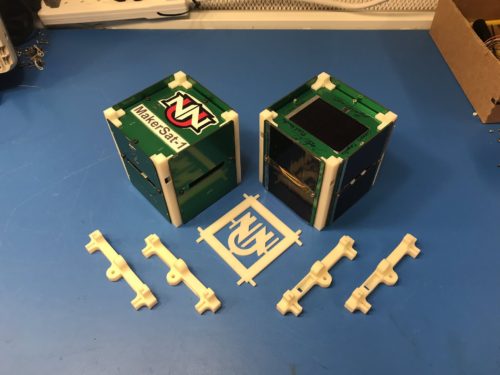
MakerSat-1 components for easy assembly. Credits: and NanoSats.eu

** After ISS departure, Cygnus resupply vehicle releases 14 CubeSats including several built by university groups:

The university satellites include:

A demo of the MakerSat 1 quick assembly:

** AMSAT news on student and amateur CubeSat/smallsat projects: ANS-033 AMSAT News Service Special Bulletin

  • HuskySat-1 Deployed, Telemetry Beacon Active
  • Free Digital Copy of “Getting Started with Amateur Satellites” Now Available for New or Renewing Members
  • Joe Spier, K6WAO, Resigns as AMSAT President
  • Melissa Pore To Be Honored at Hamcation February 2020
  • W1ANT Pro Satellite Tracker Announced
  • AMSAT Argentina Drifting APRS Buoy on 145.825 MHz
  • VUCC Awards-Endorsements for February 2020
  • Upcoming Satellite Operations
  • Upcoming AMSAT Events
  • ARISS News
  • Satellite Shorts from All Over

General CubeSat/SmallSat info:

** Judi Sandrock – Modular Smallsat Teaching Tools with Xinabox – Cold Star Project S02E17

Xinabox co-founder Judi Sandrock from South Africa is on the Cold Star Project with host Jason Kanigan, and we’re talking about their modular smallsat teaching tools.

== Amazon Ad ==

Introduction to CubeSat Technology and Subsystem:
Orbit Design, Debris Impact, and Orbital Decay Prediction

Space policy roundup – Feb.3.2020

A sampling of links to recent space policy, politics, and government (US and international) related space news and resource items that I found of interest (find previous space policy roundups here):

Webcasts:

** Economic Impact of Spaceport America is Announced | Spaceport America

** Space Defense, Military Constellations and Knights, Bishops and Pawns | Kratos

Robert Zitz, National Security Consultant, Robert Zitz & Associates, LLC: During this episode we’ll talk about the increasingly contested space environment and the role small satellite constellations might play in the identification and mitigation of threats to our space assets with Robert Zitz, national security consultant. He has held senior executive positions in the industry as well as multiple leadership roles in Army intelligence, the Central Intelligence Agency, the National Geospatial-Intelligence Agency, among others.

** Sun, 02/02/2020 – Dr. Gilbert Levin and Barry DiGregorio discussed the “Mars life searching project approved and funded by the UK but turned down by NASA, more on Viking and life on Mars possibilities”.

** January 31, 2020 Zimmerman/Batchelor podcast | Behind The Black

==

=== Amazon Ad ===

Alcohol in Space: Past, Present and Future

The Space Show this week – Feb.3.2020

The guests and topics of discussion on The Space Show this week:

1. Monday, Feb. 3, 2020; 7 pm PST (9 pm CST, 10 pm EST): No special programming today.

2. Tuesday, Feb. 4, 2020; 7-8:30 pm PDT (9-10:30 pm CDT, 10-11:30 pm EDT): Bob Zimmerman of Behind the Black returns for news and updates for space.

3. Wednesday, Feb. 5, 2020: Pre-recorded Hotel Mars Program with John Batchelor. See Upcoming Show on The Space Show website for details.

4. Thursday, Feb. 6, 2020; 7-8:30 pm PST (9-10:30 pm CST, 10-11:30 pm EST): No special show today.

5. Friday, Feb. 7, 2020; 9:30-11 am PST (11:30 am-1 pm CST, 12:30-2 pm EST): We welcome back Dr. Paul Davies to talke about his new book, The Demon in the Machine: How Hidden Webs of Information Are Solving the Mystery of Life [Amazon commission link], plus a wide ranging discussion of cosmology and physics .

6. Sunday, Feb. 9, 2020; 12-1:30 pm PST, (3-4:30 pm EST, 2-3:30 pm CST): We welcome back Michael Listner,  Atty, to discuss law as a tool of war as touched on during his last visit to The Space Show.

Some recent shows:

** Sun, 02/02/2020 – Dr. Gilbert Levin and Barry DiGregorio discussed the “Mars life searching project approved and funded by the UK but turned down by NASA, more on Viking and life on Mars possibilities”.

** Thu, 01/30/2020 – Deep Prasad discussed “quantum computers, quantum information, quantum technology, Deep’s SETI research and work based on the Tic Tac events”.

** Hotel Mars/The Space Show combo program – Wed, 01/29/2020 – John Batchelor and David Livingston spoke with Doug Messier about “Boeing problems and culture, CST 100 Starliner, Phantom Express cancellation and more”.

** See also:
* The Space Show Archives
* The Space Show Newsletter
* The Space Show Shop

The Space Show is a project of the One Giant Leap Foundation.

The Space Show - David Livingston
The Space Show – David Livingston

=== Amazon Ad ===

Rise of the Space Age Millennials:
The Space Aspirations of a Rising Generation

Carnival of Space #648 – BrownSpaceman

BrownSpaceman hosts the latest Carnival of Space.

Betelgeuse, a red giant. Image via Universe Today & Carnival of Space

=== Amazon Ad ===

Large and Dangerous Rocket Ships: The History of High-power Rocketry’s Ascent to the Edges of Outer Space

Everyone can participate in space