A sampling of links to recent space policy, politics, and government (US and international) related space news and resource items that I found of interest (find previous space policy roundups here):
** Unleashing the Power of Geospatial Intelligence, Lessons Learned from the Government and Turning… – Constellations Podcast
On this episode of the Constellations podcast we will discuss harnessing the power of geospatial intelligence (GEOINT) by moving beyond data silos and integrating, fusing and analyzing data horizontally to deliver new insights. The podcast reviews GEOINTs historical roots, the evolution today across industries and looks to the future. With more remote sensing satellites, more rapid revisits and global coverage – an enormous volume of data is being created today. There is a daunting challenge in terms of archiving, processing and analyzing all that data and turning it into insights.
As the founder and early adopter of the concept of GEOINT, the government has been on the front lines for over a decade. What lessons can be learned from the government’s efforts that can be applied to today’s new technologies and providers in the commercial sector to maximize the full value of geospatial intelligence? Keith Masback, a leading international authority on geospatial intelligence with over 30 years of experience will shed some light on this topic. Keith is the Owner and Principal Consultant at Plum Run and provides advisory and consulting services to leading-edge companies working in geospatial intelligence and related fields. Prior to founding Plum Run, he spent over a decade as the President / Chief Executive Officer of the United States Geospatial Intelligence Foundation.
** Ralph Dinsley – Moving Space Situational Awareness To Civilian Management – Cold Star Project S02E53
Following a three-and-a-half decade UK defense career culminating in managing RAF Fylingdales and in the role of Aerospace Battle Manager, Ralph “Dinz” Dinsley founded Northern Space and Security (NORSS). In this discussion with Cold Star Project host Jason Kanigan, Dinz lays out the case for moving space situational awareness from military to civilian management. Dinz answers:
– What is “Peace and Development”, the postgraduate studies subject you applied yourself to for your Masters degree? – What exactly is “Aerospace Battle Manager”, the role you held for a dozen years? – What would you describe as the main reason behind the establishment of NORSS? What problems do you solve, and for what organizations? – Is the military dominance coverage of the orbital environment still fit for purpose? Under what domain should space traffic management be? – What is the Space Law Games, which you co-initiated? What do you hope to discover from the exercise? – Where do you find yourself getting pulled into discussions as a well-known individual in the UK defense sector?
** The Space Show – Fri. July 31, 2020 – Scott Herman discussed the BlackSky Global earth satellite imaging company and “Geospatial intelligence and global monitoring, dusk-to-dawn capabilities, LEO Constellation, commercial value, market growth, national security and much more”.
A sampling of recent articles, press releases, etc. related to student and amateur CubeSat / SmallSat projects and programs (find previous smallsat roundups here):
** The annual Smallsat Conference hosted at Utah State University is on line this year due to the Covid-19 virus situation. Registration is free. Though the event is nominally August 1-6, there are dozens of videos of workshop and technical session presentations already on line.
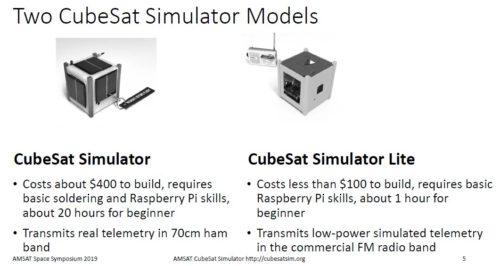
** Villanova University has a new student CubeSat Club. The group is starting out by running a locally developed CubeSat simulator, receiving signals from CubeSats in orbit, designing a test project for a high-altitude balloon flight, and more.
The club’s long-term goal involves a bigger leap: to design, build and launch an actual CubeSat—a 10-by-10-by-10-centimeter, lightweight nanosatellite that can be launched from a rocket, or put into orbit by astronauts on the ISS. But with design, equipment, programming, testing, and launch, CubeSat development can take several years and cost up to $100,000.
For now, club members are taking smaller steps towards their ultimate mission as they gain hands-on experience with satellite technology through a CubeSat simulator developed by faculty adviser Alan Johnston, PhD, associate teaching professor of Electrical and Computer Engineering. The low-cost simulator functions like a real CubeSat, with working solar panels and the capability to send telemetry to an antenna, making it an ideal learning tool.
Monitoring its Lindenblad antenna will keep Villanova’s CubeSat Club busy. First, they will design a payload to be launched into the stratosphere via a high-altitude balloon. If all goes well, the balloon’s telemetry will be detectable from the roof of Tolentine as it sails above Villanova. Also on tap is working with a project called AmbaSat-1: to program, launch and track a credit card-sized “sprite” satellite into low earth orbit.
** Student CubeSat project at the MIT Beaver Works Summer Institute. There are several CubeSat project videos available online. Here is a brief overview of the project that involved designing an system for imaging and tracking ocean plastic debris:
And here is an overview of the design that the students developed:
** AMSAT news on student and amateur CubeSat/smallsat projects:
Welcome to Week 2 of PLIX CubeSats Online! 🛰️ For the second session, we’ll be covering the Satellite Testing & Payload Integration workshop, which covers both satellite testing strategies and the incorporation of a data-collecting tool. Read more about the CubeSats activity on our PLIX Activity Repository: http://bit.ly/PLIX-CubeSats
Here is the latest episode in NASA’s Space to Ground weekly report on activities related to the International Space Station:
** Expedition 63 Demo 2 In flight Crew News Conference – July 31, 2020 – NASA Johnson
Aboard the International Space Station, Expedition 63 Commander Chris Cassidy of NASA and Flight Engineers Doug Hurley and Robert Behnken of NASA discussed the progress of their mission and preparations for the homecoming of the SpaceX Crew Dragon spacecraft during a crew news conference from orbit July 31. Hurley and Behnken are scheduled to return to Earth Aug. 2 aboard the Crew Dragon vehicle to wrap up an historic nine-week mission which was the first crewed flight on a privately owned spacecraft, while Cassidy is in the midst of a six-and-a-half month mission on the orbital complex.
** Expedition 63 In flight with EAA Young Eagles NASA ARMD – July 14, 2020
Aboard the International Space Station, Expedition 63 Flight Engineers Doug Hurley and Robert Behnken of NASA discussed life and work aboard the orbital laboratory July 14 as they answered pre-recorded questions from students involved with the Experimental Aircraft Association Young Eagles program. The group is associated with NASA’s Aeronautics Research Mission Directorate. Hurley and Behnken launched May 30 on the SpaceX Crew Dragon spacecraft to the station, inaugurating the era of commercial crew launch capability from U.S. soil on an American space vehicle. Hurley and Behnken plan to return to Earth in August on the Crew Dragon craft for the first parachute-assisted splashdown of U.S. astronauts since the Apollo-Soyuz mission 45 years ago.
** SpaceCast Weekly – July 31, 2020
SpaceCast Weekly is a NASA Television broadcast from the Johnson Space Center in Houston featuring stories about NASA’s work in human spaceflight, including the International Space Station and its crews and scientific research activities, and the development of Orion and the Space Launch System, the next generation American spacecraft being built to take humans farther into space than they’ve ever gone before.
A sampling of recent articles, videos, and images dealing with space transport (find previous roundups here):
** ULA Atlas V sends Perseverance rover on course to a Mars landing on February 18th.
A United Launch Alliance Atlas V 541 rocket, carrying NASA’s Mars Perseverance rover, lifts off from Space Launch Complex 41 at Cape Canaveral Air Force Station on July 30, 2020, at 7:50 a.m. EDT.
** Long March 5 launched Tienwan-1 mission to Mars. On July 23rd, China launched the Tianwen-1 Mars mission on a Long March-5 launch vehicle from the Wenchang Space Launch Center, Hainan Province in the southeast of the country. The LM-5 is China’s heaviest lift vehicle and this was just its fifth flight. The big payload, included an orbiter, a lander and a rover, will reach Mars in February.
** A Long March 4B rocket carried the Earth-observation remote-sensing satellite Ziyuan 3-03 into orbit on July 25th. The rocket lifted off from the Taiyuan Satellite Launch Center in Shanxi Province in northern China. There were also two small satellites on board, one for astronomical X-ray observations and the other for data-relay.
** Russian Soyuz rocket launched Progress cargo carrier to the ISS on July 23rd. The vehicle reached the ISS about 3 hours later and managed to dock successfully despite a small misalignment as it neared the docking port under automated control.
** Arianespace returning to service following Covad-19 shutdown since March with the launch of an Ariane 5 with three satellites: Intelsat Galaxy 30 telecomm satellite built by Northrop Grumman, Northrop Grumman MEV-2 mission extension vehicle, and BSAT-4b telecomm satellite built by Maxar for the Japanese company B-SAT. The current target date is July 31th.
The first flight of Virgin Orbit’s LauncherOne rocket failed to reach orbit in May when a propellant line broke seconds after the ignition of the rocket’s first stage engine, the company’s chief executive said July 22.
Speaking at a webinar organized by the SpaSpace ce Generation Advisory Council, an organization for young space industry professionals, Dan Hart said the demonstration mission for the LauncherOne rocket May 25 went well until several seconds after the ignition of the NewtonThree engine that powers the rocket’s first stage.
“We had a component break in our engine system. It was a high-pressure feed line,” he said. Liquid oxygen “stopped going into the engine and our flight was terminated.”
Dawn Aerospace, headquartered in Christchurch, unveiled its suborbital spaceplane today, the “Mk-II Aurora”, ahead of an intensive 12 month flight test campaign.
The Mk-II Aurora is the latest development in a series of test vehicles that will one day launch satellites into space. It is the second rocket-powered aircraft or “spaceplane” produced by Dawn Aerospace. It will be capable of flights to above 100km altitude, the border to space, before returning to land at an airport. Upon landing it can be refuelled and flown again within hours. It will be the first vehicle to ever be capable of such a feat multiple times per day.
…
The Mk-II Aurora will demonstrate the core technology for daily access to space in a subscale vehicle. It has a modest payload capacity, enough to bring scientific experiments to space, but too little for an orbital second stage. The later generation Mk-III will be based on the Mk-II design, but with a larger payload capacity. This will allow a 50-100 kg satellite to be delivered to orbit. The Mk-III will deliver satellites into orbit using an expendable second stage. After releasing a satellite, the second stage burns up in the atmosphere and accounts for about 6 percent of the whole vehicle, making the whole system 94% reusable.
The first test flights could happen by the end of this year. In a preliminary phase, the vehicle will use two jet engines. The operational vehicle will use a rocket engine burning hydrogen peroxide with kerosene. Operational suborbital spaceflights will cost $50k.
** Scott Manley gives his views on the Virgin Galactic SpaceShipTwo interior, which was revealed to the public on July 28th:
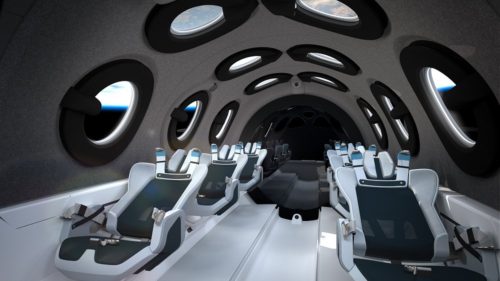
Virgin Galactic had a ‘virtual reveal’ of the interior design of Spaceplane Two, the passenger cabin designed to safely carry tourists over 50 miles above the Earth for rocket powered suborbital hops. It’s not as simple as picking out nice colours and fancy materials, the seats need to secure the passengers through acceleration and aerobraking, which have different orientations. They also need to provide enough room for passengers to make full use of the cabin during zero g, enough windows to observe the earth from far above, and make it easy to get back in when the deceleration starts.
More than a decade after Virgin Galactic unveiled a swoopy, spacey look for the passenger cabin of its SpaceShipTwo rocket plane, the company took the wraps off a more down-to-Earth design that reflects what spacefliers will actually see when they climb into their seats. And in a move befitting this era of social distancing, the big reveal was done with the aid of virtual reality. Read more:
** “Why is 304L Stainless Steel Special for Building ROCKETS?” is the focus of the latest Workshop episode from Copenhagen Suborbitals:
Copenhagen Suborbitals is the world’s only crewed, crowdfunded space program. In the future, a volunteer astronaut will fly to space on our home-built rocket. We do this on our spare time, all the donations go to paying our workshop rent and buying materials. We are forever thankful to each of our supporters!
In this video we talk about the interesting features of stainless steel for building rockets and one special trait that we can use to our advantage to make our Spica rocket’s 304L alloy propellant tanks as strong and as light as aluminum. We also cover Bianca’s DIY contra-rotating drone project for her Master thesis in Autonomous Systems, Spica propellant tank bulkhead production and more.
This week we integrated the Launcher E-2 3D printed liquid 🚀 engine to its test stand for the first time. E-2 is a 10T / 22k lbf thrust engine. Getting closer to full scale blue kerolox Mach 💎💎💎 pic.twitter.com/TK0A24VMLX
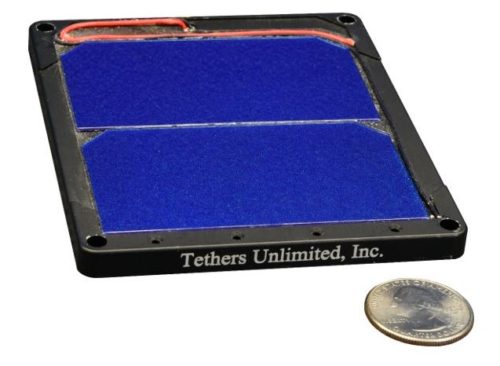
** Electrodynamic tether device from Tethers Unlimited deorbits spacecraft at the end of their missions. After several years of development and testing in space, the Terminator Tape™ Deorbit Modules is attracting more attention and customers. This arises from the growing awareness that active measures are needed to reduce orbital traffic as the number of satellites in low earth orbit rapidly expands.
Millennium Space experiment to measure speed of satellite deorbiting system – SpaceNews – “A few days into the mission, one of the satellites will autonomously deploy a 230-foot-long Terminator Tape tether provided by Tethers Unlimited. The untethered satellite will be allowed to naturally decay. Millennium will use radar to track them and collect data.“
Letting a satellite breathe – ESA – “… air intake collector is designed to harvest sufficient air particles as it skims the top of the atmosphere to fuel an ‘air-breathing’ electric thruster. The aim is to help satellites to overcome atmospheric drag to operate on an ongoing basis in orbits from as low as 180 km to a maximum 250 km altitude.“
** Another attempt at Starlink 9 launch upcoming on this Saturday, August 1st at 3:21 am EDT (0721 GMT) [Thursday, August 6th at 1:33 am EDT ( 0533 GMT)]. SpaceX Starlink mission nears third launch attempt after six weeks of delays – Teslarati. This mission to launch 57 Starlink satellites and two BlackSky earth imaging satellites has been repeatedly postponed since the end of June.
[ Update: Due to the threat of tropical storm Isaias, the launch of the Starlink 9 mission has been postponed yet again. The new target liftoff date is Thursday, August 6th at 1:33 am EDT ( 0533 GMT).
** The Crew Dragon set to depart from ISS on August 1st and splash down near Florida on August 2nd. However, an approaching tropical storm may cause a postponement of the return. Here is a schedule of coverage of the event: NASA to Provide Coverage of Astronauts’ Return from Space Station | NASA
** A briefing by NASA and SpaceX on the return of the Crew Dragon from the ISS: Expedition 63 Post Flight Readiness Review Briefing – July 29, 2020
Following the completion of a readiness review, NASA and SpaceX officials previewed the upcoming return to Earth of NASA astronauts Doug Hurley and Robert Behnken during a news conference July 29. NASA Administrator Jim Bridenstine, Commercial Crew program manager Steve Stich, International Space Station program manager Joel Montalbano and Benji Reed, the SpaceX director for crew mission management discussed splashdown and recovery options for the SpaceX Crew Dragon vehicle with Hurley and Behnken aboard. The astronauts are scheduled to undock from the space station on Aug. 1 with a planned splashdown on Aug. 2 to complete an historic nine-week mission.
Deep inside SpaceX’s Hawthorne, California rocket factory, the Crew Dragon capsule – believed to be C207 – assigned to the company’s operational astronaut launch debut (Crew-1) is in the late stages of final integration. A photo provided alongside the news confirms that the Crew Dragon is nearly complete. Aside from the installation of body panels and several other tasks that will be completed once the ship arrives in Florida, capsule C207 is already fully outfitted with a heatshield, windows, Draco maneuvering thrusters, SuperDraco abort thrusters, parachute deployment hardware, and much more.
According to Benji Reed, SpaceX Director of Crew Mission Management, SpaceX’s Crew-1 operational astronaut launch debut remains on track to launch no earlier than late September. Capsule C207 and its upgraded trunk section are also reportedly on track to head from California to SpaceX’s Florida launch facilities in time to support that schedule and could ship east just two or so weeks from now.
NASA and its international partners have assigned crew members for Crew-2, which will be the second operational SpaceX Crew Dragon flight to the International Space Station as part of NASA’s Commercial Crew Program.
NASA astronauts Shane Kimbrough and Megan McArthur will serve as spacecraft commander and pilot, respectively, for the mission. JAXA (Japan Aerospace Exploration Agency) astronaut Akihiko Hoshide and ESA (European Space Agency) astronaut Thomas Pesquet will join as mission specialists.
Crew-2 is targeted to launch in spring 2021, following the successful completion of both NASA’s SpaceX Demo-2 test flight mission, which is expected to return to Earth Aug. 2, and the launch of NASA’s SpaceX Crew-1 mission, which is targeted for late September. The Crew-2 astronauts will remain aboard the space station for approximately six months as expedition crew members, along with three crewmates who will launch via a Russian Soyuz spacecraft. The increase of the full space station crew complement to seven members – over the previous six – will allow NASA to effectively double the amount of science that can be conducted in space.
** McGregor test facility observing:
Tripod and horizontal stand today- McGregor🔥🚀✨ (And a sparkling new booster vertical)
Incredible facility, @elonmusk 🤗💫 pic.twitter.com/GHJSfh3ly1
Space Exploration Technologies, Elon Musk’s reusable rocket and satellite internet venture, is in talks to raise $500 million to $1 billion in series N funding at a valuation of $44 billion, according to documents reviewed by CNBC and people familiar with the company’s fundraising activity.
The funding would help SpaceX begin commercial operations of its Starlink satellite broadband service and to conduct suborbital and orbital test flights of its Starship and SuperHeavy booster launch vehicle. Bloomberg previously reported on the fundraising plans.
The SN5 prototype Starship was pressure tested last week. Subsequent efforts to test fire its single Raptor engine were hampered by various weather and technical issues. The first attempt today was scrubbed when a small fishing boat wandered into safety zone near the test site. A second try, though, was successful. The firing occurs at about the 30:14 point in this video:
** SN5 SpaceX Stealth Cam Ultra Up Close Static Fire 3 Views – LabPadre
The test was soon followed by this comment from Elon:
****** July 23: SpaceX Boca Chica – Mk1 Fins Mounted – SN8 Common Dome Flip – NASASpaceflight – YouTube
The Mk1 Fins were hoisted into position, SN8’s Common Dome was flipped, a new nosecone (yes, another one- this one with a header tank weld) has appeared in the nosecone fabrication tent, and modifications on the old SN2 test tank continue. Video and Pictures from Mary (@BocaChicaGal). Edited by Jack Beyer (@TheJackBeyer)
****** July 24: SpaceX Boca Chica – High Bay Level 2 – Forward Dome Sheathed – NASASpaceflight – YouTube
The new High Bay continues to rise, a Forward Dome is moved out of a fabrication tent and sheathed with a ring stack, SN2 test tank mods continue, and the Mk1 Fins make an appearance. Video and Pictures from Mary (@BocaChicaGal). Edited by Jack Beyer (@TheJackBeyer)
Starship SN5 is being prepared for another Static Fire attempt at the launch site while work continues on future Starships, including SN8 at the Production Facility. Video and Pictures from Mary (@BocaChicaGal). Edited by Jack Beyer (@TheJackBeyer).
****** July 29: SpaceX Boca Chica – Starship SN5 waits for Static Fire. Rebuilding Bluezilla – NASASpaceflight – YouTube
While Starship SN5 continues to prepare for a Static Fire test, Boca Chica is a hive of activity, with the dishes practicing linkups with SN5, rebuilding Bluezilla and more. Video and Pictures from Mary (@BocaChicaGal). Edited by Jack Beyer (@TheJackBeyer).
**** Other Starship and space transport reports:
**** July 25: SpaceX Starship Super heavy high bay, ANASIS-II + Hope Mars Launch and Gilmour Space 110-sec test – Marcus House – July.25.2020
Another action-packed week of space news. SpaceX Starship Super heavy high bay construction continues, we had the ANASIS-II Falcon 9 launch, the Hope Mars Launch and Gilmour Space 110-sec test fire. There has been no shortage of developments with Starship construction at Boca Chica. Lots to see. We’ve had another beautiful flight of the Falcon 9 with the launch of ANASIS-II with eh booster returning just recently. The HOPE Mars Mission mission launched aboard the Japanese H-2A rocket. Gilmour Space Technologies in Queensland Australia is pioneering new single-port hybrid propulsion rocket engines that are claimed to be significantly cheaper, greener, and safer to operate than traditional liquid and solid propulsion rockets.
**** July.28: SpaceX Starship Updates – 2020 Mars Mission Frenzy! – What about it!?
In this Episode, we will take a look at SpaceX’s progress in Boca Chica Texas and the recent Hurricane Hanna. Does a Hurricane pose any danger and how real is the threat in the future for SpaceX. We will also take a look at the recent Hope mission launched by the United Arab Emirates, the Tainwen-1 mission, launched by China and the imminent Mars 2020 Perseverance rover mission to be launched very soon by NASA and ULA. Why is it, that everyone is targeting Mars right now? How does a Mars transfer orbit work?
**** July.24: SpaceX Starship Updates – Why a hop will happen this time! – What about it!?
In this Episode, we will take a look at SpaceX’s progress on the Super Heavy High Bay. We will also take a look at the ongoing work at the new Super Heavy and Starship launch pad and last but not least, we will take a look at first preparations for the Starship SN5 150-meter hop!
We finally see what those incredible Starship designers had in mind for Elon’s Party Central at the Starship Village Community Center. FIN Park? This will be the hub of activity for residents of the newly-renovated homes on Weems Street and those living in the Bambi Airstream executive mansions on wheels.
100 years from now, as Elon City residents look down on the planetary home of their ancestors, they will see the Sun glint off of these wings and point to their Martian children and say… “See children… That’s where your grandfather and grandmother left Earth so you could be the ‘Hope of Consciousness’ for all of humanity.” And they will rejoice.
While confirmed by NASA, details of the film ops on the Station are not yet public. E.g. it is not known if Cruise will go himself to the station or how many people will go.
From Dennis Tito in 2001 to Guy Laliberté in 2009 there were seven private citizens who flew on Soyuz spacecraft to the ISS and spent several days there. (Charles Simonyi flew twice.) These flights were arranged by Space Adventures. The flights stopped with the retirement of the Shuttle because spare seats on the Soyuz were needed by NASA astronauts to reach the Station. With the debut flight of the SpaceX Crew Dragon, private individuals will again be heading to orbit either in a Dragon or a Soyuz, which has seats available once again.
“Our next flight will be just purely two pilots in the front to do a systems check,” he told BBC News.“And then, once we’ve done that – well, we’re in pretty exciting territory because the plan is to start putting [four of our] people in the back. We haven’t shared exactly how many flights that will be because we’ve got to see how it goes. But it could be a fairly small number.”Commercial service would begin thereafter.
Reportedly about 600 people currently have tickets for SS2 flights, which take six spaceflight participants and two pilots to about 80-90 km in altitude. This is below the Kármán line of 100 km, but is sufficient to meet the USAF criteria for spaceflight.
Following the relocation of flight operations from Mojave to Spaceport America in New Mexico, the company carried out two drop-glide tests of the SS2 Unity. Powered test flights should resume soon.
The company is now publicly traded and so is under an even more intense public spotlight than it was previously. While safety will obviously be a top priority, they will be under stockholder pressure to start flying paying customers as soon as possible.
Blue is still not taking reservations for flights on the New Shepard. Management has hinted that the prices will be in the same ball park as other companies, i.e. VG. So in the $250k range.
The test flights so far have had no one on board. There had been indications that flights with company personnel would start by the end of the year following two or three more uncrewed flights. However, this is looking increasingly unlikely.
The company has never explained why their flight rate is so low. The vehicle is fully reusable and appears to have performed well so far. Yet there are usually several months between flights. There has been no flight since Dec. 11, 2019.
There apparently was going to be a flight in late spring but some employees balked at working during the Covad-19 crisis and the flight was canceled.
Commercial suborbital spaceflight capabilities are anticipated to be more accessible, affordable, and available than missions to the International Space Station and could provide NASA additional commercial human spaceflights to conduct such activities as testing and qualification of spaceflight hardware, human-tended microgravity research, and additional training opportunities for astronauts and other NASA personnel. The agency has developed an intensive, comprehensive training program for astronauts and astronaut candidates, and suborbital crew space transportation services could provide even more training opportunities for NASA astronauts, engineers, scientists, operators, and trainers.
This could provide an additional revenue source for Virgin Galactic and Blue Origin and supplement their suborbital tourism businesses. However, if NASA requires an elaborate certification process as the agency did for the SpaceX Dragon and Boeing Starliner, it could be many years before any NASA astronaut steps into a SS2 or New Shepard for a ride to suborbital space. ASAP To Keep Eye on NASA’s Safety Review of Commercial Suborbital Flights – SpacePolicyOnline.com.
One of the defining hallmarks of the Virgin brand over 50 years, has been the use of inspired and bold design to transform the customer experience. It’s an ethos that has been successfully applied across industrial sectors and design disciplines: from aircraft cabins and hotel bedrooms to fitness classes and personal banking.
Virgin Galactic, in collaboration with London design agency, Seymourpowell, has striven to remain faithful to that tradition by developing an elegant but progressive, experience-focused concept for the cabin of its spaceship. While it has been created to integrate seamlessly with every other aspect of the Virgin Galactic astronaut journey – the cabin is also the design centrepiece; providing safety without distraction, quietly absorbing periods of sensory intensity and offering each astronaut a level of intimacy required for personal discovery and transformation.
Virgin Galactic SpaceshipTwo seats rotated back for launch and reentry configuration. Credits: VG
Virgin Galactic announced today that in preparation for the re-opening of spaceflight sales, it is introducing the One Small Step initiative. The company formally closed its doors to new ticket sales after its history-making first space flight in December 2018.
In addition to more than 600 firm reservations it has already taken from Future Astronaut customers from 60 countries, Virgin Galactic has received a consistently high level of interest from aspiring astronauts. This has resulted in 7957 online reservation registrations in the fourteen months since the first spaceflight and more than double the number the Company last reported in September 2019.
In light of continuing, strong progress towards commercial service, Virgin Galactic is now preparing to release its next tranche of seats for sale to the general public. In the first phase of that process, the Company will be launching its new One Small Step qualification process on Wednesday, February 26th, allowing those who are serious about flying to space, to register now and be front of line for firm seat reservations, once they become available.
To take One Small Step, future flyers will pay a fully refundable deposit of US$1,000 in a simple online registration process at www.virgingalactic.com/smallstep/
[July 15, 2020] Virgin Galactic Holdings, Inc. (NYSE: SPCE) (“Virgin Galactic”), a vertically integrated aerospace and space travel company, today announced the appointments of Michael Colglazier as Virgin Galactic’s new Chief Executive Officer and George Whitesides as Chief Space Officer, effective July 20, 2020.
Michael assumes the CEO role at an exciting time for Virgin Galactic as the Company progresses through its test flight program and prepares for commercial service. He will also join the Company’s Board of Directors effective July 20, 2020. Michael joins Virgin Galactic following a long and successful career at The Walt Disney Company (NYSE: DIS), bringing over three decades of experience in developing and growing consumer-oriented multi-billion dollar businesses strategically, commercially, and operationally. Most recently Michael was President and Managing Director, Disney Parks International, where he was responsible for operations, strategy, and commercial and experiential development of Disney’s international parks and resorts.
George will assume the role of Chief Space Officer, focused on developing the Company’s future business opportunities, including point-to-point hypersonic travel and orbital space travel. George will also chair the Company’s Space Advisory Board, and in conjunction with his new role will step down from the Company’s Board of Directors. George joined Virgin Galactic in 2010 as its first CEO, after serving as Chief of Staff at NASA. During the past decade, he has built the Company from 30 people to a workforce of over 900 today, and he has successfully guided Virgin Galactic through its human space flight research and development program as well as the progress to date in its flight test program, culminating in two successful space flights. These historic flights saw the first humans launched into space from US soil since the retirement of the Space Shuttle, as well as the first woman to fly on a commercial space vehicle. During the last year, George led the transition of operations from Mojave, California to Spaceport America, New Mexico, and oversaw the Company’s successful public listing —creating the world’s first publicly traded human spaceflight venture.
** VG has released a number of videos about various aspects of the SS2 development and its applications. Here is one with Beth Moses talking about her flight:
Learn what it’s like to travel to space from Beth Moses, Virgin Galactic’s Chief Astronaut Trainer, in this special Spacechat for all young people currently studying at home! Beth was the world’s 571st human to look down at Earth from the black sky of space as she became Commercial Astronaut 007. Hear Beth talk about her spaceflight, including highlights such as the rocket ride and floating in zero G! Beth invites you to join her and talk traveling through space in the first part of this series – Spacechat #WithMe!
** The “space experience company” Orbite will provide space flight training for private individuals planning to
KBR, the Houston company currently training NASA astronauts, will start training their private, deep-pocket counterparts at NASA facilities.
KBR signed a Space Act Agreement with NASA’s Johnson Space Center to train private astronauts in a wide variety of spaceflight tasks, including operating onboard International Space Station systems, integrating into the existing ISS crew, performing routine operational tasks, maintaining health and performance and responding to emergencies. KBR will also provide medical operations and services prior to, during and after spaceflights.
All I know is I was stunned in a way that was completely unexpected. It was overwhelmingly impressive — beyond anything I’d heard from my colleagues who’ve flown before. We just can’t describe it, you know? When you go to different places here on Earth and experience things that you never thought you would before, it’s difficult to describe it. I think with a lot of those things, you’re seeing it, but you’re feeling it, too. You feel like it’s just getting in you.
The planet just glows. I remember trying to describe to my son, who was seven at the time, what it was looking like to me. I’m like, “Okay, the simplest way I can think is just, take a lightbulb — the brightest lightbulb that you could ever possibly imagine — and just paint it all the colors that you know Earth to be, and turn it on, and be blinded by it.” Because day, night, sunrise, sunset, it is just glowing in all of those colors.
People go all over the world, often at great expense in both money and time, for no other reason than to see sights of historical significance, beauty, uniqueness, etc. Space travelers like those above come back to earth reporting that space offers stupendously unforgettable sights and mind-bending experiences. Any suggestion that there is no market for space flight is absurd.
The private sector has been gearing up outside the public eye for many years now. Soon, Virgin Galactic and Blue Origin may both begin space tourism flights sending guests to the edge of space and back. While SpaceX is the first private company to send humans to the ISS, Boeing’s Starliner will soon follow performing the same mission. Currently scheduled for 2021, the NASA Artemis program, using a new launch vehicle, Space Launch System, and crew capsule, Orion, are scheduled to begin missions that will eventually take humans to deep space destinations such as the Moon and Mars.
Human space flight brings new risks to the companies involved. The ISS will now host guests that are not sponsored by governments but by the private commercial sector. These individuals could be NASA astronauts as with the SpaceX crew, but they could also be employees of the launch company or space tourists. NASA and the FAA are still refining how these new risks are addressed. The space underwriters are working with the private space companies and NASA/FAA to create the insurance product that appropriately addresses the risks facing s the private sector when it comes to human flight. As the space industry evolves so too do the insurance programs that address the hazards.
At a press conference during the Next-Generation Suborbital Researchers Conference here March 3, Matt Gohd, who became chief executive of [ZERO-G] about three months ago, said global interest in the company’s flights prompted him to examine the possibility of doing flights in other countries.
“One thing that stuck out for me was the amount of people from all over the world who would fly into the various places where a plane would go up for either passenger flights or research experiments,” he said, with customers coming to the U.S. from as far away as the Middle East and New Zealand, often just for the experience.
To tap into that demand, he said Zero-G is planning to conduct flights outside in other countries. He declined to identify what countries the company is considering to conduct such flights, but said more information about this “global initiative” will be released in the coming months.
** Michael Lyon – Space Tourism and Space Startups – Cold Star Project S02E13
Michael Lyon, founder of Xtronaut Enterprises, is a mentor at the Creative Destruction Lab tech accelerator, with a history of work in the space tourism and education fields. He has been an Adjunct Professor at the George Mason University School of Management, and was general counsel with James Cameron on Deep Ocean Expeditions (Titanic, Bismark).
On the Cold Star Project with host Jason Kanigan we discuss:
– the experience of traveling in a submersible to hydrothermal vents 8600 feet beneath the ocean surface – what Michael has learned as a mentor at the Creative Destruction Lab – what space and AI company founders need to do before they start looking for seed round funding – the deadly things startups consistently miss to protect themselves legally as they begin operation – how Michael’s company, Xtronaut Enterprises, is involved in the NASA OSIRIS-REx mission – the hurdles to commercial space tourism and how the field may develop.
** High-altitude Near Space balloon travel adventures have been promised for many years but, like suborbital space tourism on rockets, have yet to take off.
Zero2Infinity of Spain was probably the first company to begin serious development of a high altitude (~35 km) system to provide a Near Space travel experience. Several adventurers would ride in a large enclosed gondola capsule below a helium balloon and they would enjoy a multi-hour journey in luxuious comfort before the capsule would detach from the balloon and parachute back to earth. Their Bloon system has yet to lift off as a business, but they have carried out extensive testing.
The Bloon’s experience consists in a four hour trip sitting in a pleasant, intimate environment. Fly up to an altitude of 36 km to enjoy of a spectacular view of our planet and learn about Earth in the most unique way.
World View, founded by Jane Poynter and Taber MacCallum, whose company Paragon Space Development Corp. had advised Zero2Infinity on life support systems, started out planning to offer similar Near Space trips but later became focused on using hi-alt balloon systems as platforms for broadband internet routers, scientific experiments, remote sensing, etc.
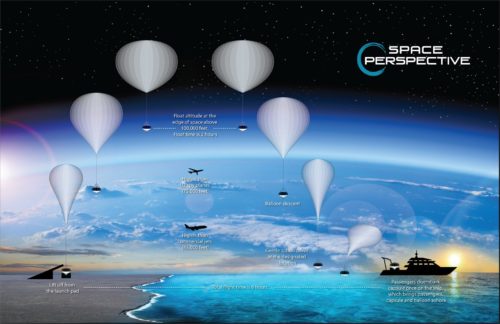
Space Perspective today announced its plans to fly passengers and research payloads to the edge of space with its Spaceship Neptune, a high-performance balloon and pressurized capsule. The human space flight company plans to launch from the iconic Shuttle Landing Facility at NASA’s Kennedy Space Center (KSC) in Florida, with the first un-crewed test flight scheduled in early 2021 that will include a suite of research payloads.
“We’re committed to fundamentally changing the way people have access to space – both to perform much-needed research to benefit life on Earth and to affect how we view and connect with our planet,” said Space Perspective Founder and Co-CEO Jane Poynter. “Today, it is more crucial than ever to see Earth as a planet, a spaceship for all humanity and our global biosphere.”
The company has completed extensive international market research and a new design built on 50+ years of proven technology. Spaceship Neptune was developed from the ground up for maximum safety, accessibility, near zero-emissions and routine operations around the world. The balloon measures the length of a football stadium and the pressurized capsule is comfortable and spacious.
Flown by a pilot, Neptune takes up to eight passengers called “Explorers” on a six-hour journey to the edge of space and safely back, where only 20 people have been before. It will carry people and research payloads on a two-hour gentle ascent above 99% of the Earth’s atmosphere to 100,000 feet, where it cruises above the Earth for up to two hours allowing passengers to share their experience via social media and with their fellow Explorers. Neptune then makes a two-hour descent under the balloon and splashes down, where a ship retrieves the passengers, the capsule, and the balloon. Neptune’s commercial human spaceflight launches are regulated by the FAA Office of Commercial Spaceflight.
A Neptune flight from takeoff to landing in the sea. Credits: Space Perspective
Space tourism is the most profitable commercial space service to date and soon to be the fastest growing and most exciting sector within the space industry. Analysts say that by 2030 outer space travel will represent an annual market of at least $20 billion. Given the advancements, trials and growth already implemented this century, the Space Tourism Society and team behind the Space Tourism Conference foresee the acceleration of this marketplace in the near future, dubbing it the Space Tourism Decade. This session examines how and why the space tourism market is trending waaay up and analyzes the potential profits awaiting investors in this dynamic field.
The event will be hosted by Allison Dollar, CEO of ITV Alliance, and moderated by Robert Jacobson, author of Space is Open for Business, and will include speakers:
Bonnie Rosen, Program Manager to the Techstars Starburst Space Accelerator.
Meagan Crawford, Managing Partner, SpaceFund
Matthew Kuta, Co-Founder, President, and COO of Voyager Space Holdings
This webinar series is free for Space Tourism Conference ticket holders