Category Archives: Rockets

Spaceport America Cup results + ULA Interns launch “Future Heavy”

The Spaceport America Cup college student rocket competition took place last week at the New Mexico spaceport.  (See earlier preview posting here.) Over 90 colleges were represented from around the world. The results are in:

Final launch on Friday:

==

Interns working at United Launch Alliance built a big one-stage sport rocket that was launched at the event:

Here is the ULA release about the project:

United Launch Alliance Interns, Ball Aerospace, and
Colorado Students Participate in Record-setting 

Spaceport America, N.M. (June 24, 2017) – A 53-foot-tall high-power sport rocket carried payloads thousands of feet above the New Mexico desert today at Spaceport America. United Launch Alliance (ULA) summer interns designed, built and launched the Future Heavy rocket, which carried 16 payloads (experiments and instruments) built by K-12 students, Ball Aerospace mentors and a combined ULA/Roush Industries team. The rocket launched at the Spaceport America Cup International Intercollegiate Rocket Engineering Competition in association with the Experimental Sounding Rocket Association (ESRA).
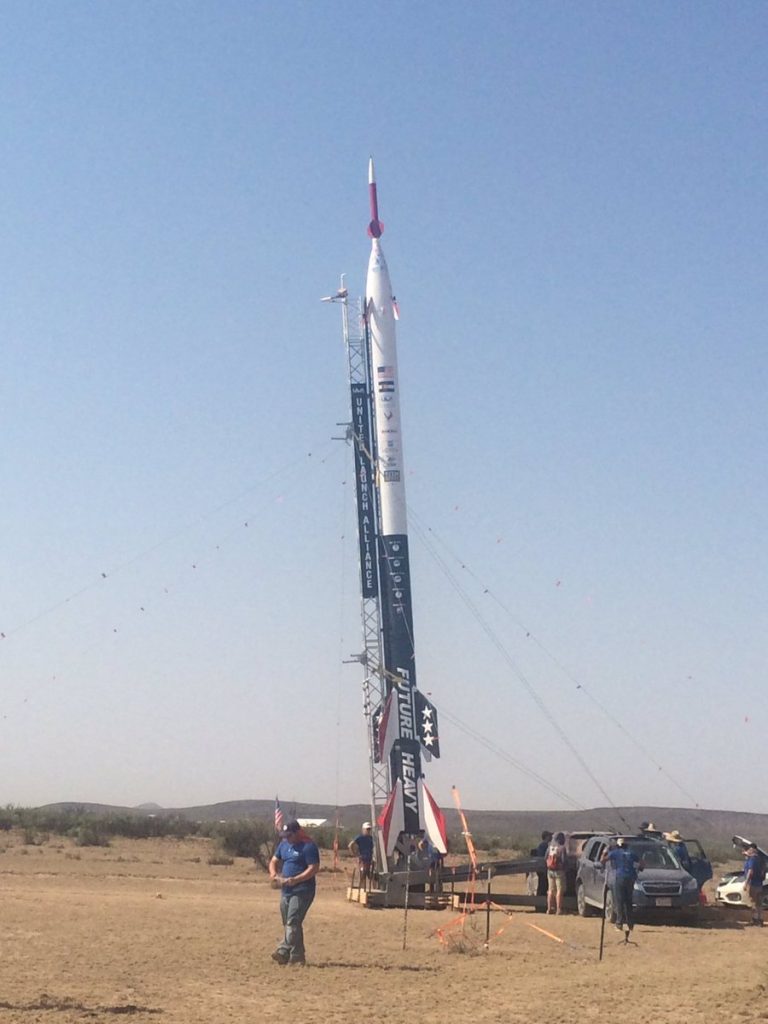
ULA Interns’ Future Heavy rocket vertical on its launch rail.

Future Heavy is the largest sport rocket to launch anywhere in the world, breaking the record set previously by ULA in 2016, when the rocket towered at 50 feet. The launch marked the culmination of an experience designed to simulate a real-life launch campaign and inspire students from kindergarten through graduate school to pursue careers in science, technology, engineering and math (STEM).
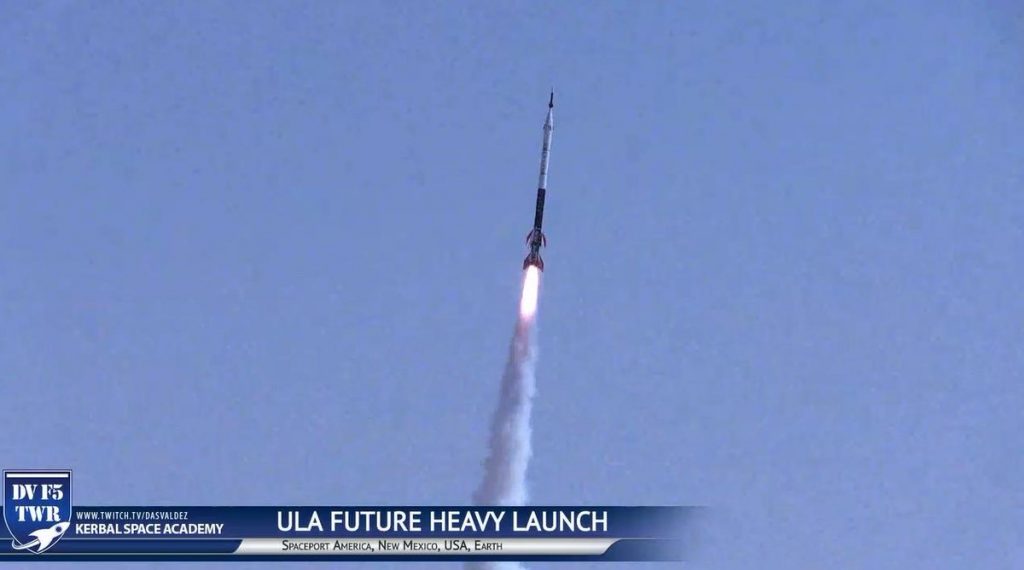

“The future of the space industry lies in the interns and students designing, building, and launching Future Heavy and the payloads it carried,” said Tory Bruno, ULA president and CEO. “United Launch Alliance continuously works to encourage the next generation of rocket scientists, astronauts, space entrepreneurs and enthusiasts. The sky (and physics) is the limit on the creativity and ingenuity at the Student Rocket Launch.”

Working on their own time, ULA interns designed, built and launched the rockets with the guidance of mentors, and Ball Aerospace mentors volunteered their time to create and test their payload. Altogether, more than 50 interns and 8 mentors from ULA along with Ball mentors participated in the 2017 event.
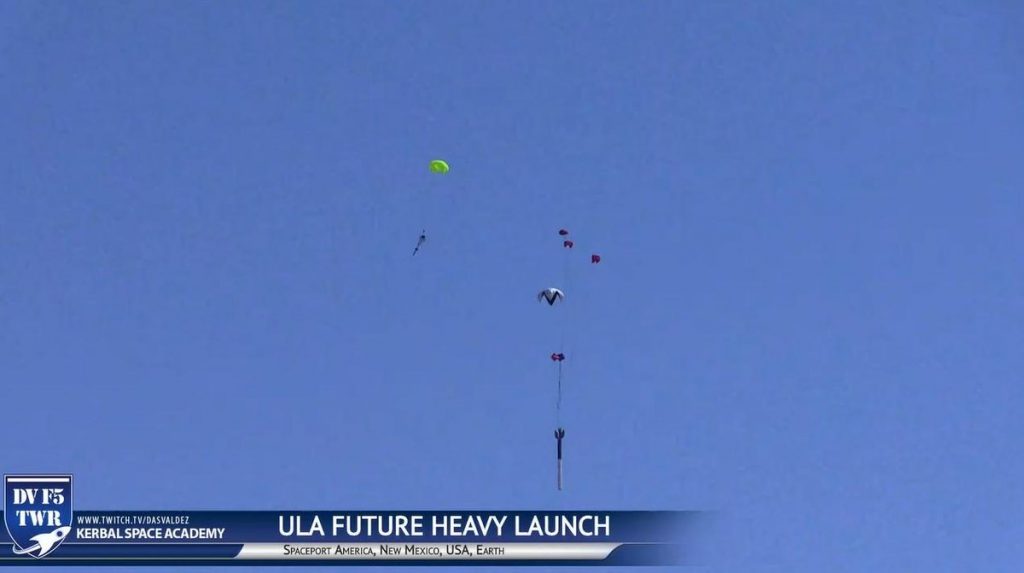
Parachutes deployed and returning to earth.

ULA and Roush Industries teamed up on a payload to test next-generation technology planned for use on future ULA rockets. The ULA and Roush payload will test a number of Integrated Vehicle Fluids (IVF) system components. IVF uses an internal combustion engine, manufactured by Roush Industries, that runs on propellant boil-off, otherwise vented to waste, to provide power to enable long-duration missions for the upper stage.

The Future Heavy and its payloads weighed in at more than 1,350 pounds and generated approximately 8,000 pounds of thrust off the launch pad. The K-12 payloads included a swarm of small gliders to gather atmospheric data, a test of various methods to harvest the energy of descent and a kindergarten parachute experiment.

“This program demonstrates a collaborative real-world aerospace industry partnership and experience,” said Rob Strain, president of Ball Aerospace. “We are proud to be supporting the next generation of space leaders.”
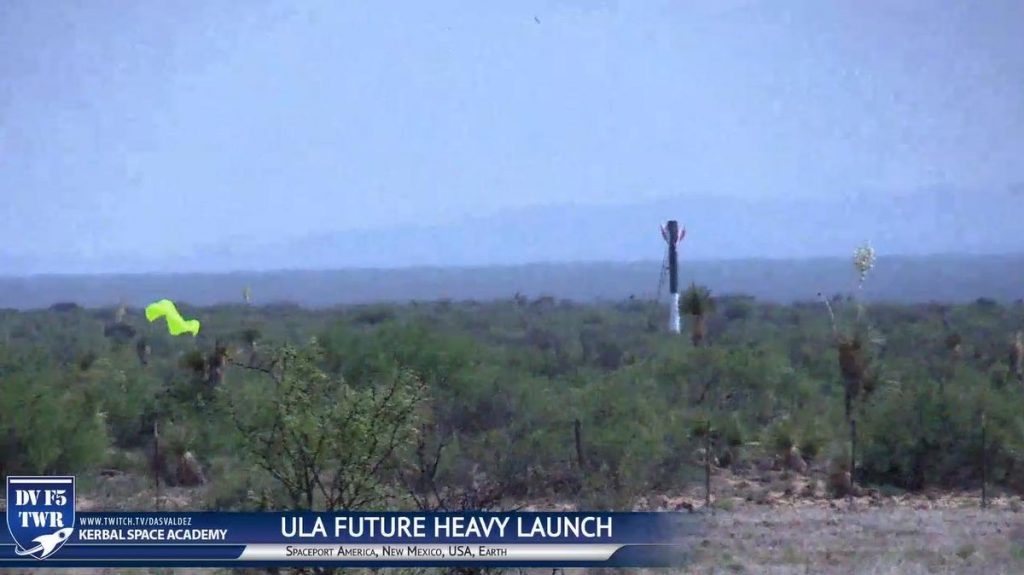
Ball designed, built and tested the largest payloads including: a black box data recorder; an environmental sensor suite with on-board data storage; accelerometer, pressure, temperature and humidity sensors; and a parafoil using ram-air inflation.

Earlier this year, ULA’s Greg Arend, who leads the Student Rocket Launch project, received the Distinguished Engineering Educator Award by the Engineers’ Council for his work on the program over the last five years. Over that time, hundreds of interns across all five of ULA’s sites participated in this unique, hands-on STEM activity and worked to build Future Heavy, the world’s largest high-powered sport rocket.
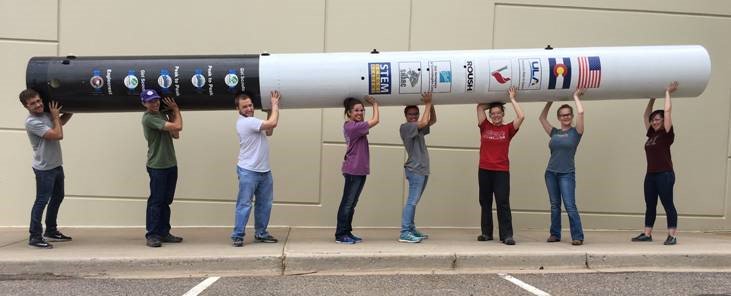
ULA interns lift the fuselage of the Future Heavy rocket that they built.

====

NASA Wallops hosts rocket training for students and educators

College students and high school educators participate next week in rocket programs hosted by NASA’s Wallops Island Space Flight Facility:

Students and Educators Become Rocket Scientists for a Week at Wallops 

A sounding rocket launches from Wallops Island in 2016. Credits: NASA

Have you wondered what it would be like to be a real rocket scientist?

Approximately 150 university and community college students and instructors and high school educators will get that chance during Rocket Week June 17 through 23 at NASA’s Wallops Flight Facility in Virginia.

Nearly 130 university and community college students and instructors from across the country will build and fly experiments on a NASA suborbital rocket through the RockOn! and RockSat-C programs. Another 20 high school educators from across the United States will examine how to apply rocketry basics into their curriculum through the Wallops Rocket Academy for Teachers (WRATs)

RockOn 2016 participants work to prepare their experiments for flight. Credits: NASA/Patrick Black

The week ends with the students launching their experiments on a NASA Terrier-Improved Orion suborbital sounding rocket at 6 a.m. EDT on June 22. The rocket is 36 feet long and the payload weighs 667 pounds.

The NASA Visitor Center at Wallops will open at 5 a.m. EDT on launch day for viewing the flight.  Live coverage of the mission is scheduled to begin at 5:30 a.m. on the Wallops Ustream site. Launch updates also are available via the Wallops Facebook and Twitter sites. Facebook Live coverage begins at 5:45 a.m. The rocket launch is expected to be seen from the eastern shore of Virginia and Maryland.

Smartphone users can download the “What’s Up at Wallops” app for information on the launch as well as a compass showing the precise direction for launch viewing.

High school educators work on building model rockets during WRATS 2016. Credits: NASA/Patrick Black

The June rocket will carry 23 experiments (measuring acceleration, humidity, pressure, temperature and radiation counts) from the RockOn! program, nine experiments from the RockSat-C program and more than 80 small cubes with experiments developed by middle school students in 49 states as part of the Cubes in Space program, a partnership between idoodlelearning inc. and the Colorado Space Grant Consortium.

After flying to nearly 73 miles altitude, the payload will land via a parachute in the Atlantic Ocean where it will be recovered by boat. The participants should have their experiments returned to them later in the day to begin their data analysis.

Joyce Winterton, Wallops senior advisor for education and leadership development, said,

“We look forward each year to Rocket Week and the students and educators who come to Wallops with an enthusiasm to learn the skills to advance their careers and instruction to advance those of younger students.”

Conducted with the Colorado and Virginia Space Grant Consortia, RockOn! is in its tenth year, RockSat-C its ninth and WRATS is in its seventh year.

“The longevity of these programs shows the continued interest from students and educators, “said Phil Eberspeaker, chief of the NASA Sounding Rocket Program Office at Wallops. “Participants receive hands-on instruction, personal attention and the opportunity to work with career “rocket scientists” — engineers and technicians who work on rockets on a daily basis.”

In RockOn! the participants receive instruction on the basics required in building and developing a scientific payload for flight on a suborbital rocket. After learning the basics in RockOn!, students may then participate in RockSat-C, where they design and build an experiment for rocket flight during the school year.

Chris Koehler, director of the Colorado Space Grant Consortium, said,

“The partnership with NASA has led to excellent learning opportunities for the participants in the RockOn! and RockSat-C programs.  More than 500 students and instructors, including this years’ attendees, have participated in the 10-years RockOn! has been conducted.”

WRATS works with high school teachers to show them the basics of rocketry and how to take what they learn into the classroom. The 20 participants from Virginia, Maryland,  New York, New Jersey, Colorado, Kentucky, Tennessee, Delaware, and Oklahoma will receive instruction on the basics of rocketry including Newton’s Laws, fundamentals of electronics, drag and propulsion. This instruction will be applied to hands-on learning activities including building and launching model rockets.

The RockOn!, RockSat and WRATS programs are supported by the NASA Sounding Rocket Program. RockOn! also is supported by NASA’s Office of Education and NASA’s National Space Grant College and Fellowship Program in partnership with the Colorado and Virginia Space Grant Consortia, as well as the program participants.

NASA’s Sounding Rocket Program is conducted at the agency’s Wallops Flight Facility, which is managed by NASA’s Goddard Space Flight Center in Greenbelt, Maryland. Orbital ATK provides mission planning, engineering services and field operations for the NASA Sounding Rocket Operations Contract. NASA’s Heliophysics Division manages the sounding rocket program for the agency.

Keith Koehler
Wallops Flight Facility, Wallops Island, Va.

Videos: SpaceX Falcon 9 launches Cargo Dragon and lands 1st stage booster

SpaceX launched a Dragon spacecraft from Kennedy Space Center on Saturday afternoon. The Dragon is now headed for a rendezvous and berthing on Monday with the International Space Station. It is delivering about 2700 kilograms of cargo, primarily consisting of instruments and materials for science and technology experiments. After separating from the upper stage, the first stage booster returned and landed at Cape Canaveral. This is the 11th successful landing of a Falcon 9 booster (6 at sea and 5 on land).

Here are some images and videos from the launch and landing:

CRS-11 Mission

CRS-11 Mission


Space X rocket landing (sorry for the language)

A post shared by Zachary Grannan (@zacharygrannan) on

====

NASA sounding rocket to light up Eastern Shore + College students launch Mars rovers

Early on the morning of May 31st, people living along the Mid-Atlantic region of the US coast may see a big light show in the sky:  NASA Sounding Rocket will Release Early Morning Artificial Clouds Light | NASA

The early morning skies along the mid-Atlantic coast will light up with luminescent clouds as NASA tests a new system that supports science studies of the ionosphere and aurora with a sounding rocket launch May 31 from the Wallops Flight Facility on the eastern shore of Virginia. Backup launch days are June 1 through 6. 

During the flight of a two-stage Terrier-Improved Malemute sounding rocket between 4:25 and 4:42 a.m. EDT, ten canisters about the size of a soft drink can will be deployed in the air, 6 to 12 miles away from the 670-pound main payload.

The canisters will deploy between 4 and 5.5 minutes after launch blue-green and red vapor forming artificial clouds. These clouds or vapor tracers allow scientists on the ground to visually track particle motions in space.

The development of the multi-canister or ampule ejection system will allow scientists to gather information over a much larger area than previously allowed when deploying the vapor just from the main payload.

Ground cameras will be stationed at Wallops and in Duck, North Carolina, to view the vapor tracers. Clear skies are preferred, but not required, at both sites for the launch to occur.

The vapor tracers are formed through the interaction of barium, strontium and cupric-oxide. The tracers will be released at altitudes 96 to 124 miles high and pose absolutely no hazard to residents along the mid-Atlantic coast.

The vapor tracers could be visible from New York to North Carolina and westward to Charlottesville, Virginia.

===

Recently a sounding rocket launched from Wallops Island (near Chincoteague Island) with Mars rover prototype models built by university students:

Student-Made Mars Rover Concepts Lift Off

Virginia Tech students watch a Black Brant IX sounding rocket take off from NASA’s Wallops Flight Facility in Virginia. [Larger image.]
Witnessing a rocket launch is a special occasion. Watching a rocket launch with materials you made go up into the sky is priceless.

That’s how it felt for researchers from NASA’s Langley Research Center in Hampton, Virginia, and students from Virginia Tech and the University of Central Florida as they watched a sounding rocket launch on Tuesday, May 16 from NASA’s Wallops Flight Facility in Virginia. On board: Mars rover concepts designed by the students.

“Very few students get the opportunity to design something, put it on a NASA rocket and fly it,” said Jamshid Samareh, ‎research engineer at NASA Langley’s Systems Analysis and Concepts Directorate (SACD), who assisted the students.

Funded through NASA’s SACD Internal Research and Development (IRAD) program, the project saw more than 30 Virginia Tech students and one Central Florida student conceptualize, design and build 3-D printed test models of deployable Mars rovers.

Dr Jamshid Samareh with the a design of a Mars Rover. [Larger image.]
The Mars rover concept has its roots in recreational vehicles that have elements that can fold, going with the theme that collapsible items make for easier transport to Mars. This concept has pop-out sections like RVs that would deploy once on Mars.

“It’s always fun when practical solutions necessitate creativity – not to mention it always looks cool!” said Central Florida student J.T. Madigan.

The test models were launched on a 56-foot-tall Black Brant IX sounding rocket as part of the SubTec-7 payload mission.

The Mars RV rover concepts were part of the nearly 1,200-pound payload, which flew to an altitude of about 154 miles before descending by parachute and landing in the Atlantic Ocean to be recovered. SubTec-7 provided a flight test for more than 20 technologies to improve sounding rocket and spacecraft capabilities.

Students at Virginia Tech are pictured working an assembling their Mars rover concept. [Larger image.]
A sounding rocket’s overall time in space is brief, typically five to 20 minutes, and at a lower speed than vehicles designed to go into orbit or beyond. The short time and lower speed are more than adequate (in some cases they are ideal) to carry out a successful scientific experiment.

Solving a packaging problem

Samareh has worked on many projects in his time at Langley, and says that getting materials to the Red Plant safely and efficiently is one of the bigger challenges.

“Part of the problem we keep running into is packaging,” he said. “We have to carry a lot of payloads – rovers, habitats and such. We want to package them on top of the launch vehicle.”

That problem-solving drive led to teams of undergraduate and graduate students from Virginia Tech and Central Florida to work on this project on campus with the support of Langley researchers.

The researchers and students designed 18 Mars rover concepts using Computer-Aided Design, or CAD, software.  Four of those designs were fabricated, assembled and tested before they were delivered to Wallops for flight on the sounding rocket.

“I have always thought of mass to be the limiting factor in space travel,” said Virginia Tech student Alex Matta, who was also the team’s graduate advisor. “Participation in this project led me to realize that minimizing volume of the cargo is important as well.”

“A rover is one the big pieces that we want to be able to see if it can be packaged in any way,” Samareh said.

The objective of the project is to develop rigid and deployable Mars rover concepts to improve lander packaging efficiency and aerodynamic stability during entry, descent and landing, and aerocapture, which is a flight maneuver that inserts a spacecraft into orbit around a planet or moon by using the destination’s atmosphere like a brake.

Previous concepts for rovers on Mars from decades ago were not the sleek designs of today – they were big, bulky and heavy, something Samareh did not want to recreate.

“They’re not realistic,” he said. “They cannot be efficiently packed.”

Evolution of the deployable Mars rover design started simple and changed to meet certain requirements, such as the height, width and weight needed to fit on a launch vehicle while taking up as little space as possible.

“Real estate on any type of launch is valuable, so I think it’s awesome that such a novel project was given the opportunity to flight test hardware,” Madigan said.

Samareh encouraged the students to come up with all of the crazy ideas they could so they could pick a few and specifically work on them.

“They come up with these ideas that I cannot come up with,” he said. “They have a different mentality. That worked out nicely.”

The Mars RV rover concepts also received recognition outside of NASA, winning first place in the American Institute of Aeronautics and Astronautics Region I Student Paper Conference for the Undergraduate Team category in April.

When all was said and done, seeing the students’ faces at the launch at Wallops was “the biggest payoff,” Samareh said, adding that there is not only value in the designs, but also in getting students involved with NASA and motivated on a deeper level for space flight.

“There are things we learned from them,” he said, “and there are things they learned from us.”

Eric Gillard
NASA Langley Research Center

===

See also: Sounding Rocket Mission Providing Real-World Test for New Technologies | NASA.

Videos: Copenhagen Suborbitals launching Nexø II rocket this summer

Copenhagen Suborbitals is a Danish non-profit volunteer group that aims eventually to send a person up to suborbital space and back safely. Since 2011 they have been launching a series of rockets, each more sophisticated and capable than the last. They launch from a sea platform towed into the Baltic. This summer they plan to launch the Nexø II. Support their efforts at Launch of World’s most advanced amateur rocket | Indiegogo.

Here is a video of highlights of their rocket adventures:

Below is a new documentary video about last summer’s launch of Nexø I.

In the summer of 2016, Copenhagen Suborbitals launched one of the most advanced liquid fueled rockets built by a team of volunteer amateurs. Follow the team close up during final preparations for the launch and during the launch of the Nexø I rocket. Enjoy.

Copenhagen Suborbitals is the world’s only manned, amateur space program, 100% crowdfunded and nonprofit. In the future, one of us will fly to space on a home built rocket.

If you like the video please go to https://www.copsub.com and support our project. Your donations is our rocket fuel

More info on the project at:

Twitter : https://twitter.com/CopSub
Facebook : https://www.facebook.com/CopenhagenSu…
Instagram : https://www.instagram.com/copsub/
LinkedIn : https://www.linkedin.com/company/cope…
Pinterest : https://www.pinterest.com/copsub/