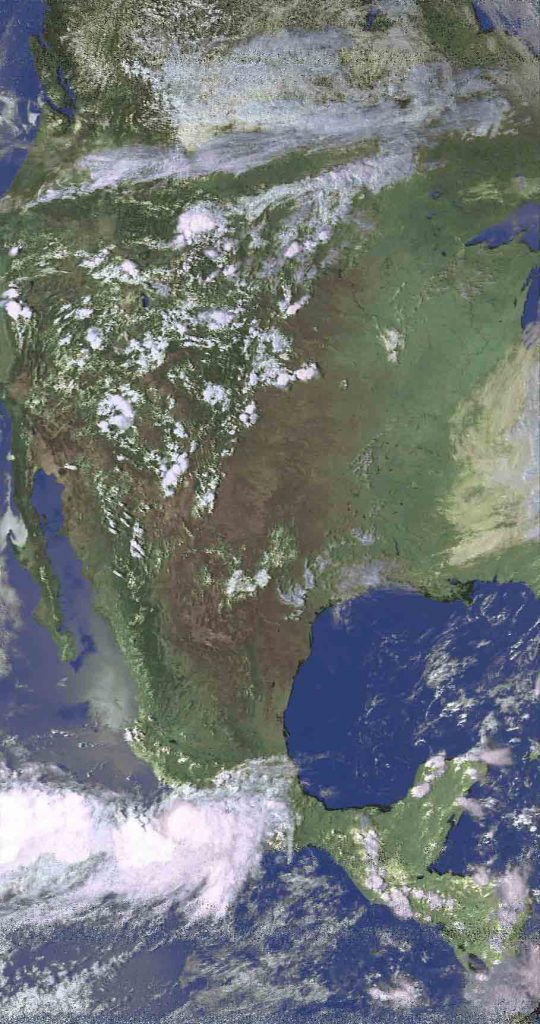
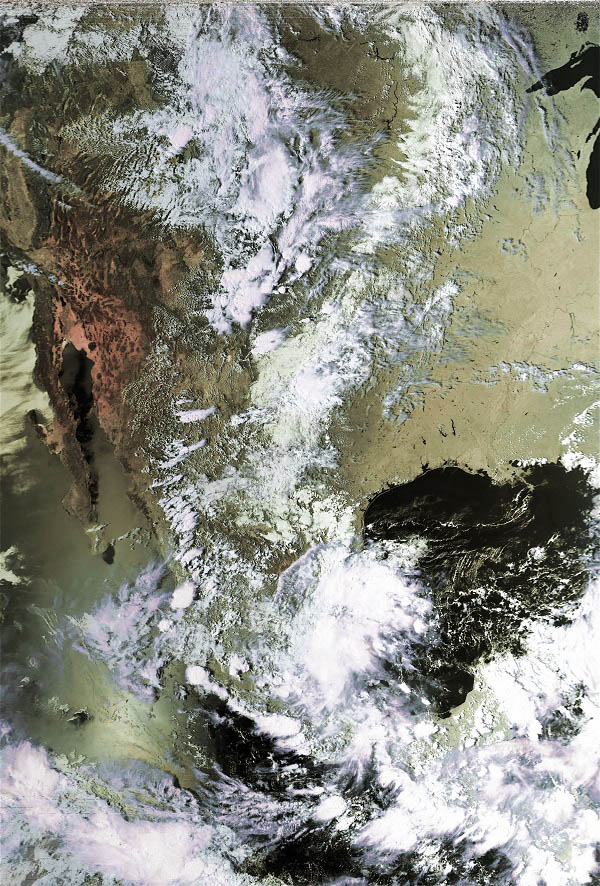
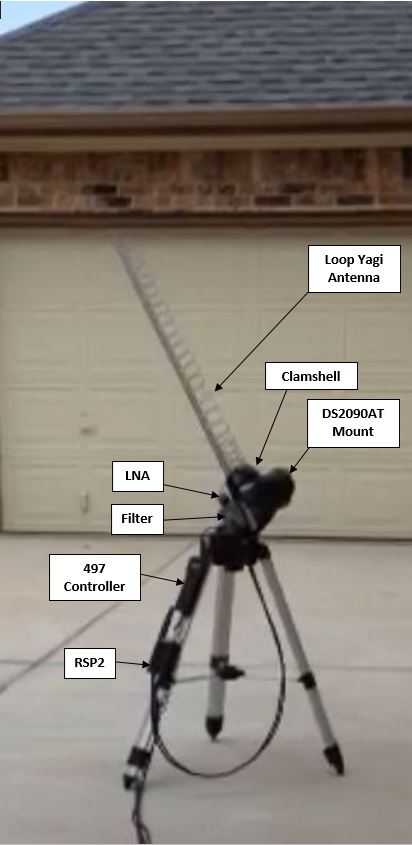
Here are links to a set of How-To postings on receiving weather satellite images with a low cost home system that includes the conversion of a telescope mount into an automated antenna that follows weather satellites across the sky:
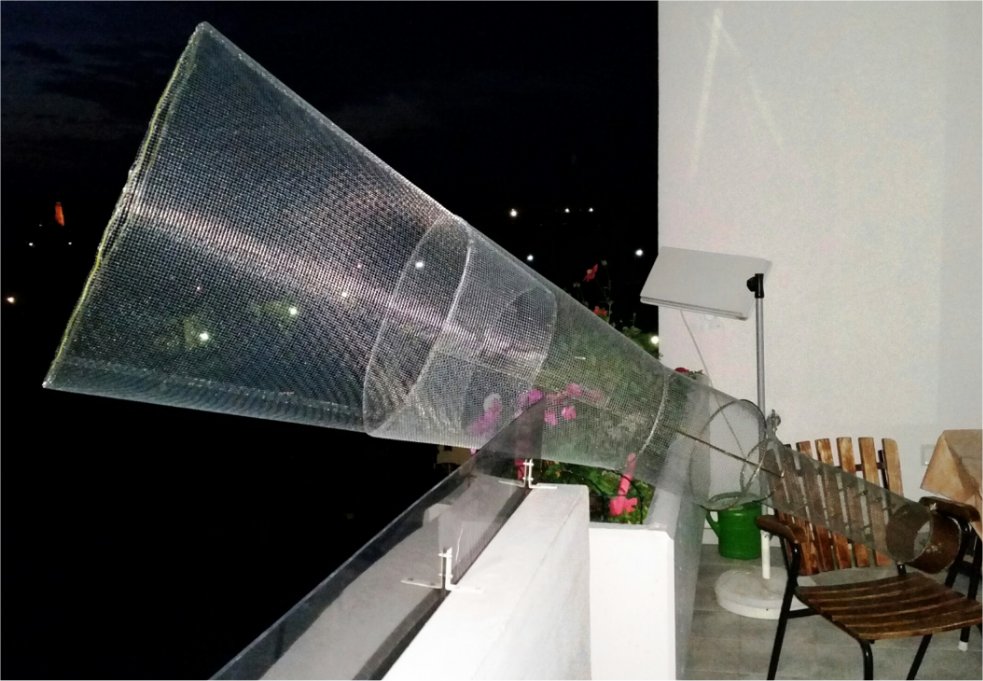
Hannes Fasching, OE5JFL, of Braunau am Inn, Austria, has demonstrated that you don’t need a huge antenna system to operate EME (moonbounce) successfully. Fasching fired up for the October 22-23 weekend of the ARRL EME Contest, using a small horn antenna on 1.2 GHz.
The 1.2 GHz mesh antenna for EME – Hannes Fasching (OE5JFL)
“Because of other commitments I had only a few hours to be QRV in the first part of the ARRL EME Contest,” he said in a Moon-Net post on October 26. “As tests with my recently built 23-centimeter horn antenna were promising, I decided to give it a try to work some stations.” Fasching placed the horn on his balcony with an 80 W solid-state amplifier.
Operating WSJT, he logged contacts with Switzerland, Russia, Germany, and the Czech Republic. He also heard stations in the Netherlands, Finland, Denmark, and Italy on digital modes and in the UK, Czech Republic, Denmark, and Italy on CW.
Fasching, who also has a 7.3-meter homemade dish, has uploaded recordings of some EME signals to his website, along with the results of tests with his small system.
A candidate signal for SETI is a welcome sign that our efforts in that direction may one day pay off. An international team of researchers has announced the detection of “a strong signal in the direction of HD164595” in a document now being circulated through contact person Alexander Panov. The detection was made with the RATAN-600 radio telescope in Zelenchukskaya, in the Karachay–Cherkess Republic of Russia, not far from the border with Georgia in the Caucasus.
The signal was received on May 15, 2015, 18:01:15.65 (sidereal time), at a wavelength of 2.7 cm. The estimated amplitude of the signal is 750 mJy.
No one is claiming that this is the work of an extraterrestrial civilization, but it is certainly worth further study. Working out the strength of the signal, the researchers say that if it came from an isotropic beacon, it would be of a power possible only for a Kardashev Type II civilization. If it were a narrow beam signal focused on our Solar System, it would be of a power available to a Kardashev Type I civilization. The possibility of noise of one form or another cannot be ruled out, and researchers in Paris led by Jean Schneider are considering the possible microlensing of a background source by HD164595. But the signal is provocative enough that the RATAN-600 researchers are calling for permanent monitoring of this target.
No one has yet seen a subsequent pulse from the star and, as mentioned above, there are various background sources that could have generated the original signal. Here are some updates on the analyses and observations from other radio telescopes:
A SETI Signal? – Seth Shostak/SETI Institute – “So what’s the bottom line? Could it be another society sending a signal our way? Of course, that’s possible. However, there are many other plausible explanations for this claimed transmission – including terrestrial interference. Without a confirmation of this signal, we can only say that it’s “interesting.”
Talk description: There are about a dozen communications satellites orbiting the earth that were designed and built by teams of amateur enthusiasts. Dave talks about what they are, how they got there, and how you can build simple equipment to listen to their transmissions.
Check out the HobbySpace Satellite Building and Space Radio sections for more info and web resources on the making of and radio communications with amateur satellites. (These sections need updating but still have lots of useful material.)
There is also a new AMSAT guide on amateur satellites:
Students all over the world are talking to the space station using amateur radio. TMRO correspondent Lisa Stojanovski discusses how schools can get involved, and how an Australian, Tony Hutchinson, is helping it all happen.
See the recent posting here on astronaut Sunita Williams’ comments about the ISS ham radio station. As mention there, you can check the ARISS Amateur Radio on the International Space Station) website for info on how to arrange for your local school to have a ham radio session with the ISS.
TMRO is viewer supported:
TMRO Space Pods are crowd funded shows. If you like this episode consider contributing to help us to continue to improve. Head over to http://www.patreon.com/spacepod for information, goals and reward levels. Don’t forget to check out our weekly live show campaign as well over at http://www.patreon.com/tmro