Category Archives: Satellite Watching

European ATV cargo module departs from the ISS

The European Space Agency’s ATV cargo vessel, which has been docked to the International Space Station since June, departed from the station today:

The ATV, which is named Albert Einstein, will de-orbit on November 2nd and burn up in the atmosphere. They are providing a track of the vehicle until then at ATV-4: Follow the ground track – Albert Einstein.

Here’s advice on how to image the spacecraft : Guide to photographing ATV Albert Einstein from your backyard – Albert Einstein

Photographing the ISS from the ground

Astrophotographer Ralf Vandebergh posts more amazingly detailed shots  on his website of the International Space Station made with an amateur telescope:

[]

Find more about tracking and imaging of spacecraft in the HobbySpace Satellite Observing section.

Tracking the Cygnus cargo module as it heads for the ISS

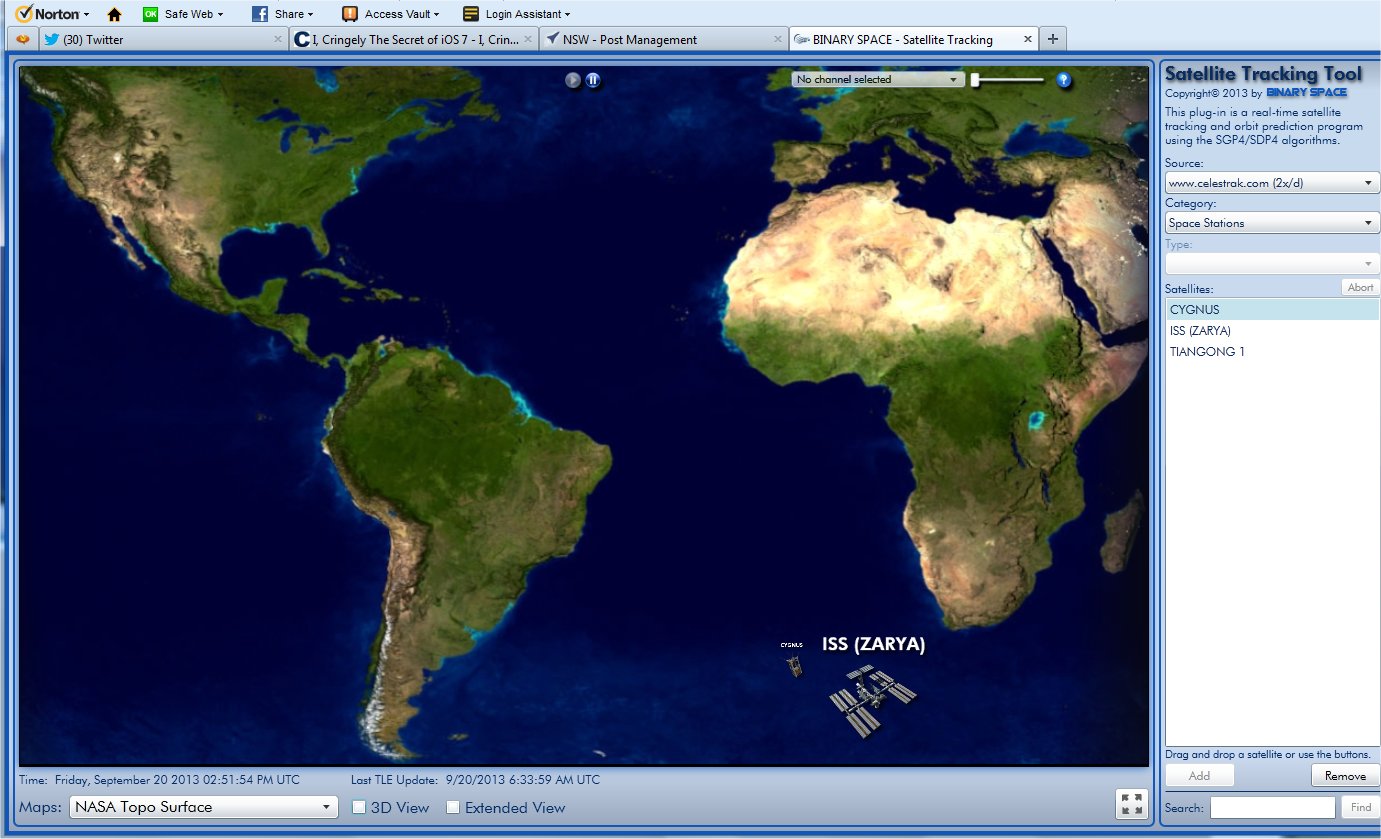
The Orbital Sciences Cygnus cargo spacecraft, which launched on an Antares rocket on Wednesday from the Mid-Atlantic Regional Spaceport (MARS) at Wallops Island, Virginia, is gradually altering its orbit to match with the International Space Station. It will rendezvous and berth with the Station on Sunday morning. You can follow the vehicles with the Satellite Tracking Tool provided by BINARY SPACE. Here’s a recent screen capture:

CygnusISS_2DView_1381x839

I report on commercial launch activities like that of the Antares/Cygnus in my other gig as managing editor of NewSpace Watch. There’s a tremendous amount of exciting activity going on in entrepreneurial spaceflight and we report on it daily at NSW. Check it out and please consider subscribing.

Here is a video of Wednesday’s launch:

The FUNcube Dongle SDR for satellite reception

I’ve posted about the FUNcube Dongle before but it’s worth a repeat. This small device plugs into a USB port and when combined with a program like  SDR# “A Software Defined Radio in C#” your computer becomes a fully functional radio tuner. With a proper antenna and preamplifier you can pick up satellite transmissions such as weather satellite images.

The FUNcube Dongle came out of a AMSAT UK project to allow students and hobbyists an easy system to use to receive signals from the FUNcube UK Amateur Radio Educational Satellite, which is expected to be launched this fall.

More at

See also the See HobbySpace Space Radio section and the HobbySpace Weather Satellite Station.

**************************

Shop Amazon – Most Wished For Items

Tracking satellites and other space objects with RF signal reflections

Mike Coletta is a ham radio hobbyist who uses RF signals emitted by the Air Force Space Surveillance System (AFSSS), also known as the space fence,  “to track near-Earth objects like satellites and space debris”: Tracking the International Space Station with metal coat hangers – gigaom.com

Coletta tracks all kind of near-Earth objects: the International Space Station, satellites, meteors. Signals picked up by the antenna, which is made of a 10-foot wooden board and metal coat hangers, are converted into tones that differ depending on the direction and location of an object. The tones, layered over a background of heavy static, grown louder and then softer as the object passes by, like a train traveling toward you and then barreling away. Listen to the sound of the ISS here.

This space fence is described in this recent article:  Air Force Space Command to discontinue space surveillance system – U.S. Air Force

The AFSSS, which has been operational since 1961, is just one part of AFSPC’s global Space Surveillance Network. The system is designed to transmit a “fence” of radar energy vertically into space to detect all objects intersecting that fence. The operational advantage of the AFSSS is its ability to detect objects in an un-cued fashion, rather than tracking objects based on previous information.  The disadvantage is the inherent inaccuracy of the data, based on its dated design. The new operating modes at Cavalier AFS and Eglin AFB will provide more accuracy than the AFSSS and still collect un-cued observations.

Coletta’s website SatWatch.org describes the hobby. For example, the diagrams at Orbiting Object RF Reflection 101 at SatWatch.org  show the basics of how an amateur radio receiving station can pick up the reflections of the AFSSS signals when an object passes through the AFSS beams. He also shows the data displays for over 100 different objects that he has tracked.

As a money saving measure, the AF is planning to shut down the AFSSS and use a lower cost system until a new $3B “space fence” is built.

Coletta and other space fence hobbyists won’t have to hang up their receivers, though:

Now, he’ll have to turn his attention to another source of radio waves: Mexican television stations.

“Guess what: Those signals also get bounced down from satellites, meteors and what not,” Coletta said. “You use it just like a space fence.”

===

Check out Mike Coletta’s SPACE GAB webcast program “where we Gab about SPACE”.