Category Archives: Space Systems

Video: Skateboard from scrap rocket carbon fiber lifted to edge of space

The company 121C Boards  converts scrap carbon fiber material used for rocket building into ultra-light and strong skateboards and longboards. The company started in 2015 with a Kickstarter aiming to raise $10k. They instead got over $44k. The money went for the shop equipment to manufacture the Aileron, their first skateboard.

A new Kickstarter campaign opened at the end of June and aimed for $15k. With 16 days left, over $69,000 has been committed to their next project:  production of a new improved board called the Rover.

Here is a video about the Rover:

Here is a press release about a recent Rover promotional event:

Team lofts skateboard to space in “awesome” VR film
The “Space Skateboard” is offered on Kickstarter

Los Angeles, California, July 5, 2016 — 121C has announced that it launched a carbon fiber skateboard to the edge of space above the Mojave Desert earlier this year. The event can be experienced in Virtual Reality (VR) narrated by NASA astronaut Michael López-Alegría (VRs are best viewed from a mobile device):

“The space jump of ‘Fearless’ Felix Baumgartner got us thinking about riding a skateboard down from space and that was the inspiration for this VR film.” said Ryan Olliges, President of 121C and a 2016 graduate in Aerospace Engineering at the University of Southern California. Ryan continues, “It seems like a crazy stunt at first, but this was the perfect way to call attention to our ultralight carbon fiber decks.”

“The launch is even more appropriate since we build them from scrap material generated in the production of modern spacecraft.” adds Greg Autry, cofounder of 121C and an Assistant Clinical Professor with the Lloyd Greif Center for Entrepreneurial Studies at the University of Southern California. Dr. Autry adds, “Watching this VR while listening to Mike LA narrate his experience on a Soyuz flight to the Space Station is really pretty thrilling. Engineers love this stuff and we also hope to inspire a new positive and forward looking attitude in skate that appeals to mature, upscale skaters.”

The board and camera rig were launched using a helium weather balloon and safely descended via parachute. After reaching an estimated altitude of 90,000 ft a GPS tracking system with a satellite uplink helped to locate and recover the payload. The launch and recovery are described in detail in a 121C blog post at: http://www.121cboards.com/blog.

The actual space skateboard, equipped with Shark Wheels and Randal trucks, can be acquired with a $2,500 pledge to the firm’s successful Kickstarter campaign which launched on June 16 and was fully funded by the next day. The campaign ends on July 30. Olliges remarks, “I’d kind of like to keep it, but people like having the ‘first’ of just about anything. We think somebody will look at the amazing photos and VR and really want this odd bit of history.”

About 121C: 121C designs, manufactures and occasionally launches the world’s most advanced skateboards. The company was founded in 2015 as the first phase in a major effort to upcycle scrap carbon fiber generated by the aerospace industry. For more information, visit www.121cboards.com.

Video: “Space to Ground” report on the ISS – July.9.16

Here is the latest weekly Space to Ground report from NASA on activities related to the Int. Space Station:

Juno successfully enters orbit around Jupiter

[ Update: Here is a video of the jubilant briefing held shortly after it was confirmed that the spacecraft was in orbit around Jupiter:

]

NASA’s Juno spacecraft successfully fired its engine and went into orbit around Jupiter:

NASA’s Juno Spacecraft in Orbit Around Mighty Jupiter

PIA20703_1400[1]

After an almost five-year journey to the solar system’s largest planet, NASA’s Juno spacecraft successfully entered Jupiter’s orbit during a 35-minute engine burn. Confirmation that the burn had completed was received on Earth at 8:53 p.m. PDT (11:53 p.m. EDT) Monday, July 4.

“Independence Day always is something to celebrate, but today we can add to America’s birthday another reason to cheer — Juno is at Jupiter,” said NASA administrator Charlie Bolden. “And what is more American than a NASA mission going boldly where no spacecraft has gone before? With Juno, we will investigate the unknowns of Jupiter’s massive radiation belts to delve deep into not only the planet’s interior, but into how Jupiter was born and how our entire solar system evolved.”

Confirmation of a successful orbit insertion was received from Juno tracking data monitored at the navigation facility at NASA’s Jet Propulsion Laboratory (JPL) in Pasadena, California, as well as at the Lockheed Martin Juno operations center in Littleton, Colorado. The telemetry and tracking data were received by NASA’s Deep Space Network antennas in Goldstone, California, and Canberra, Australia.

“This is the one time I don’t mind being stuck in a windowless room on the night of the 4th of July,” said Scott Bolton, principal investigator of Juno from Southwest Research Institute in San Antonio. “The mission team did great. The spacecraft did great. We are looking great. It’s a great day.”

Preplanned events leading up to the orbital insertion engine burn included changing the spacecraft’s attitude to point the main engine in the desired direction and then increasing the spacecraft’s rotation rate from 2 to 5 revolutions per minute (RPM) to help stabilize it..

The burn of Juno’s 645-Newton Leros-1b main engine began on time at 8:18 p.m. PDT (11:18 p.m. EDT), decreasing the spacecraft’s velocity by 1,212 miles per hour (542 meters per second) and allowing Juno to be captured in orbit around Jupiter. Soon after the burn was completed, Juno turned so that the sun’s rays could once again reach the 18,698 individual solar cells that give Juno its energy.

“The spacecraft worked perfectly, which is always nice when you’re driving a vehicle with 1.7 billion miles on the odometer,” said Rick Nybakken, Juno project manager from JPL. “Jupiter orbit insertion was a big step and the most challenging remaining in our mission plan, but there are others that have to occur before we can give the science team the mission they are looking for.”

Over the next few months, Juno’s mission and science teams will perform final testing on the spacecraft’s subsystems, final calibration of science instruments and some science collection.

“Our official science collection phase begins in October, but we’ve figured out a way to collect data a lot earlier than that,” said Bolton. “Which when you’re talking about the single biggest planetary body in the solar system is a really good thing. There is a lot to see and do here.”

Juno’s principal goal is to understand the origin and evolution of Jupiter. With its suite of nine science instruments, Juno will investigate the existence of a solid planetary core, map Jupiter’s intense magnetic field, measure the amount of water and ammonia in the deep atmosphere, and observe the planet’s auroras. The mission also will let us take a giant step forward in our understanding of how giant planets form and the role these titans played in putting together the rest of the solar system. As our primary example of a giant planet, Jupiter also can provide critical knowledge for understanding the planetary systems being discovered around other stars.

The Juno spacecraft launched on Aug. 5, 2011 from Cape Canaveral Air Force Station in Florida. JPL manages the Juno mission for NASA. Juno is part of NASA’s New Frontiers Program, managed at NASA’s Marshall Space Flight Center in Huntsville, Alabama, for the agency’s Science Mission Directorate. Lockheed Martin Space Systems in Denver built the spacecraft. The California Institute of Technology in Pasadena manages JPL for NASA.

More information on the Juno mission is available at: http://www.nasa.gov/juno

Follow the mission on Facebook and Twitter at:


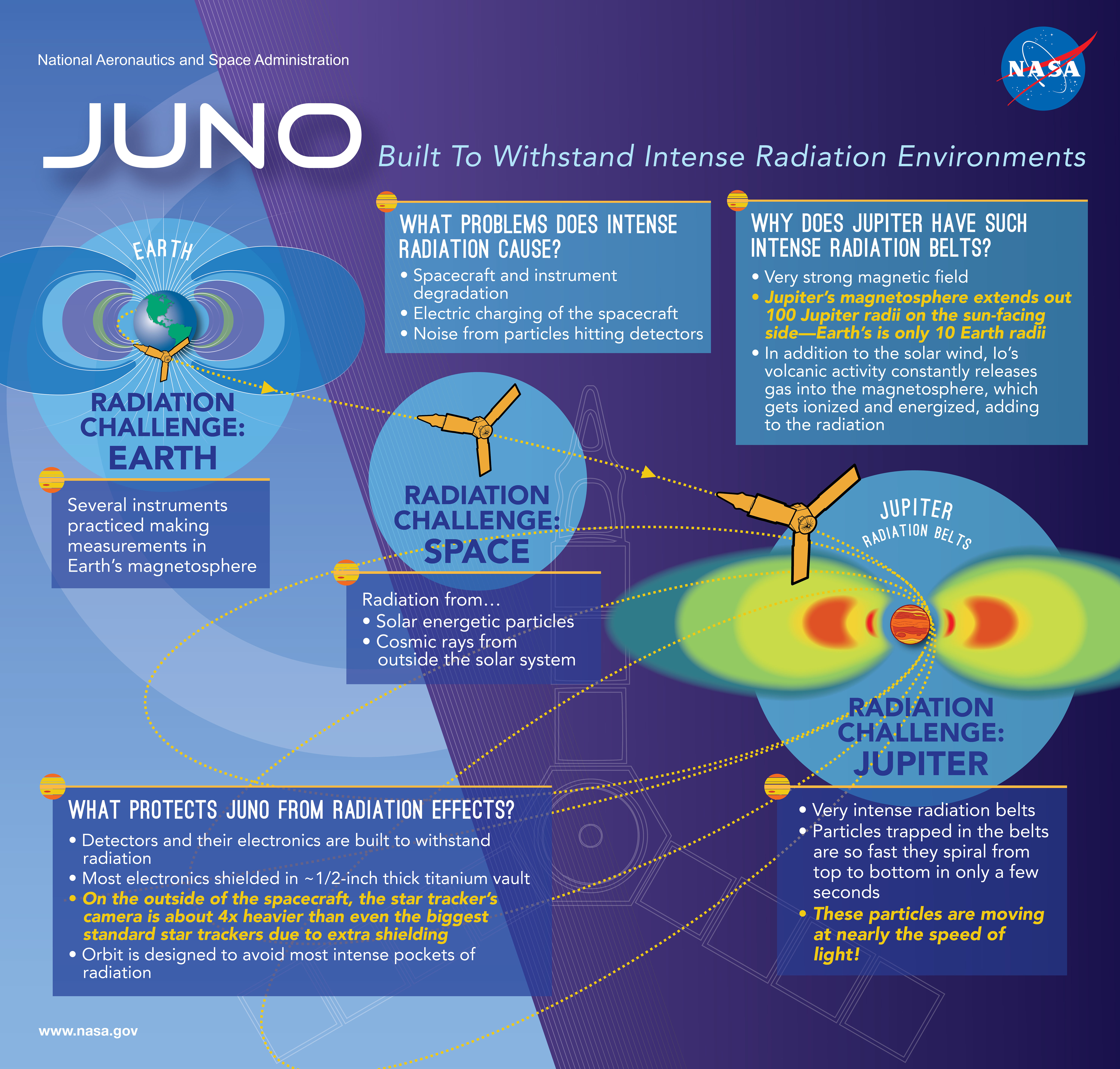
Here is an infographic (full size) about the harsh radiation environment that Juno will endure during its mission at the largest gas giant in our solar system:

PrintFull size version

Video: NASA TV coverage of arrival of Juno probe at Jupiter

NASA’s Juno spacecraft will fire its engine to go into orbit around Jupiter this evening: Live coverage: Juno spacecraft hours away from arriving at Jupiter – Spaceflight Now

By the time engineers on Earth receive confirmation of the start of Juno’s one-shot Jupiter Orbit Insertion burn at 11:18 p.m. EDT (0318 GMT), it will all be over.

If the firing goes according to plan, Juno will already be in orbit around Jupiter at that time, ground controllers won’t know for sure until 11:53 p.m. EDT (0353 GMT), when a tone sent by the spacecraft at the conclusion of the burn will be received by NASA’s Deep Space Network.

At Jupiter’s distance a half-billion miles away, it takes 48 minutes and 19 seconds for a radio signal to travel at the speed of light between Juno and Earth.

Here is a timeline of major events in the mission

NASA TV coverage:

This video from Juno shows the moons of Jupiter rotating around the planet as the spacecraft approached the Jupiter system:


Video: “Space to Ground” report on the ISS – July.1.16

The latest episode of NASA’s Space to Ground report on activities related to the Int. Space Station includes news about 3D printing and robotic spheres on the station: