Category Archives: Space Systems

Videos: Presentations at the NASA Innovative Advanced Concepts (NIAC) symposium

The NASA Innovative Advanced Concepts (NIAC) program held its annual NIAC Symposium this week in Raleigh, North Carolina. Videos of the presentations are now available on Livestream. (See also postings for previous NIAC symposiums.)

Here is a sampling of the sessions:

  • Joshua Rovey, University of Missouri, Rolla, Experimental Demonstration and System Analysis for Plasmonic Force Propulsion;
  • Philip Lubin, University of California, Santa Barbara, Directed Energy for Interstellar Study;
  • David Kirtley, MSNW, LLC, Magnetoshell Aerocapture for Manned Missions and Planetary Deep Space Orbiters

  • Michael VanWoerkom, Exoterra Resource, LLC , NIMPH: Nano Icy Moons Propellant Harvester;
  • Stephanie Thomas, Princeton Satellite Systems, Inc., Fusion-Enabled Pluto Orbiter and Lander;
  • Jonathan Sauder, NASA Jet Propulsion Laboratory, Automaton Rover for Extreme Environments (AREE);
  • Lynn Rothschild, NASA Ames Research Center, Urban biomining meets printable electronics: end-to-end destination biological recycling and reprinting

More about Stephanie Thomas’s presentation at NIAC Pluto mission talk now available online – Princeton Satellite Systems.

  • Robert Youngquist, NASA Kennedy Space Center, Cryogenic Selective Surfaces;
  • Melville Ulmer, Northwestern University, Further Development of Aperture: A Precise Extremely Large Reflective Telescope Using Re-configurable Elements;
  • Robert Skelton, Texas A&M University, Tensegrity Approaches to In-Space Construction of a 1g Growable Habitat

  • Bruce Wiegmann, NASA Marshall Space Flight Center, Heliopause Electrostatic Rapid Transit System “HERTS”;
  • Adrian Stoica, NASA Jet Propulsion Laboratory, Trans-Formers for Lunar Extreme Environments: Ensuring Long-Term Operations in Regions of Darkness and Low Temperatures;
  • Michael Paul, Pennsylvania State University, SCEPS in Space – Non-Radioisotope Power Systems for Sunless Solar System Exploration Missions

====
Video: ‘Space to Ground” report on the ISS – Aug.19.2016

Here is this week’s episode of NASA’s Space to Ground report on activities related to the Int. Space Station:

Videos: OSIRS-REx mission to the asteroid Bennu

On September 8th a ULA Atlas V rocket will launch the OSIRIS-REx (Origins, Spectral Interpretation, Resource Identification, Security-Regolith Explorer)  from Cape Canaveral. The spacecraft’s mission is to visit the asteroid Bennu and bring back a small sample of it to earth. Analysis of the sample will provide hints about the conditions of the early solar system and provide clues on such as to how water and organic molecules came to the Earth. The mission will also add to the general knowledge about asteroids including possible resources of use in space and on earth.

On Wednesday, NASA held a panel briefing to  discuss the meeting with the press:

This video describes the Bennu asteroid:

This video shows the trajectory of OSIRIS-REx reaches Bennu and returns to earth, taking advantage of the fact that the asteroid’s orbit is near earth and crosses earth’s:

Video: The story of the $50SAT Eagle2 pocketqube

Here is another video from the Electromagnetic Field event held in Guildford, UK earlier this summer (see previous posts A hacker’s guide to satellites and … An Intro to Rockets). Stuart Robinson tells the story of the $50Sat Eagle2 satellite that was launched to orbit in 2013:

More info about the project:

The PocketQube Shop sells components for the PocketQube satellite standard.

See also the HobbySpace Satellite Building  section on student and amateur satellites.

Here is a video of the launch of the Russian Dnepr rocket, a converted ICBM, on which the $50Sat got a free ride:


====

Interstellar laser driven lightsails, planetary defense, and the Voices of Humanity Kickstarter

The Planetary Radio program had a recent interesting interview with  Philip Lubin, Professor of Physics at UC Santa Barbara, and Travis Brashears, an undergrad at UC Berkeley, about their proposal to accelerate a tiny wafer sized lightsail spacecraft up to 10-25% of the speed of light using an array of lasers and sending the sail to a nearby star: Interstellar Dreams Turn Real – The Planetary Society

Lubin’s concept has become the baseline technology for the $100 million StarShot project announced last April by the Breakthrough Initiatives program.

VoicesOfHumanity-WaferSatSpacecraft
WaferSat Spacecraft

The key element of the concept is the use of a phased array of many commercially available lasers rather than one hugely powerful laser. The concept is presented on their Directed Energy website and on the DEEP-IN page at UCSB. Lubin’s team has won two grants from the NASA Innovative Advance Concepts (NIAC) program to develop the concept further: DEEP IN Directed Energy Propulsion for Interstellar Exploration –  NASA.

Lubin gave a seminar at the SETI Institute in 2014 about the use of such a phased array of lasers for not only propulsion but also for defense against large objects heading for earth: Video: Philip Lubin (UCSB) on planetary defense with beamed power. Find resources on this at DE-STAR (Directed Energy Planetary Defense).

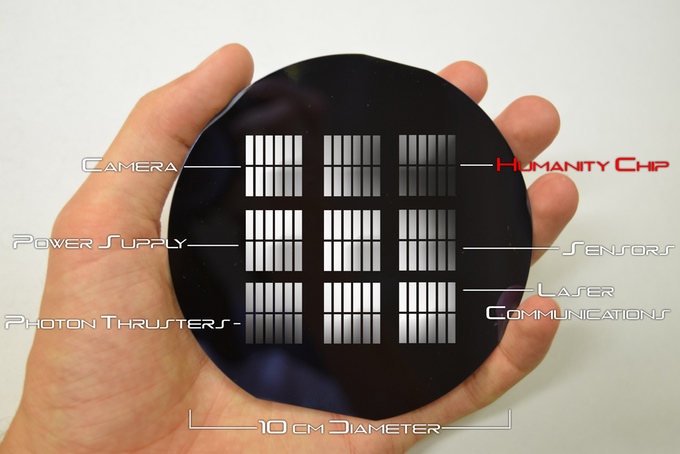
Lubin and Brashears recently opened a crowd-funding campaign to fund development of the Humanity Chip, which would carry all sorts of data submitted by the public to space in 2017 (not by laser) and eventually to another star: Voices of Humanity – The World’s Space Time Capsule by Prof. Philip Lubin & Travis Brashears — Kickstarter

Our goal is to directly engage all humanity in space exploration. We want to send your dreams and aspirations to the stars! With our basic funding goal of $30,000, we will put your data on a custom spacecraft that will be launched in 2017 initially into Low Earth Orbit (LEO), then to more distant missions to the moon, Mars, etc in subsequent missions. In the future, we intend to offer the Humanity Chip to all spacecraft being launched.

With 25 days to go, they have gotten $5,515 pledged towards a $30,000 goal.

Here are a couple of videos from the Kickstarter:


====