Category Archives: Space Systems

ExoMars: New images of the ExoMars Schiaparelli crash site

The European Space Agency‘s Trace Gas Orbiter (TGO) spacecraft went into orbit around Mars successfully last week. However, TGO’s companion on the ExoMars mission, the Schiaparelli lander demonstrator, went permanently silent when it neared the surface of the Red Planet. NASA’s Mars Reconnaissance Orbiter has taken pictures of the landing site and the mission team will use the images to try to understand what happened in the final seconds of Schiaparelli’s fatal fall:

Here is NASA’s statement on the MRO images:

Further Clues to Fate of Mars Lander, Seen From Orbit

pia21131-hirise_of_edm1
This Oct. 25, 2016, image from the HiRISE camera on NASA’s Mars Reconnaissance Orbiter shows the area where the Europe’s Schiaparelli test lander struck Mars, with magnified insets of three sites where spacecraft components hit the ground. It adds detail not seen in earlier imaging of the site. Credits: NASA/JPL-Caltech/Univ. of Arizona

The most powerful telescope orbiting Mars is providing new details of the scene near the Martian equator where Europe’s Schiaparelli test lander hit the surface last week.

An Oct. 25 observation using the High Resolution Imaging Science Experiment (HiRISE) camera on NASA’s Mars Reconnaissance Orbiter shows three impact locations within about 0.9 mile (1.5 kilometers) of each other.

The scene shown by HiRISE includes three locations where hardware reached the ground. A dark, roughly circular feature is interpreted as where the lander itself struck. A pattern of rays extending from the circle suggests that a shallow crater was excavated by the impact, as expected given the premature engine shutdown. About 0.8 mile (1.4 kilometers) eastward, an object with several bright spots surrounded by darkened ground is likely the heat shield. About 0.8 mile (1.4 kilometers) south of the lander impact site, two features side-by-side are interpreted as the spacecraft’s parachute and the back shell to which the parachute was attached. Additional images to be taken from different angles are planned and will aid interpretation of these early results.

The test lander is part of the European Space Agency’s ExoMars 2016 mission, which placed the Trace Gas Orbiter into orbit around Mars on Oct. 19. The orbiter will investigate the atmosphere and surface of Mars and provide relay communications capability for landers and rovers on Mars.

Data transmitted by Schiaparelli during its descent through Mars’ atmosphere is enabling analysis of why the lander’s thrusters switched off prematurely. The new HiRISE imaging provides additional information, with more detail than visible in an earlier view with the Context Camera (CTX) on the Mars Reconnaissance Orbiter.

With HiRISE, CTX and four other instruments, the Mars Reconnaissance Orbiter has been investigating Mars since 2006.

The University of Arizona, Tucson, operates HiRISE, which was built by Ball Aerospace & Technologies Corp. of Boulder, Colorado. NASA’s Jet Propulsion Laboratory, a division of Caltech in Pasadena, California, manages the Mars Reconnaissance Orbiter Project for NASA’s Science Mission Directorate, Washington. Lockheed Martin Space Systems, Denver, built the orbiter and collaborates with JPL to operate it. For additional information about the project, visit: mars.nasa.gov/mro
Video: Int. Space Station fisheye fly-through at 4K (Ultra HD)

In this video, fly through the International Space Station at the 4k resolution setting for a super high definition tour of the orbital facility:

Videos: ‘Space to Ground’ report on ISS + TMRO Spacepod on ISS cargo

Two launches highlight the latest Space to Ground report from NASA on activities related to the Int. Space Station:

[ Update Oct.21.2016: Here are videos of the Soyuz with three new crew members docking at the ISS today and then entering the station:

After launching on Oct. 19, in their Soyuz MS-02 spacecraft from the Baikonur Cosmodrome in Kazakhstan, Expedition 49/50 Soyuz Commander Sergey Ryzhikov and Flight Engineer Andrey Borisenko of Roscosmos and Flight Engineer Shane Kimbrough of NASA arrived at the International Space Station on Oct. 21 to complete their two-day journey.

A few hours after docking to the International Space Station on Oct. 21, Expedition 49/50 Soyuz Commander Sergey Ryzhikov and Flight Engineer Andrey Borisenko of Roscosmos and Flight Engineer Shane Kimbrough of NASA, opened the hatch of their Soyuz MS-02 spacecraft and were greeted by station Commander Anatoly Ivanishin of Roscosmos and Flight Engineers Kate Rubins of NASA and Takuya Onishi of the Japan Aerospace Exploration Agency.

]

===

And here is a TMRO.tv Spacepod report on some of the cargo that was launched to the ISS: Cygnus carries cool cargo to Station – Space Pod 10/12/16 – TMRO

This week Lisa Stojanovski investigates the cargo onboard the next Cygnus to fly – including two Spire Cubesats, Cool Flames, and brand new lights.

TMRO Space Pods are crowd funded shows. If you like this episode consider contributing to help us to continue to improve. Head over to http://www.patreon.com/spacepod for information, goals and reward levels. Don’t forget to check out our weekly live show campaign as well over at http://www.patreon.com/tmro


====

Videos: Asteroid mining + 3D printing in space + Smallsats

Here is an interview with Chris Lewicki, chief of the asteroid mining company Planetary Resources:

As Humans venture out far away from the Earth into the solar system, they will need material resources to keep us going. Where do we get those from? One for-profit company, Planetary Resources, wants to be the one to make it happen.

We had a chance to speak with the company’s President and CEO, Chris Lewicki about the company’s plans to survey, prospect, and exploit near-Earth asteroids. The company has a lot of financial backing and has plans to send its first satellite to an asteroid in 2020.

This interview was originally broadcast as part of our ongoing Facebook Live segment, The Convo: www.facebook.com/PCMag/videos…

====

Jason Dunn, CTO of Made In Space, talks about the role of 3d printing in space development:

NASA intern turned Silicon Valley entrepreneur, Jason Dunn, saw what was holding humans back from colonizing outer space…and decided to do something about it. With his company Made in Space’s cutting-edge 3D printer, astronauts can break their reliance on costly resupply missions from Earth and—for the first time ever—build new supplies for themselves in space. Dunn and his team believe their invention will usher in a new era of dramatic progress in space.

===

Craig Clark, CEO of Clyde Space in Scotland, talks about their smallsat projects:

Update: An interview about long time space advocate and entrepreneur Rick Tumlinson and the New Worlds Conferences:

Webcast coverage of the ExoMars arrival at the Red Planet

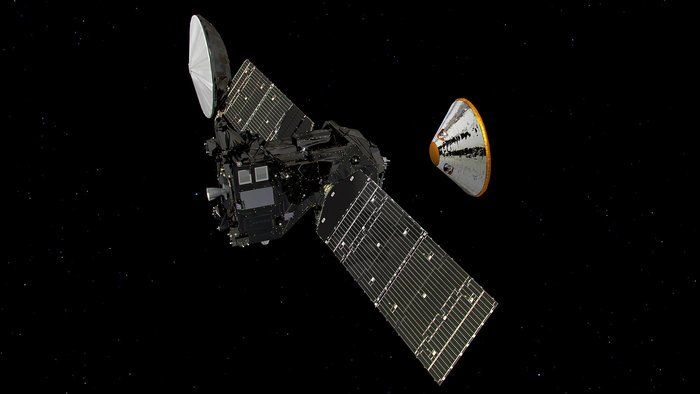
The European/Russian ExoMars mission is nearing the Red Planet. The spacecraft consists of two parts: the Trace Gas Orbiter (TGO) and the Schiaparelli lander. On Sunday, Oct. 16th the two will separate and on Wednesday, Oct. 19th the TGO will go into orbit and Schiaparelli will make its landing.

exomars_2016_separation_node_full_image_21
Artist’s impression visualising the separation of the ExoMars entry, descent and landing demonstrator module, Schiaparelli, from the Trace Gas Orbiter (TGO). The separation is scheduled to occur on 16 October 2016, about seven months after launch. Schiaparelli is set to enter the martian atmosphere on 19 October, while TGO will enter orbit around Mars.

Webcasts reports will cover the events on both days:

The Live coverage overview

16 October – spacecraft separation

In addition to text updates here and via our twitter channels, a short statement confirming the outcome of the separation will be streamed live from the main control room of ESA’s Spacecraft Operations Centre starting at 14:30 GMT / 16:30 CEST.

19 October – landing and arriving at Mars

Live coverage of ExoMars Trace Gas Orbiter arrival and Schiaparelli landing on Mars will begin with our Social TV programme via ESA’s Facebook page and Livestream 13:00–15:15 GMT / 15:00–17:15 CEST on 19 October.

The ESA TV programme will be broadcast on this page in two parts on 19 October:

15:44–16:59 GMT / 17:44–18:59 CEST
18:25–20:03 GMT / 20:25–22:03 CEST

20 October – status report and first images

A press conference is scheduled for 20 October at 08:00 GMT / 10:00 CEST, when a mission status update is expected, along with the first images from the Schiaparelli descent camera. This will also be streamed live via the player above.

For additional mission status text updates starting 14 October, see here.

====