Category Archives: Space Systems

Lots of rocket launches planned for next 10 days

Several rocket launches around the world are scheduled for the next couple of weeks. Most of these will be webcast.

** Rocket Lab Electron – Nov.10/11, 10 p.m.-2 a.m. EST (0300-0700 GMT on 11th) – Rocket Lab is ready to put several commercial smallsats into low earth orbit on the third Electron launch from New Zealand (see earlier posting).

** Northrop Grumman Antares – Nov.15 – Thursday – 4:49 a.m. EST (0949 GMT) Wallops Island, Virginia. The Northrop Grumman Antares rocket will send a Cygnus spacecraft with cargo to the ISS.

** SpaceX Falcon 9 – Nov. 15, 3:46-5:29 p.m. EST (2046-2229 GMT Kennedy Space Center. The F9 will send the Es’hail 2 communications satellite into geostationary transfer orbit for Es’hailSat of Qatar.

** Russian Soyuz – Nov.16, 1:14 p.m. EST (1814 GMT) – The Soyuz rocket will send a Progress cargo spacecraft to the ISS.

** SpaceX Falcon 9 – Nov.19, 1:32 p.m. EST; 10:32 a.m. PST (1832 GMT) Vandenberg AFB, California. The F9 will put over 70 satellites from 50+ customers into low earth orbit on the SSO-A mission organized by Spaceflight Services.

Other launches coming up but no times fixed yet:

  • Geosynchronous Satellite Launch Vehicle Mk. 3 (GSLV Mk.3-D2) – Nov.14? Satish Dhawan Space Center, Sriharikota – India’s biggest rocket is to launch the GSAT 29 communications from .
  • Chinese Long March 3B – Nov.19? Xichang, China – The LM-3B is to put 2 Beidou navigation satellites into medium earth orbit.
  • Northrop Grumman Pegasus XL air launch out of Kennedy Space Center. An attempt to launch the ICON spacecraft to study the Earth’s Ionosphere was scrubbed last week and no new target date is set yet.

====

Telescopes and Binoculars at Amazon

Video: TMRO Orbit 11.43 – Dawn and Kepler goodbyes, ISS 8k video, & Soyuz failure

The latest episode of TMRO.tv Space is on line: Goodbye to Dawn and Kepler, 8K video from Space and Soyuz Failure Investigation – Orbit 11.43 – TMRO

We tweaked the roundtable news format a bit. Still working on timing for this as clearly we’re going suuuuuuuper long. But fun nonetheless. Lisa, Mike, Cariann, Jared and Benjamin nerd out over the latest comic happenings while interacting with the community! Would love your feedback and what we’re doing right and wrong here.

Launch news covered:

Zhuque-1 | Weilai-1
Long March 2C | CFOSat
H-IIA | GOSAT-2
Long March 3B | Beidou-3 G1Q/GEO-1

Space News:

First 8K footage from space
Goodbye Dawn, Goodbye Kepler
Investigation completed on the Soyuz MS-10 launch failure
Science at 28163 km per hour – ISS Science Update
Yep, We’ve Got A Black Hole

====

Check out the Best Selling Electronics at Amazon

Videos: IAC 2018 presentations

Some of the presentations at the most recent International Astronautical Congress (IAC 2018) have been posted on Youtube. Here is a sampling:

** Reusability: The Key to Reliability and Affordability – Hans Koenigsmann, SpaceX

[ Oct.29.2018: For some reason, this video was removed from the IAC 2018 video play list. Hopefully, this is temporary. In the meantime, these two videos made by a person in the audience show Koenigsmann’s talk. The audio and video quality are actually pretty good.

]

** URBAN: Conceiving a Lunar Base Using 3D Printing Technologies

** The Next Generation Plenary – Small Sats – Involving Everyone through Their Applications

** Commercial Platforms on the International Space Station – New Low Cost Opportunities for Commercial and Institutional Missions

====

The High Frontier: An Easier Way


Videos: “Space to Ground” ISS report – Oct.26.2018

The two most recent Space to Ground reports from NASA on activities related to the International Space Station:

A brief video about research aboard the ISS

====

Einstein’s Monsters: The Life and Times of Black Holes


Video: A spacecraft magnetic shield for solar and galactic radiation

The earth’s magnetic field and the atmosphere protect life from much of the radiation prevalent in space. That radiation consists primarily of two types: energetic charged particles from the sun and super-energetic particles, typically referred to as galactic cosmic rays (GCR), from deep space sources far beyond our solar system.

The sun’s particles, mostly protons and electrons, can be quite intense during a solar storm but are in an energy range such that a modest amount of shielding will block them. Though they are above the atmosphere, crews on the ISS are fairly well protected by the deflection properties of the earth’s magnetic fields. (Particles trapped by these fields create the Van Allen Belts and the aurora at the north and south poles.)

Cosmic rays, on the other hand, are very sparse but their extremely high energies makes them difficult to shield against. And a bit of shielding can, in fact, be a bad thing since when a GCR runs into another particle, it will create a shower of many additional particles, which if not blocked by additional shielding, will greatly multiply the radiation dosage to any living tissue they encounter.

Cosmic ray shower. Credits: John Slough, 2018 NIAC Symposium

They are so energetic, cosmic rays are hardly affected by the earth’s magnetic fields. However, the earth’s atmosphere is thick enough to absorb most of them such that the showering particles are either blocked or converted to particles like muons that interact every little and are eventually absorbed deep in the earth’s surface.

For human settlements on the Moon, Mars or other body, the local materials can provide material shielding sufficient to block both solar radiation and cosmic rays. For spacecraft traveling in space, keeping the total mass as minimal as possible is a top design requirement, at least with current propulsion systems. While solar radiation can be fairly easily blocked (an extra heavily shielded “safe room” could be available during a solar flare), cosmic rays are much more problematic. Designing spacecraft habitats inside out such that a crew on the way to, say, Mars is surrounded by all the equipment, food storage containers, fuel tanks, etc. would definitely help but could still result in substantial cumulative dosages. (Even those dosages, though, are likely to be minor risks compared to all the other risks on a Martian mission.)

An alternative, or supplement, to material shielding is to use a magnetic field that deflects particles from the spacecraft’s habitat. Such a system should be designed in such a way that no magnetic fields reside inside the internal volume of the spacecraft where people live.

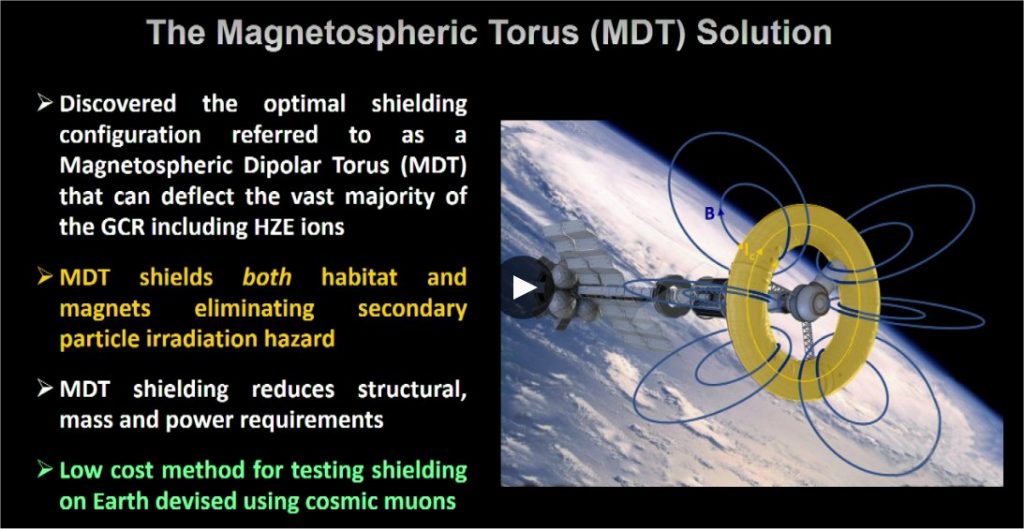
There have been various designs proposed over the years for magnetic shields. During the recent NIAC Symposium (see earlier posting), plasma physicist John Slough described what looks to be a viable design that he calls the Magnetospheric Torus (MDT). It appears to be doable with current technology, e.g. high-temperature superconducting magnets are now commonplace, and is quite effective, even for the highest energy GCR.

The Magnetospheric Torus (MDT) provides protection against GCR. Credits: John Slough, 2018 NIAC Symposium

A prototype system can be tested and optimized on earth by examining how well the system deflects all those muons flowing through us constantly. Slough describes the MDT design in this video of his NIAC talk (his presentation starts at around 27:00):

Space radiation is often portrayed in the press as some sort of deal-breaker for long distance spaceflight. That is simply not true. Whether building really big spaceships that allow for a lot of material shielding or using magnetic shielding (or employing both approaches), radiation can be dealt such that it becomes a relatively minor issue.

====

Genesis: The Story of Apollo 8: The First Manned Mission to Another World