Category Archives: Space Systems

“Ham TV” becomes operational on the ISS

The ESA reports on TV transmission using the amateur radio station on the ISS:

Ham video premiers on Space Station

5 May 2014: Astronauts on the International Space Station can now talk with people on Earth with video using simple transmitters. ‘Ham TV’ has been set up in ESA’s Columbus laboratory and already used for talking with ground control.


Commissioning of the  ISS Ham TV

Amateur radio enthusiasts have been able to poll astronauts circling our planet using standard radio equipment since the Station was inaugurated in 2000. Radio signals easily reach the orbital outpost flying 350 km above us on sets readily available to radio enthusiasts.

The new Ham TV adds a visual dimension, allowing an audience on the ground to see and hear the astronauts.

Ham TV equipment

The hardware, developed by Kayser Italia, was sent to the Station on Japan’s space freighter in August last year and connected to an existing S-band antenna on Columbus.

Ham video in action

NASA astronaut Mike Hopkins had the honour of being the first to commission the unit and broadcast over Ham TV. He had a video chat with three ground stations in Italy: Livorno, Casale Monferrato and Matera. The crew finished commissioning the set-up on 12 April for general use.

Just like standard television, the video signal is one way. The astronauts cannot see their audience but they will still be able to hear them over the traditional amateur radio on the Station.

Ham TV ground station

Contacts are brief – the connection requires direct line of sight and the Station’s 28 800 km/h means it quickly passes through the field of view of amateur stations.

ESA has provided five ground antennas and equipment to the Amateur Radio on the International Space Station organisation to receive video from the Station. These stations can be transported easily and positioned to follow the laboratory as it flies overhead. Linked together in this way, the stations can supply up to 20 minutes of contact at a time.

Ham TV will add to ham radio for space educational purposes, offering schoolchildren the chance to talk and see astronauts in space with simple equipment.

Anybody can still hail the Station via radio and, if an astronaut floats by the always-on receiver, they might just pick up and answer the call.

For more information on how to get involved and organise an educational event, contact the Amateur Radio on the International Space Station organisation.
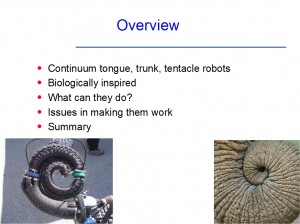
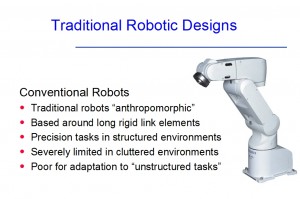
FISO: Continuum trunk & tentacle robots for space – Ian Walker, Clemson

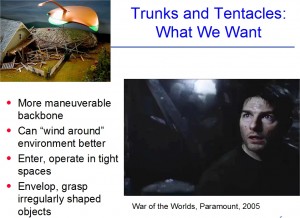
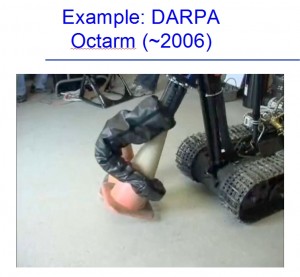
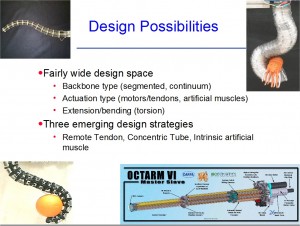
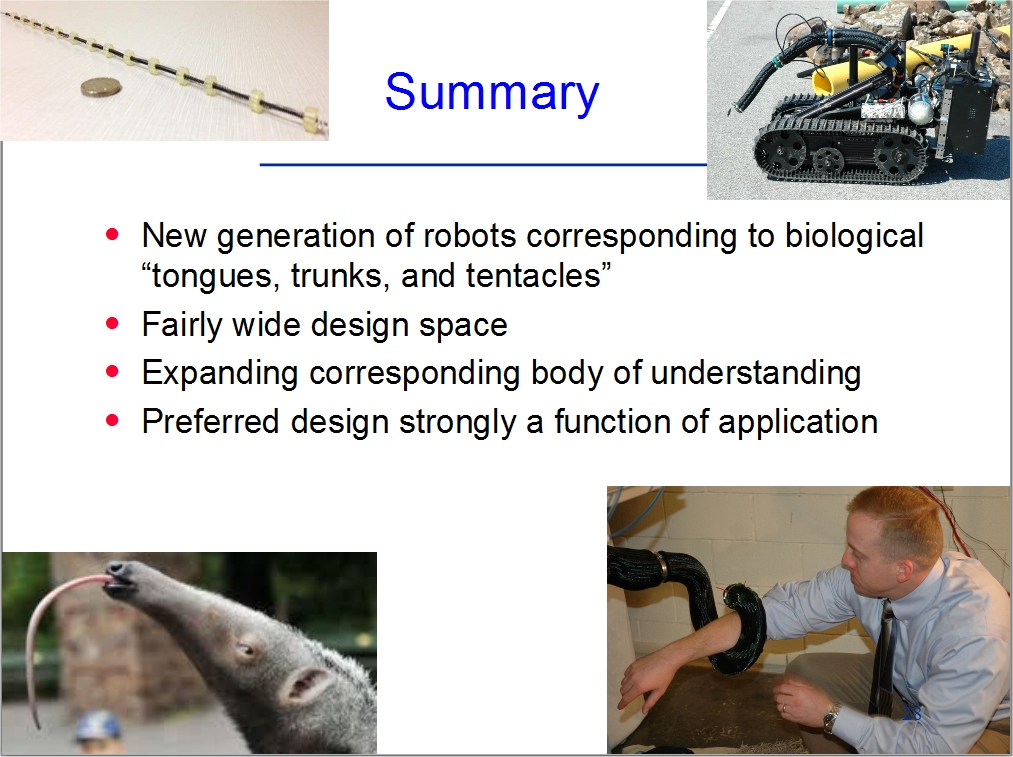
The latest presentation to the Future In-Space Operations (FISO) study group is now posted in the FISO Working Group Presentations Archive. Slides and movies are available in a zip file and there is an audio (mp3) available for the talk, Continuum Trunk and Tentacle Robots for Space Applications, Ian Walker , Clemson University – April.30.2014.

Here is a sampling of Walker’s slide’s:

Overview

TraditionalRobots

TrunksAndTentacles

Octarm

Designs


Summary

Video: Space to Ground report on ISS

NASA’s latest Space to Ground video reports on the past week’s activities on the Int. Space Station:

NASA announces Z-2 EVA spacesuit design style contest winner

I wrote a post here at the end of March about NASA’s Z-2 Spacesuit contest. They announced the winner on Thursday:

NASA’s Next Prototype Spacesuit has a Brand New Look,
and it’s All Thanks to You

With 233,431 votes, the “Technology” option has won NASA’s Z-2 Spacesuit design challenge with just over 63% of the total vote. This design now will be incorporated into the final version of the suit, which is expected to be ready for testing by November 2014.

z2_final_0

NASA’s Z-2 suit is the newest prototype in its next-generation spacesuit platform, the Z-series. With the agency laser focused on a path to Mars, work to develop the technologies astronauts one day will use to live and work on Mars has already begun. Each iteration of the Z-series will advance new technologies that one day will be used in a suit worn by the first humans to step foot on the Red Planet.

There are many key advances to be found in the Z-2 suit when compared to the previous Z-1. The most significant is that the Z-1 had a soft upper torso and the Z-2 has a hard composite upper torso. This composite hard upper torso provides the much-needed long-term durability that a planetary Extravehicular Activity (EVA) suit will require. The shoulder and hip joints differ significantly based on extensive evaluations performed during the last two years with the Z-1 to look at different ways of optimizing mobility of these complex joints. Lastly, the boots are much closer in nature to those that would be found on a suit ready for space, and the materials used on the Z-2 are compatible with a full-vacuum environment.

Besides the typical fit checks and mobility evaluations, NASA currently is planning a very comprehensive test campaign for the Z-2 suit. Engineers will conduct multiple vacuum chamber tests, including one series at full vacuum, mimicking the lack of atmosphere found in space. The suit will be tested at NASA’s Johnson Space Center in Houston in the Neutral Buoyancy Lab, the huge indoor pool used to train astronauts to spacewalk. Further testing at a site at Johnson that imitates the rocky Martian surface  will help evaluate the suit’s mobility, comfort and performance. Ultimately, all of these tests will guide engineers in designing the Z-3.

With the Z-2, NASA will employ cover layer design elements, like electroluminescent wiring, never used before in a spacesuit. The designs that were available for voting were produced in collaboration with ILC Dover, the primary suit vendor, and Philadelphia University. The intent of the designs was to highlight certain mobility features for testing. To take it a step further, NASA offered the public the opportunity to decide which of three candidates will be built.

Because the Z-series is still in the prototype, or non-flight, phase, the design won’t be making a trip to space. The cover layer of a non-flight suit still performs an important function in ground-based testing. The cover protects the lower layers and technical details from abrasion and snags during testing. It also serves to provide the suit with an aesthetic appeal. The cover layer on flight suits used for spacewalks performs many other important functions like protecting the spacewalker from micrometeorite strikes, the extreme temperatures in space and the harmful effects of radiation. These requirements drive selection of specific high-performance materials and design details that aren’t necessary at this stage in a prototype suit.

NASA’s Z-2 Spacesuit is a project under the Advanced Exploration Systems Division which pioneers the development and demonstration of new technologies for future human missions beyond Earth orbit as part of the Human Exploration and Operations Mission Directorate.

Engineers and scientists around the country are working hard to develop the technologies astronauts will use one day to live and work on Mars and safely return home from the next giant leap for humanity. Follow our progress at www.nasa.gov/exploration and http://www.nasa.gov/mars.

Video: Dr. Gerald Cleaver on Icarus Interstellar, warp drive, and matter/antimatter propulsion

Project Persephone is an effort by the Icarus Interstellar group to design a workable generation ship for making a trip to a distant star: Project Persphone: British Scientists Building ‘Living Space Ark’ To Save Humanity – Huffington Post

===

Prof. Gerald Cleaver is a noted theoretical physicist in string theory at Baylor University and a member of the Icarus Interstellar team. In this video of a luncheon presentation at NASA JSC,  he gives a fascinating talk (aimed at a general audience) about the Icarus group, about interstellar flight, the possibilities of making Alcubeirre Warp Drive a reality (he says string theory is key!), and a couple of ways to create large amounts of antimatter for propulsion :