Category Archives: Education

Virtual SpaceTV 3D – June 2014

Here is the latest episode of The Virtual SpaceTV 3D show with Amanda Bush. The programs are created by BINARY SPACE (www.binary-space.com) with story content from HobbySpace.com.

In this show, Amanda Bush talks about the following topics:
01:27 – 04:32 A better Dragon on Stage
04:33 – 06:09 Virgin Galactic likes Nylon
06:10 – 07:36 Google to fill the Sky with Satellites
07:37 – 09:06 A new Look in NASA Space Suits
09:07 – 10:01 A new Mars Crater

Previous Virtual SpaceTV 3D shows are available on the  HobbySpace Youtube Channel.

These videos are intended as educational programs and as demonstrations of an experimental technique for generating animated presentations. The show was generated autonomously by software according to a text script. The project is described in the Virtual Producer whitepaper (Release 1.1, Oct.2013, pdf). For further information contact info@binary-space.com.

RockOn! sounding rocket flies student payloads to space

I posted recently about the  rocket week at NASA Wallops involving over 60 college students and faculty who were learning to build and prepare science payloads for rocket flights. Today their experiments flew successfully on a sounding rocket. There will be another launch on Saturday (webcast here).  Here is a report from NASA:

RockOn Sounding Rocket Launches Successfully

The RockOn sounding rocket launches successfully.
The sounding rocket carrying the RockOn student-built
payloads launches from the Wallops Flight Facility.
Image Credit: NASA/G. Qian

The RockOn Terrier-Improved Orion sounding rocket containing multiple student-built experiments launched successfully at 7:21 a.m. EDT on June 26, 2014 from NASA’s Wallops Flight Facility in Virginia. The payload was recovered and has been returned to Wallops.  The students will conduct their preliminary analysis on their experiments later this afternoon. According to the preliminary information, the payload flew to an altitude of 73.3 miles and landed via parachute 43.9 miles from Wallops Island in the Atlantic Ocean 12.16 minutes after launch.

The next launch from Wallops will be a Terrier-Improved Malemute sounding rocket carrying the SubTec-6 payload between 4 and 5 a.m., Saturday, June 28.  Backup launch days run through July 2. More information on the SucTec-6 mission is available at: www.nasa.gov/wallops.  Ustream coverage of the mission will begin at 3:30 a.m. on the Wallops Ustream site at http://www.ustream.tv/channel/nasa-tv-wallops

===

Two video views of today’s launch:

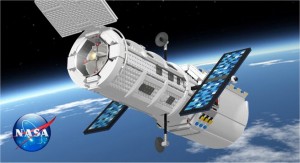
The Hubble observatory in LEGO

A great looking model of the Hubble telescope is on display at LEGO Ideas – The Hubble Space Telescope. The site will consider turning a scratch built model like this into a production product if there is enough interest shown.

HubblebyGRusso

Amateur Radio on the ISS (ARISS) going strong

The ARISS (Amateur Radio on the ISS)  activities were highlighted during the ISS Research & Development Conference held last week in Chicago: Amateur Radio Role on Space Station Featured at ISS Research and Development Conference – ARRL

ARISS is the first and longest continuously running educational outreach program involving the International Space Station. The first ARISS school contact took place in late 2000, and nearly 900 such Amateur Radio contacts have taken place since then. ARISS functions with participation from the ARRL, NASA, the European Space Agency (ESA), the Russian Space Agency (ROSCOSMOS), CNES, JAXA,CSA and AMSAT. It allows students, as part of a science and technology curriculum, to speak with a member of the ISS crew and ask questions about life in space or other space-related topics.

ARISS conducts about 100 such school contacts per year, each about 10 minutes long — the time of a typical ISS pass — with students in the US and around the world. Preparation for the ARISS experience motivates both students and teachers to further their educations. Educators involved in an ARISS event can learn about electronics and wireless technology through the hands-on training provided in an ARRL Teachers Institute on Wireless Technology session — several are held each year. In similar fashion, youngsters preparing for a contact with an ISS crew member may learn about radio waves, space technology, science experiments onboard the ISS, geography, and the space environment. Some 15,000 students are touched directly by an ARISS contact each year, and many more become aware the program and its benefits either directly or via news media coverage resulting from an event.

See also the  ISS Fan Club for more about amateur radio on the ISS.

Program sends educators to Space Camp

The Honeywell Educators @ Space Academy project sends teachers to Space Camp in Huntsville, Alabama:

this professional development program is designed to help middle school math and science teachers from around the world become more effective educators in science, technology, engineering, and math. Educators are empowered with supplemental teaching techniques through simulated astronaut training and innovative educational tools that help bring science to life in the classroom.

Here’s are article about teachers in Illinois who participated in the program: At Space Academy, teachers learn to help students reach for the stars – Chicago Sun-Times.