Category Archives: Education

Citizen Science Milky Way Project finds new ‘Yellowballs” star formation features

NASA JPL highligs citizen science:

Citizen Scientists Lead Astronomers to
Mystery Objects in Space

Sometimes it takes a village to find new and unusual objects in space. Volunteers scanning tens of thousands of starry images from NASA’s Spitzer Space Telescope, using the Web-based Milky Way Project, recently stumbled upon a new class of curiosities that had gone largely unrecognized before: yellow balls. The rounded features are not actually yellow — they just appear that way in the infrared, color-assigned Spitzer images.
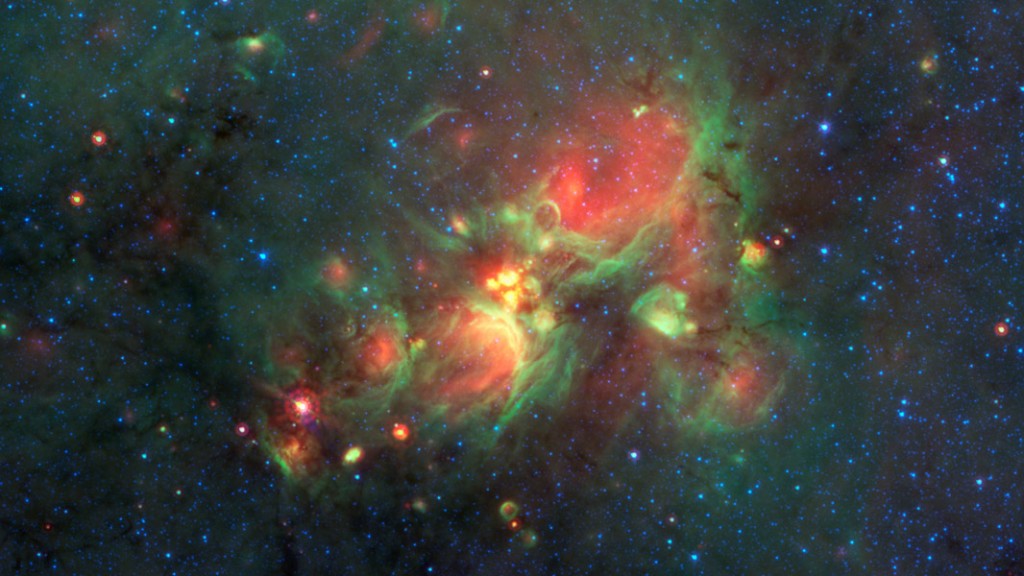
PIA18908_ip[1]Finding ‘Yellow Balls’ in our Milky Way galaxy

“The volunteers started chatting about the yellow balls they kept seeing in the images of our galaxy, and this brought the features to our attention,” said Grace Wolf-Chase of the Adler Planetarium in Chicago. A colorful, 122-foot (37-meter) Spitzer mosaic of the Milky Way hangs at the planetarium, showcasing our galaxy’s bubbling brew of stars. The yellow balls in this mosaic appear small but are actually several hundred to thousands of times the size of our solar system.

“With prompting by the volunteers, we analyzed the yellow balls and figured out that they are a new way to detect the early stages of massive star formation,” said Charles Kerton of Iowa State University, Ames. “The simple question of ‘Hmm, what’s that?’ led us to this discovery.” Kerton is lead author, and Wolf-Chase a co-author, of a new study on the findings in the Astrophysical Journal.

The Milky Way Project is one of many so-called citizen scientist projects making up the Zooniverse website, which relies on crowdsourcing to help process scientific data. So far, more than 70 scientific papers have resulted from volunteers using Zooniverse, four of which are tied to the Milky Way Project. In 2009, volunteers using a Zooniverse project called Galaxy Zoo began chatting about unusual objects they dubbed “green peas.” Their efforts led to the discovery of a class of compact galaxies that churned out extreme numbers of stars.

In the Milky Way Project, volunteers scan through images that Spitzer took of the thick plane of our galaxy, where newborn stars are igniting in swaths of dust. The infrared wavelengths detected by Spitzer have been assigned visible colors we can see with our eyes. In addition to the yellow balls, there are many green bubbles with red centers, populating a landscape of swirling gas and dust. These bubbles are the result of massive newborn stars blowing out cavities in their surroundings. The green bubble rims are made largely of organic molecules called polycyclic aromatic hydrocarbons (PAHs), cleared away by blasts of radiation and winds from the central star. Dust warmed by the star appears red in the center of the bubbles.

Volunteers have classified more than 5,000 of these green bubbles using the project’s Web-based tools. When they started reporting that they were finding more reoccurring features in the shape of yellow balls, the Spitzer researchers took note and even named the features accordingly. In astronomy and other digital imaging, yellow represents areas where green and red overlap. So what are these yellow balls?

A thorough analysis by the team led to the conclusion that the yellow balls precede the green bubble features, representing a phase of star formation that takes place before the bubbles form.

“The yellow balls are a missing link,” said Wolf-Chase, “between the very young embryonic stars buried in dark filaments and newborn stars blowing the bubbles.”

“If you wind the clock backwards from the bubbles, you get the yellow ball features,” said Kerton.
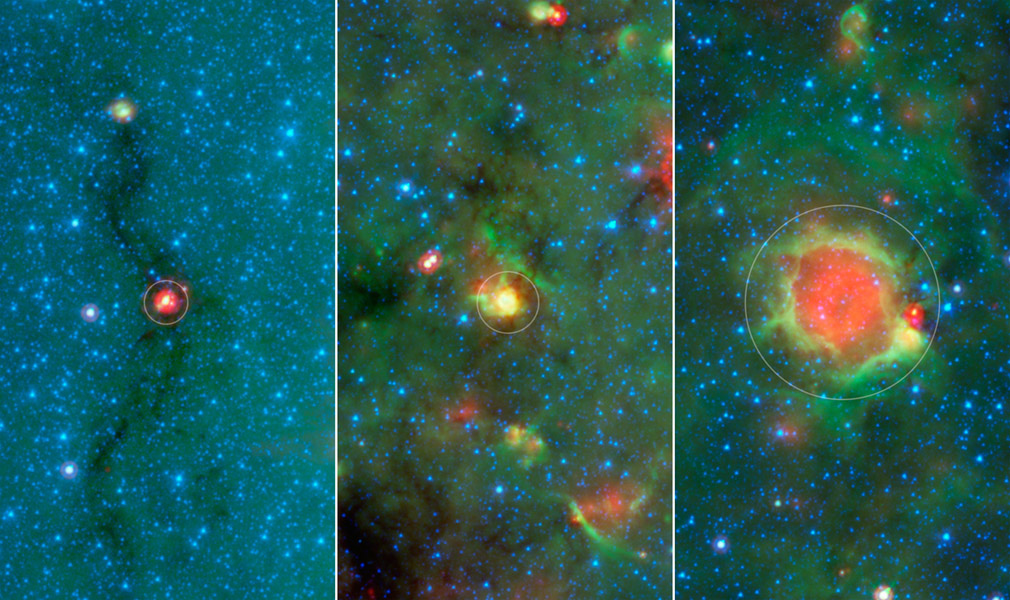
PIA18909_ip[1]Evolution of a massive star

The researchers explained why the yellow balls appear yellow: The PAHs, which appear green in the Spitzer images, haven’t been cleared away by the winds from massive stars yet, so the green overlaps with the warm dust, colored red, to make yellow. The yellow balls are compact because the harsh effects of the massive star have yet to fully expand into their surroundings.

So far, the volunteers have identified more than 900 of these compact yellow features. The next step for the researchers is to look at their distribution. Many appear to be lining the rims of the bubbles, a clue that perhaps the massive stars are triggering the birth of new stars as they blow the bubbles, a phenomenon known as triggered star formation. If the effect is real, the researchers should find that the yellow balls statistically appear more often with bubble walls.

“These results attest to the importance of citizen scientist programs,” said Wolf-Chase. Kerton added, “There is always the potential for serendipitous discovery that makes citizen science both exciting for the participants and useful to the professional astronomer.”

NASA’s Jet Propulsion Laboratory, Pasadena, California, manages the Spitzer Space Telescope mission for NASA’s Science Mission Directorate, Washington. Science operations are conducted at the Spitzer Science Center at the California Institute of Technology in Pasadena. Spacecraft operations are based at Lockheed Martin Space Systems Company, Littleton, Colorado. Data are archived at the Infrared Science Archive housed at the Infrared Processing and Analysis Center at Caltech. Caltech manages JPL for NASA.

For more information about Spitzer, visit: spitzer.caltech.edu and www.nasa.gov/spitzer.

Video: High school team develops robot to release weather balloons before Cape launches

A high school group has built a robotic system for releasing balloons to test upper atmosphere winds before launches at Cape Canaveral. This is useful in lightning conditions when people are restricted from releasing them out in the open: Students’ pink robot could save space industry millions – Florida Today –

For decades, specialists at the Air Force station’s weather balloon facility would brave blustery or otherwise bad conditions to release large white weather balloons by hand. But when lightning was too close, no balloons got launched.

Now, a hot-pink robot built by local high school students is rolling to the rescue.

“Even if you save one launch, it’s worth it,” Nick McAleenan, 16, told media members crowded outside the Air Force station’s weather balloon facility to see the robot in action.

“PINK Team,” a robotics team of students from Rockledge, Cocoa Beach, Viera and Space Coast high schools, fashioned a clever way to release weather balloons without risking human life.

[See video at linked page – can’t stop the autoplay if embedded here so removed it.]

The PINK team got its name as follows:

The girls on the team won out on the choice of team name and color. Bradley says the boys had skipped out on that team meeting.

“The guys were out surfing that day,” Bradley said. “Out of spite, the girls picked pink.”

Challenger Center marks 29 years since the Shuttle tragedy

A message from the  Challenger Center for Space Science Education:

Challenger Center Marks 29 Years Since Shuttle Tragedy

Crew’s Legacy Lives On in Thriving STEM Education Organization

WASHINGTON (January 26, 2015) – Challenger Center for Space Science Education (Challenger Center) and its network of 44 Centers around the globe will honor the crew of the Challenger Shuttle by observing the 29th anniversary of the accident on Wednesday, January 28. The nonprofit STEM education organization was formed in 1986 as a living tribute to the crew and works to strengthen students’ interest and knowledge in science, technology, engineering, and math (STEM).

Challenger Center will accompany Challenger family members, June Scobee Rodgers and Dr. Chuck Resnik and his family, to NASA‘s Day of Remembrance at Arlington National Cemetery on Wednesday. NASA’s Day of Remembrance was created in the wake of the Columbia tragedy to honor those who gave their lives in the cause of exploration and discovery. The date commemorates the astronauts who died in the Columbia, Challenger and Apollo I accidents as well as the other NASA pilots and employees who lost their lives in the pursuit of exploration.

  • February 1, 2003 is the anniversary of the Columbia Accident, and the loss of the STS-107 crew; Rick Husband, Willy McCool, Mike Anderson, David Brown, Kalpana Chawla, Laurel Clark and Ilan Ramon.
  • January 28, 1986 is the anniversary of the Challenger Explosion and the loss of STS-51L astronauts; Dick Scobee, Mike Smith, Ronald McNair, Ellison Onizuka, Judy Resnik, Gregory Jervis and Christa McAuliffe.
  • January 27, 1967 is the anniversary of the Apollo 1 fire, which took the lives of Gus Grissom, Ed White and Roger Chaffee.

Challenger Learning Centers around the globe will recognize the anniversary through special events, programs, and discussions with their local students and communities.

“It is hard to believe that we lost our beloved Challenger crew 29 years ago. They had such grand plans to teach and inspire kids around the globe,” said Dr. June Scobee Rodgers, founding chair, Challenger Center, and widow of Challenger commander Dick Scobee. “As family members, we knew that from that tragedy we had to create triumph, and continue the work of our loved ones. It is awe inspiring to watch Challenger Center continue to flourish and keep our loved one’s legacies alive.”

Nearly 30 years after the tragedy, Challenger Center continues to grow and be recognized for its successes. In 2014, Challenger Center opened its first newly designed Center since the organization’s founding. Challenger Learning Center at the Scobee Education Center, San Antonio College is a state-of-the-art Center that has quickly become Challenger Center’s flagship facility. Last year, the organization also opened a Center in Reno, Nevada, marking the first location in the state. Challenger Learning Centers in Schenectady, NY and Lockport, NY are scheduled to open later this year.

In addition to expanding its brick and mortar footprint, Challenger Center began work on a new project funded through a $3 million grant from the U.S. Department of Education. The research and development grant will assist in the creation of a program that will deliver Challenger Center missions directly into the classroom, helping to reach students who do not have access to a Challenger Learning Center.

“Challenger Center is inspiring today’s students to see their full potential and follow a path that leads to a career in the STEM industry, helping us build a stronger society,” said Dr. Lance Bush, president and CEO, Challenger Center. “Never before has this mission been so critical. Just as the Challenger crew demonstrated a true commitment to being innovators in both their work and personal lives, we work to inspire that desire and passion for innovation in our Challenger Center students.”

About Challenger Center for Space Science Education (Challenger Center)
As a leader in science, technology, engineering, and math (STEM) education, Challenger Center and its international network of Challenger Learning Centers use space simulations to engage students in dynamic, hands-on opportunities. These experiences strengthen knowledge in STEM subjects and inspire students to pursue careers in these important fields. Centers reach hundreds of thousands of students and tens of thousands of teachers each year. Founded in 1986, Challenger Center was created to honor the crew of shuttle flight STS-51-L: Dick Scobee, Gregory Jarvis, Christa McAuliffe, Ronald McNair, Ellison Onizuka, Judith Resnik, and Michael J. Smith. Learn more about Challenger Center at www.challenger.organd connect with us on facebook.com/challengerctr, twitter.com/challengerctr and youtube.com/ccsse.

Help send the Garden of ETON to space

Back in December I posted about the DreamUP! program created by NanoRacks and FISE ( Foundation for International Space Education), which aims to send STEM projects to the International Space Station.

Chicks in Space is the first team attempting to raise the $15k needed to get an experiment to the station:

Chicks in Space is a group of high school girls who hope to advance space science. We have grown up working on NASA challenges and have had the opportunity to participate in the Conrad Spirit of Innovation – a program aimed at development of innovative ideas. We have created the Garden of ETON – or Extra Terrestrial Organic Nutrition.

This is a hydroponic garden developed to function under conditions of microgravity. It has always been our dream to have an experiment on NASA’s International Space Station. We hope to be able to have the opportunity to launch a reconfigured Garden of ETON – NanoETON – on NanoRacks LLC on NASA’s International Space Station. NanRacks LLC is a company that helps projects like ours get through NASA’s safety and review processes.

When we are not working on space related projects we enjoy golfing and hanging out with our family.

 They have raised about a third of the funding needed to Send the Garden of ETON to Space.

http://vimeo.com/117641900

Part 5: Photometry tutorial for amateur and pro astronomers

Rick Boozer on his Astro Maven blog has posted the fifth and final installment of Photometry with AIP4WIN: a Tutorial, which is aimed at astronomers both amateur and professional:

From Part 1:

The science of photometry can be used by both amateur astronomers and professionals for some very advanced scientific work.  You can detect the light changes caused by eclipsing binary stars, plot the changes in luminosity of a variable star and even detect an exoplanet orbiting another star.  This tutorial will be your step-by-step guide on how to employ the powerful Magnitude Measurement Tool that comes with the renowned astronomical imaging software known as AIP4WIN by Richard Berry and Robert Burnell.  Special thanks to Mr. Berry for giving me permission to include screen images and extensive operating details from AIP4WIN.