** ** What’s Up: October 2021 Skywatching Tips from NASA – NASA JPL
What are some skywatching highlights in October 2021? See several groupings of the Moon, planets, and stars at sunrise and sunset. Then get to know two bright stars that are part of a special group: along with a handful of others, they take turns with Polaris as North Star over thousands of years. Plus, Oct. 16 is International Observe the Moon Night! Details: https://moon.nasa.gov/observe Additional information about topics covered in this episode of What’s Up, along with still images from the video, and the video transcript, are available at https://solarsystem.nasa.gov/whats-up….
Crisp, clear October nights are full of celestial showpieces. Find Pegasus, the flying horse of Greek myth, to pinpoint dense globular star clusters and galaxies, and keep watching for space-based views of M15, NGC 7331, and the Andromeda Galaxy.
An update from Immortal Data on the partnership with students at the New Mexico Institute of Mining and Technology on a sub-orbital rocket project:
Geared Up for Launch: Four Years of Space Engineering Takes Flight
August, 30, 2021 (New Mexico) – Innovation works hard behind the scenes, often for years, before its accomplishments see the light of day. This year marks an exciting one for Immortal Data and the students of the New Mexico Institute of Mining and Technology, as their industrial partnership is finally set to take off, with all their hard work on board. Since 2017, IDI and NM Tech students have toiled long hours, developing the payload mounting and attaching system for sub-orbital flight, using extremely strict weight and volume guidelines. Their combined efforts have resulted in a payload that not only holds IDI’s data acquisition and logging system “microDAQ and ShipsStore,” but also includes structural health monitoring capabilities.
Structural Health Monitoring is an important technology that improves flight safety and reduces operation cost of future space systems. By monitoring structural conditions in real time, information on changes and damage can be reported immediately to the support team, which allows fast decisions to be made.
According to Dr. Andrei Zagrai,
“We believe that structural health monitoring will be one of key components in re-usability of future space vehicles. We are very excited to demonstrate its feasibility and integration with the blackbox system developed by Immortal Data. It is a great opportunity to test our ideas during sub-orbital space flight.”
This partnership has been a great opportunity for not only Immortal Data, but also for their partners at NMT. Students have been able to participate in a project that will reshape the future of space safety standards.
“This project is also an excellent example of collaboration between the institute and a commercial company as it has both educational and research objectives. We have an undergraduate student team which helped to design and fabricate payload and gained much experience interacting with space engineers at Immortal Data. A graduate student and a former New Mexico Tech graduate were involved in design, implementation and validation of SHM experiment further advancing research and engineering solutions for space vehicles. We hope that our joint work will help to make spaceflight safer and affordable to everyone.”
Through blended endeavors of passion and drive, NM Tech students and IDI have crafted a piece of technology that will impact the future of space engineering for years to come. IDI ShipStore’s patented solution to accumulate, store, and share sensor data in real time, combined with the enclosure designed by NMT to withstand the rigorous stress of a space launch, is a huge achievement for both parties involved. Immortal Data will be delivering the payload this month in anticipation of the sub-orbital flight scheduled to take place in November. They continue to prove their commitment to safety in space and to the space community.About Immortal Data: Immortal Data is an affordable solution to the data collection and recovery demands of the burgeoning and budget-minded private space craft industry.
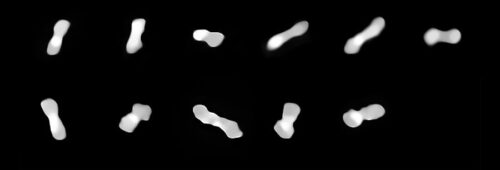
These eleven images are of the asteroid Kleopatra, viewed at different angles as it rotates. The images were taken at different times between 2017 and 2019 with the Spectro-Polarimetric High-contrast Exoplanet REsearch (SPHERE) instrument on ESO’s VLT. Kleopatra orbits the Sun in the Asteroid Belt between Mars and Jupiter. Astronomers have called it a “dog-bone asteroid” ever since radar observations around 20 years ago revealed it has two lobes connected by a thick “neck”.
Using the European Southern Observatory’s Very Large Telescope (ESO’s VLT), a team of astronomers have obtained the sharpest and most detailed images yet of the asteroid Kleopatra. The observations have allowed the team to constrain the 3D shape and mass of this peculiar asteroid, which resembles a dog bone, to a higher accuracy than ever before. Their research provides clues as to how this asteroid and the two moons that orbit it formed.
“Kleopatra is truly a unique body in our Solar System,”
says Franck Marchis, an astronomer at the SETI Institute in Mountain View, USA and at the Laboratoire d’Astrophysique de Marseille, France, who led a study on the asteroid — which has moons and an unusual shape — published today in Astronomy & Astrophysics.
“Science makes a lot of progress thanks to the study of weird outliers. I think Kleopatra is one of those and understanding this complex, multiple asteroid system can help us learn more about our Solar System.”
Kleopatra orbits the Sun in the Asteroid Belt between Mars and Jupiter. Astronomers have called it a “dog-bone asteroid” ever since radar observations around 20 years ago revealed it has two lobes connected by a thick “neck”. In 2008, Marchis and his colleagues discovered that Kleopatra is orbited by two moons, named AlexHelios and CleoSelene, after the Egyptian queen’s children.
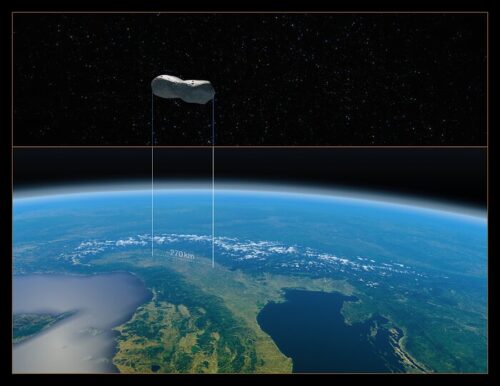
This image provides a size comparison of the asteroid Kleopatra with northern Italy. The top half of the image shows a computer model of Kleopatra, a “dog-bone” shaped asteroid which orbits the Sun in the Asteroid Belt between Mars and Jupiter. End to end, Kleopatra is 270 kilometres long. The bottom half of the image gives an aerial view of northern Italy, with the footprint Kleopatra would have if it were hovering above it.
To find out more about Kleopatra, Marchis and his team used snapshots of the asteroid taken at different times between 2017 and 2019 with the Spectro-Polarimetric High-contrast Exoplanet REsearch (SPHERE) instrument on ESO’s VLT. As the asteroid was rotating, they were able to view it from different angles and to create the most accurate 3D models of its shape to date. They constrained the asteroid’s dog-bone shape and its volume, finding one of the lobes to be larger than the other, and determined the length of the asteroid to be about 270 kilometres or about half the length of the English Channel.
In a second study, also published in Astronomy & Astrophysics and led by Miroslav Brož of Charles University in Prague, Czech Republic, the team reported how they used the SPHERE observations to find the correct orbits of Kleopatra’s two moons. Previous studies had estimated the orbits, but the new observations with ESO’s VLT showed that the moons were not where the older data predicted them to be.
“This had to be resolved,” says Brož. “Because if the moons’ orbits were wrong, everything was wrong, including the mass of Kleopatra.”
Thanks to the new observations and sophisticated modelling, the team managed to precisely describe how Kleopatra’s gravity influences the moons’ movements and to determine the complex orbits of AlexHelios and CleoSelene. This allowed them to calculate the asteroid’s mass, finding it to be 35% lower than previous estimates.
Combining the new estimates for volume and mass, astronomers were able to calculate a new value for the density of the asteroid, which, at less than half the density of iron, turned out to be lower than previously thought [1]. The low density of Kleopatra, which is believed to have a metallic composition, suggests that it has a porous structure and could be little more than a “pile of rubble”. This means it likely formed when material reaccumulated following a giant impact.
Kleopatra’s rubble-pile structure and the way it rotates also give indications as to how its two moons could have formed. The asteroid rotates almost at a critical speed, the speed above which it would start to fall apart, and even small impacts may lift pebbles off its surface. Marchis and his team believe that those pebbles could subsequently have formed AlexHelios and CleoSelene, meaning that Kleopatra has truly birthed its own moons.
The new images of Kleopatra and the insights they provide are only possible thanks to one of the advanced adaptive optics systems in use on ESO’s VLT, which is located in the Atacama Desert in Chile. Adaptive optics help to correct for distortions caused by the Earth’s atmosphere which cause objects to appear blurred — the same effect that causes stars viewed from Earth to twinkle. Thanks to such corrections, SPHERE was able to image Kleopatra — located 200 million kilometres away from Earth at its closest — even though its apparent size on the sky is equivalent to that of a golf ball about 40 kilometres away.
ESO’s upcoming Extremely Large Telescope (ELT), with its advanced adaptive optics systems, will be ideal for imaging distant asteroids such as Kleopatra.
“I can’t wait to point the ELT at Kleopatra, to see if there are more moons and refine their orbits to detect small changes,” adds Marchis.
Notes
[1] The newly calculated density is 3.4 grams per cubic centimetre, while previously Kleopatra was believed to have a mean density of about 4.5 grams per cubic centimetre.
** What’s Up: September 2021 Skywatching Tips from NASA – NASA JPL
What are some skywatching highlights in September 2021? Mercury provides a challenging target to spot in the fading light after sunset at the beginning of the month. Enjoy spotting two “fast” stars all month long: speedy Arcturus and fast-spinning Altair. Additional information about topics covered in this episode of What’s Up, along with still images from the video, and the video transcript, are available at https://solarsystem.nasa.gov/whats-up….
In September, Pegasus becomes increasingly prominent in the southeastern sky, allowing stargazers to locate globular star clusters and a nearby double star, Alpha Capricorni. Keep watching for space-based views of densely packed, spherical collections of ancient stars in visible and X-ray light.
** What’s Up: August 2021 Skywatching Tips from NASA – NASA JPL
What are some skywatching highlights in August 2021? The best-known meteor shower of the year should be a good time this year on the peak night of Aug. 11, with no bright Moon to interfere. Jupiter and Saturn are at their best all month long. And on Aug. 22, the full moon will be a “seasonal blue moon.” Additional information about topics covered in this episode of What’s Up, along with still images from the video, and the video transcript, are available at https://solarsystem.nasa.gov/whats-up….
In August, a flock of star-studded figures soars overhead. Look for the Vega and Lyra constellations, which point to Epsilon Lyrae and the Ring Nebula. You can also spot three bright summer stars: Vega, Deneb, and Altair, which form the Summer Triangle. Keep watching for space-based views of these and other stars and nebulas.
About this Series “Tonight’s Sky” is a monthly video of constellations you can observe in the night sky. The series is produced by the Space Telescope Science Institute, home of science operations for the Hubble Space Telescope, in partnership with NASA’s Universe of Learning. This is a recurring show, and you can find more episodes—and other astronomy videos—at [Tonight’s Sky].