The SpaceX Crew Dragon spacecraft successfully docked with the International Space Station early this morning. The uncrewed vehicle, which was launched on Saturday morning, approached the station very systematically, carrying out a set of highly choreographed actions to prove that it was capable of safely maneuvering near the station before being allowed to approach autonomously, and very slowly, push its nose into the docking adapter on the port of the Harmony module.
The first Crew Dragon docked to the ISS.
The hatch was opened about 2 hours after the docking. Crew members entered the capsule wearing air masks in case there were any leaks of noxious fumes into the capsule during the trip to the station.
Some photos of the Dragon and the ISS during the rendezvous and docking:
The Crew Dragon nears the station. The nose cap was opened soon after the Dragon was deployed from the Falcon 9 upper stage.A view of the ISS from the Crew Dragon. Overlaid are indicators of the vehicle’s distance from the station, relative speed, etc. Targeting the docking adapter on the Harmony module.Views from a camera on the Crew Dragon of the docking port (left) and from a camera on the ISS of the Dragon (right).Ripley waits in the Dragon while the crew prepared to open the hatch. The astronauts wear masks initially in case of any air quality problems in the capsule.Astronaut David Saint-Jacques and cosmonaut Oleg Kononenko test the air inside the Dragon. Astronaut Anne McClain remained in the Harmony module.
The latest Space to Ground weekly report from NASA on activities related to the International Space Station:
A profile of astronaut Christina Kcoh
It may not look like mountain climbing has much to do with being an astronaut, even though both involve great heights and special equipment. But NASA’s Christina Koch says the concentration and control she learned in climbing helped her prepare to be an astronaut and to make the climb to space for her first mission to the International Space Station.
Here is the latest episode of NASA’s weekly Space to Ground report on activities related to the International Space Station:
** A recent interview with ISS crew member Anne McClain:
Aboard the International Space Station, Expedition 58 Flight Engineer Anne McClain of NASA discussed life and research on the outpost and her thoughts on the Apollo program fifty years after humankind’s first landing on the moon during a pair of in-flight interviews Feb. 15 with CNN and National Public Radio’s “Weekend Edition”. McClain is in the third month of a planned six-and-a-half month mission on the complex.
Using state of the art robotics and their proprietary polymer, AI SpaceFactory is contending for the final top prize of $500,000 given to the highest scoring team to print a sub-scale habitat in the third and final phase of the construction competition. The 1:3 scale prototype will be printed in front of a live audience at Bradley University in Peoria, Illinois, from April 29 to May 4.
AI SpaceFactory was one of only four teams awarded among six who submitted entries, placing 2nd overall on the basis of 3D-printed samples that were tested for strength, impact resistance, and durability in extreme temperatures. In contrast to other teams, which used concrete as their construction material, AI SpaceFactory formulated their own material – a “Martian polymer” that can be made from matter found or grown on Mars. The polymer was validated by a third-party lab and proven to outperform concrete in every important way: superior tensile and compressive strength, extreme durability in freeze-thaw cycles, and enhanced ductility. The polymer also provides superior cosmic radiation absorption and thermal resistance (insulation) and can be made without water: essential characteristics in the construction of off-world habitats
In five weeks, AI SpaceFactory progressed from basic tests to an autonomously-printed large-area slab validated by NASA in November 2018. Four weeks later the team successfully printed, in only 24 hours, a large cylinder designed to hold twelve-hundred gallons of water complete with prefabricated wall penetrations robotically placed and sealed “on the fly”.
AI SpaceFactory describes MARHSA as a first-principles rethinking of what a Martian habitat could be — not another low-lying dome or confined half-buried structure, but an airy, multi-level environment filled with diffuse light. This innovation challenges the conventional image of “space age” architecture by focusing on the creation of highly habitable spaces tuned to the demands of a Mars mission.
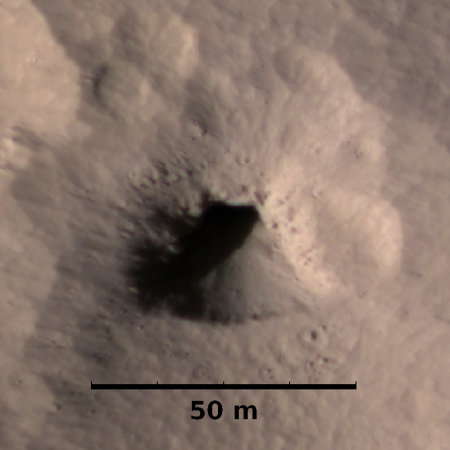
My first reaction was, “Whoa! That tiny pit is at the head of an increasingly growing canyon!” To a caver on Earth, this instantly implies that water has flowed out of that pit and down the canyon, carving it out as it flowed. It also implied that the possible underground passage under the pit’s north rim might conceivably be extensive.
Reinforcing this first impression were the numerous dark streaks flowing down the canyon’s cliff walls to the south. They all seemed to originate at about the same elevation as the pit itself, suggesting they all come from the same contact between two geological layers, a contact where water tends to gather. On Earth, when water seeps downward through water-soluble limestone and then gets blocked at a contact of more resistant material, it then starts to flow horizontally, creating a cave at that contact. The Martian dark streaks and pit in the image to the right suggest a similar process is occurring here.
Bob goes on to discuss the region around the above canyon and what role water may have played in forming the features there.
Nonetheless, the data illustrated by these images makes that tiny pit most enticing. It not only appears to be relatively easy to access its interior, there is visual evidence that suggests the presence of water.
If I was a future settler of Mars, I would give this pit a very high priority for exploration. In fact, I think someone (maybe Elon Musk?) should already be considering a probe to delve its depths.
** Rotating in-space habitats can provide artificial gravity and don’t require that space transports go in and out of deep gravity wells. The Gateway Foundation initiative aims to develop a wheel-shaped station as the first large in-space habitat. This video lays out some of the design features: SpaceX Starship and The Von Braun Rotating Space Station –
Scott Manley gives a brief critique of the Gateway group’s approach: A Realistic Look At The Gateway Foundation & Von Braun Station –
Manley emphasizes that funding is the biggest challenge. I agree and believe that the only viable financial approach to such an orbital facility is one that allows for incremental growth. That is, devise a design that can start small and simple and grows step-by-step, just as happened with most towns on earth. For example, start with two Bigelow habitats connected with a tether and rotating. Prove that this works technically and then show it works commercially by attracting a constant stream of paying visitors. This will then provide the basis to attract more investment to expand to more modules and a more elaborate structure.