Category Archives: Space participation

Videos: Watch “Moon Shot” series by Orlando von Einsiedel & J.J. Abrams

I posted earlier about the “Moon Shot” documentary project by Orlando von Einsiedel & J.J. Abram, which profiles participants in the Google Lunar XPRIZE competition. The nine short films are now available on YouTube. (The videos are also available for free at Google Play.) You can watch all the films in sequence here starting with the trailer:

The films are very well done and often quite poignant. Below are descriptions of each episode.

Ep. 1 – Astrobotic – Pittsburgh, USA : “Legendary roboticist Red Whittaker is a professor who splits his time between teaching future engineers at Carnegie Mellon and owning/operating a working cattle farm in rural Pennsylvania. With a crack team of former students, he co-founded Astrobotic because he believes robots are the best solution for exploring remote, harsh environments — from nuclear disaster zones to the moon.”

Ep. 2 – Part-Time Scientists – Germany: “Founded by an ad hoc group of part-timers, this Berlin-based GLXP team [PT Scientists] plans to open source its mission data. Team leader Robert Böhme, who was raised in the former East Germany, says the free exchange of information is ultimately more important than money.”

Ep. 3 – Team Indus – India “Deepana Gandhi dreamed of a career in math/science, but she grew up in rural India where women aren’t typically afforded the same opportunities as men. After struggling to find a job, Deepana eventually landed at Indus in Bangalore, where she works on the equations necessary for navigating to the moon.”

Ep. 4 – Team Plan B – Canada: “Alex Dobrianski emigrated from the Ukraine to Vancouver to build a better life for his wife Luda and their three children. Twenty years later, after launching a career in IT, he staked his retirement money on the GLXP and recruited his son Sergei to help him pursue his lifelong passion for aerospace, which Alex had been forced to abandon in post-Soviet Ukraine.” – Team Plan B

Ep. 5 – Hakuto – Japan: “When the 2011 tsunami decimated Japan’s Pacific coast, robotics Professor Kazuya Yoshida and his family were lucky to escape harm’s way. Understanding that it’s only a matter of time before an even greater natural disaster strikes, the professor wants his rovers to explore the lunar caves, which could provide a suitable location for future human settlements that will help preserve our species.” – Hakuto team

Ep. 6 – Moon Express – Cape Canaveral, USA: “When Naveen Jain moved from India to the U.S., he was a poor university student with an uncertain future and a hunch that anything is possible. Decades later, after becoming a successful Internet entrepreneur, he co-founded Moon Express to help find a solution to the world’s energy crisis.” Moon Express

Ep. 7 – SpaceIL – Israel: “One of the last teams to enter the GLXP, SpaceIL was co-founded by Yariv Bash, whose grandfather’s life was tragically altered by the Holocaust. Inspired by his grandfather’s work as an engineer, Bash hopes SpaceIL’s efforts to build cool new technology will encourage others, including his young son, to improve the world for future generations.”

Ep. 8 – Mecaliks – Mexico: “9-year-old Jana González turned to playing videogames after her parent’s divorce. As her love of playing games evolved into programming them, she soon discovered robotics and joined an all-girl team competing in the Moonbots, a worldwide robotics competition for kids.” –Mecaliks Moonbots team

Ep. 9 – Race for the Prize: “For nearly a decade, people around the world have been racing to The Moon as part of the Google Lunar X-PRIZE, a $30 million contest. Developing an array of new technologies for landing and exploring the lunar surface, these private teams are making big strides and sacrifices to chase their dream of reaching the moon!”
VIdeo: Sunita Williams talks about ISS amateur radio contacts with students

There is a ham radio station on the Int. Space Station that the crew members (many of whom  have amateur radio licenses) use to talk with hams on the ground. In addition, quite often there is an arrangement made with a school group that allows students to talk with and ask questions of the crew via the ham radio when the ISS is flying over the school’s area.

In this video, NASA astronaut Sunita Williams talks about the big impact that the ISS ham radio contacts with such class room groups had on her. Over 1000 such class room contacts have been made so far.

Find more about the ISS amateur radio program at the ARISS (Amateur Radio on the International Space Station) website. There is info there on how you can arrange for your local school to have a ham radio session with the ISS.

Sarah Parcak wins $1M TED prize to combine archaeology, space imagery, and citizen science

Archaeologist Sarah Parcak uses satellite imagery to find previously undiscovered sites of ancient human activities. She also uses such images to detect looting of known sites. She describes her techniques in the TED talk video below. See also the Gallery: Archaeological mysteries hidden in satellite images.

Parcak won the million dollar TED Prize for 2016:

She will use the prize to develop the online Global Xplorer site to involve citizen scientists in using satellite imagery to find new archaeological sites and to protect known ones:

I wish for us to discover the millions of unknown archaeological sites across the globe. By building an online citizen science platform and training a 21st century army of global explorers, we’ll find and protect the world’s hidden heritage, which contains clues to humankind’s collective resilience and creativity.


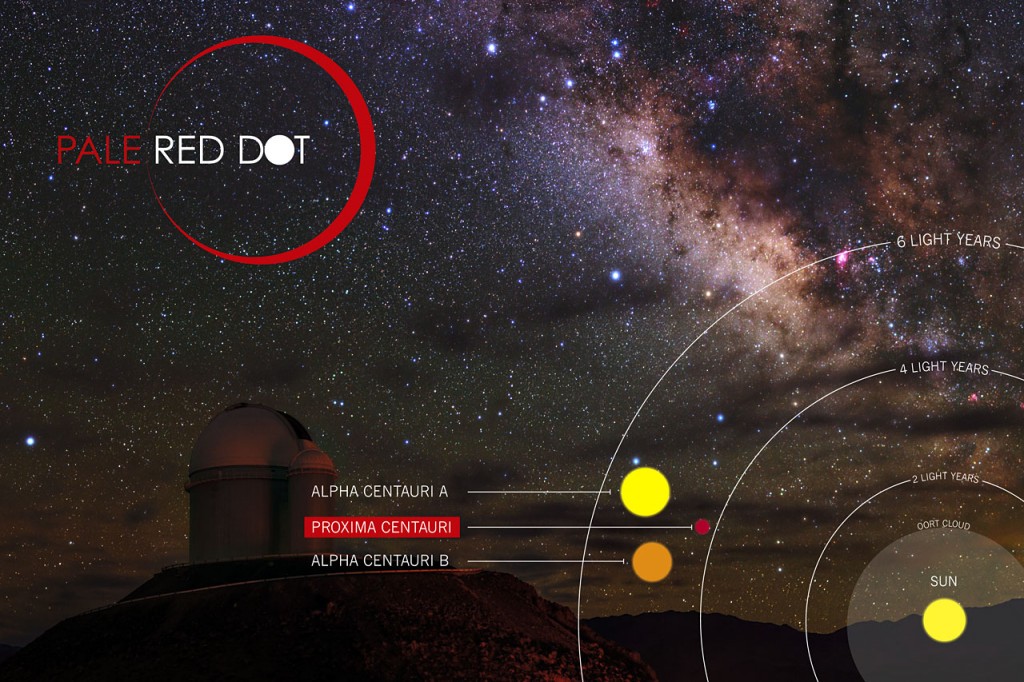
ESO: Public invited to watch the search for a planet around Proxima Centauri

ESO opens a new outreach program that allows the general public to follow closely the hunt for an earth-like exoplanet around the nearest star Proxima Centauri:

Follow a Live Planet Hunt!

A unique outreach campaign has been launched that will allow the general public to follow scientists from around the globe as they search for an Earth-like exoplanet around the closest star to us, Proxima Centauri. The observing campaign will run from January to April 2016 and will be accompanied by blog posts and social media updates. No one knows what the outcome will be. In the months following the observations, the scientists will analyse the data and submit the results to a peer-reviewed journal.

Pale Red Dot is an international search for an Earth-like exoplanet around the closest star to us, Proxima Centauri. It will use HARPS, attached to ESO’s 3.6-metre telescope at La Silla Observatory, as well as the Las Cumbres Observatory Global Telescope Network (LCOGT) and the Burst Optical Observer and Transient Exploring System (BOOTES).  It will be one of the few outreach campaigns allowing the general public to witness the scientific process of data acquisition in modern observatories. The public will see how teams of astronomers with different specialities work together to collect, analyse  and interpret data, which may or may not be able to confirm the presence of an Earth-like planet orbiting our nearest neighbour . The outreach campaign consists of blog posts and social media updates on the Pale Red Dot Twitter account and using the hashtag #PaleRedDot. For more information visit the Pale Red Dot website: http://www.palereddot.org
Pale Red Dot is an international search for an Earth-like exoplanet around the closest star to us, Proxima Centauri. It will use HARPS, attached to ESO’s 3.6-metre telescope at La Silla Observatory, as well as the Las Cumbres Observatory Global Telescope Network (LCOGT) and the Burst Optical Observer and Transient Exploring System (BOOTES). It will be one of the few outreach campaigns allowing the general public to witness the scientific process of data acquisition in modern observatories. The public will see how teams of astronomers with different specialities work together to collect, analyse  and interpret data, which may or may not be able to confirm the presence of an Earth-like planet orbiting our nearest neighbour . The outreach campaign consists of blog posts and social media updates on the Pale Red Dot Twitter account and using the hashtag #PaleRedDot. For more information visit the Pale Red Dot website: http://www.palereddot.org

At a distance of just 4.2 light-years from the Sun, and located in the constellation of Centaurus, Proxima Centauri is the closest known star to the Sun. Previous observations have provided tantalising, but weak hints of a small companion orbiting this red dwarf star, but this new campaign will make a more sensitive search for the telltale wobbles in the dwarf star’s orbital motion that might reveal the presence of an Earth-like orbiting planet.

Observations will be made with the High Accuracy Radial velocity Planet Searcher (HARPS), attached to ESO’s 3.6-metre telescope at La Silla Observatory. The HARPS data will be complemented by images from an assortment of robotic telescopes located across the world [1].

The telescopes that comprise the Burst Optical Observer and Transient Exploring System (BOOTES) and the Las Cumbres Observatory Global Telescope Network (LCOGT) will support the search by measuring the brightness of Proxima Centauri every night during the two and a half month long project. These observations will help astronomers determine whether any detected wobbles in the star’s motion are caused by features on its turbulent surface or by an orbiting planet.

Once the data have been collected by the various telescopes, astronomers can start their analysis. In the following months, their research methods and conclusions will be described in a paper submitted to a peer-reviewed scientific journal. When the scientific community has validated the research, the results will be published, concluding a long and substantial programme of scientific research.

Apart from following the scientific observations as they arrive, the Pale Red Dot outreach campaign [2] gives the public the opportunity to see how science is done in modern observatories, and how teams of astronomers with different specialities work together to collect, analyse and interpret data, which may or may not be able to confirm the presence of an Earth-like planet orbiting our nearest neighbour.

“We are taking a risk to involve the public before we even know what the observations will be telling us  — we cannot analyse the data and draw conclusions in real time. Once we publish the paper summarising the findings it’s entirely possible that we will have to say that we have not been able to find evidence for the presence of an Earth-like exoplanet around Proxima Centauri. But the fact that we can search for such small objects with such extreme precision is simply mind-boggling,” said Guillem Anglada-Escude, the Project Coordinator.

“We want to share the excitement of the search with people and show them how science works behind the scenes, the trial and error process and the continued efforts that are necessary for the discoveries that people normally hear about in the news. By doing so, we hope to encourage more people towards STEM [3] subjects and science in general,” adds Guillem.

The Pale Red Dot outreach campaign will illuminate the often unseen side of planet hunting with background articles and through social media. A bustling array of blog posts on many topics — including planet-hunting techniques, ESO’s European Extremely Large Telescope (E-ELT), and the lives of stars — are planned, written by the astronomers, scientists and engineers from the observatories involved, as well as science writers, observers and other experts in the field.

There will be daily social media updates, briefing the public on how the observations are going and any events taking place at the three observatories involved. To receive updates, people are invited to follow the Pale Red Dot Twitter account and the hashtag #PaleRedDot.

The name of the campaign was inspired by the famous “pale blue dot” image of the Earth, taken in 1990 by Voyager 1 on its way to interstellar space. The phrase was later used by Carl Sagan for his essay, Pale Blue Dot: A Vision of the Human Future in Space. As Proxima Centauri is a red dwarf star, astronomers expect that an exoplanet orbiting it will appear reddish. At the same time, just as Voyager’s image of Earth was a remarkable achievement for humanity, finding an Earth-like exoplanet around the closest star to us would be a another step towards answering humanity’s biggest question: Are we alone?

The Pale Red Dot campaign will begin in earnest on 15 January 2016 with observations commencing just three days later from ESO’s La Silla Observatory, situated at the edge of the Chilean Atacama Desert, and continuing until the first week of April. All of the scientific data obtained as part of the project are expected to become publicly available for all to exploit in late 2016.

Notes

[1] The team of astronomers leading the observations and outreach campaign are: Guillem Anglada-Escude, Gavin Coleman, John Strachan (Queen Mary University of London, UK), James Jenkins  (Universidad de Chile, Chile), Cristina Rodriguez-Lopez, Zaira M. Berdinas, Pedro J. Amado (Instituto de Astrofisica de Andalucia/CSIC), Julien Morin (Universite de Montpellier, France), Mikko Tuomi (Centre for Astrophysics Research/University of Hertfordshire, UK), Yiannis Tsapras (Heidelberg/LCOGT, Astronomisches Rechen-Institut – Heidelberg & LCOGT) and Christopher J. Marvin (University of Goettingen).

[2] The outreach campaign is coordinated by the project team with support from the outreach departments of ESO, Queen Mary University of London, Instituto de Astrofisica de Andalucia/CSIC, Universite de Montpellier, University of Goettingen, Universidad de Chile and Las Cumbres Observatory Global Telescope Network.

[3] STEM, Science, Technology, Engineering and Mathematics.

Dwarf galaxy spotted by Australian “strongman” amateur astrophotographer

Australian Michael Sidonio is “a competitive strongman” and also a first rate amateur astrophotographer who spotted a previously unheralded dwarf galaxy:

From his gallery:

[]
NGC 253-dw2 Deep Discovery Image – Credits Michael Sidonio

As part of a professional team lead by Aaron J. Romanowsky and David Martinez-Delgardo, this is my first involvement in a scientific discovery and my first scientific paper too. The paper was accepted for publication in the Monthly Notices of The Royal Astronomical Society on Monday 21 Dec 2015.

The galaxy, in this case a Dwarf Spheroidal, was first discovered in a deep image I did of NGC 253 using my Orion Optics UK AG12 a 12″ F3.8 corrected Newtonian. This was then subsequently followed up by deep exposures by the CHART 32 team with their 32″ F7 corrected Cassegrain telescope at Cerro Tololo and then finally the Suprime-Cam on the 8m Subaru telescope was used, in sub arc sec seeing, to resolve stars and confirm the discovery and galaxy classification.

So to discover something so faint and so close to such a well researched galaxy like NGC 253 is extra special and the new galaxy is called NGC 253-dw2

The last line of the abstract is very encouraging too: “We also note the continued efficacy of small telescopes for making big discoveries”