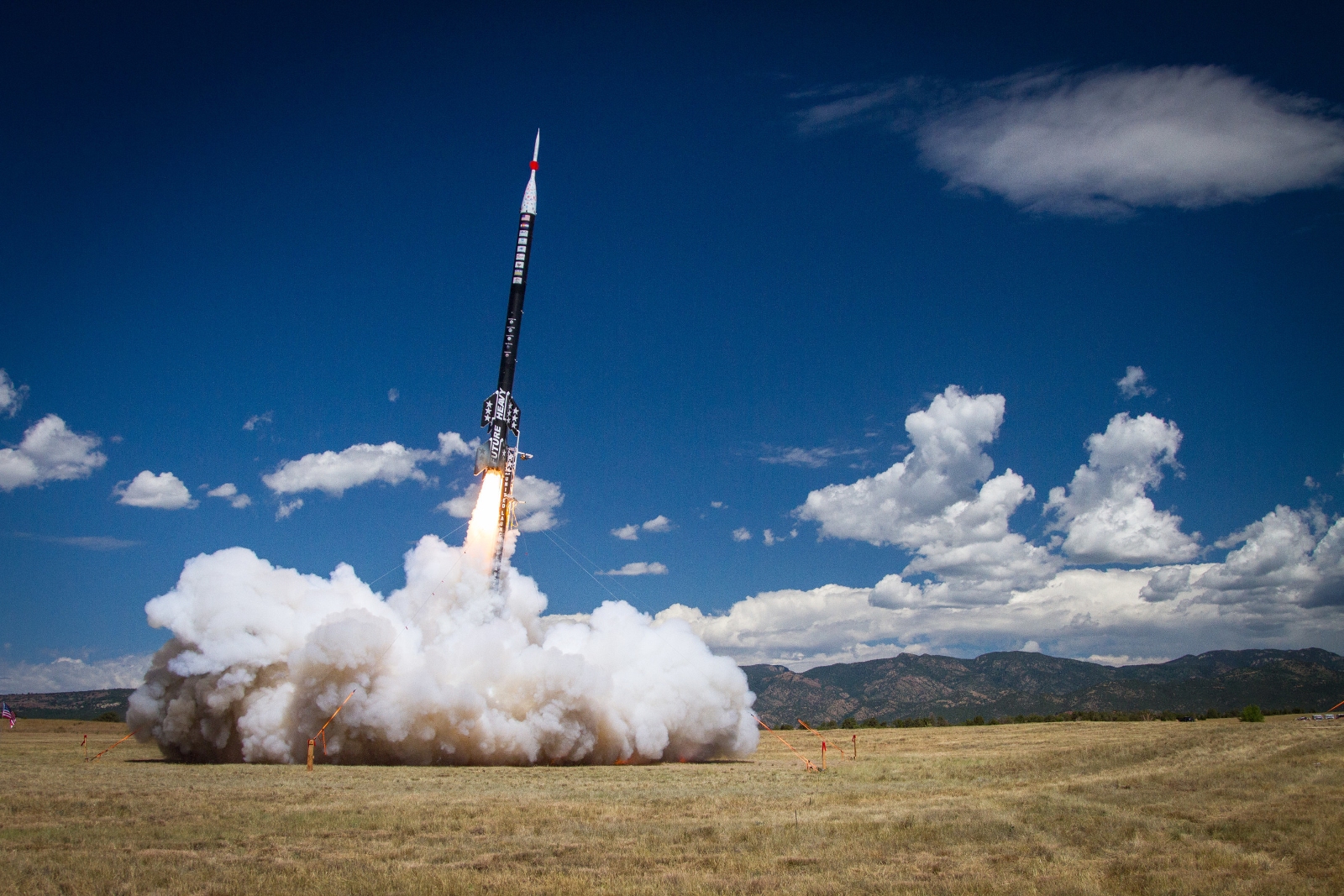
On Sunday, interns at United Launch Alliance (ULA) and Ball Aerospace in Colorado flew a 50 foot (15.24 m) rocket that they built this summer. The “Future Heavy” rocket carried 16 payloads developed by interns and students as well.
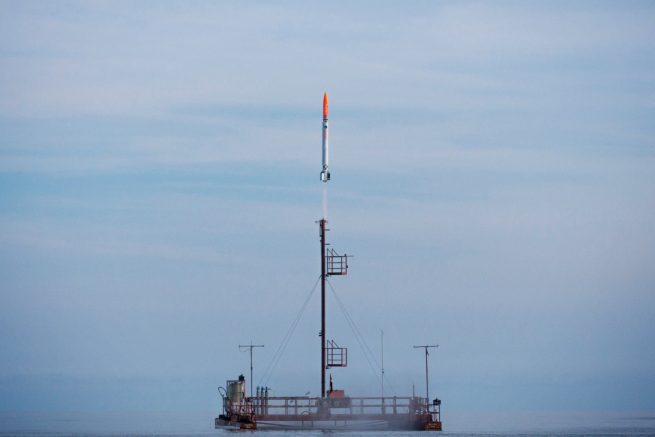
Yesterday Copenhagen Suborbitals launched their rocket Nexø I, their most advanced vehicle yet, from a floating platform in the Baltic Sea. (See earlier posting). The good news is that the rocket lifted off successfully with its liquid-fueled engine (Ethanol and Liquid Oxygen) and active guidance system and was successfully recovered. The bad news is that it failed to reach its planned altitude and the parachute system failed to open: The Nexø I rocket launched – Copenhagen Suborbitals –
It was a beautiful launch with a not so great landing. The rocket flew to about 1514 meters before a catastrophic failure occurred.
Even though it didn’t go completely as planed we still see it as a partially success. A lot of sub systems actually work as they should.
We managed to recover the rocket. We will therefore have a good chance of finding the root cause of the failure.
We will post more about the launch and crash after we have had a closer look at the rocket and telemetry data.
Here is a video of the webcast. The countdown to liftoff starts at the 3 hr 20 min 8 sec mark:
We have not yet had opportunity to examine data, parts or footage.
A tentative speculation on root cause would be simple LOX [Liquid Oxygen] overload. In other words a problem with measuring the correct amount of LOX in the tank, which we have encountered previously, and worked on solving via several methods. We will look into this.
Too much LOX will result in a too small gas pocket in the tank – which equals too little gas propellant energy and a premature loss of tank pressure in the LOX tank, again resulting in an increasing O/F-ratio mismatch. The engine subsequently extinguished.
The GNC didn’t detect acceleration below minimum, as this detection was removed from the algorithm prior to the mission, based on the fact that the acceleration, through the use of pressure blow-down at relatively low altitude, would be very low before the occurrence of MECO.
The GNC instead used the chamber pressure. This was low at an unusually early time. The GNC treated this as a sensor failure, and instead an estimated pressure, based on a table generated from earlier tests, was used.
Thus the GNC didn’t signal the deployment of the parachute, as it was under the (false) impression that the engine was still operating as expected.
The company 121C Boards converts scrap carbon fiber material used for rocket building into ultra-light and strong skateboards and longboards. The company started in 2015 with a Kickstarter aiming to raise $10k. They instead got over $44k. The money went for the shop equipment to manufacture the Aileron, their first skateboard.
A new Kickstarter campaign opened at the end of June and aimed for $15k. With 16 days left, over $69,000 has been committed to their next project: production of a new improved board called the Rover.
Here is a video about the Rover:
Here is a press release about a recent Rover promotional event:
Team lofts skateboard to space in “awesome” VR film The “Space Skateboard” is offered on Kickstarter
Los Angeles, California, July 5, 2016 — 121C has announced that it launched a carbon fiber skateboard to the edge of space above the Mojave Desert earlier this year. The event can be experienced in Virtual Reality (VR) narrated by NASA astronaut Michael López-Alegría (VRs are best viewed from a mobile device):
“The space jump of ‘Fearless’ Felix Baumgartner got us thinking about riding a skateboard down from space and that was the inspiration for this VR film.” said Ryan Olliges, President of 121C and a 2016 graduate in Aerospace Engineering at the University of Southern California. Ryan continues, “It seems like a crazy stunt at first, but this was the perfect way to call attention to our ultralight carbon fiber decks.”
“The launch is even more appropriate since we build them from scrap material generated in the production of modern spacecraft.” adds Greg Autry, cofounder of 121C and an Assistant Clinical Professor with the Lloyd Greif Center for Entrepreneurial Studies at the University of Southern California. Dr. Autry adds, “Watching this VR while listening to Mike LA narrate his experience on a Soyuz flight to the Space Station is really pretty thrilling. Engineers love this stuff and we also hope to inspire a new positive and forward looking attitude in skate that appeals to mature, upscale skaters.”
The board and camera rig were launched using a helium weather balloon and safely descended via parachute. After reaching an estimated altitude of 90,000 ft a GPS tracking system with a satellite uplink helped to locate and recover the payload. The launch and recovery are described in detail in a 121C blog post at: http://www.121cboards.com/blog.
The actual space skateboard, equipped with Shark Wheels and Randal trucks, can be acquired with a $2,500 pledge to the firm’s successful Kickstarter campaign which launched on June 16 and was fully funded by the next day. The campaign ends on July 30. Olliges remarks, “I’d kind of like to keep it, but people like having the ‘first’ of just about anything. We think somebody will look at the amazing photos and VR and really want this odd bit of history.”
About 121C: 121C designs, manufactures and occasionally launches the world’s most advanced skateboards. The company was founded in 2015 as the first phase in a major effort to upcycle scrap carbon fiber generated by the aerospace industry. For more information, visit www.121cboards.com.
Artistically-inclined since childhood (“my mom calls me the ‘artsy-crafty’ one in the family”), Stott was inspired to take the watercolor set to space after the crew support staff at NASA asked her to think about what she would like to do during her limited free time on the station.
“I thought it would be kind of cool to paint in space,” she recalled. “At that time, I did not know that no one else had painted in space.”
Her website, The Artistic Astronaut, includes a gallery displaying her current artwork as well as this picture of one of her watercolors painted while on the station:
“First NASA Astronaut to paint with watercolors in Space during ISS Expedition 21 / Oct 2009. Nicole brought along with her to ISS a small watercolor kit & the paintbrush of friend & wonderful artist Ron Wood’s. She painted “The Wave” based on a picture she took of Isla Los Roques, Venezuela through the window of the Russian Service Module.”She is also a co-leader in the new Space Suit Art Project with the MD Anderson Cancer Center:
MD Anderson News Release 07/08/2016: Today, several of Space City’s best-known institutions — The University of Texas MD Anderson Cancer Center, theNational Aeronautics and Space Administration (NASA) and ILC Dover — announced a partnership that brings the benefits of arts and science to pediatric cancer patients while increasing awareness of childhood cancer. More than 530 patients, families, and staff members painted original artwork used to create full-sized suits for the Space Suit Art Project.
Born out of an idea from MD Anderson’s Arts in Medicine Program, which helps pediatric patients cope with cancer treatment through art, this project inspired leaders at NASA’s International Space Station (ISS) to support the effort with help from astronauts, scientists and engineers. NASA provided patterns for the suits and worked with ILC Dover, a manufacturing and engineering company that develops NASA space suits, to assemble the suits by stitching the hand-painted art pieces together into a wearable replica space suit.
“This project has inspired hope for kids fighting cancer, instilled them with courage and created unity, all while increasing awareness of childhood cancer and the importance of pediatric cancer research,” said Ronald A. DePinho, M.D., president of MD Anderson. “We are so proud of this project and grateful for the passion and support we’ve received from NASA, ISS and ILC Dover. This is a wonderful example of the power of collaboration.”
On average, one in 285 children in the US will be diagnosed with cancer before the age of 20. Similar to adults, children going through cancer treatment can experience anxiety and depression. Research shows creative arts therapy benefits cancer patients as mental health and behavioral health are positively impacted. At MD Anderson, art gives patients a sense of control and purpose, makes them more comfortable in the hospital environment, and helps build community among patients and families.
“This collaboration highlights both the knowledge and inspiration that flow from the International Space Station,” said Ellen Ochoa, Ph.D., veteran astronaut and director of NASA’s Johnson Space Center. “Our astronauts conduct research on board the orbiting National Laboratory that benefit people around the world, including experiments that may inform future cancer research.”
Leading the effort to connect science, technology, arts and the human spirit are Ian Cion, director of the Arts in Medicine Program; Nicole Stott, retired NASA astronaut and the first person to paint in space; and David Graziosi of ILC Dover. Their collaboration created the Space Suit Art Project, which demonstrates the transformative power of arts in the healing process through three space suits designed to convey different meanings: Hope, Courage and Unity.
The first suit, HOPE was stitched together from more than 600 hand-painted art pieces created by patients, families and staff at MD Anderson. It represents the hope patients and families have as they go through treatment. Their primary hope is to survive cancer, but it’s deeper than survival. The project inspires hope for progress in childhood cancer research, which is consistently underfunded, and hope that childhood diseases like cancer can one day be eliminated. One patient inspired by the Space Suit Art Project and who provided artwork for the first two suits shared his hope.
“Even though my cancer is back after I already survived it twice, working on this project makes the days go faster and reminds me about the importance of hope,’ said Jacob, a 17-year-old Ewing’s sarcoma survivor. “I’m excited to tell people that my art may go to space, and, one day, I hope to work with the space exploration vehicles at NASA.”
COURAGE, the second space suit created with patients at MD Anderson, many of whom were on isolation during their treatment, is meant to demonstrate the courage it takes to be isolated from family and friends during long periods of time. Astronauts face similar isolation during space exploration missions. Stott took a watercolor paint kit on her space missions to remain connected to the world left behind and to help document her experiences.
Creation of the third space suit, UNITY, will be an international collaboration with children’s hospitals around the world. The UNITY space suit will represent the global issues surrounding childhood cancers, with a goal to unite others, help spread awareness about childhood cancers and offer hope and courage to cancer patients around the globe.
“The kids and families we’ve met during this creative journey have shown us all the importance of hope, the power of courage and the strength of unity,” said Stott. “All of the partners involved with this project and I hope people will see these works of art and they will be inspired to learn more about the story behind it, which is the need for increased awareness of childhood cancer. There’s so much work to be done for pediatric cancer research — we’re just trying to do our little part.”
The Space Suit Art Project officially launched today at MD Anderson. Ochoa, Stott, patients and families, astronauts and other collaborative leaders of the project joined MD Anderson President Dr. DePinho on stage for the special unveiling of the first space suit, HOPE, and a special announcement that COURAGE will be going into space later this month.
The Kickstarter The Speed of Light Project by Caspar Noyons has raised $9,141 towards a goal of$11,148goal with two days remaining. The goal is to create an installation that demonstrates the 8.3 minutes that it takes for light to travel from the earth to the sun. The plan is to build a 555 meter long trail on which a person will
follow a LED path (3 LED per meter, 1665 LED’s in total) showing the exact speed of 4km/h which is slow walking pace. This journey will then take the amount of time required: 8.3 minutes. A perfect place for this is the IJpromenade in the North of Amsterdam. Next to the IJ Canal it offers a great open space next to the water along a long straight line of just the right size.
wants to change the world by bringing science and technology together with art to capture minds and hearts, engaging all of society in the future of space exploration, and promoting scientific innovation and collaboration.
![0-3[1]](http://hobbyspace.com/Blog/wp-content/uploads/2016/07/0-31.jpeg)
![924868_b0b4705e90cd4cff8e513e361c242d4d[1]](http://hobbyspace.com/Blog/wp-content/uploads/2016/07/924868_b0b4705e90cd4cff8e513e361c242d4d1.jpg)
![1468002829155[1]](http://hobbyspace.com/Blog/wp-content/uploads/2016/07/14680028291551.jpg)
