The Cubes in Space is a program to provide opportunities for students age 11 to 18 to design and build experiments that will be launched into space and near-space:
Cubes in Space™ is the only program in the world to provide students (ages 11-18) with a free opportunity to design experiments to be launched into space on a NASA rocket or balloon!
This is a Science, Technology, Engineering, Arts and Mathematics (STEAM) based global education program, enabling kids to learn about space exploration utilizing innovative problem-solving inquiry-based learning methods. By participating in this program, students and educators are provided with engaging content and activities in preparation for the design and development of an experiment to be integrated into a small cube.
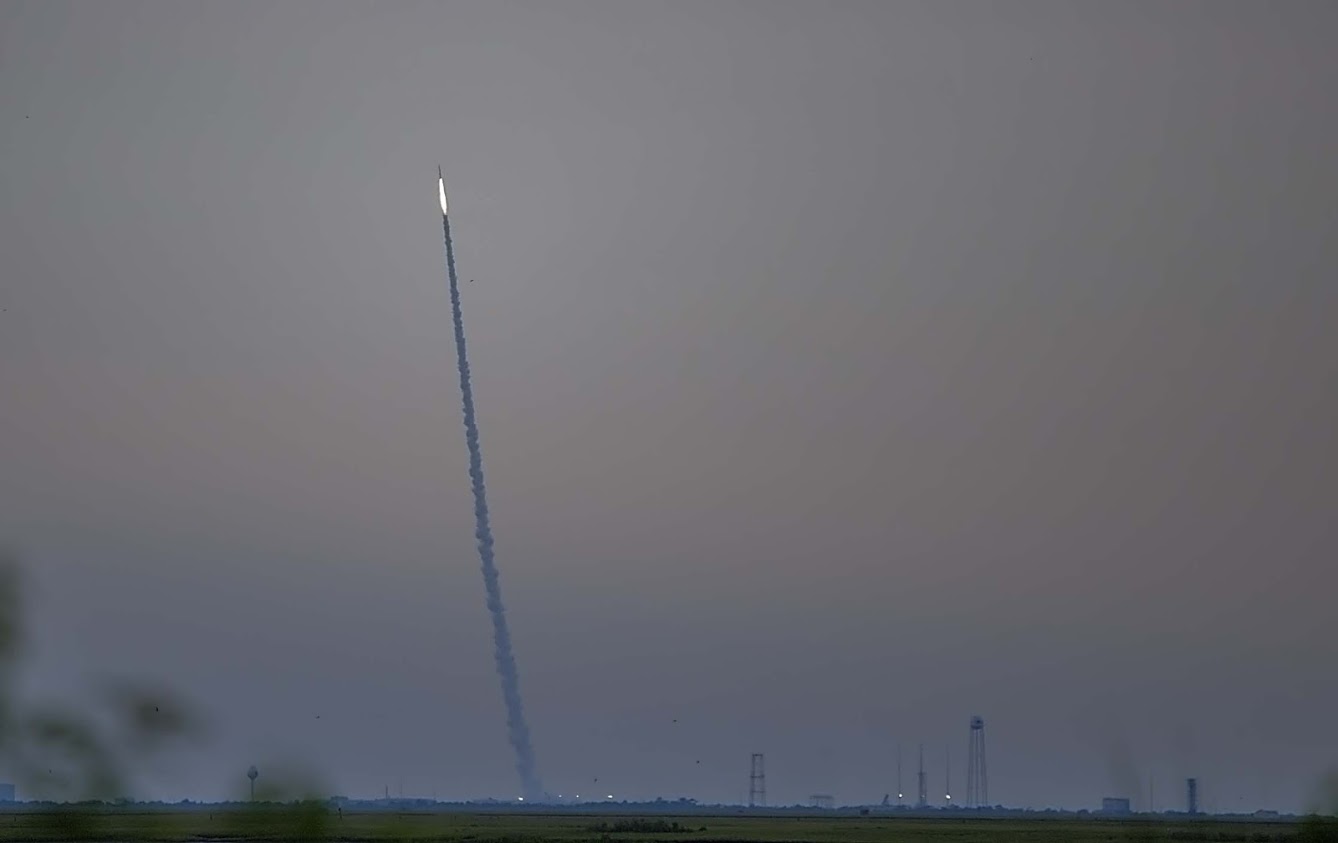
This year, successful experiments/cubes will be launched into space via sounding rocket from NASA Wallops Flight Facility on Wallops Island, Virginia in late June 2017 or on a high altitude balloon launched from the NASA Columbia Scientific Balloon Facility at Fort Sumner, New Mexico in August 2017.
Since we first began the Cubes in Space program in 2014, we have had over 5000 participants from 37 countries, and counting! Come and join us!
The program is sponsored by education organization idoodlelearning in partnership with NASA.
idoodlelearning is proud to partner with the Colorado Space Grant Consortium with support from NASA’s Science Mission Directorate and Sounding Rocket Program Offices to bring Cubes in Space™ to this new generation of future inventors, scientists, engineers, artists and innovators.
idoodlelearning is excited to be working with NASA’s Balloon Program Office, to bring high altitude balloon opportunities to students around the world.
Sally Ride Earth Knowledge Acquired by Middle Schools (EarthKAM):
The crew configured the camera, laptop and associated Sally Ride EarthKAM software at the Node 2 Nadir hatch window. Once configured, the EarthKAM team, in association with middle school students around the world, selected image targets which will be downlinked and used in the study of physics, computers, geography, math, earth science, biology, art, history, and cultural studies.
The objective of Sally Ride EarthKAM is to integrate Earth images with inquiry-based learning to enhance curricula in support of national and state education standards; to provide students and educators the opportunity to participate in a space mission and to develop teamwork, communication, and problem solving skills; to engage teams of students, educators, and researchers in collaborative investigations using remotely-sensed data; and to incorporate the active use of Web-based tools and resources in support of the learning process.
In this video, Tom Marshburn shows how the EarthKAM is set up on the ISS:
Leesa Hubbard is a school teacher in Tennesseee and here she talks about using the EarthKAM and other space resources in her science lessons:
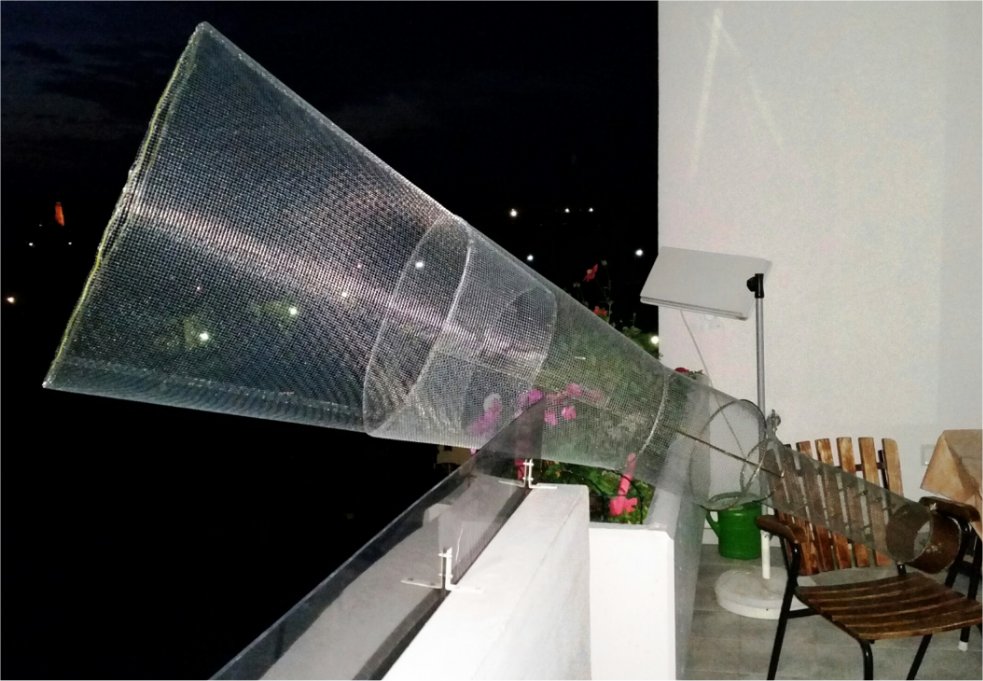
Hannes Fasching, OE5JFL, of Braunau am Inn, Austria, has demonstrated that you don’t need a huge antenna system to operate EME (moonbounce) successfully. Fasching fired up for the October 22-23 weekend of the ARRL EME Contest, using a small horn antenna on 1.2 GHz.
The 1.2 GHz mesh antenna for EME – Hannes Fasching (OE5JFL)
“Because of other commitments I had only a few hours to be QRV in the first part of the ARRL EME Contest,” he said in a Moon-Net post on October 26. “As tests with my recently built 23-centimeter horn antenna were promising, I decided to give it a try to work some stations.” Fasching placed the horn on his balcony with an 80 W solid-state amplifier.
Operating WSJT, he logged contacts with Switzerland, Russia, Germany, and the Czech Republic. He also heard stations in the Netherlands, Finland, Denmark, and Italy on digital modes and in the UK, Czech Republic, Denmark, and Italy on CW.
Fasching, who also has a 7.3-meter homemade dish, has uploaded recordings of some EME signals to his website, along with the results of tests with his small system.
Via a NASA-led citizen science project, eight people with no formal training in astrophysics helped discover what could be a fruitful new place to search for planets outside our solar system – a large disk of gas and dust encircling a star known as a circumstellar disk.
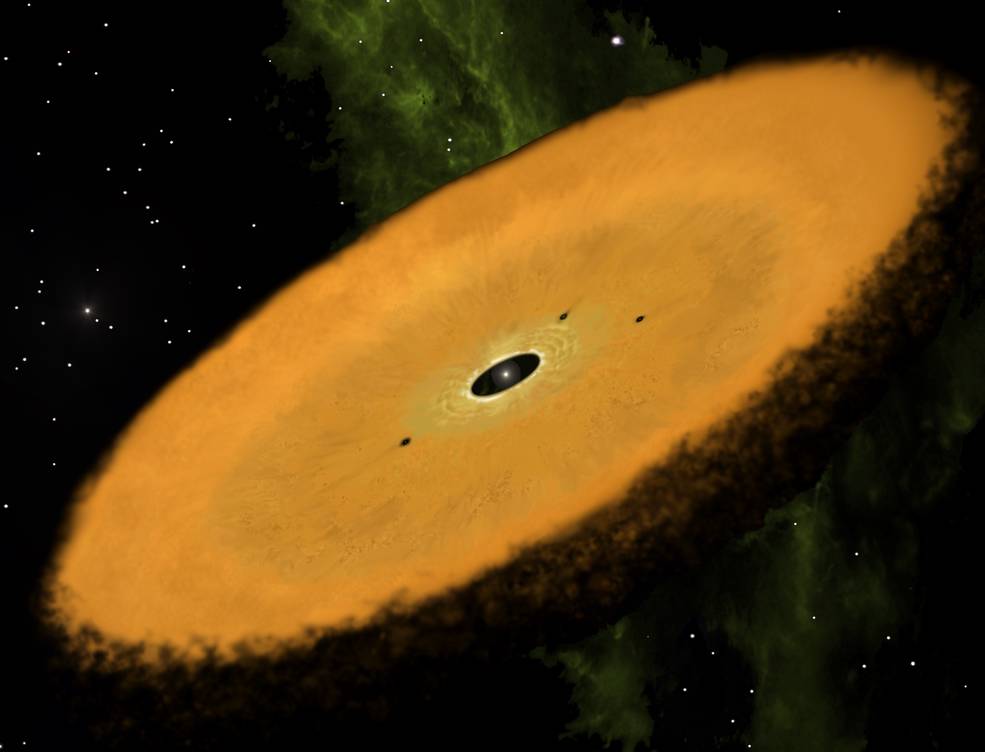
Artist’s concept of the newly discovered disk. Credits: Jonathan Holden
A paper, published in The Astrophysical Journal Letters and coauthored by eight citizen scientists involved in the discovery, describes a newly identified red dwarf star, AWI0005x3s, and its warm circumstellar disk, the kind associated with young planetary systems. Most of the exoplanets, which are planets outside our solar system, that have been imaged to date dwell in disks similar to the one around AWI0005x3s.
The disk and its star are located in what is dubbed the Carina association – a large, loose grouping of similar stars in the Carina Nebula approximately 212 light years from our sun. Its relative proximity to Earth will make it easier to conduct follow-on studies.
“Most disks of this kind fade away in less than 30 million years,” said Steven Silverberg, a graduate student at Oklahoma University and lead author of the paper. “This particular red dwarf is a candidate member of the Carina association, which would make it around 45 million years old. It’s the oldest red dwarf system with a disk we’ve seen in one of these associations.”
Since the launch of NASA’s Disk Detective website in January 2014, approximately 30,000 citizen scientists have performed roughly two million classifications of stellar objects, including those that led to this discovery. Through Disk Detective, citizen scientists study data from NASA’s Wide-field Infrared Survey Explorer mission (WISE), the agency’s Two-Micron All Sky Survey project, and other stellar surveys.
“Without the help of the citizen scientists examining these objects and finding the good ones, we might never have spotted this object,” said Marc Kuchner, an astrophysicist at NASA’s Goddard Space Fight Center in Greenbelt, Maryland, who leads Disk Detective. “The WISE mission alone found 747 million objects, of which we expect a few thousand to be circumstellar disks.”
The eight citizen scientist co-authors, members of an advanced user group, volunteered to help by researching disk candidates. Their data led to the discovery of this new disk.
“I’ve loved astronomy since childhood and wanted to be part of the space program, as did every boy my age,” adds Milton Bosch, a citizen scientist co-author from California. “I feel very fortunate to be part of such a great group of dedicated people, and am thrilled to partake in this adventure of discovery and be a co-author on this paper.”
Disk Detective is a collaboration between NASA, Zooniverse, the University of Oklahoma, University of Córdoba in Argentina, National Astronomical Observatory of Japan, Space Telescope Science Institute, Harvard-Smithsonian Center for Astrophysics, Carnegie Institution of Washington, University of Hawaii and Korea Astronomy and Space Science Institute.
To learn more about opportunities for the public to participate in NASA science and technology projects, visit: www.nasa.gov/solve
is a new science initiative to capture the first photograph of a potential Earth-like planet orbiting another Sun-like star. The mission aims to launch a lightweight space telescope to directly image exoplanets around Earth’s nearest star system, Alpha Centauri A and B.
With a budget the fraction of the cost of a mid-size astrophysics mission, and a planned launch by the end of the decade, this venture represents an ambitious leap forward in low-cost, high-impact space exploration.
Through active collaboration between research institutions, universities, private industry and citizens, Project Blue seeks to make space exploration a participatory, collective endeavor and inspire millions worldwide to engage in scientific inquiry.
The key technology will be a coronagraph that blocks the otherwise blinding light of the star and allows the planet’s far weaker reflected light to be observed:
Project Blue will place a state-of-the-art exoplanet imaging telescope into orbit. The instrument will be equipped with advanced high contrast imaging technologies embedded in a coronagraph with a deformable mirror, multi-star wavefront control, and specialized post-processing techniques.
Together they can efficiently suppress the light from both stars (Alpha Centauri A and B) separately, thus allowing any planets to be seen. Our team has extensive experience developing and testing these technologies — now it’s time to get them into space!
Unusual proximity: At only 4.37 light years distance, Alpha Centauri is the closest star system to us, and contains not just one, but two stars similar to our Sun. The next Sun-like star is located 2.5x further away and would require a telescope 2.5 times larger in size.
Accessible Habitable Zone: Its proximity allows us to observe the habitable zone of each star for Earth-like planets with a modest space telescope with a powerful coronagraph, while any other star requires telescopes of at least 1 meter in size.
Fertile ground: Proxima Centauri, which is thought to be part of the same system, is now known to have a potentially habitable planet. We are acting on a new scientific urgency to investigate our nearest Sun-like stars!
The goal is to launch the privately funded observatory in 2019.
To sign up for email updates and/or to donate to the project, see Get Involved.
SAN FRANCISCO, CA–(Marketwired – Oct 11, 2016) – A consortium of prominent science and research institutions led by BoldlyGo Institute and Mission Centaur today announced Project Blue, an endeavor for a new era of discovery and space exploration. Employing recent technological advances, Project Blue is designed to be the first mission capable of obtaining an image of another planet like Earth — a powerful next step to understanding and exploring worlds outside our solar system. This new kind of privately-led, non-profit space initiative unites an extraordinary range of experts, including teams from the SETI Institute and the University of Massachusetts Lowell, on a daunting scientific and technical challenge.
Project Blue will work to fund, build and launch a compact exoplanet imaging telescope aimed at Alpha Centauri — the closest star system to Earth — to determine whether Earth-like planets exist around it and if so, to capture a direct “pale blue dot” image. While NASA’s Kepler mission has shown that terrestrial-sized planets are common in our galaxy, no one has yet been able to take a picture of one as small as Earth, in an orbit that could potentially sustain life. Project Blue would be the first. The mission will take about three years to construct and will conduct an intensive two-year study once in orbit.
“Now is the time to embark on this mission. Scientific imperative and technological advancements have converged to a point where we can finally take a serious look at our closest neighbor, Alpha Centauri,” said Jon Morse, CEO of BoldlyGo Institute. “Does it contain rocky planets? Do they have oceans and atmospheres? Could they conceivably support life? We launched Project Blue because we believe such a discovery would profoundly impact humankind’s understanding of the universe and spur a new wave of excitement in science and astronomy.”
Seeing Blue
Recent developments, including the extraordinary success of the Kepler mission and advances in optics and imaging technologies, have laid the groundwork for Project Blue. Kepler has discovered over 2300 confirmed exoplanets through indirect observation techniques, many of which scientists believe could have Earth-like characteristics. Imaging one directly is an achievement that would open a new path to detecting and characterizing possible life-sustaining worlds around nearby stars.
An Earth-like planet is characterized as 0.5 to 1.5 times the size of Earth and orbiting within the host star’s “habitable zone,” where the temperature could allow liquid water to exist on the planet’s surface. Such a planet with oceans and an atmosphere similar to Earth, unless obscured by clouds, could appear blue to the human eye.
Project Blue’s customized telescope will be mounted on an optimized commercial spacecraft and specifically focus on Alpha Centauri, allowing it to maintain modest size and cost compared to larger astrophysics missions. The spacecraft will conduct its study of the Alpha Centauri system from a special north-south, low-Earth orbit that provides the stable conditions necessary for such precise measurements.
Despite Alpha Centauri’s proximity, there is currently no telescope with high enough contrast capability to observe orbiting planets directly; detecting an Earth-sized planet next to its host star has been compared to detecting a firefly next to a lighthouse from ten miles away. Additionally, Alpha Centauri’s binary structure makes it a particularly challenging target. Since the system’s two stars, Alpha Centauri A and B, appear so close together in the night sky, observation requires a special approach to suppress both light sources to see any orbiting planets.
“What makes the Alpha Centauri system so attractive is that each of the two stars is a lot like our own sun, which gives us two chances to find planets in either of their habitable zones,” said Supriya Chakrabarti, professor in the Department of Physics and Applied Physics at the University of Massachusetts Lowell and director of its Lowell Center for Space Science and Technology. “This also gives us an opportunity to design a mission that leverages technology we’ve been developing and space qualifying in our NASA-supported programs.”
The Blue Moment
Beyond pioneering a range of cutting-edge technologies, Project Blue represents a new kind of endeavor: a privately-funded partnership of research organizations, universities and industry aiming to play a leadership role in space science. With BoldlyGo Institute and Mission Centaur at the helm, a number of leading institutions will partner on the project, with the list expected to grow.
“We’re excited to be an original member of this distinguished consortium working on this seminal project,” said Bill Diamond, President and CEO of the SETI Institute. “The SETI Institute has accumulated world-class scientific and technical expertise from previous space missions that we can contribute to make Project Blue a success.”
The partnership will combine its expertise to design, construct and operate the mission. Launch services will be provided by one of several commercial vendors expected to be proven by the time of launch.
About BoldlyGo Institute: The BoldlyGo Institute is based in New York and was founded to address highly compelling scientific questions through new approaches to developing space science missions while engaging the global community in the quest. The organization is led by a highly qualified and reputable Board of Directors, comprised of space scientists, engineers and explorers. Board members have decades of combined space involvement, including more than a decade of recent, senior leadership experience across NASA, specializing in spaceflight and the development of space hardware.
About Mission Centaur: Mission Centaur is a nonprofit organization that fosters public and private collaboration through Project Blue, an initiative seeking to find and capture the first image of an Earth-like planet in our neighboring star system Alpha Centauri. Mission Centaur was founded by a group of philanthropists, scientists and engineers to pursue one of humanity’s most ambitious and transformational space exploration missions.