Category Archives: Space participation

MoonWatcher crowdfunding to launch smallsat for 24/7 live video of the Moon

The MoonWatcher project aims to raise $150,000 to fund a small satellite that would broadcast hi-definition video of the lunar surface: MoonWatcher: A 24/7 Live Video of the Moon for Everyone by MoonWatcher — Kickstarter

MoonWatcher will offer spectacular views of the Moon and the latest lunar information and scientific breakthroughs. Working with our launch provider, Virgin Galactic, we will place our MoonWatcher Satellite into Low Earth Orbit (LEO) giving you a front row seat. 

MoonWatcher will show a real-time, unobstructed view of the lunar surface offering spectacular images. In addition to the MoonWatcher  Satellite, the project also includes The MoonWatcher Channel which will deliver the video feed and also share breakthrough scientific discoveries and the latest lunar news. 

Here is the press release:

MoonWatcher Will Launch on Virgin Galactic’s LauncherOne
Bringing the Moon Closer to You

CAMBRIDGE, Mass., Feb. 1, 2017 /PRNewswire/ — Imagine seeing the Moon as only astronauts have seen it before. Now with MoonWatcher, the FIRST private satellite mounted with a state of the art camera, you will have this amazing opportunity.

Spectacular images of the Moon will stream LIVE to the Internet with accompanying information and featuring the latest lunar news. To accelerate the path to orbit, today MoonWatcher announced a crowdfunding Kickstarter campaign to raise $150K. MoonWatcher will be putting these Kickstarter pledges towards their first satellite, which will be carried by Virgin Galactic’s LauncherOne into Low Earth Orbit (LEO) in 2018.

https://www.kickstarter.com/projects/moonwatcher/moonwatcher-a-24-7-live-video-of-the-moon-for-ever

After Virgin Galactic’s LauncherOne places MoonWatcher‘s satellite into (LEO), everyone will see the moon as only astronauts and governments have seen before.  MoonWatcher will bring the moon to the PCs and mobile devices of educators, lunar enthusiasts and scientists giving equal public access to a view of the lunar surface, while it unveils its many mysteries and reports future exploration.

Why are so many people excited about the MoonWatcher project besides the cool rewards?  According to Google, the Moon is the most searched for subject in space…more than the Sun, even more than Mars.

Although we have learned a great deal about the Moon, we still have much to learn. Besides the Moon’s treasure trove of minerals that are needed here on Earth, we know that if we want to explore our solar system, the first step is the Moon. MoonWatcher will give you, the public, a front row seat to the greatest adventure of our lifetime, the exploration of the Moon.

As MoonWatcher looks to the future, the stretch goals include a fleet of satellites, a MoonWatcher Channel covering all the excitement and adding a team of media professionals who will create in-depth lunar programming.

Tonight as we look up at the Moon, we will know that next year, with MoonWatcher, we will be joining other famous space explorers. Please give generously so that MoonWatcher brings the moon closer to all of us.

The NewSpace Club opens Indiegogo crowdfunding campaign

Dr. Anis Karim points me to an Indiegogo crowdfunding campaign to raise $1000 to create the online NewSpace Club  –

There needs to be a place where people interested in outer space (whether to travel to orbit, work out there, be a student out there, vacation out there, settle on another world, or any of billions of other reasons) can contact and communicate with other people interested in outer space. What exists is woefully inadequate and frustrating and not helpful. This is why we want to create a space social network to connect space enthusiasts and ultimately realize a new life out there!

From the Indiegogo page:

Why Only $1000?

People might ask: “If you’re really serious about creating the space social network of the future, why are you asking for only $1000?”

We made this financial decision for a reason. As mentioned above, the goal of this – specific – Indiegogo campaign is to engage a community of space enthusiasts excited about the possibilities of a new life out there. This community will be our ambassadors. The $1000 will only help us launch the NewSpace Club. And, the NewSpace Club team is currently volunteering; so labor is not a factor yet.

It is true that after the NewSpace Club is launched at www.newspace.club, we will have to hire programmers, developers and software engineers. Many IT companies started with students and volunteers before having to hire people on salary. Some of the resources our members will ask for and those we plan for will cost a lot of money, and perhaps those can be added if we have an InDemand period. Other costs will include specialized hardware, and we can invest pre-seed money in space transportation startups.

We would be very grateful if we went substantially over the $1000 goal of this Indiegogo campaign. We hope we do.

Video: Children’s space art displayed in orbit by Peggy Whitson

While floating in the ISS Cupola module with the earth seen passing by in the windows behind her, NASA astronaut Peggy Whitson shows off some of the art submitted by children ( 4 to 12 years old) to the Commercial Crew 2017 Calendar Contest –

Help choose Juno’s next image targets on Jupiter

Help select spots on Jupiter for the Juno spacecraft to image on its next pass close to the planet:

Public to Choose Jupiter Picture Sites for NASA Juno 

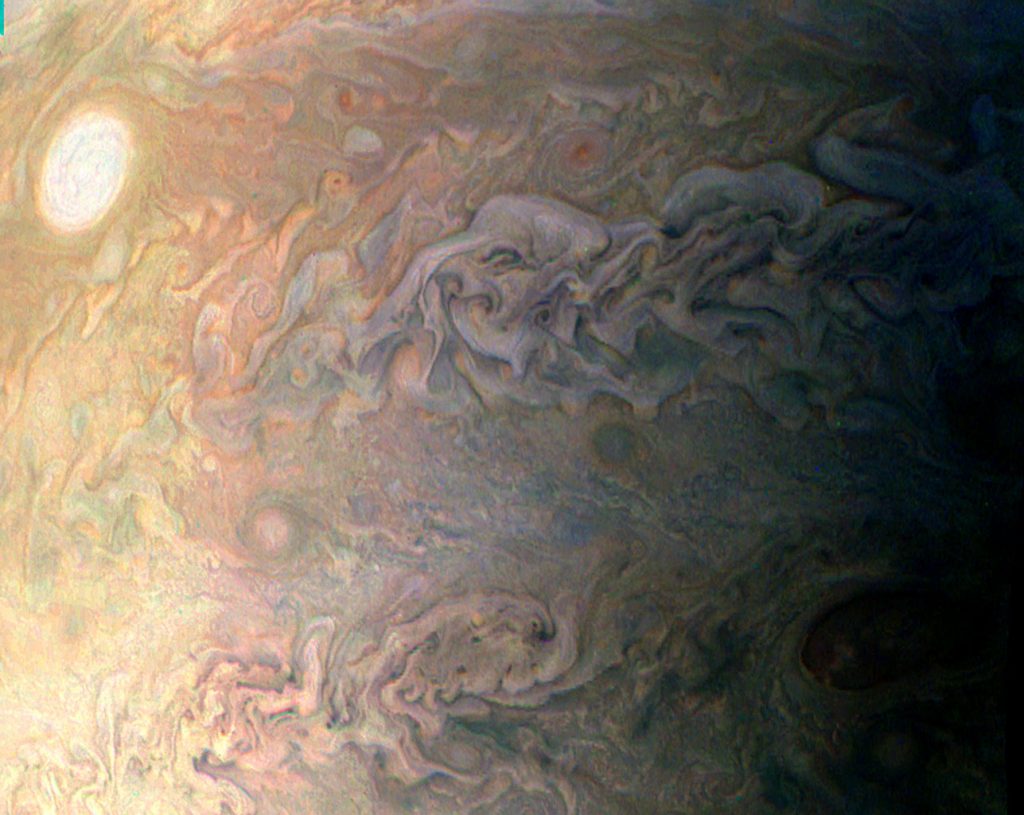
This amateur-processed image was taken on Dec. 11, 2016, at 9:27 a.m. PST (12:27 p.m. EST), as NASA’s Juno spacecraft performed its third close flyby of Jupiter. At the time the image was taken, the spacecraft was about 15,200 miles (24,400 kilometers) from the gas giant planet. The citizen scientist (Eric Jorgensen) cropped the JunoCam image and enhanced the color to draw attention to Jupiter’s swirling clouds southeast of the “pearl.” The “pearl” is one of eight massive rotating storms at 40 degrees south latitude on Jupiter, known colloquially as the “string of pearls.” The processing of this image highlights the turbulence of the clouds in the south temperate belt of the planet. [Other image sizes]
Where should NASA’s Juno spacecraft aim its camera during its next close pass of Jupiter on Feb. 2? You can now play a part in the decision. For the first time, members of the public can vote to participate in selecting all pictures to be taken of Jupiter during a Juno flyby. Voting begins Thursday, Jan. 19 at 11 a.m. PST (2 p.m. EST) and concludes on Jan. 23 at 9 a.m. PST (noon EST).

“We are looking forward to people visiting our website and becoming part of the JunoCam imaging team,” said Candy Hansen, Juno co-investigator from the Planetary Science Institute, Tucson, Arizona. “It’s up to the public to determine the best locations in Jupiter’s atmosphere for JunoCam to capture during this flyby.”

NASA’s JunoCam website can be visited at: www.missionjuno.swri.edu/junocam

The voting page for this flyby is available at: www.missionjuno.swri.edu/junocam/voting/

JunoCam will begin taking pictures as the spacecraft approaches Jupiter’s north pole. Two hours later, the imaging will conclude as the spacecraft completes its close flyby, departing from below the gas giant’s south pole. Juno is currently on its fourth orbit around Jupiter. It takes 53 days for Juno to complete one orbit.

“The pictures JunoCam can take depict a narrow swath of territory the spacecraft flies over, so the points of interest imaged can provide a great amount of detail,” said Hansen. “They play a vital role in helping the Juno science team establish what is going on in Jupiter’s atmosphere at any moment. We are looking forward to seeing what people from outside the science team think is important.”

There will be a new voting page for each upcoming flyby of the mission. On each of the pages, several points of interest will be highlighted that are known to come within the JunoCam field of view during the next close approach. Each participant will get a limited number of votes per orbit to devote to the points of interest he or she wants imaged. After the flyby is complete, the raw images will be posted to the JunoCam website, where the public can perform its own processing.

“It is great to be able to share excitement and science from the Juno mission with the public in this way,” said Scott Bolton, Juno principal investigator from the Southwest Research Institute in San Antonio. “Amateur scientists, artists, students and whole classrooms are providing the world with their unique perspectives of Jupiter. I am really pleased that this website is having such a big impact and allowing so many people to join the Juno science team. The public involvement is really affecting how we look at the most massive planetary inhabitant in our solar system.”

During the Feb. 2 flyby, Juno will make its closest approach to Jupiter at 4:58 a.m. PST (7:58 a.m. EST), when the spacecraft is about 2,700 miles (4,300 kilometers) above the planet’s swirling clouds.

JunoCam is a color, visible-light camera designed to capture remarkable pictures of Jupiter’s poles and cloud tops. As Juno’s eyes, it will provide a wide view of Jupiter over the course of the mission, helping to provide context for the spacecraft’s other instruments. JunoCam was included on the spacecraft primarily for public engagement purposes, although its images also are helpful to the science team.

NASA’s Jet Propulsion Laboratory, Pasadena, California, manages the Juno mission for the principal investigator, Scott Bolton, of Southwest Research Institute in San Antonio. The Juno mission is part of the New Frontiers Program managed by NASA’s Marshall Space Flight Center in Huntsville, Alabama, for NASA’s Science Mission Directorate. Lockheed Martin Space Systems, Denver, built the spacecraft. JPL is a division of Caltech in Pasadena, California.

More information on the Juno mission is available at:

The public can follow the mission on Facebook and Twitter at:

====

Low Earth Orbit Art Challenge – A student space art competition

There is still time to submit your artwork to the LEO Art Challenge, which is open to “All full-time students at any grade level between the ages of 13 and 22 are eligible”. It is sponsored by Enterprise In Space (EIS) and is a program of the National Space Society.

Low Earth Orbit Art Challenge

Imagine & share with us the exciting environment of Low Earth Orbit in one of many ways.  

Are you ready for the next great adventure?  To mark the first steps of the National Space Society’s Enterprise In Space (E(S) program that will send over 100 student experiments into Low Earth Orbit (LEO), we are offering this worldwide search to find a group of kindred spirits to embark on this exciting adventure challenge. 

We want to see what a low Earth orbit adventure means to you!   Imagine yourself as a professional engineer, designer, advertiser, writer, or artist that has been hired to create promotional materials about LEO and its environment.  What topic or aspect about LEO would your choose to promote?  What format would you use to present it to your customer?   Show us, and you could become part of history as one of the first groups of students to win the chance to virtually make this incredible journey into low Earth orbit. 

You can be one of the first EIS virtual crew members!

Check out the prizes here.

Submission deadline is January 31, 2017 at 23:59 UT.