The Australian TV program ABC Stargazing Live with Brian Cox recently challenged its viewers to become citizen exoplanet finders. They succeeded within a couple of days in finding four “Super Earth” planets each about twice the size of earth.
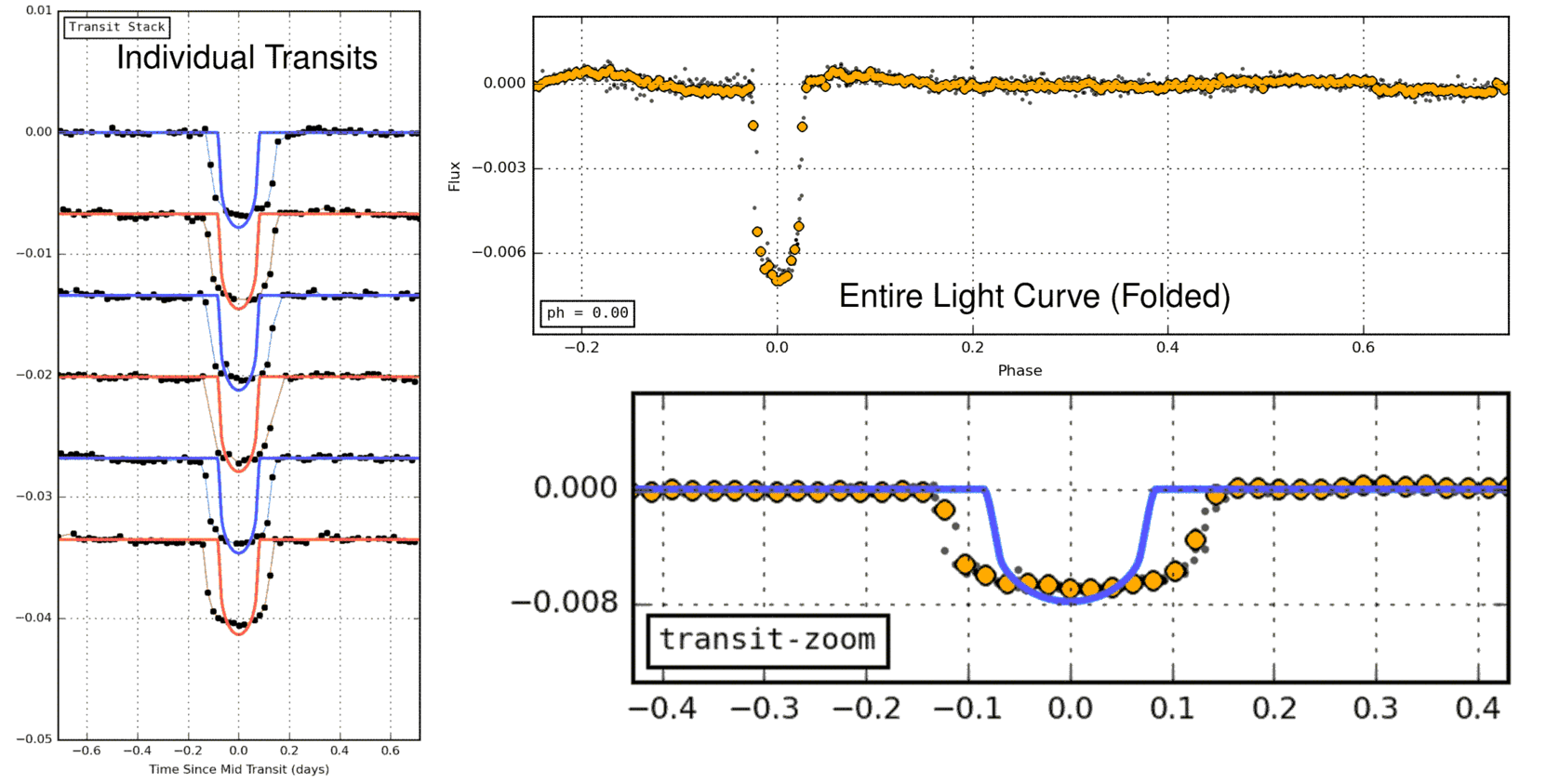
Kepler observes thousands of stars and records the stars’ brightness for long continuous periods. If a star’s planet comes between the line of sight with the earth, a dip in the star’s brightness can be seen in the data.
The width and depth of the drop in the light and the frequency of the dips provides clues to the size of the planet and its orbital period and distance from its star.
While the above diagrams are very clean and unambiguous, most real data is noisy and messy. Human’s are still much better than computer algorithms in spotting structures and unexpected features in such data and that is why citizen science volunteers can provide very useful services for the pro scientists who are collecting the data, especially when there are huge amounts of such data.
In this case, the dips of four planets were seen in the light output of a star in the Aquarius constellation 600 light years from earth. This video provides more details about these exoplanets:
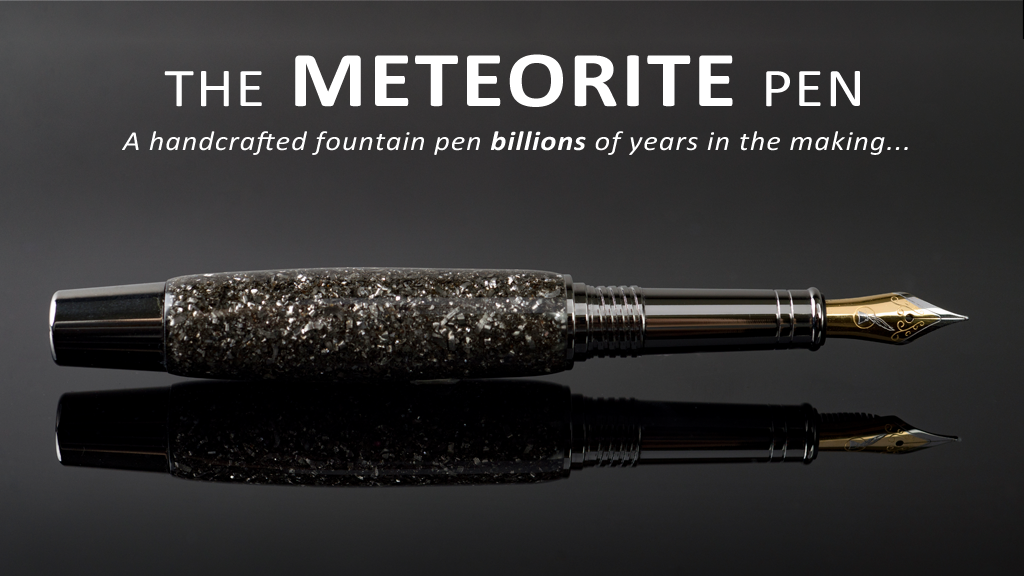
Participants in this crowd-funding campaign will help get a meteorite penmaker venture off the ground and get discounts on pens as well.
We are proud to offer you a Kickstarter exclusive first edition B. Smith & Co. fountain pen. Our Meteorite pen manufacturing process has been completely redesigned to more elegantly highlight the cosmic beauty of this rare material. You will enjoy it for a lifetime.
Your fountain pen will be meticulously handcrafted with high quality black titanium plated hardware featuring pen and cap barrels encrusted with actual Campo del Cielo meteorite that had traveled across the cosmos, in space, for billions of years. It crashed to earth in a fireball 4,000-6,000 years ago before being discovered more than 400 years ago.
Each pen will be carefully fitted with a fine point two-tone stainless steel nib manufactured in Germany by Jowo, one of the world’s largest suppliers of fountain pen nibs, and will include two methods of filling the ink supply– a standard cartridge and a piston converter.
Please keep in mind that every order is individually handcrafted and therefore no two pens will be exactly alike, although they will look very similar. We take great pride in our craftsmanship and guarantee your pen will be just as beautiful as you would expect, hopefully more!
to enable everybody to launch a career in space-related companies. I work day and night to get more companies to participate and to present their openings, to get more universities involved, and to help companies at every stage to find the best possible candidates.
The Space Job Fair grew in less than 1 year from a virtual only event to a full university hosted job fair. With having a hybrid career event, where companies can promote their openings and candidates can present themselves, we created a unique experience to get value for everyone participating. Hybrid means, it is hosted by a university and all presentations are streamed online and a participation is possible from everywhere (internet access required). Our modular and hybrid approach enables us to deliver an easy yet powerful sourcing solution and give universities the chance to bring more international openings to their students.
** Winston Churchill’s essay on ET Churchill was a soldier, a wartime leader, an author, a historian, and a talented participant in various other vocations. Turns out he was also quite informed about scientific topics and recently an essay was found that he had written in 1930 on the possibilities of life beyond earth:
“[W]ith hundreds of thousands of nebulae, each containing thousands of millions of suns, the odds are enormous that there must be immense numbers which possess planets whose circumstances would not render life impossible. I, for one, am not so immensely impressed by the success we are making of our civilization here that I am prepared to think we are the only spot in this immense universe which contains living, thinking creatures, or that we are the highest type of mental and physical development which has ever appeared in the vast compass of space and time.”
The SpaceX Dragon cargo spacecraft, launched last Sunday from the Kennedy Space Center, berthed today to the International Space Station. Astronauts on the station reached out with a robotic arm, snagged the Dragon, and then attached the craft to the station:
The Dragon carries over 5,000 pounds (2300 kg) of supplies, hardware, and research materials, including 21 experiments from students in grade school through high school who are participating in the Student Spaceflight Experiments Program (SSEP) . This is the 9th SSEP mission to the ISS:
This was a really exciting launch for the team at DreamUp as we had the fantastic V3PO students fly all the way from Germany to join us for the launch. These students crowd-funded their plant-growth research project and got some great advisors on board, including Airbus and BASF Crop Protection. With the team put together, the students commenced their vegetative plant propagation.
Learn more about the plant growth experiment here.
…
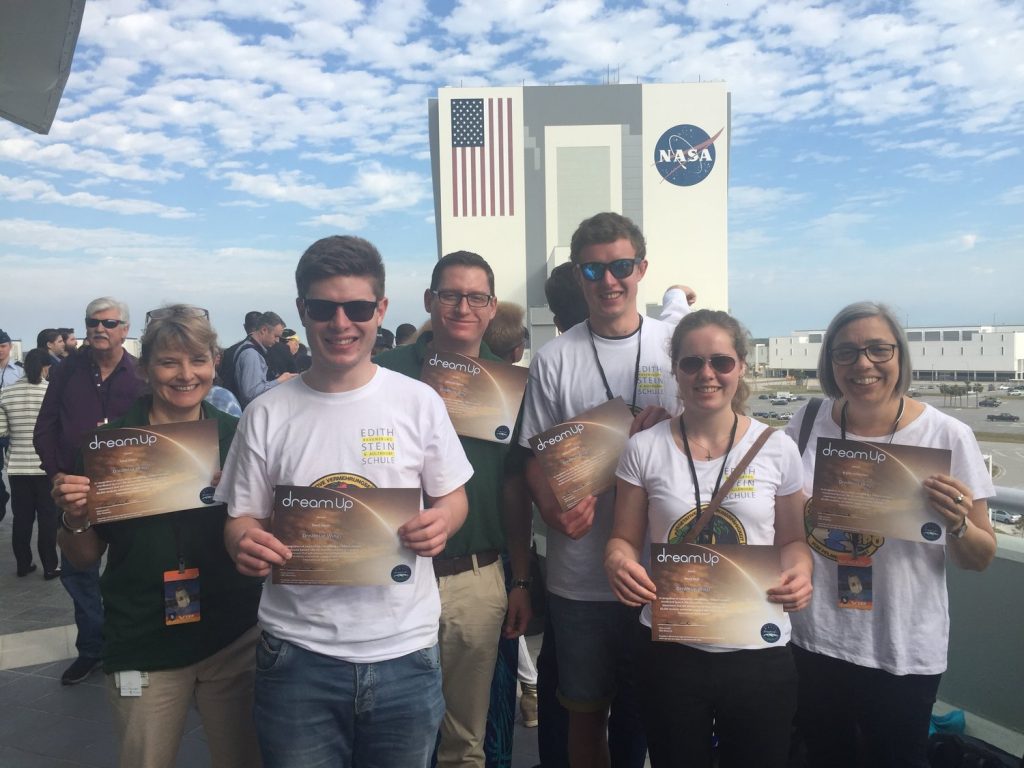
All together, DreamUp was able to bring over 55 student researchers and advisors to this launch. We really saw our students’ perseverance when on the first planned launch date…the launch was scrubbed with just 13 seconds to go! They held on to all of their excitement and brought it to the launch the following day, with big smiles and loud cheers as they saw the rocket go up, holding on tight to their experiments.
The V3PO team receiving their DreamUp Wings certificates with the view of the Vehicle Assembly Building (VAB) in the background. Photo credits DreamUp
Last year alone, we launched over 60 educational payloads to space on five different rockets, designed by student researchers from 7 different countries. We’ve also grown our myLAUNCH and DreamUp graduation programs – offering 50 students a once-in-a-lifetime opportunity to attend a rocket launch and honoring over 100 DreamUp graduates with certificates to celebrate their incredible achievements and welcome them to our growing alumni community.
Part of DreamUp’s core mission is to immerse students and educators at every level of education in the wonder of outer space through engaging programs that highlight the multifaceted applications of STEM skills and the growing opportunities in the global space industry. In 2016, we produced and released our first-ever, completely free, curriculum for educators. Located on our website, the “Eye in the Sky” curriculum was developed in partnership with Jenny Pieratt at CraftED and incorporates space-based data and images to help students determine whether the Earth is a just planet. All are welcome to download and use this Next Generation Science Standard-compliant resource at no cost, but if you do, please send us feedback so we can incorporate your thoughts in our next curriculum release!
Looking ahead, we foresee a very active 2017. As we implement the first-ever DreamUp Challenge, realize partnership agreements with some of the largest school districts in the country, and invite more and more student researchers to experience the wonder of rocket launches, DreamUp will continue to improve our services as the leading provider for experiential learning in space.
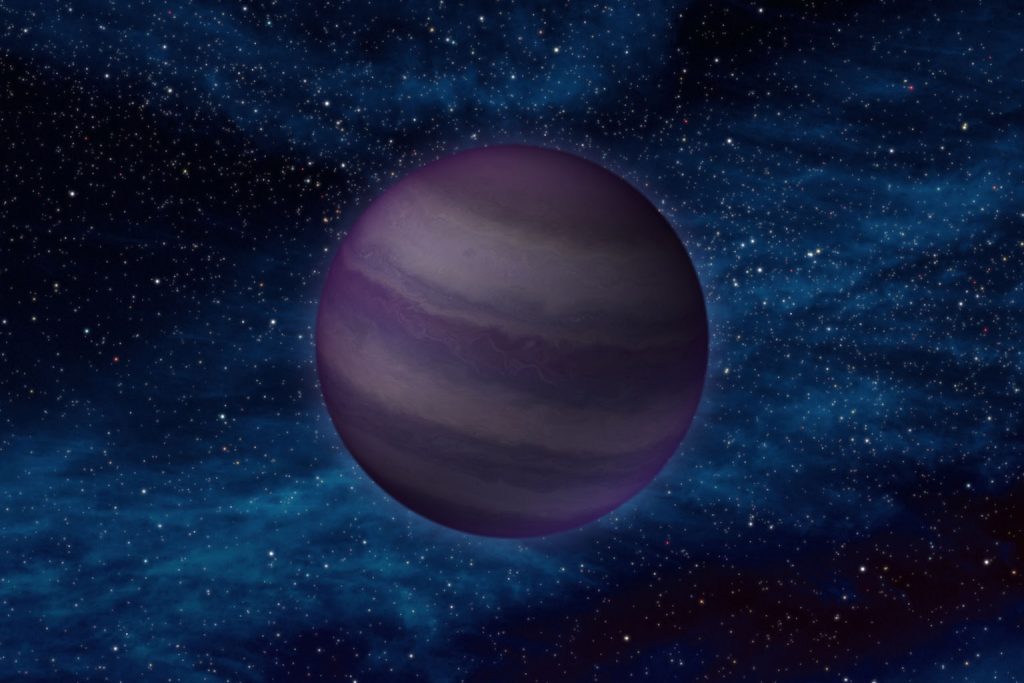
This artist’s concept illustrates a close-up view of a cool brown dwarf. Objects like this, drifting just beyond our solar system, have been imaged by NASA’s Wide-field Infrared Survey Explorer and could be discovered by Backyard Worlds: Planet 9. Credit: NASA/JPL-Caltech › Full image and caption
NASA is inviting the public to help search for possible undiscovered worlds in the outer reaches of our solar system and in neighboring interstellar space. A new website, called Backyard Worlds: Planet 9, lets everyone participate in the search by viewing brief movies made from images captured by NASA’s Wide-field Infrared Survey Explorer (WISE) mission. The movies highlight objects that have gradually moved across the sky.
“There are just over four light-years between Neptune and Proxima Centauri, the nearest star, and much of this vast territory is unexplored,” said lead researcher Marc Kuchner, an astrophysicist at NASA’s Goddard Space Flight Center in Greenbelt, Maryland. “Because there’s so little sunlight, even large objects in that region barely shine in visible light. But by looking in the infrared, WISE may have imaged objects we otherwise would have missed.”
WISE scanned the entire sky between 2010 and 2011, producing the most comprehensive survey at mid-infrared wavelengths currently available. With the completion of its primary mission, WISE was shut down in 2011. It was then reactivated in 2013 and given a new mission assisting NASA’s efforts to identify potentially hazardous near-Earth objects (NEOs), which are asteroids and comets on orbits that bring them into the vicinity of Earth’s orbit. The mission was renamed the Near-Earth Object Wide-field Infrared Survey Explorer (NEOWISE).
The new website uses the data to search for unknown objects in and beyond our own solar system. In 2016, astronomers at Caltech, in Pasadena, California, showed that several distant solar system objects possessed orbital features indicating they were affected by the gravity of an as-yet-undetected planet, which the researchers nicknamed “Planet Nine.” If Planet Nine — also known as Planet X — exists and is as bright as some predictions, it could show up in WISE data.
The search also may discover more-distant objects like brown dwarfs, sometimes called failed stars, in nearby interstellar space.
“Brown dwarfs form like stars but evolve like planets, and the coldest ones are much like Jupiter,” said team member Jackie Faherty, an astronomer at the American Museum of Natural History in New York. “By using Backyard Worlds: Planet 9, the public can help us discover more of these strange rogue worlds.”
Unlike more distant objects, those in or closer to the solar system appear to move across the sky at different rates. The best way to discover them is through a systematic search of moving objects in WISE images. While parts of this search can be done by computers, machines are often overwhelmed by image artifacts, especially in crowded parts of the sky. These include brightness spikes associated with star images and blurry blobs caused by light scattered inside WISE’s instruments.
Backyard Worlds: Planet 9 relies on human eyes because we easily recognize the important moving objects while ignoring the artifacts. It’s a 21st-century version of the technique astronomer Clyde Tombaugh used to find Pluto in 1930, a discovery made 87 years ago this week.
On the website, people around the world can work their way through millions of “flipbooks,” which are brief animations showing how small patches of the sky changed over several years. Moving objects flagged by participants will be prioritized by the science team for follow-up observations by professional astronomers. Participants will share credit for their discoveries in any scientific publications that result from the project.
“Backyard Worlds: Planet 9 has the potential to unlock once-in-a-century discoveries, and it’s exciting to think they could be spotted first by a citizen scientist,” said team member Aaron Meisner, a postdoctoral researcher at the University of California, Berkeley, who specializes in analyzing WISE images.
Backyard Worlds: Planet 9 is a collaboration among NASA, UC Berkeley, the American Museum of Natural History in New York, Arizona State University in Tempe, the Space Telescope Science Institute in Baltimore, and Zooniverse, a collaboration of scientists, software developers and educators who collectively develop and manage citizen science projects on the internet.
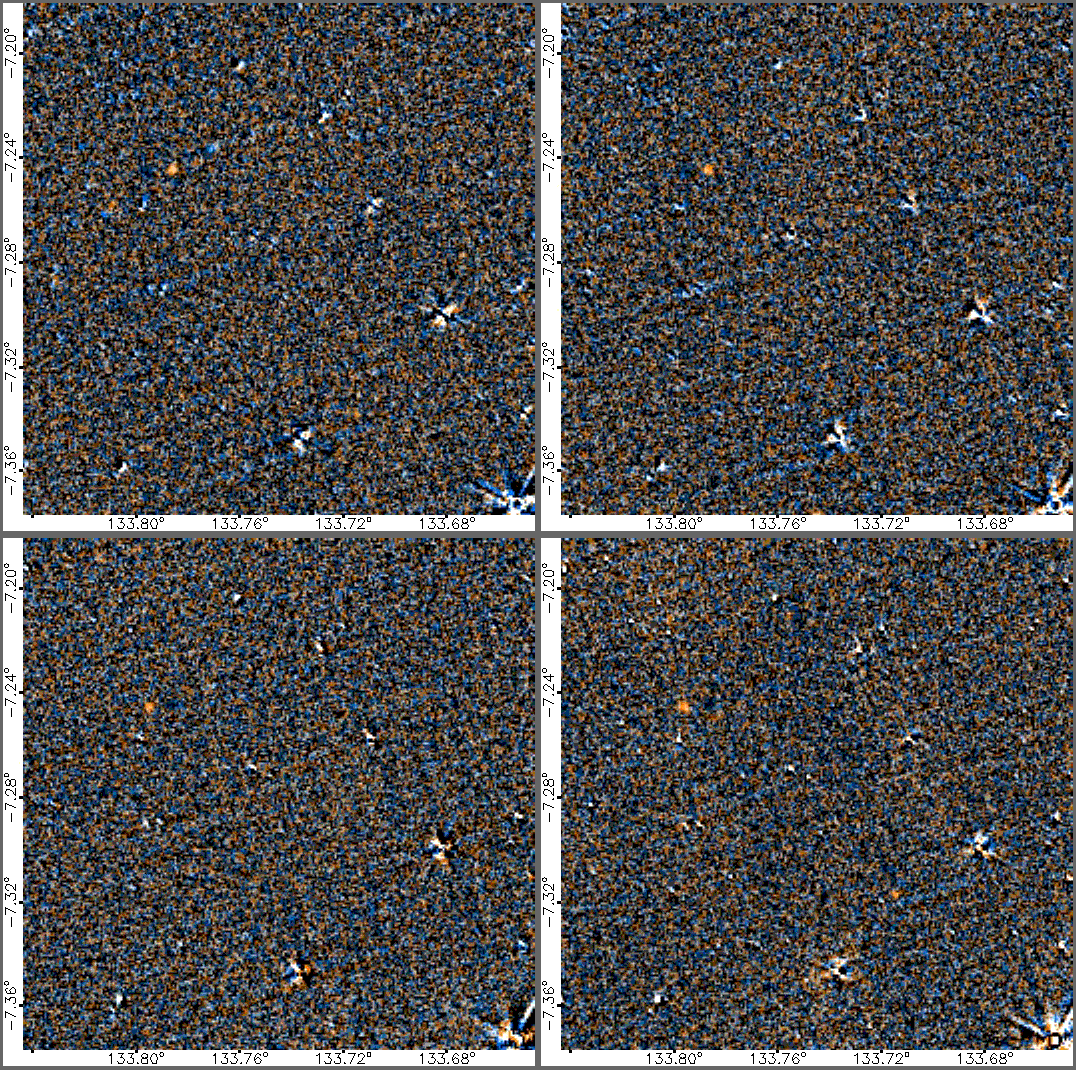
A previously cataloged brown dwarf named WISE 0855?0714 shows up as a moving orange dot in this loop of WISE images spanning five years. By viewing movies like this, anyone can help discover more of these objects. Credits: NASA/WISE › Larger view
NASA’s Jet Propulsion Laboratory in Pasadena manages and operates WISE for NASA’s Science Mission Directorate. The WISE mission was selected competitively under NASA’s Explorers Program managed by the agency’s Goddard Space Flight Center. The science instrument was built by the Space Dynamics Laboratory in Logan, Utah. The spacecraft was built by Ball Aerospace & Technologies Corp. in Boulder, Colorado. Science operations and data processing take place at IPAC at Caltech, which manages JPL for NASA.
The Space Nation Astronaut Program aims to involve the public in space flight. Their first initiative is a space flight training app for cell phones with
which people all around the world can compete in challenges to gain a deeper understanding of space exploration and the science and technology behind human spaceflight. Candidates earn points by completing tasks and advance through multiple merit levels to earn the ultimate mission: a trip to space.
The trip to space will be on a suborbital rocket vehicle.
The Finland base project is a collaboration of four companies – Cohu Experience, Axiom Space (commercial space station builder), Fun Academy, and Edge of Space (high alt balloons) – who plan “to create concrete ways to make space travel dreams possible for everyone”.
A crowd-funding campaign has raised over 2,350,000 euros in just the first few days. Here is a video outlining the Space Nation plan:
 by
by