Category Archives: Space participation

Citizen Scientist in NASA project spots ancient white dwarf star with puzzling rings

As often reported here, citizen scientists, especially in astronomy, continue to make significant contributions to the sciences. Here is a new article from NASA detailing one such case:

Citizen Scientist Finds Ancient White Dwarf Star With Puzzling Rings

A volunteer working with the NASA-led Backyard Worlds: Planet 9 project has found the oldest and coldest known white dwarf — an Earth-sized remnant of a Sun-like star that has died — ringed by dust and debris. Astronomers suspect this could be the first known white dwarf with multiple dust rings.
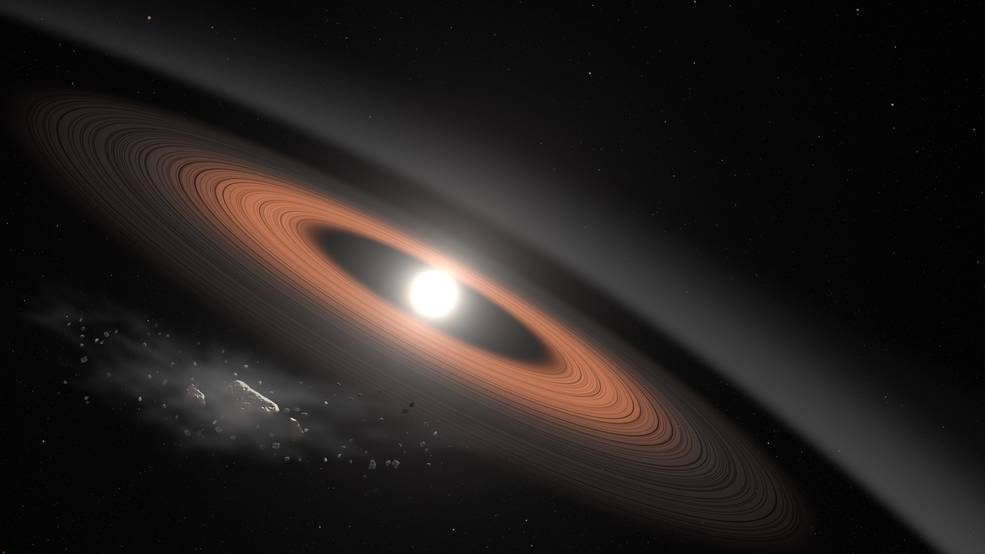
In this illustration, an asteroid (bottom left) breaks apart under the powerful gravity of LSPM J0207+3331, the oldest, coldest white dwarf known to be surrounded by a ring of dusty debris. Scientists think the system’s infrared signal is best explained by two distinct rings composed of dust supplied by crumbling asteroids. Credits: NASA’s Goddard Space Flight Center/Scott Wiessinger. Download in high-resolution formats from NASA Goddard’s Scientific Visualization Studio

The star, LSPM J0207+3331 or J0207 for short, is forcing researchers to reconsider models of planetary systems and could help us learn about the distant future of our solar system.

“This white dwarf is so old that whatever process is feeding material into its rings must operate on billion-year timescales,” said John Debes, an astronomer at the Space Telescope Science Institute in Baltimore. “Most of the models scientists have created to explain rings around white dwarfs only work well up to around 100 million years, so this star is really challenging our assumptions of how planetary systems evolve.”

A paper detailing the findings, led by Debes, was published in the Feb. 19 issue of The Astrophysical Journal Letters and is now available online.

J0207 is located around 145 light-years away in the constellation Capricornus. White dwarfs slowly cool as they age, and Debes’ team calculated J0207 is about 3 billion years old based on a temperature just over 10,500 degrees Fahrenheit (5,800 degrees Celsius). A strong infrared signal picked up by NASA’s Wide-field Infrared Survey Explorer (WISE) mission — which mapped the entire sky in infrared light — suggested the presence of dust, making J0207 the oldest and coldest white dwarf with dust yet known. Previously, dust disks and rings had only been observed surrounding white dwarfs about one-third J0207’s age.

When a Sun-like star runs out of fuel, it swells into a red giant, ejects at least half of its mass, and leaves behind a very hot white dwarf. Over the course of the star’s giant phase, planets and asteroids close to the star become engulfed and incinerated. Planets and asteroids farther away survive, but move outward as their orbits expand. That’s because when the star loses mass, its gravitational influence on surrounding objects is greatly reduced.

This scenario describes the future of our solar system. Around 5 billion years from now, Mercury, then Venus and possibly Earth will be swallowed when the Sun grows into a red giant. Over hundreds of thousands to millions of years, the inner solar system will be scrubbed clean, and the remaining planets will drift outward.
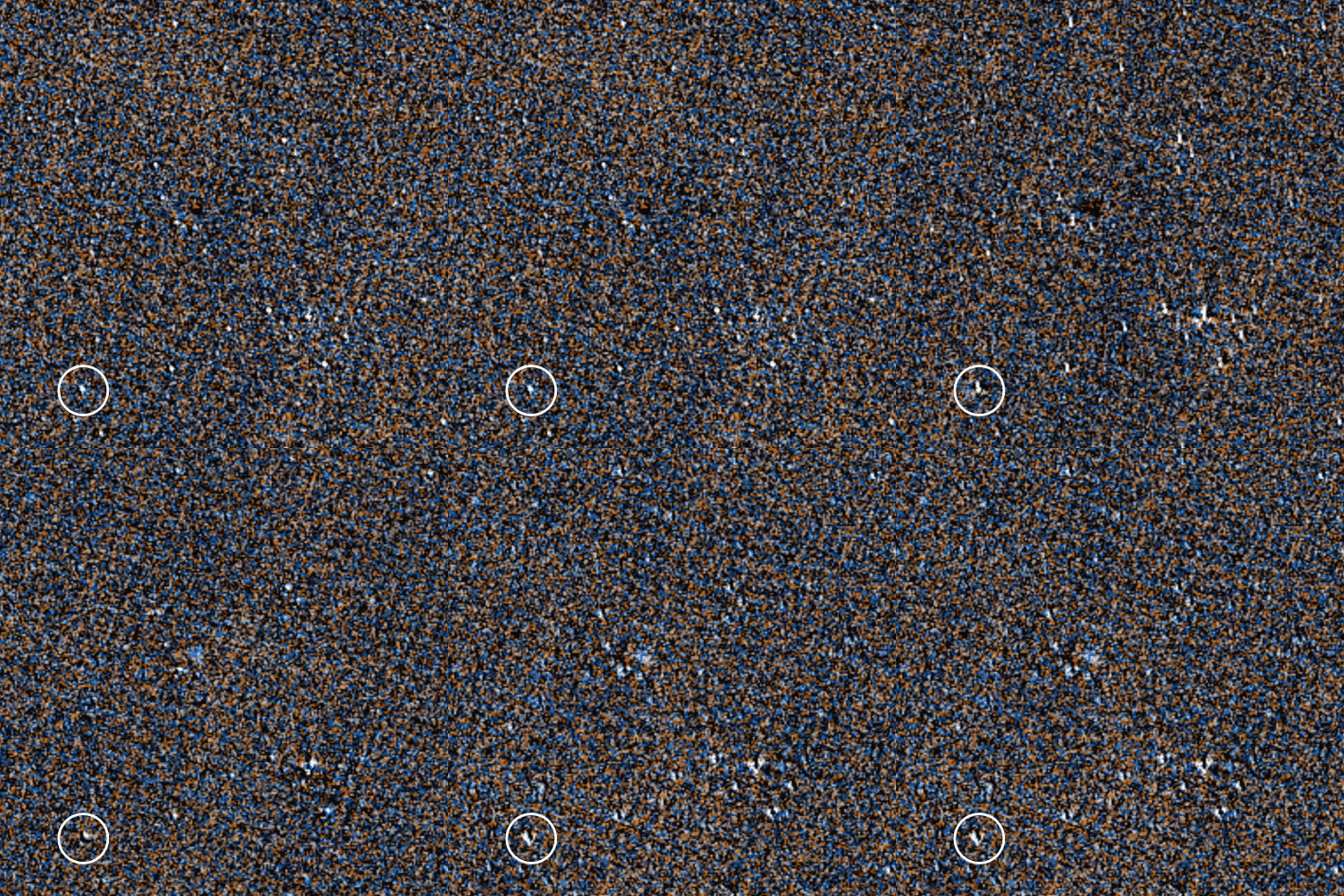
Citizen scientists working on Backyard Worlds: Planet 9 scrutinize “flipbooks” of images from NASA’s Wide-field Infrared Survey Explorer. This animation shows a flipbook containing the ring-bearing white dwarf LSPM J0207+3331 (circled).
Credit: Backyard Worlds: Planet 9/NASA’s Goddard Space Flight Center

Yet some white dwarfs — between 1 and 4 percent — show infrared emission indicating they’re surrounded by dusty disks or rings. Scientists think the dust may arise from distant asteroids and comets kicked closer to the star by gravitational interactions with displaced planets. As these small bodies approach the white dwarf, the star’s strong gravity tears them apart in a process called tidal disruption. The debris forms a ring of dust that will slowly spiral down onto the surface of the star.

J0207 was found through Backyard Worlds: Planet 9, a project led by Marc Kuchner, a co-author and astrophysicist at NASA’s Goddard Space Flight Center in Greenbelt, Maryland, that asks volunteers to sort through WISE data for new discoveries.

Melina Thévenot, a co-author and citizen scientist in Germany working with the project, initially thought the infrared signal was bad data. She was searching through the ESA’s (European Space Agency’s) Gaia archives for brown dwarfs, objects too large to be planets and too small to be stars, when she noticed J0207. When she looked at the source in the WISE infrared data, it was too bright and too far away to be a brown dwarf. Thévenot passed her findings along to the Backyard Worlds: Planet 9 team. Debes and Kuchner contacted collaborator Adam Burgasser at the University of California, San Diego to obtain follow-up observations with the Keck II telescope at the W. M. Keck Observatory in Hawaii.

“That is a really motivating aspect of the search,” said Thévenot, one of more than 150,000 citizen scientists on the Backyard Worlds project. “The researchers will move their telescopes to look at worlds you have discovered. What I especially enjoy, though, is the interaction with the awesome research team. Everyone is very kind, and they are always trying to make the best out of our discoveries.”

The Keck observations helped confirm J0207’s record-setting properties. Now scientists are left to puzzle how it fits into their models.
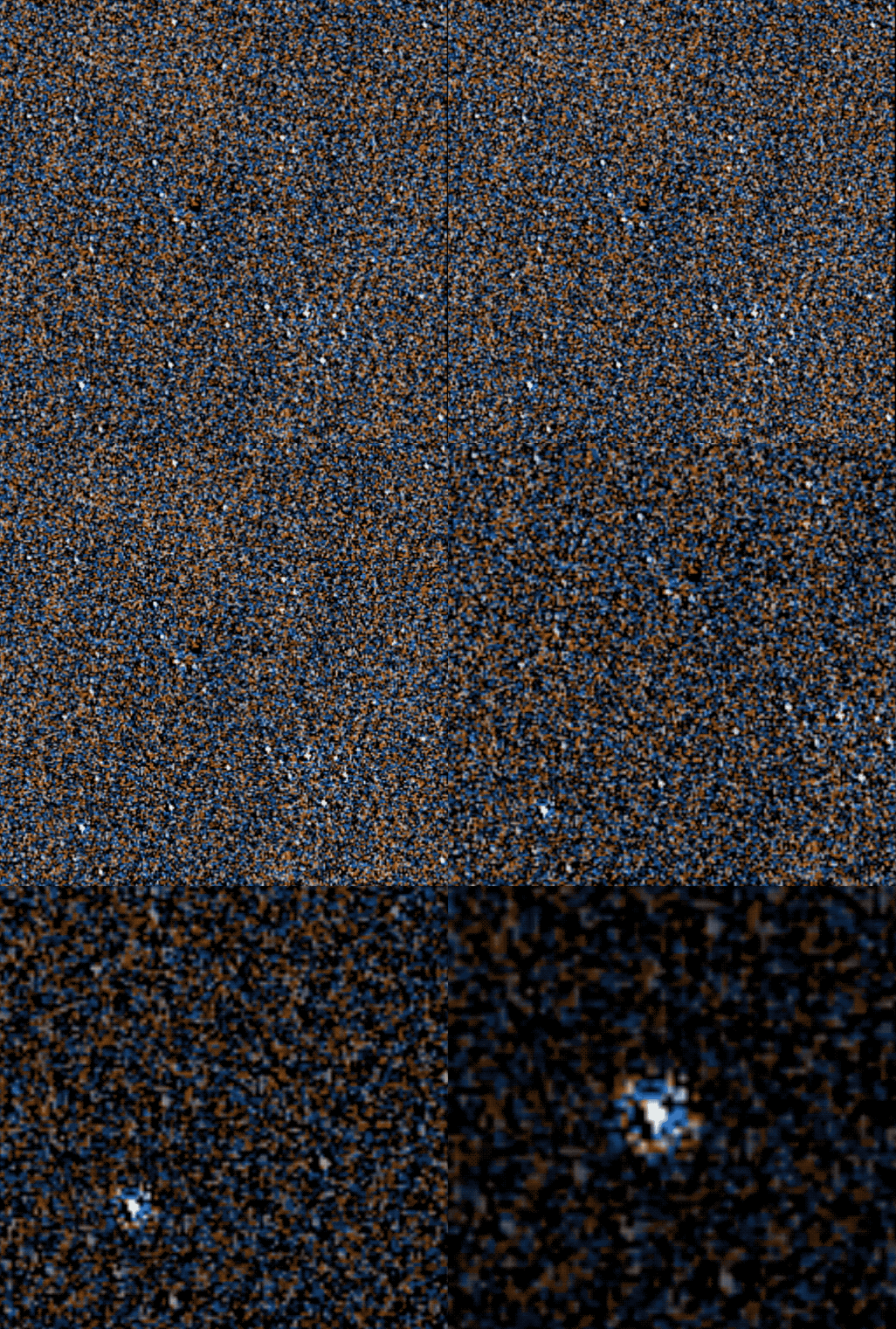
Citizen scientists working on Backyard Worlds: Planet 9 scrutinize “flipbooks” of images from NASA’s Wide-field Infrared Survey Explorer. This animation zooms in on the ring-bearing white dwarf LSPM J0207+3331 (highlighted). Credit: Backyard Worlds: Planet 9/NASA’s Goddard Space Flight Center

Debes compared the population of asteroid belt analogs in white dwarf systems to the grains of sand in an hourglass. Initially, there’s a steady stream of material. The planets fling asteroids inward towards the white dwarf to be torn apart, maintaining a dusty disk. But over time, the asteroid belts become depleted, just like grains of sand in the hourglass. Eventually, all the material in the disk falls down onto the surface of the white dwarf, so older white dwarfs like J0207 should be less likely to have disks or rings.

J0207’s ring may even be multiple rings. Debes and his colleagues suggest there could be two distinct components, one thin ring just at the point where the star’s tides break up the asteroids and a wider ring closer to the white dwarf. Follow-up with future missions like NASA’s James Webb Space Telescope may help astronomers tease apart the ring’s constituent parts.

“We built Backyard Worlds: Planet 9 mostly to search for brown dwarfs and new planets in the solar system,” Kuchner said. “But working with citizen scientists always leads to surprises. They are voracious — the project just celebrated its second birthday, and they’ve already discovered more than 1,000 likely brown dwarfs. Now that we’ve rebooted the website with double the amount of WISE data, we’re looking forward to even more exciting discoveries.”  

Backyard Worlds: Planet 9 is a collaboration between NASA, the American Museum of Natural History in New York, Arizona State University, National Optical Astronomy Observatory, the Space Telescope Science Institute in Baltimore, the University of California San Diego, Bucknell University, the University of Oklahoma, and Zooniverse, a collaboration of scientists, software developers and educators who collectively develop and manage citizen science projects on the internet.

NASA’s Jet Propulsion Laboratory in Pasadena, California, manages and operates WISE for NASA’s Science Mission Directorate. The WISE mission was selected competitively under NASA’s Explorers Program managed by the agency’s Goddard Space Flight Center. The science instrument was built by the Space Dynamics Laboratory in Logan, Utah. The spacecraft was built by Ball Aerospace & Technologies Corp. in Boulder, Colorado. Placed in hibernation in 2011, the spacecraft was reactivated in 2013 and renamed NEOWISE. Science operations and data processing take place at the Infrared Processing and Analysis Center at Caltech, which manages JPL for NASA.

For more information about Backyard Worlds: Planet 9, visit: http://backyardworlds.org

For more information about NASA’s WISE mission, visit: http://www.nasa.gov/wise

By Jeanette Kazmierczak
NASA’s Goddard Space Flight Center, Greenbelt, Md.

====

Telescopes and Binoculars at Amazon

Winners announced for Space Foundation’s Int. Student Art Contest

The winners of the Space Foundation‘s ninth international student space art contest, co-sponsored by Firefly Aerospace, have been selected. See the gallery of terrific winning entries here.

Winners of the Space Foundation’s
9th Annual International Student Art Contest Announced

  • 25 winners selected from 61 countries
  • 3,908 entries submitted
  • Space Achievement Award winner is Xinyi Christine from New Jersey
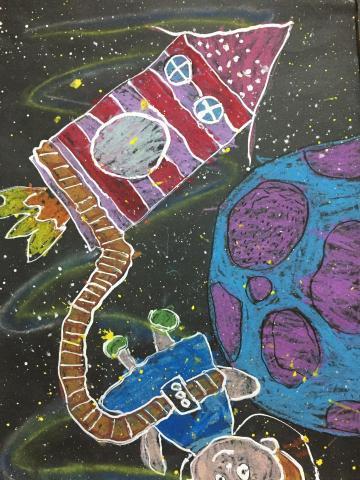
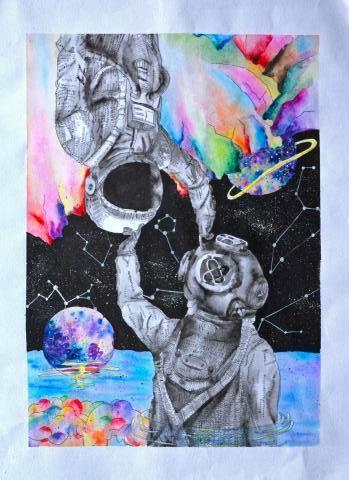
Xinyi Christine, Space Achievement Award 13 – 14 Years Old, USA

COLORADO SPRINGS, Colo. (Jan 23, 2019) — The Space Foundation has announced the winners of its 9th Annual Space Foundation International Student Art Contest, co-sponsored by Firefly Aerospace. The 25 winners represent five U.S. states and 12 countries, with one entry chosen for the Space Achievement Award.

The Space Foundation invited public, private and homeschool children from around the world, ages 3-18, to submit original artwork depicting the theme, “Where Will Your Spaceship Take You?” The contest is free to enter every year, and the response for 2019 included more than 3,900 entries from 36 U.S. states and 61 countries, including Lithuania, United Arab Emirates, Kenya and Mongolia.

“Everything that has been constructed existed first in the imagination of its architect,” said Firefly CEO Dr. Tom Markusic. “We are inspired by the vision of these student space architects as they imagine ‘where their spaceships will take them.’”

Rui Xi, 1st Place 3 – 4 Years Old, Malaysia

The winning entries will be shown at the Space Foundation’s 35th Space Symposium, to be held April 8-11, 2019, at The Broadmoor in Colorado Springs, Colo., USA. After the Symposium, the winning art will be displayed at Space Foundation Headquarters and Discovery Center in Colorado Springs.

“I have greatly enjoyed personally viewing thousands of inspired contest entries over the years,” said Nancy Reed, Director – Marketing & Creative Services for the Space Foundation.  “I treasure gained insights from my involvement with the contest – that young artists’ creativity, desire to win and their view of space is universal throughout the world and transcends world politics and differing ideologies – a wonderful thing indeed!”

The winners will receive an astronaut autograph, certificate, ribbon and an art kit.

Adeena, 3rd Place 9 – 10 Years Old, Indonesia

In August 2019, the Space Foundation will make an announcement about the 2020 contest.

About the Contest

Students were invited to enter artwork in the following media formats: drawing, painting, mixed media and digital. The contest featured eight age categories, with first, second and third place honors for each of the age categories, plus one Space Foundation Achievement Award.

Jun Yao, 1st Place, 7 – 8 Years Old, China

The 2019 winners are listed by first name only in consideration of the children’s privacy.

3 – 4 Years      

  • 1st Place – Rui Xi, Malaysia
  • 2nd Place – Naajiha, Bangladesh
  • 3rd Place – Pulasi, Sri Lanka

5 – 6 Years      

  • 1st Place – Sansthita, India
  • 2nd Place – Hangyu, China
  • 3rd Place – Richard, United States

7 – 8 Years      

  • 1st Place – Jùn yáo, China
  • 2nd Place – Ruixi, China
  • 3rd Place – KeXin, China

9 – 10 Years    

  • 1st Place – Aaron, United States
  • 2nd Place – Xu Yuan, United States
  • 3rd Place – Adeena, Indonesia

11 – 12 Years  

  • 1st Place – Peter, United States
  • 2nd Place – Timur, Russia
  • 3rd Place – Maria, Ukraine

13 – 14 Years  

  • 1st Place – Crystal, United States
  • 2nd Place – Daria, Ukraine
  • 3rd Place – Jonathan, United States

15 – 16 Years  

  • 1st Place – Adrian, United States
  • 2nd Place – Natalie, United States
  • 3rd Place – Ziqing, China

17 – 18 Years  

  • 1st Place – Calum, United States
  • 2nd Place – Adriana, United States
  • 3rd Place –  Eva Sophie, Germany

Space Achievement Award   

Xinyi Christine, United States, Age 14

Where to See the Artwork
Winning artwork submitted for this year’s contest can be seen on the International Student Art Contest website gallery at http://art.spacefoundation.org/winners-gallery/2019, and all of the submitted artwork can be seen at http://art.spacefoundation.org.

About the Judges

Space Art Expertise

  • Richard Green, senior artist/designer with more than 20 years’ experience in creating and designing for the video game, aerospace and industrial design industries, Seattle, Washington.
  • Joe Vinton, digital artist, Renderosity Artist of the Year, Burton, Trent, United Kingdom.

Children’s Art Expertise

  • Hans Wolfe, middle and upper school visual arts, Visiting Artist Coordinator, Art Department Chair, The Colorado Springs School, Colorado Springs, Colorado.

Commercial Art Expertise

  • Lourn Eidal, Assistant Art Director, Crystal Peak Design, Colorado Springs, Colorado.
  • Susanne Arens, President, Crystal Peak Design and Art Director, photographer, fine artist, college instructor, Executive Director of the Pikes Peak Studio Tour, Springs Recovery Connection board member, Colorado Springs, Colorado.

About Firefly Aerospace

Firefly is developing a family of launch vehicles to provide industry-leading affordability, convenience and reliability for dedicated light to medium lift launches. Firefly’s Alpha and Beta vehicles utilize common technologies, manufacturing infrastructure and launch capabilities, providing LEO launch solutions for up to one and four metric tons of payload respectively. Alpha and Beta will provide the space industry with access to frequent launches at the lowest cost/kg, enabling ambitious commercial and exploration missions from LEO to the Moon. Headquartered in Cedar Park, Tex., Firefly has additional presence in Washington, D.C., Dnipro, Ukraine, and Tokyo, Japan. Firefly is financed by Noosphere Ventures of Menlo Park, Calif. Learn more by visiting fireflyspace.com.

About the Space Foundation
Founded in 1983, the Space Foundation is a 501(c)(3) and the world’s premier organization to inspire, educate, connect, and advocate on behalf of the global space community. It is a nonprofit leader in space awareness activities, educational programs, and major industry events, including the annual Space Symposium. Space Foundation headquarters is in Colorado Springs, Colo., USA, and has a public Discovery Center, including El Pomar Space Gallery, Northrop Grumman Science Center featuring Science On a Sphere® and the Lockheed Martin Space Education Center. The Space Foundation has a Washington, D.C., office and field representatives in Houston and the Florida Space Coast. It publishes The Space Report: The Authoritative Guide to Global Space Activity, and through its Space CertificationTM and Space Technology Hall of Fame® programs, recognizes space-based innovations that have been adapted to improve life on Earth. Visit both of our websites www.SpaceFoundation.org and DiscoverSpace.org – and follow us on Facebook, Twitter, Instagram, LinkedIn and YouTube.

Student and amateur CubeSat news roundup – Dec.26.2018

A sampling of recent articles, press releases, etc. about student and amateur CubeSat / SmallSat projects and programs:

** UF research satellite launches into orbit – Gainesville Sun – Gainesville, FL

… NASA launched a University of Florida satellite that could help improve the accuracy of timing-sensitive satellites, such as GPS.

The satellite is more than 500 kilometers (315 miles) above Earth, orbiting at a speed of 17,500 miles per hour.

“We’ve spent five and a half years to get to this point, and the launch is always the riskiest part,” said UF mechanical and aerospace engineering Associate Professor John Conklin. “Having passed that hurdle, it feels great.”

The UF satellite was one of 13 research cube satellites launched by Rocket Lab Electron from New Zealand as part of NASA’s Educational Launch of Nanosatellites (ELaNa) program. The goal of UF’s research from space is to improve time-transfer synchronizing systems through laser technology. Systems like GPS synchronize their times through radio waves, which have a higher delay in the atmosphere and also a higher error rate.

** UWE-4 satellite ready to launch | Southgate Amateur Radio News – UWE-4 – Lehrstuhl für Informatik VII

The University Würzburg Experimental Satellite 4 (UWE-4) is the most recent project within the UWE CubeSat family. This 1U (one unit) CubeSat will incorporate for the first time in the UWE program a propulsion system. The satellite is scheduled for launch on board a Soyuz-2 mission using a Fregat upper stage in December 2018.

** CubeSats Could Use Laser Pointers to Transmit Data to Earth > ENGINEERING.com

But laser communications also have a significant drawback: because laser beams are much more focused than radio waves, they need to be pointed with much greater precision at receivers on the ground.

The MIT team developed a laser-pointing platform about the size of a coffee mug that uses a mirror, smaller than a fingernail, to bounce the laser down toward a ground receiver. The platform can adjust the angle of the mirror to change the laser’s direction.

** AMSAT news on student and amateur CubeSat/smallsat projects: ANS-357 AMSAT News Service Special Bulletin

  • Changes to the AMSAT-NA TLE Distribution for December 20, 2018
  • UWE-4 Satellite Ready to Launch
  • New Amateur Radio Packet Gear Awaits Unpacking, Installation on Space Station
  • Successful “AMSAT on the Queen Mary” Operation
  • AMSAT CW Activity Day January 1, 2019 In Memory Of W3XO
  • ELaNa-XIX Successfully Launched
  • AMSAT Awards
  • Upcoming Satellite Operations
  • ARISS News
  • Satellite Shorts from All Over

General CubeSat/SmallSat info:

  • Venture Class Rockets First Class Flights for CubeSats – NASA:

====

Telescopes and Binoculars at Amazon</p

New Virgin Galactic video about SpaceShipTwo spaceflight

In this video, Richard Branson tells his children about his own father and relates his father’s advice on living a good life to the recent SpaceShipTwo flight to the edge of space. The video includes some new footage of the flight: To my grandchildren | Virgin

====


Check out the Best Selling Electronics at Amazon

Israel’s nonprofit SpaceIL lunar lander mission to include time capsule

The Israeli non-profit SpaceIL organization now expects SpaceX to launch its lunar lander mission in February. SpaceIL was a competitor in the Google Lunar XPRIZE contest, which ended before any entrant reached the Moon. However, SpaceIL and several other GLXP entrants are continuing with plans to send landers to the lunar surface. Recently, for example, three former GLXP entrants are involved in partnerships with NASA to participant in the agency’s Commercial Lunar Payload Delivery program in which NASA will pay commercial companies to take technology and scientific experiment payloads to the Moon.

Here is the latest announcement from SpaceIL:

SpaceIL, IAI to Send Time Capsule on Israel’s Historic Moon Mission
The time capsule will include Israeli national, cultural and traditional symbols,
such as Israel’s Declaration of Independence, Hebrew songs, the Wayfarer’s Prayer,
and paintings by Israeli children.

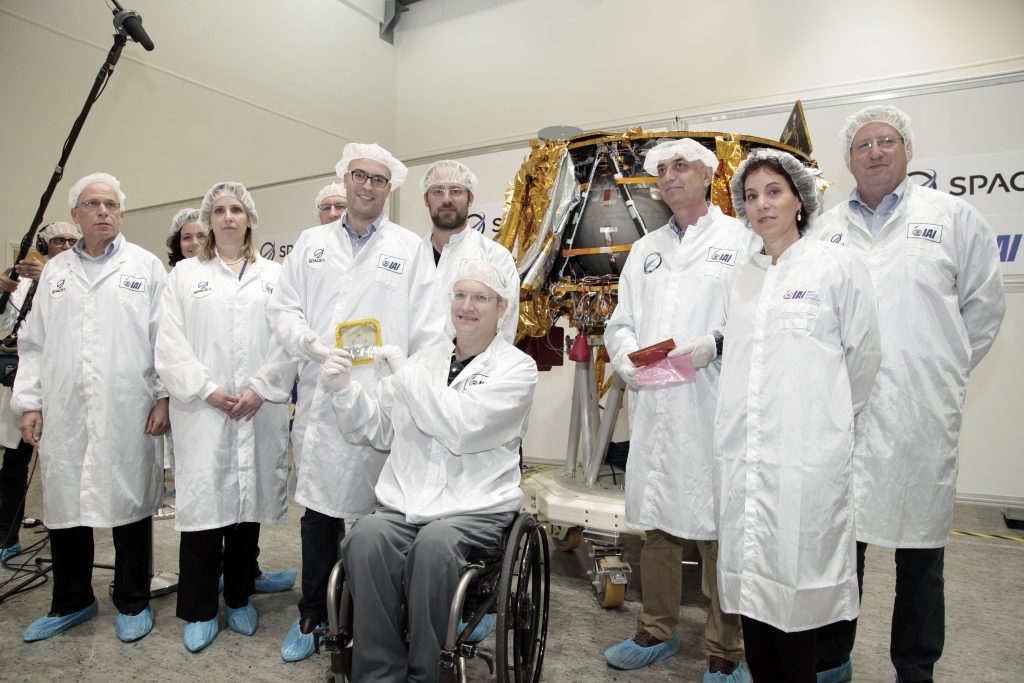
YEHUD, Dec. 17 – Israeli nonprofit SpaceIL and Israel Aerospace Industries (IAI) presented today at IAI’s Space Division a time capsule that will travel to the moon — and remain there indefinitely — with the first Israeli spacecraft, which will launch from Cape Canaveral, Florida, in February, 2019.

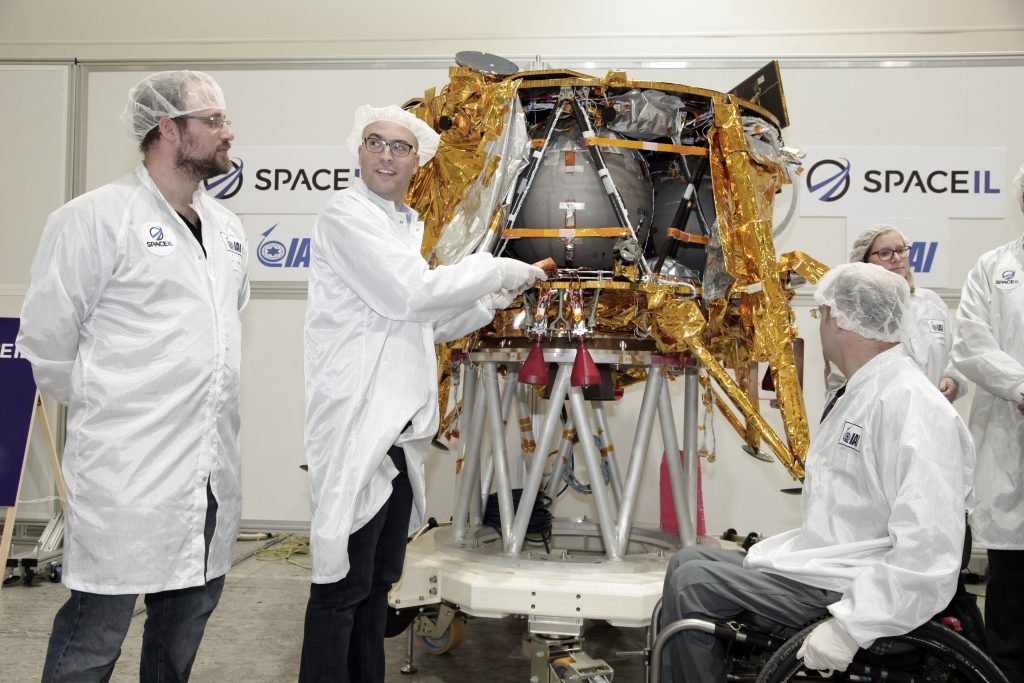
The SpaceIL lunar spacecraft. Photo by Yoav Weiss

The time capsule consists of three discs, each containing hundreds of digital files. Included among the files, which will travel to the moon inside SpaceIL’s lunar spacecraft, are: Details about the spacecraft and the crew building it; national symbols, like Israel’s Declaration of Independence, the Bible, Israel’s national anthem, “Hatikvah”, and the Israeli flag; cultural objects; materials – paintings, for example – collected over many years from the public for sending to the moon; dictionaries in 27 languages and encyclopedias, an indication of knowledge accumulated by all humanity thus far; Israeli songs; the Wayfarer’s Prayer; books of art and science and Israeli literature; information about Israeli scientific and technological discoveries and developments that influenced the world; photos Israel’s landscapes and of leading figures in Israeli culture; a children’s book that was inspired by SpaceIL’s mission to the moon.

The time capsule, along with the spacecraft, will remain on the Moon indefinitely, even after completing Israel’s first lunar mission. With no plans to return to Earth, the spacecraft and information within the time capsule’s disks will possibly be found and distributed by future generations.

Time capsule data disks to go to the Moon on SpaceIL lander. Photo by Yoav Weiss

In early 2019, the spacecraft, recently named Beresheet (the Hebrew word for Genesis), will launch alongside other satellites as a secondary payload on a SpaceX Falcon 9 rocket. The precise launch date remains undetermined, as SpaceIL awaits final confirmation from the launch company.

“This is another step on our way to the moon,” said Ido Anteby, CEO of SpaceIL. “Inserting the disks into the spacecraft, which is a real “time capsule,” indicates the spacecraft’s readiness to blast off from the launch site in a few weeks. SpaceIL’s crews and IAI have completed testing of the spacecraft and its systems, and are preparing for the beginning of the amazing and complex journey that exemplifies innovation, creativity and courage. The spacecraft’s historic journey, which also includes a scientific mission, makes a significant contribution to advancing the space industry and the subject of space in Israel.”

Yonatan Winetraub, one of three SpaceIL founders, said, as he inserted the time capsule into a spacecraft:

“This is a very emotional moment. We do not know how long the spacecraft and the time capsule will remain on the moon. It is very possible that future generations will find this information and want to learn more about this historic moment.”

Opher Doron, IAI’s Space Division General Manager, said:

“We are proud to be the first non-governmental entity in the world to go to the moon. Landing on the moon was for many years a little-discussed topic among the public, but recently we see growing interest as world superpowers seek to return to the moon in a variety of commercial missions. There is no doubt that the technological knowledge acquired by IAI during the development and construction of Beresheet, together with Space IL and combined with the space capabilities developed over more than 30 years at IAI, puts us at the global forefront in the ability to complete lunar missions.”

The spacecraft, whose construction was carried out at IAI’s Space Division, successfully completed a series of recent tests to examine the integration of systems, and a series of complex experiments aimed at testing its durability. Concurrently, validation and verification tests checked the function of the spacecraft in scenarios it could experience during the mission. Since actual space conditions cannot be replicated, tests are carried out in part by a SpaceIL simulator that mimics space conditions and part on the spacecraft itself. Next, SpaceIL will soon ship the spacecraft to the launch site in Cape Canaveral, Florida.

In October, SpaceIL and the Israeli Space Agency announced a collaboration with NASA that will enable SpaceIL to improve its ability to track and communicate with the spacecraft before, during, and after landing on the moon. Two weeks ago a retro-reflector from NASA was installed on the spacecraft, an instrument that reflects laser beams and will enable NASA to precisely locate the spacecraft on the lunar surface after the landing. SpaceIL, the Israel Space Agency and NASA also agreed that NASA will have access to data gathered by the magnetometer installed aboard the Israeli spacecraft. The instrument, which was developed in collaboration with Israel’s Weizmann Institute of Science, will measure the magnetic field on and above the landing site.

About SpaceIL: SpaceIL is a non-profit organization established in 2011 aiming to land the first Israeli spacecraft on the Moon. The organization was founded by three young engineers: Yariv Bash, Kfir Damari and Yonatan Winetraub who answered the international challenge presented by Google Lunar XPRIZE: to build, launch and land an unmanned spacecraft on the Moon. SpaceIL was the only Israeli representative. In October 2015, SpaceIL reached a dramatic project milestone by becoming the first team to announce a signed launch contract, that symbolizes an actual “ticket to the Moon”. In January 2017, SpaceIL became one of the competition’s five finalists. The competition officially ended with no winners in March 31, 2018, after Google ended their sponsorship.
Regardless of the competition, SpaceIL is committed to continue and complete its mission, to land on the Moon and to the advancement of science and technology education in Israel.

SpaceIL is actively working to create an Israeli “Apollo Effect.” SpaceIL is committed to inspiring the next generation in Israel and around the world to choose to study science, technology, engineering and mathematics (STEM).

The launch will take place on an American SpaceX rocket in first quarter of 2019, and the Moon landing will be at the end of a two-month journey in space, after the launch. Read More

====

Chasing New Horizons: Inside the Epic First Mission to Pluto