Category Archives: Astronomy

NASA Kepler mission confirms over 700 new exoplanets

Despite the suspension of observations with the Kepler planet-finder telescope, lots of planets continue to be found in the massive amount of data that was collected while it was working.

NASA’s Kepler Mission Announces a Planet Bonanza, 715 New Worlds

NASA’s Kepler mission announced Wednesday the discovery of 715 new planets. These newly-verified worlds orbit 305 stars, revealing multiple-planet systems much like our own solar system.

Nearly 95 percent of these planets are smaller than Neptune, which is almost four times the size of Earth. This discovery marks a significant increase in the number of known small-sized planets more akin to Earth than previously identified exoplanets, which are planets outside our solar system.

The artist concept depicts multiple-transiting planet systems, which are
stars with more than one planet. The planets eclipse or transit their host
star from the vantage point of the observer. This angle is called edge-on.
Image Credit:  NASA

“The Kepler team continues to amaze and excite us with their planet hunting results,” said John Grunsfeld, associate administrator for NASA’s Science Mission Directorate in Washington. “That these new planets and solar systems look somewhat like our own, portends a great future when we have the James Webb Space Telescope in space to characterize the new worlds.”

Since the discovery of the first planets outside our solar system roughly two decades ago, verification has been a laborious planet-by-planet process. Now, scientists have a statistical technique that can be applied to many planets at once when they are found in systems that harbor more than one planet around the same star.
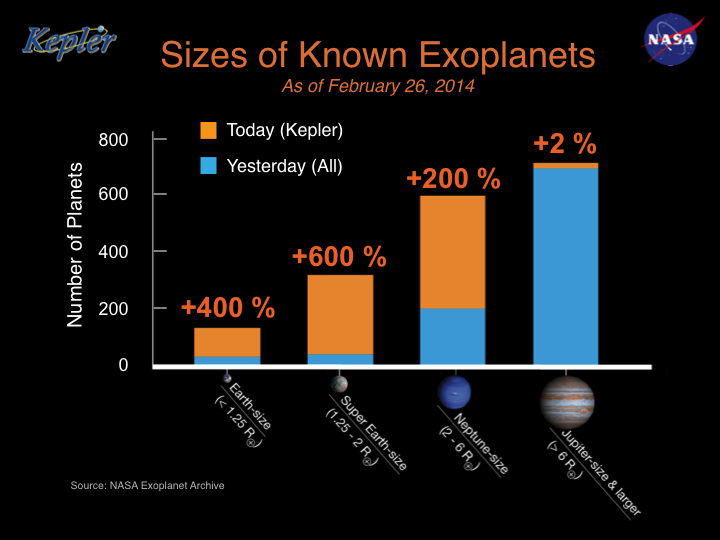
knownexoplanetsThe histogram shows the number of planets by size for all known exoplanets.
The blue bars on the histogram represents all the exoplanets known, by size,
before the Kepler Planet Bonanza announcement on Feb. 26, 2014. The gold
bars on the histogram represent Kepler’s newly-verified planets.
Image Credit: NASA Ames/W Stenzel

To verify this bounty of planets, a research team co-led by Jack Lissauer, planetary scientist at NASA’s Ames Research Center in Moffett Field, Calif., analyzed stars with more than one potential planet, all of which were detected in the first two years of Kepler’s observations — May 2009 to March 2011.

The research team used a technique called verification by multiplicity, which relies in part on the logic of probability. Kepler observes 150,000 stars, and has found a few thousand of those to have planet candidates. If the candidates were randomly distributed among Kepler’s stars, only a handful would have more than one planet candidate. However, Kepler observed hundreds of stars that have multiple planet candidates. Through a careful study of this sample, these 715 new planets were verified.

This method can be likened to the behavior we know of lions and lionesses. In our imaginary savannah, the lions are the Kepler stars and the lionesses are the planet candidates. The lionesses would sometimes be observed grouped together whereas lions tend to roam on their own. If you see two lions it could be a lion and a lioness or it could be two lions. But if more than two large felines are gathered, then it is very likely to be a lion and his pride. Thus, through multiplicity the lioness can be reliably identified in much the same way multiple planet candidates can be found around the same star.

“Four years ago, Kepler began a string of announcements of first hundreds, then thousands, of planet candidates –but they were only candidate worlds,” said Lissauer. “We’ve now developed a process to verify multiple planet candidates in bulk to deliver planets wholesale, and have used it to unveil a veritable bonanza of new worlds.”

These multiple-planet systems are fertile grounds for studying individual planets and the configuration of planetary neighborhoods. This provides clues to planet formation.

Four of these new planets are less than 2.5 times the size of Earth and orbit in their sun’s habitable zone, defined as the range of distance from a star where the surface temperature of an orbiting planet may be suitable for life-giving liquid water.

One of these new habitable zone planets, called Kepler-296f, orbits a star half the size and 5 percent as bright as our sun. Kepler-296f is twice the size of Earth, but scientists do not know whether the planet is a gaseous world, with a thick hydrogen-helium envelope, or it is a water world surrounded by a deep ocean.

“From this study we learn planets in these multi-systems are small and their orbits are flat and circular — resembling pancakes — not your classical view of an atom,” said Jason Rowe, research scientist at the SETI Institute in Mountain View, Calif., and co-leader of the research. “The more we explore the more we find familiar traces of ourselves amongst the stars that remind us of home.”
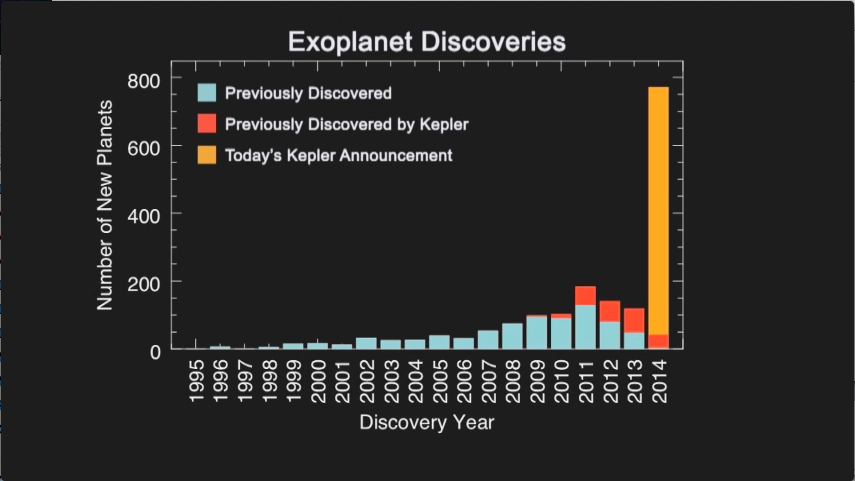
exoplanetdiscoverieshistogramThe histogram shows the number of planet discoveries by year for roughly the
past two decades of the exoplanet search. The blue bar shows previous planet
discoveries, the red bar shows previous Kepler planet discoveries, the gold
bar displays the 715 new planets verified by multiplicity.
Image Credit: NASA Ames/SETI/J Rowe

This latest discovery brings the confirmed count of planets outside our solar system to nearly 1,700. As we continue to reach toward the stars, each discovery brings us one step closer to a more accurate understanding of our place in the galaxy.

Launched in March 2009, Kepler is the first NASA mission to find potentially habitable Earth-size planets. Discoveries include more than 3,600 planet candidates, of which 961 have been verified as bona-fide worlds.

The findings papers will be published March 10 in The Astrophysical Journal and are available for download at: http://www.nasa.gov/ames/kepler/digital-press-kit-kepler-planet-bonanza

Ames is responsible for the Kepler mission concept, ground system development, mission operations and science data analysis. NASA’s Jet Propulsion Laboratory in Pasadena, Calif., managed Kepler mission development. Ball Aerospace & Technologies Corp. in Boulder, Colo., developed the Kepler flight system and supports mission operations with the Laboratory for Atmospheric and Space Physics at the University of Colorado in Boulder. The Space Telescope Science Institute in Baltimore archives, hosts and distributes Kepler science data. Kepler is NASA’s 10th Discovery Mission and was funded by the agency’s Science Mission Directorate.

For more information about the Kepler space telescope, visit: http://www.nasa.gov/kepler
Video: Painted Stone – Asteroids in the Sloan Digital Sky Survey

The Sloan Digital Sky Survey released this impressive visualization of  100,000 asteroids. From the caption:

Over 100,000 asteroids and their colors, as seen by a single remarkable survey telescope.

This animation shows the orbital motions of over 100,000 of the asteroids observed by the Sloan Digital Sky Survey (SDSS), with colors illustrating the compositional diversity measured by the SDSS five-color camera. The relative sizes of each asteroid are also illustrated.

All main-belt asteroids and Trojan asteroids with orbits known to high precision are shown. The animation is rendered with a timestep of 3 days.

The compositional gradient of the asteroid belt is clearly visible, with green Vesta-family members in the inner belt fading through the blue C-class asteroids in the outer belt, and the deep red Trojan swarms beyond that.

Occasional diagonal slashes that appear in the animation are the SDSS survey beams; these appear because the animation is rendered at near the survey epoch.

The average orbital distances of Mercury, Venus, Earth, Mars, and Jupiter are illustrated with rings.

Colors represented with the same scheme as Parker et al. (2008): 
adsabs.harvard.edu/cgi-bin/bib_query?arXiv:0807.3762

Concept and rendering by Alex H. Parker: alexharrisonparker.com/

Painted Stone: Asteroids in the Sloan Digital Sky Survey from Alex Parker on Vimeo.

Video: Astronomy intro – class 1 – A tour of the Solar System

Bruce Betts, of the Planetary Society and California State University Dominguez Hills, opens his new 13 week  astronomy course  with the following video: Intro Astronomy Class 1: Tour of the Solar System – The Planetary Society

Subscribe at csuDHTV – YouTube to get notices when new course videos are posted.

The Astronomy Legacy Project – digitizing more than a century of astronomical photos

The Astronomy Legacy Project, supported by the nonprofit Pisgah Astronomical Research Institute (PARI), has opened an Indiegogo crowdfunding campaign to raise $60,000 to finance their program of digitizing stellar photographic films and plates:

Before the invention of digital cameras in the 1990’s, and for more than 120 years before that, astronomers put in several million telescope hours photographing the night sky – measuring star brightnesses, detecting comets, planets, nebulae, mapping our Galaxy, and building the foundations of our understanding of our Universe!  All of this raw beauty, and secrets yet to be discovered, are held as largely unexplored photographic images on thin, fragile pieces of glass.  Imagine digitizing these hundreds of thousands of photographic images with such high precision that the images appearing on your screen replicates the original. This digitization process is the heart of the Astronomy Legacy Project.

The Astronomy Legacy Project (ALP) will digitize the extensive and diverse set of twentieth century analog (photographic) astronomical data housed at the Astronomical Photographic Data Archive and make it available to the twenty-first century digital world.  Funding will help us to purchase the OPTEK 463 VSM, a highly precise scanning machine that we have chosen to do the digitizing. A staff member will receive 10% of the funding who is responsible for administration of the scanning process with volunteers.

Your donation will honor and preserve the legacy of generations of astronomers and inspire the next generation of space science enthusiasts and people everywhere who are inspired by the mystery and beauty of the night sky!

Exploration. Discovery. Inspiration. from Michael Castelaz, Ph.D. on Vimeo.

ESO: Asteroid internal structure revealed

An announcement from the ESO (European Southern Observatory):

The Anatomy of an Asteroid

ESO’s New Technology Telescope (NTT) has been used to find the first evidence that asteroids can have a highly varied internal structure. By making exquisitely precise measurements astronomers have found that different parts of the asteroid Itokawa have different densities. As well as revealing secrets about the asteroid’s formation, finding out what lies below the surface of asteroids may also shed light on what happens when bodies collide in the Solar System, and provide clues about how planets form.

Using very precise ground-based observations, Stephen Lowry (University of Kent, UK) and colleagues have measured the speed at which the near-Earth asteroid (25143) Itokawa spins and how that spin rate is changing over time. They have combined these delicate observations with new theoretical work on how asteroids radiate heat.

This small asteroid is an intriguing subject as it has a strange peanut shape, as revealed by the Japanese spacecraft Hayabusain 2005. To probe its internal structure, Lowry’s team used images gathered from 2001 to 2013, by ESO’s New Technology Telescope (NTT) at the La Silla Observatory in Chile among others [1], to measure its brightness variation as it rotates. This timing data was then used to deduce the asteroid’s spin period very accurately and determine how it is changing over time. When combined with knowledge of the asteroid’s shape this allowed them to explore its interior — revealing the complexity within its core for the first time [2].

“This is the first time we have ever been able to to determine what it is like inside an asteroid,” explains Lowry. “We can see that Itokawa has a highly varied structure — this finding is a significant step forward in our understanding of rocky bodies in the Solar System.”

The spin of an asteroid and other small bodies in space can be affected by sunlight. This phenomenon, known as the Yarkovsky-O’Keefe-Radzievskii-Paddack (YORP) effect, occurs when absorbed light from the Sun is re-emitted from the surface of the object in the form of heat. When the shape of the asteroid is very irregular the heat is not radiated evenly and this creates a tiny, but continuous, torque on the body and changes its spin rate [3], [4].

Loading player…

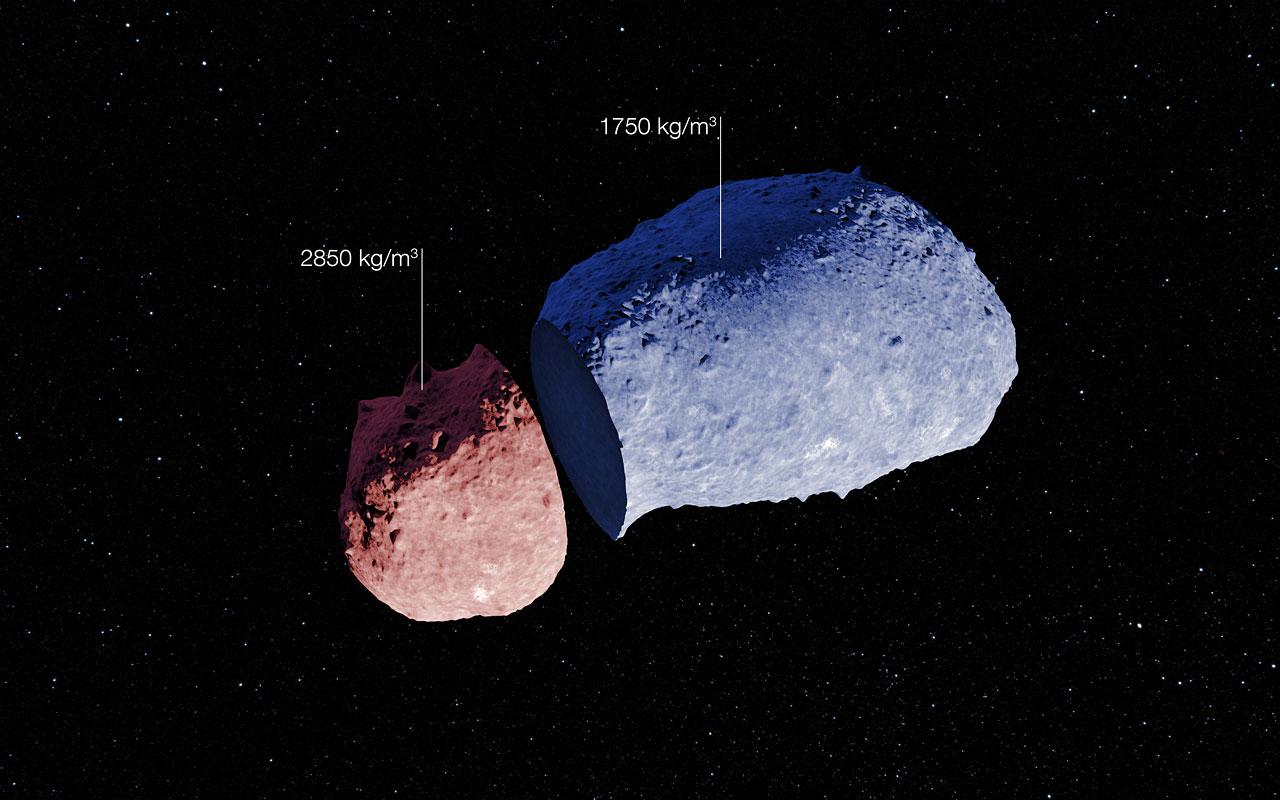
This artist’s impression, based on detailed spacecraft observations, shows the strange peanut-shaped asteroid Itokawa. By making exquisitely precise timing measurements using ESO’s New Technology Telescope a team of astronomers has found that different parts of this asteroid have different densities. As well as revealing secrets about the asteroid’s formation, finding out what lies below the surface of asteroids may also shed light on what happens when bodies collide in the Solar System, and provide clues about how planets form.

Lowry’s team measured that the YORP effect was slowly accelerating the rate at which Itokawa spins. The change in rotation period is tiny — a mere 0.045 seconds per year. But this was very different from what was expected and can only be explained if the two parts of the asteroid’s peanut shape have different densities.

This is the first time that astronomers have found evidence for the highly varied internal structure of asteroids. Up until now, the properties of asteroid interiors could only be inferred using rough overall density measurements. This rare glimpse into the diverse innards of Itokawa has led to much speculation regarding its formation. One possibility is that it formed from the two components of a double asteroid after they bumped together and merged.

Lowry added, “Finding that asteroids don’t have homogeneous interiors has far-reaching implications, particularly for models of binary asteroid formation. It could also help with work on reducing the danger of asteroid collisions with Earth, or with plans for future trips to these rocky bodies.”

This new ability to probe the interior of an asteroid is a significant step forward, and may help to unlock many secrets of these mysterious objects.

===

Find more images and videos here.