Category Archives: Astronomy

Mike Simmons of Astronomers Without Borders on The Space Show

Mike Simmons, founder and president of Astronomers Without Borders, was interviewed on the Space Show last Friday: Mike Simmons, Friday, 8-29-14 – Thespaceshow’s Blog

 During our 61 minute discussion, Mr. Simmons started out by introducing us to Astronomers Without Borders and visits to Iran and Iraq.  He talked about astronomy as a cultural connection among nations and peoples, especially with young and well educated people around the world.  We discussed the organization and total eclipse tours, trips, and other astro tourism projects.  He mentioned the organization’s Monthly Hangout which is a Google Plus monthly meeting with guests which you can find on YouTube. 

Our guest talked about the Mt. Wilson Observatory in Los Angeles and several listeners asked him about visiting the famous observatory.  The same for Mt. Palomar which is still in use and also in S. California.  Joe asked about the best age to introduce children to astronomy.  Mike then told us about telescopes and pointed us to basic telescopes his organization sells for those interested.  Seehttp://store.astronomerswithoutborders.org. 

Listeners asked Mike about their participation in Uwingu programs, specifically the Beam Me to Mars program.  We learned that the organization has been a beneficiary of Uwingu grants.  Listeners asked about night viewing, light pollution and dark skies programs.  Paul sent in a question inquiring about astronomy and the connection to space exploration & development which are major themes for The Space Show. This provoked an interesting discussion with our guest. 

Near the end of our discussion, Mike talked about astronomy in the arts including astro crafts, astro poetry, space artists, and more.

—-

Here is a recent announcement about one of their projects, for which they are raising funding on Indiegogo:

Telescopes to Tanzania

The future of children’s science education in Tanzania is
looking brighter than ever.

http://vimeo.com/89799690

Telescopes to Tanzania’s campaign to bring quality science education to the children of the East African nation is off to a fantastic start by raising $11,000 and successfully completing its first phase of building The Center for Science Education and Observatory.

To build on this momentum and share our project with the world we are launching our next phase on Indiegogo – the web’s largest crowd-funding platform.

Your generous support has already been put to work by funding a pioneering Curriculum Development Workshop,  just completed in June 2014 in Tanzania. Attended by all the regional stakeholders – science teachers, school administrators, scientists and government officials – the conference laid the foundation for the development of a national science curriculum integrated with astronomy concepts and applications.  Those gathered at the four-day meeting in Usa River, near Arusha, were able to create the core structure of a space science model for advancing the development of inquiry-based science education in Tanzania.

Once completed, The Center for Science Education and Observatory will become a Tanzanian hub that will have a long-lasting impact nationwide by training teachers, offering hands-on laboratories (including  an astronomical observatory), and providing quality educational resources.

The gateway to the development of Tanzania’s own STEM curriculum has been opened, and the groundwork has been laid to begin the next critical phase of our campaign.

We invite you to visit our official fundraising campaign website on Indiegogo. And in exchange for your support we are offering a wonderful line-up of rewards that will surely remain a lasting keepsake.

To thank all of our donors who are helping make this project possible we have created a Thank You Wall.

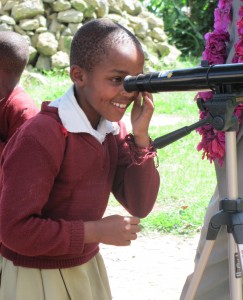
20140630013044-Meru_girl_cropped[1]

A Standard 6 student looks through a telescope for the first
time during a science workshop at Kalinga Primary School
in northern Tanzania

Video: What’s Up for Sept. 2014 – a night sky preview

The night sky for the coming month is described in NASA JPL’s  What’s Up for September 2014:

New dust cloud around a star appears to be from asteroid collision

The Spitzer infrared space telescope spotted the debris cloud from what looks to be the collision of two asteroids around a star 1200 light years away from us.

NASA’s Spitzer Telescope Witnesses Asteroid Smashup

NASA’s Spitzer Space Telescope has spotted an eruption of dust around a young star, possibly the result of a smashup between large asteroids. This type of collision can eventually lead to the formation of planets.

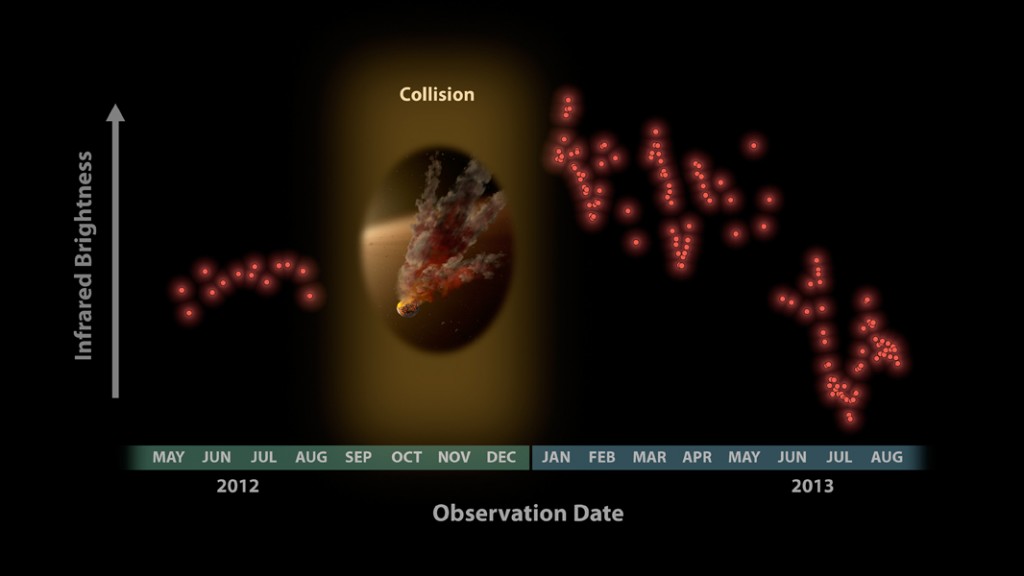
Scientists had been regularly tracking the star, called NGC 2547-ID8, when it surged with a huge amount of fresh dust between August 2012 and January 2013.

Building Planets Through Collisions
This artist’s concept shows the immediate aftermath of a large asteroid impact around
NGC 2547-ID8, a 35-million-year-old sun-like star thought to be forming rocky planets.
Image credit: NASA/JPL-Caltech

“We think two big asteroids crashed into each other, creating a huge cloud of grains the size of very fine sand, which are now smashing themselves into smithereens and slowly leaking away from the star,” said lead author and graduate student Huan Meng of the University of Arizona, Tucson.

While dusty aftermaths of suspected asteroid collisions have been observed by Spitzer before, this is the first time scientists have collected data before and after a planetary system smashup. The viewing offers a glimpse into the violent process of making rocky planets like ours.

Rocky planets begin life as dusty material circling around young stars. The material clumps together to form asteroids that ram into each other. Although the asteroids often are destroyed, some grow over time and transform into proto-planets. After about 100 million years, the objects mature into full-grown, terrestrial planets. Our moon is thought to have formed from a giant impact between proto-Earth and a Mars-size object.

In the new study, Spitzer set its heat-seeking infrared eyes on the dusty star NGC 2547-ID8, which is about 35 million years old and lies 1,200 light-years away in the Vela constellation. Previous observations had already recorded variations in the amount of dust around the star, hinting at possible ongoing asteroid collisions. In hope of witnessing an even larger impact, which is a key step in the birth of a terrestrial planet, the astronomers turned to Spitzer to observe the star regularly. Beginning in May 2012, the telescope began watching the star, sometimes daily.

A dramatic change in the star came during a time when Spitzer had to point away from NGC 2547-ID8 because our sun was in the way. When Spitzer started observing the star again five months later, the team was shocked by the data they received.

“We not only witnessed what appears to be the wreckage of a huge smashup, but have been able to track how it is changing — the signal is fading as the cloud destroys itself by grinding its grains down so they escape from the star,” said Kate Su of the University of Arizona and co-author on the study. “Spitzer is the best telescope for monitoring stars regularly and precisely for small changes in infrared light over months and even years.”

PIA18470_ip[1]Space Images: Witnessing a Planetary Wreckage

A very thick cloud of dusty debris now orbits the star in the zone where rocky planets form. As the scientists observe the star system, the infrared signal from this cloud varies based on what is visible from Earth. For example, when the elongated cloud is facing us, more of its surface area is exposed and the signal is greater. When the head or the tail of the cloud is in view, less infrared light is observed. By studying the infrared oscillations, the team is gathering first-of-its-kind data on the detailed process and outcome of collisions that create rocky planets like Earth.

“We are watching rocky planet formation happen right in front of us,” said George Rieke, a University of Arizona co-author of the new study. “This is a unique chance to study this process in near real-time.”

The team is continuing to keep an eye on the star with Spitzer. They will see how long the elevated dust levels persist, which will help them calculate how often such events happen around this and other stars. And they might see another smashup while Spitzer looks on.

The results of this study are posted online Thursday in the journal Science.

NASA’s Jet Propulsion Laboratory in Pasadena, California, manages the Spitzer Space Telescope mission for NASA’s Science Mission Directorate in Washington. Science operations are conducted at the Spitzer Science Center at the California Institute of Technology in Pasadena. Spacecraft operations are based at Lockheed Martin Space Systems Company in Littleton, Colorado. Data are archived at the Infrared Science Archive housed at the Infrared Processing and Analysis Center at Caltech. Caltech manages JPL for NASA.

For more information about Spitzer, visit: http://www.nasa.gov/spitzer

All sorts of sounds of space

Here’s an overview of “space sounds”, i.e. naturally produced radio signals from the planets, deep space, meteors, etc converted to audio: The spooky sounds of space:  Since the 1950s, probes sent into space have been sending back data that reveal eerie sounds from the vastness of the galaxy. – CNET.

Find more space sound resources in the Natural Space Radio, Natural Space Music, and Natural Space Sounds sections at HobbySpace.

Finding ET in the mid-infrared (maybe)

An interesting indirect way to detect very distant extraterrestrial super-civilizations: Spot ET’s waste heat for chance to find alien life – New Scientist.

Or just a proposal  for a count of a new class of galaxies.