Category Archives: Astronomy

2015 Year in Space calendars

Continuing my Christmas shopping advice tradition, I’m again recommending that readers consider The Year In Space Desk Calendar and Year In Space Wall Calendar as gifts for  others and as well as for yourselves. My wife has used the space desk calendar for years and years and I always have the wall calendar on my studio wall.

Virtual_2015_Desk_Calendar

The calendars are published in co-operation with the Planetary Society and contain a profusion of wonderful space related images. Get a big discount on a new membership to the Planetary Society when buying a calendar.

Wall-calendar-blurb_2015_A

There is also a free Year In Space  Online Calendar.


ESO: Beautiful view of a bright star cluster

This week’s finding from the European Space Observatory (ESO):

A Colourful Gathering of Middle-aged Stars

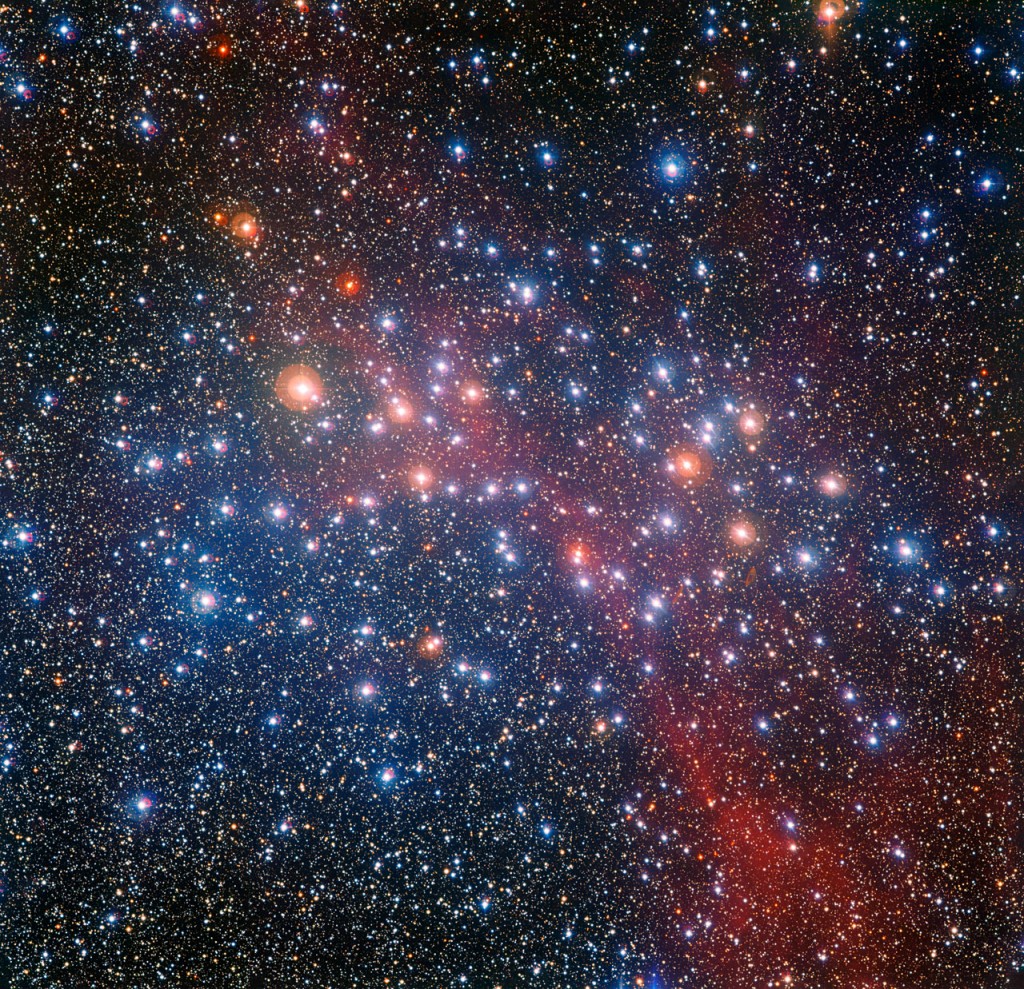
The MPG/ESO 2.2-metre telescope at ESO’s La Silla Observatory in Chile has captured a richly colourful view of the bright star cluster NGC 3532. Some of the stars still shine with a hot bluish colour, but many of the more massive ones have become red giants and glow with a rich orange hue.

The colourful star cluster NGC 3532

The MPG/ESO 2.2-metre telescope at ESO’s La Silla Observatory in Chile captured this richly colourful view of the bright star cluster NGC 3532. Some of the stars still shine with a hot bluish colour, but many of the more massive ones have become red giants and glow with a rich orange hue. Credit: ESO/G. Beccari

NGC 3532 is a bright open cluster located some 1300 light-years away in the constellation of Carina (The Keel of the ship Argo). It is informally known as the Wishing Well Cluster, as it resembles scattered silver coins which have been dropped into a well. It is also referred to as the Football Cluster, although how appropriate this is depends on which side of the Atlantic you live. It acquired the name because of its oval shape, which citizens of rugby-playing nations might see as resembling a rugby ball.

This very bright star cluster is easily seen with the naked eye from the southern hemisphere. It was discovered by French astronomer Nicolas Louis de Lacaille whilst observing from South Africa in 1752 and was catalogued three years later in 1755. It is one of the most spectacular open star clusters in the whole sky.

NGC 3532 covers an area of the sky that is almost twice the size of the full Moon. It was described as a binary-rich cluster by John Herschel who observed “several elegant double stars” here during his stay in southern Africa in the 1830s. Of additional, much more recent, historical relevance, NGC 3532 was the first target to be observed by the NASA/ESA Hubble Space Telescope, on 20 May 1990.

This grouping of stars is about 300 million years old. This makes it middle-aged by open star cluster standards [1]. The cluster stars that started off with moderate masses are still shining brightly with blue-white colours, but the more massive ones have already exhausted their supplies of hydrogen fuel and have become red giant stars. As a result the cluster appears rich in both blue and orange stars. The most massive stars in the original cluster will have already run through their brief but brilliant lives and exploded as supernovae long ago. There are also numerous less conspicuous fainter stars of lower mass that have longer lives and shine with yellow or red hues. NGC 3532 consists of around 400 stars in total.

The background sky here in a rich part of the Milky Way is very crowded with stars. Some glowing red gas is also apparent, as well as subtle lanes of dust that block the view of more distant stars. These are probably not connected to the cluster itself, which is old enough to have cleared away any material in its surroundings long ago.

This image of NGC 3532 was captured by the Wide Field Imager instrument at ESO’s La Silla Observatory in February 2013.

Videos: Random space facts from Bruce Betts

A couple of recent “Random Space Fact” videos from Dr. Bruce Betts at the Planetary Society:


Hubble finding overturns theory of how globular clusters of stars are formed

A new fining from ESA/Hubble:

The riddle of the missing stars

Thanks to the NASA/ESA Hubble Space Telescope, some of the most mysterious cosmic residents have just become even more puzzling. New observations of globular clusters in a small galaxy show they are very similar to those found in the Milky Way, and so must have formed in a similar way. One of the leading theories on how these clusters form predicts that globular clusters should only be found nestled in among large quantities of old stars. But these old stars, though rife in the Milky Way, are not present in this small galaxy, and so, the mystery deepens.
Four globular clusters in Fornax

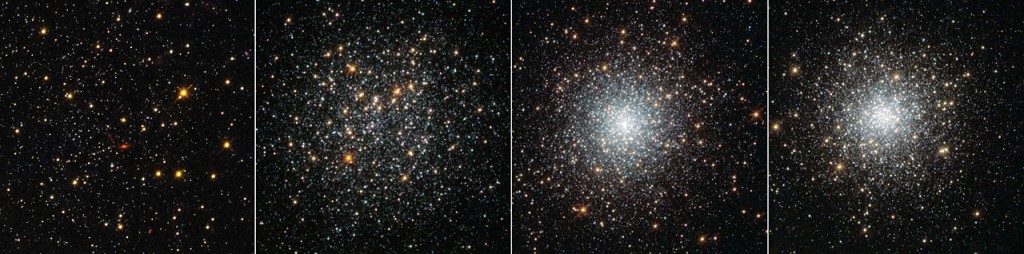
Four globular clusters in the dwarf galaxy Fornax.
Left to right: Fornax 1, Fornax 2, Fornax 3 and Fornax 5.
Their positions within the galaxy are shown below.

New observations of the clusters — large balls of stars that orbit the centres of galaxies — show they are very similar to those found in our galaxy, the Milky Way. The finding is at odds with leading theories on how these clusters form — in these theories, globular clusters should be nestled among large quantities of old stars — and so the mystery of how these objects came to exist deepens.

Globular clusters — large balls of stars that orbit the centres of galaxies, but can lie very far from them — remain one of the biggest cosmic mysteries. They were once thought to consist of a single population of stars that all formed together. However, research has since shown that many of the Milky Way’s globular clusters had far more complex formation histories and are made up of at least two distinct populations of stars.

Of these populations, around half the stars are a single generation of normal stars that were thought to form first, and the other half form a second generation of stars, which are polluted with different chemical elements. In particular, the polluted stars contain up to 50-100 times more nitrogen than the first generation of stars.

The proportion of polluted stars found in the Milky Way’s globular clusters is much higher than astronomers expected, suggesting that a large chunk of the first generation star population is missing. A leading explanation for this is that the clusters once contained many more stars but a large fraction of the first generation stars were ejected from the cluster at some time in its past.

This explanation makes sense for globular clusters in the Milky Way, where the ejected stars could easily hide among the many similar, old stars in the vast halo, but the new observations, which look at this type of cluster in a much smaller galaxy, call this theory into question.

Astronomers used Hubble’s Wide Field Camera 3 (WFC3) to observe four globular clusters in a small nearby galaxy known as the Fornax Dwarf Spheroidal galaxy [1].
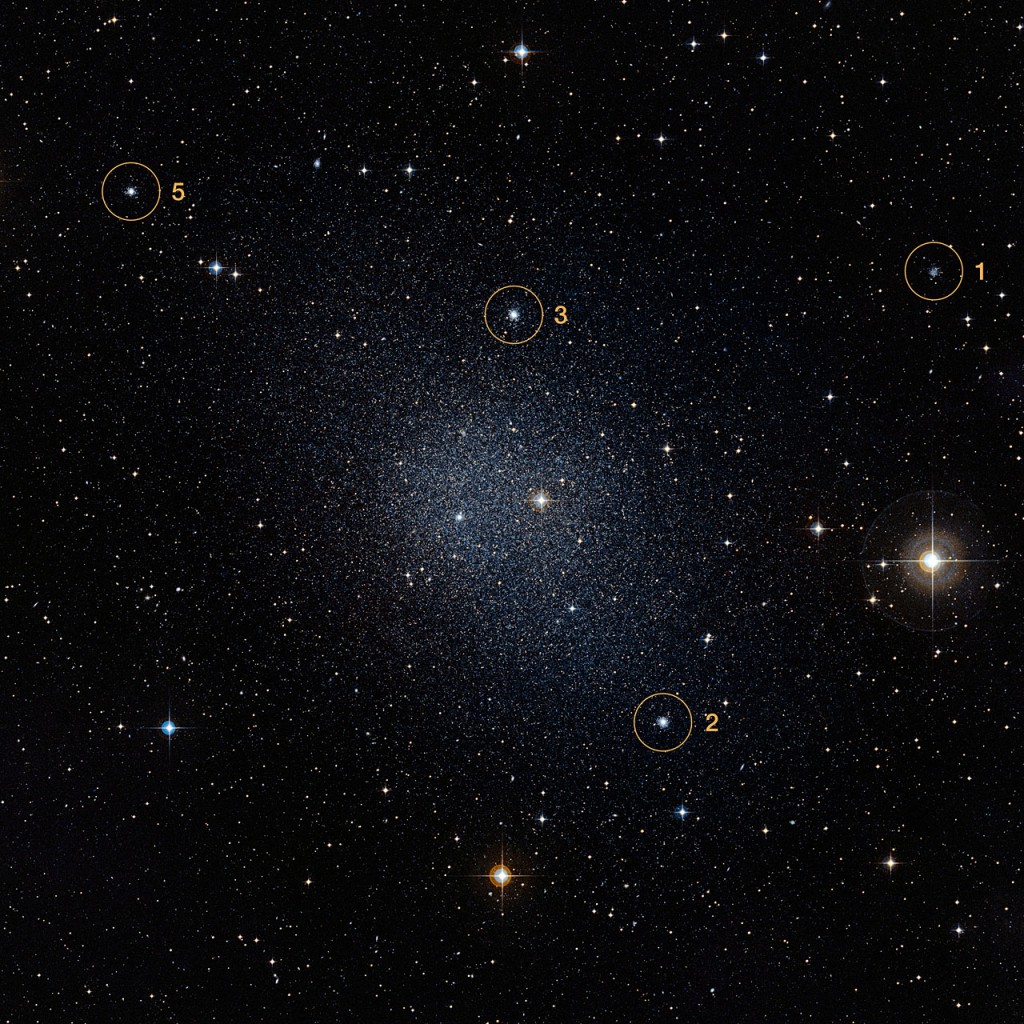
Fornax galaxy with four globular clusters marked Digitized Sky Survey 2 image of the dwarf galaxy Fornax. Highlighted here are four
globular clusters found in the galaxy called Fornax 1, 2, 3 and 5. (Large image)

“We knew that the Milky Way’s clusters were more complex than was originally thought, and there are theories to explain why. But to really test our theories about how these clusters form we needed to know what happened in other environments,”says Søren Larsen of Radboud University in Nijmegen, the Netherlands, lead author of the new paper. “Before now we didn’t know whether globular clusters in smaller galaxies had multiple generations or not, but our observations show clearly that they do!”

The astronomers’ detailed observations of the four Fornax clusters show that they also contain a second polluted population of stars [2] and indicate that not only did they form in a similar way to one another, their formation process is also similar to clusters in the Milky Way. Specifically, the astronomers used the Hubble observations to measure the amount of nitrogen in the cluster stars, and found that about half of the stars in each cluster are polluted at the same level that is seen in Milky Way’s globular clusters.

This high proportion of polluted second generation stars means that the Fornax globular clusters’ formation should be covered by the same theory as those in the Milky Way.

Based on the number of polluted stars in these clusters they would have to have been up to ten times more massive in the past, before kicking out huge numbers of their first generation stars and reducing to their current size. But, unlike the Milky Way, the galaxy that hosts these clusters doesn’t have enough old stars to account for the huge number that were supposedly banished from the clusters.

“If these kicked-out stars were there, we would see them — but we don’t!” explains Frank Grundahl of Aarhus University in Denmark, co-author on the paper. “Our leading formation theory just can’t be right. There’s nowhere that Fornax could have hidden these ejected stars, so it appears that the clusters couldn’t have been so much larger in the past.”

This finding means that a leading theory on how these mixed generation globular clusters formed cannot be correct and astronomers will have to think once more about how these mysterious objects, in the Milky Way and further afield, came to exist.

The new work is detailed in a paper published today, 20 November 2014, in The Astrophysical Journal.

—-

Video about the findings:

Loading player…

ESO: Spooky alignment of quasars spans billions of light-years

A report from the European Southern Observatory (ESO):

Spooky Alignment of Quasars Across Billions of Light-years

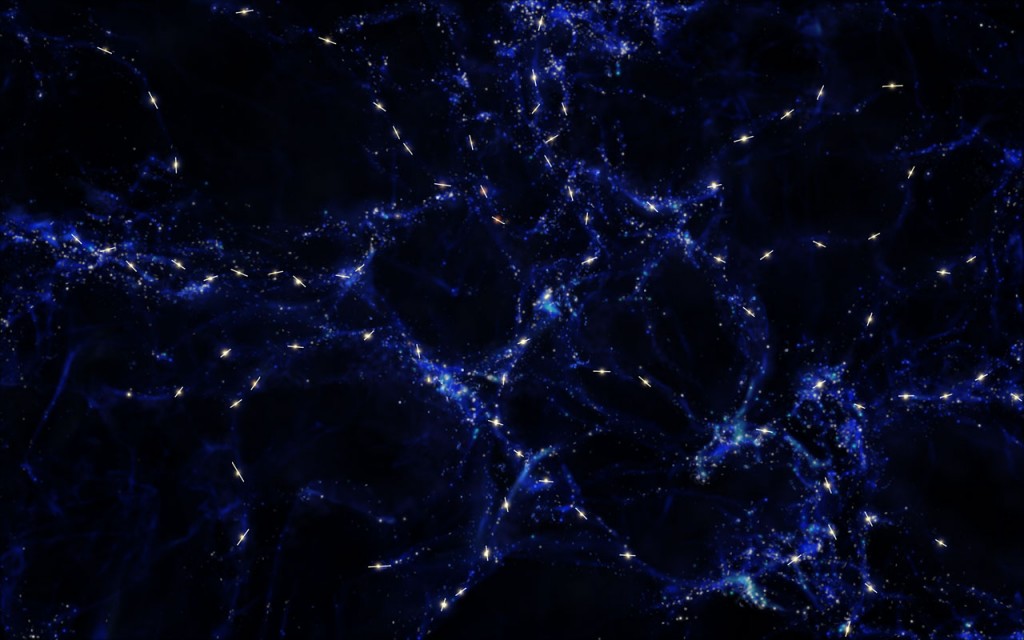
New observations with ESO’s Very Large Telescope (VLT) in Chile have revealed alignments over the largest structures ever discovered in the Universe. A European research team has found that the rotation axes of the central supermassive black holes in a sample of quasars are parallel to each other over distances of billions of light-years. The team has also found that the rotation axes of these quasars tend to be aligned with the vast structures in the cosmic web in which they reside.

Artist’s impression of mysterious alignment of quasar rotationArtist’s impression of mysterious alignment of quasar rotation axes.

Quasars are galaxies with very active supermassive black holes at their centres. These black holes are surrounded by spinning discs of extremely hot material that is often spewed out in long jets along their axes of rotation. Quasars can shine more brightly than all the stars in the rest of their host galaxies put together.

A team led by Damien Hutsemékers from the University of Liège in Belgium used the FORS instrument on the VLT to study 93 quasars that were known to form huge groupings spread over billions of light-years, seen at a time when the Universe was about one third of its current age.

“The first odd thing we noticed was that some of the quasars’ rotation axes were aligned with each other — despite the fact that these quasars are separated by billions of light-years,” said Hutsemékers.

The team then went further and looked to see if the rotation axes were linked, not just to each other, but also to the structure of the Universe on large scales at that time.

When astronomers look at the distribution of galaxies on scales of billions of light-years they find that they are not evenly distributed. They form a cosmic web of filaments and clumps around huge voids where galaxies are scarce. This intriguing and beautiful arrangement of material is known as large-scale structure.

The new VLT results indicate that the rotation axes of the quasars tend to be parallel to the large-scale structures in which they find themselves. So, if the quasars are in a long filament then the spins of the central black holes will point along the filament. The researchers estimate that the probability that these alignments are simply the result of chance is less than 1%.

“A correlation between the orientation of quasars and the structure they belong to is an important prediction of numerical models of evolution of our Universe. Our data provide the first observational confirmation of this effect, on scales much larger that what had been observed to date for normal galaxies,” adds Dominique Sluse of the Argelander-Institut für Astronomie in Bonn, Germany and University of Liège.

The team could not see the rotation axes or the jets of the quasars directly. Instead they measured the polarisation of the light from each quasar and, for 19 of them, found a significantly polarised signal. The direction of this polarisation, combined with other information, could be used to deduce the angle of the accretion disc and hence the direction of the spin axis of the quasar.

“The alignments in the new data, on scales even bigger than current predictions from simulations, may be a hint that there is a missing ingredient in our current models of the cosmos,” concludes Dominique Sluse.