A sampling of recent articles, videos, and images dealing with space transport (find previous roundups here):
** Rocket Lab launches ninth Electron rocket with Astro Digital satellite: Rocket Lab successfully launches ninth Electron mission, deploys payload to highest orbit yet | Rocket Lab
The mission, named ‘As The Crow Flies,’ lifted off from Rocket Lab Launch Complex 1 on New Zealand’s Māhia Peninsula at 01:22 UTC, 17 October 2019 (14:22 NZDT). Approximately 71 minutes after lift-off, Electron’s Kick Stage deployed the payload to a circular orbit of more than 1,000 km – more than twice the altitude of any Electron mission to date. The mission successfully demonstrated recent upgrades to the Kick Stage’s 3D-printed Curie engine, including the move to a bi-propellant design for improved performance. Curie also serves as the propulsion system on Rocket Lab’s Photon satellite bus, and the flight-proven engine upgrades support enduring missions in LEO, as well as higher orbits.
This mission takes the total number of satellites deployed by Rocket Lab to 40 and continues the company’s track record of 100% mission success for customers.
The spacecraft on board was a Palisade technology demonstration satellite – a 16U CubeSat with on-board propulsion and next generation communications systems developed by Astro Digital, and software developed by Advanced Solutions Inc. including an advanced version of ASI’s MAX Flight Software.
This video of the webcast shows the liftoff at the 15:05 point. There are also interesting background stories about the company’s rocket making process, plans for reusing the first stage, the launch site, etc.
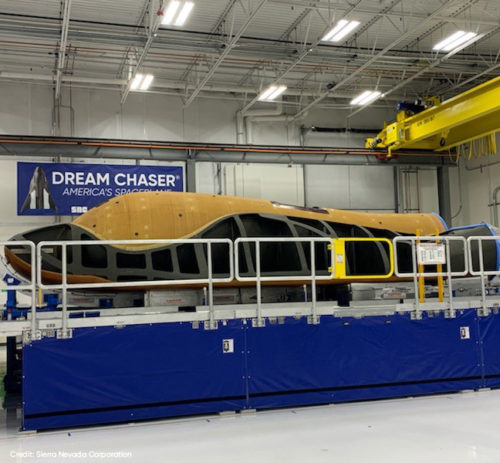
** Composite vehicle frame for Sierra Nevada Dream Chaser ready for full assembly and preparation for first flight in 2021:
- Dream Chaser on a path to maiden flight as primary structure arrives at SNC – NASASpaceFlight.com
- Dream Chaser Primary Structure Arrives in Colorado – Sierra Nevada Corporation
…The structure is the largest piece of technology to make up Dream Chaser and the most advanced high-temperature composite spaceframe ever built.
…
The primary structure is a pressurized composite structure that will contain pressurized payloads heading to the International Space Station. The structure was manufactured by subcontractor Lockheed Martin and recently shipped from their Fort Worth, Texas facility to Louisville, Colorado, where Dream Chaser is being built and integrated by SNC.
Design highlights:
-
- Uses advanced composite 3D woven assembly methods and represents the most advanced high-temperature composite spaceframe ever built.
- Structure is about 30 feet long by 15 feet wide and approximately 6 feet high and weighs roughly 2,200 pounds.
- Materials include carbon fiber reinforced polymers (CFRPs), more traditionally referred to as “composites.”
- The use of CFRP materials instead of aluminum and titanium alloys, lowers manufacturing costs for creating a unique, aerodynamically complex spaceframe design.
- Composites decrease the amount of thermal protection required compared to an aluminum primary structure.
- Advanced 3D woven construction minimize penetrations to the hot lower aeroshell.
** South Korea’s Perigee Aerospace to launch from the Whalers Way Orbital Launch Complex on the southern Coast of Australia. The Whalers Way facility is a project of the Australian company, Southern Launch.
- Southern Launch Welcomes Perigee Aerospace — Southern Launch
- Perigee Aerospace Signs on to Use Southern Launch Rocket Facilities in South Australia – Satnews
** Launcher company Skyrora of Scotland opens a new facility and begins firing tests of a 30kN rocket engine: Scottish space explorer completes crucial first phase of tests – Business Insider
UK launch company @Skyrora_Ltd has released some footage of its latest engine test, a 30kN engine that will fly on its orbital launch vehicle Skyrora XL.
This is from a new European test site, although for “commercial reasons” (?) the company isn’t revealing the location. pic.twitter.com/QcX4dnV3of
— Jonathan O’Callaghan (@Astro_Jonny) October 14, 2019
**Report released on flight safety of the proposed Georgia spaceport. While waiting for FAA licensing process to be completed, Spaceport Camden management says that they have been working
… to determine a way to increase transparency about the project’s licensing information without complicating the agency’s ongoing review or releasing sensitive or export-controlled information that cannot lawfully be shared with the public. Pursuant to those goals, the County initiated the development of a publicly releasable report, prepared by The Aerospace Corporation, that describes the project’s flight safety analysis.
The report can be viewed at Flight Safety Analysis for Spaceport Camden County – CamdenCountyBOC – issuu
** Today China launched a Long March 3B with the TJSW-4 military satellite, whose capability and mission have not been publicized: Long March 3B launches TJSW -4 – NASASpaceFlight.com
Official launch video by Our Space
ℹ:https://t.co/t9dvACjy4U pic.twitter.com/uodRQUvhQ5
— LaunchStuff (@LaunchStuff) October 17, 2019
** China developing a second super heavy rocket in addition to Long March 9: Initial research on rocket ends successfully – ecns.cn
According to the report, the new rocket is being designed at the China Academy of Launch Vehicle Technology in Beijing. Its main body will be 87 meters tall, which means it will be almost twice as tall as the Long March 5, currently the biggest of China’s rockets.
The gigantic craft will boast liftoff weight of about 2,200 metric tons, nearly triple that of the Long March 5. This will enable the rocket to place a 25-ton spacecraft in a lunar transfer trajectory, the newspaper said.
The Long March 9 is expected to fly in 2030.
“But it is necessary for China to develop a new rocket for manned missions because such a rocket will offer us a new option, besides the Long March 9, for future explorations to the moon or other deep-space destinations,” he said.
“And compared with the Long March 9, it will have lower costs and can enter service earlier.”
According to the designers’ plan, a Long March 9 will be capable of lifting 140 tons of payload into a low-Earth orbit or a 50-ton spacecraft to a lunar transfer trajectory. The 100-meter colossal machine will also be able to ferry 44 tons of payload to a Mars transfer orbit.
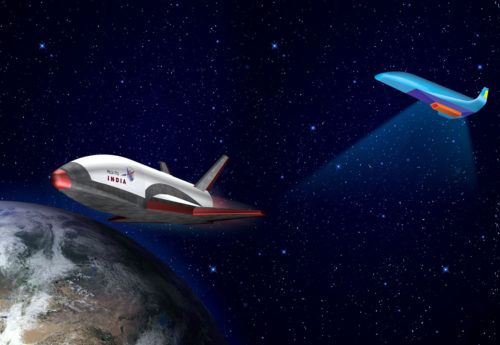
** Indian RLV program to do a drop test of a prototype reusable spaceplane: Isro readies its Swadeshi space shuttle – DeccanChronicle.com
The Reusable Launch Vehicle (RLV), for the first time, will be tested on land — the 2.2 km runway at ATR to be precise — with its under carriage in position after a freefall from a helicopter flying at an altitude of three km. The onboard computer will help the RLV to glide for some distance before touching down like an aircraft, scientists at Isro told Deccan Chronicle.
** SpaceX:
*** NASA funding to assist development of in-orbit refueling of Starships: NASA shows interest in SpaceX’s Starship orbital refueling ambitions – Florida Today
The technology to dock spacecraft and transfer propellants or other necessities has a history in spaceflight, but doing so autonomously and in more modern ways has long been sought after by NASA, commercial satellite operators, and even the Department of Defense.
Having that ability could mean spacecraft such as Starship go on longer voyages; or it could help existing satellites in orbit around Earth stay in their positions longer without having to shut down due to fuel depletion. And it doesn’t have to just be fuel – such docking maneuvers could help pave the way for in-orbit repairs and servicing, too.
*** A new Starship/Super Heavy animation was posted by SpaceX this week. The in-orbit refueling starts at about the 1:15 point.
** More details on development of the vacuum version of the Raptor engine released by Elon Musk: SpaceX’s Starship Raptor Vacuum engine plans laid out by CEO Elon Musk
Elon Musk says that SpaceX Starship engine upgrades are on track to begin static fire tests of a Raptor Vacuum variant as few as a “couple months” from now.
Designed to enable more efficient performance in thin atmosphere or vacuum, Musk admitted that the first version(s) of Raptor Vacuum (RVac) will likely be a compromise between efficiency and speed of development. Nevertheless, the faster SpaceX can prepare Raptor Vacuum for flight, the easier it will be for Starship to begin serious (sub)orbital flight tests.
** Raptor vertical test stand under construction at McGregor, Texas facility:
- SpaceX renovating former Falcon 9 test stand at McGregor – NASASpaceFlight.com
- SpaceX Starship’s Raptor engine test facilities are about to get a big upgrade, says Elon Musk – Teslarati
According to CEO Elon Musk, SpaceX’s Starship and Super Heavy rockets are about to get a new test stand that will enable additional and more useful static fire tests of their Raptor engines.
These modifications could reportedly lead to a simplified engine design and will generally expand SpaceX’s ability to rapidly acceptance-test a huge number of Raptors – a necessity given that each Starship/Super Heavy pair will need up to 43 engines.
*** Latest on SpaceX efforts to buy out Boca Chica home owners:
- No place like home: SpaceX extends deadline, reappraises Boca Chica properties – Brownsville Herald
- UPDATE: SpaceX residential buyout | KVEO-TV
*** Recent views of Boca Chica Beach facilities:
— SPadre (@SpacePadreIsle) October 15, 2019
*** And of the Cocoa Beach Starship site:
@SpaceX #Starship #MK4 stacking has begun 17 October 2019. pic.twitter.com/skDfMea1GD
— John Winkopp (@John_Winkopp) October 17, 2019
Update: More about the start of construction of a third demo starship: SpaceX starts construction of another Starship rocket in Florida – CNBC
SpaceX now has three of its next-generation Starship rockets under construction, as aerial video shows the latest developments at the company’s facility in Florida.
The first bands of stainless steel for another Starship rocket were put on a stand Thursday, and were captured in a video taken from a flying drone. Former commercial pilot John Winkopp took the video and gave CNBC permission to use his footage.
*** SpaceX sea fleet grows to assist reusability.
— Two ships will now be deployed for satellite missions so that both nosecone fairings can be caught: SpaceX preparing to catch two Falcon 9 fairings at once with twin net-carrying ships – Teslarati.
— And another sea-going platform is being prepared so that both side boosters of a Falcon Heavy can land at sea: Elon Musk says SpaceX is still building a third drone ship – but is it for Falcon or Starship? – Teslarati
*** Lots of launches for Falcon 9 and Starship rockets: SpaceX could upgrade Starlink constellation with tens of thousands of satellites
====