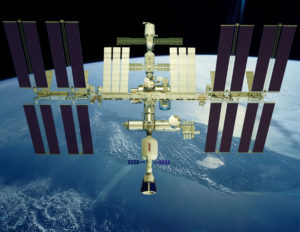
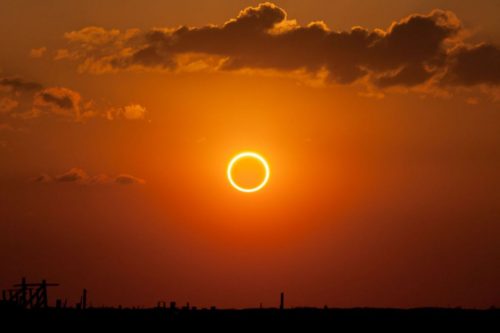
In January, the northern hemisphere features beautiful views of Capella, a pair of giant yellow stars; Aldebaran, a red giant star; and two star clusters—the Hyades and the Pleiades. Keep watching for the awe-inspiring space-based views of the Crab Nebula, the remains of a star that exploded as a supernova.
A sampling of recent articles, videos, and images dealing with space transport (find previous roundups here):
** China’s Long March 5 heavy lift rocket placed a satellite into geostationary transfer orbit last Friday in a successful return to flight following a failure on the second launch of the system in 2017.
China can now proceed with a series of important launches including a Mars rover in July, a new crew spacecraft in September, and the Chang’e 5 lunar sample return mission in late 2020. The LM-5 is also needed for the launch of modules for a new space station that begins assembly in 2021.
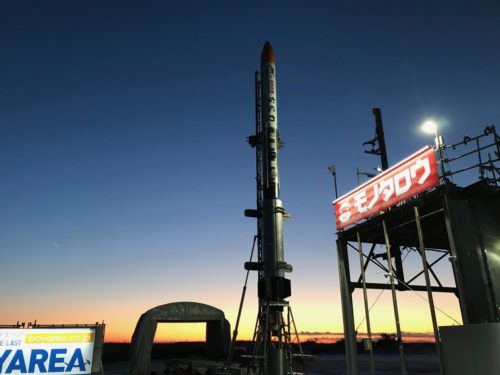
** Interstellar Technologies to carry out the fifth launch of an suborbital MOMO rocket in Japan. The liftoff planned forlast Saturday was scrubbed:
MOMO-F5 sounding rocket countdown has been halted due to range safety and technical issue. Launch is scrubbed for this window.
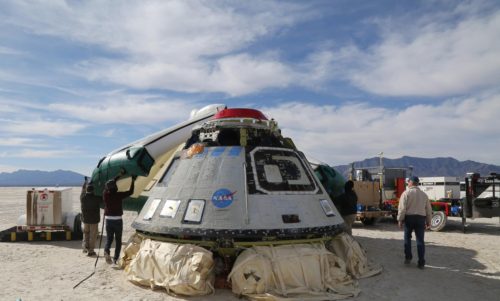
Boeing emphasized the good condition of the spacecraft, which showed “little scorching” from reentry and used only a fraction of its onboard propellant reserved for reentry, which the company said confirmed aerodynamic models of the spacecraft. The interior of the Starliner cabin appeared the same after landing as it did before its Dec. 20 launch from Cape Canaveral, the company noted, evidence that “the Starliner’s fully operational life support system functioned as intended and the layout of the interior is well-suited to support crew members in the future.”
The statement, though, provided no updates on the timer problem that turned what was originally an eight-day mission into a two-day one without a planned docking at the International Space Station. The spacecraft’s mission elapsed timer, which is set by communicating with its Atlas 5 rocket prior to liftoff, was off by 11 hours. That caused the spacecraft to think it was on the wrong phase of its mission after separation from the rocket’s upper stage, triggering thruster firings that used excessive amounts of fuel until ground controllers could take over and turn off the thrusters.
Starliner “Calypso” after landing at White Sands Missile Range in New Mexico.
Now, we’re getting ready to shift all of our operations to the customized 747 that serves as our fully mobile launch site. Parked at “the hammerhead,” a part of the taxiway adjoining the primary runway at the Mojave Air and Spaceport, we’ll do the final mate of the rocket to Cosmic Girl and run through our rehearsals again.
In January, we plan to have Chief Test Pilot Kelly Latimer and the rest of our flight crew guide us through one more taxi test with the mated rocket and an additional captive carry test with our orbital flight hardware. Then, we’ll be ready to light this candle and conduct our launch demonstration.
For years, everything’s been building: our team, our market, our technical expertise, and our enthusiasm. As 2019 draws to a close, we’re stronger and smarter than we’ve ever been before, and feeling ready to rock. To stay in the loop, follow us on Twitter, Facebook, Instagram or LinkedIn.
Firefly has begun Alpha Stage 1 Qualification testing, the last major milestone of Alpha development. We’ve installed the stage, which includes four Reaver engines, on Firefly’s TS2. We’ll begin hotfire testing soon, culminating in multiple 165 sec full mission duty cycle tests. pic.twitter.com/lUULGH3gHo
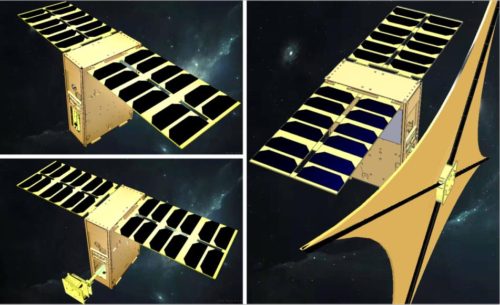
** The Chinese SIASAIL-I sail passes deployment tests following launch last September. The sail, developed by the Shenyang Institute of Automation (SIA), was packed within a CubeSat and successfully deployed in orbit. Although structurally the same as a solar sail, this sail test is apparently aimed not at demonstrating net solar propulsion but at acceleration of spacecraft de-orbiting by increasing the drag through the minute amount of atmosphere in low earth orbit.
[Liu Jinguo, deputy director of the SIA Space Automation Technology Research Office, ]l said that they managed to fold the flexible membrane and put it into the deployment machine, which is smaller than a billiard ball.
After the satellite platform is put into orbit, scientists carry out technical verification through two-stage deployment. At the first stage, the solar sail body is pushed out of the satellite platform and turned 90 degrees. The second stage is to erect masts and gradually spread the sail. The unfolded solar sail is about 0.6 square meters, which is equivalent to the size of eight Macbook airs laptop computers.
Illustration of SIASAIL-1 before and after sail deployment. Credits: SIA & China Daily.
First and foremost 2019 showed a decline in total launches from 2018, with global launches dropping from 111 to 97. The 2019 totals were also about 30% below the number of launches predicted by the various countries and launch companies that are now active.
Does this drop in launches mean that the rocket industry is in decline? Not at all. The 97 launches last year were also the most launches in a single year since 1990, when the Soviet Union existed and routinely puffed up the totals each year with many unnecessary launches prompted by their bloated communist bureaucracy. (See last year’s graph for the yearly numbers going back to 1980.)
More important, the numbers this year are based on a much more robust launch industry, made up of many more sound competing constituents, both public and private.
And he concludes:
Thus, it appears that 2020 could herald the beginning of a very aggressive worldwide space industry, achieving more launches each year than ever accomplished in any year since Sputnik launched in 1957.
** A video roundup of launches in 2019 from Cape Canaveral
Good news: If you enjoy rockets and covertly dancing at your desk so no one else notices, this year’s launch roundup is for you pic.twitter.com/wsYEGBh9TA
Space Launches in 2019: 101 launches were attempted, 97 missions made orbit and were cataloged. By country:
-China(32)1x fail
-Russia(25)
-USA(21)
-NZ/@RocketLab(6)
-Europe/@ESA(6)1x fail
-India(6)
-Iran(3)2x fails
-Japan(2)
Via: https://t.co/NiKz0uoHP8pic.twitter.com/mpn5GXvmiV
**** Falcon 9 launch of Starlink 2 with the second set of 60 satellites is set for this Friday, Jan. 3rd at 10:24 pm EST (0324 GMT on 4th from Cape Canaveral. It appears that the static firing test on the pad may happen on the day before rather than the usual several days prior. This is consistent with their efforts to speed up the launch pace. The company hopes to do Starlink launches about twice a month in 2020.
A launch planned for Friday from the Space Coast will test a possible solution. SpaceX will experiment with a non-reflective coating on the bottom of one satellite in its next batch of 60, scheduled to lift off from launch complex 40 at Cape Canaveral Air Force Station at 11:20 p.m.
The Astronomical Society has had numerous conversations with SpaceX since the first Starlink launch, on May 23, to discuss how to make the satellites less intrusive. Even now, at their operating altitude of about 550 kilometers, they are still right on the edge of visibility to the unaided eye.
But for research-grade telescopes? They’re “ferociously bright,” Hall said. That means they’re getting in the way of data collection, with the streaks of light ruining the scientific quality of images.
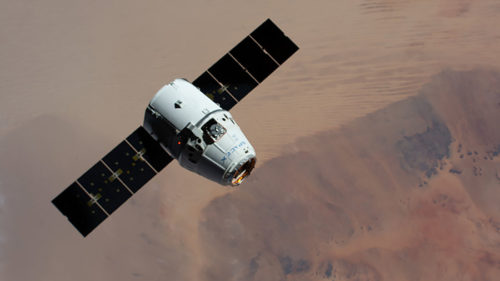
**** CRS-19 Cargo Dragon set to depart from the ISS next Sunday, Jan. 5th. NASA.gov/live will broadcast the departure starting at 9:15 p.m. EST.
Unfortunately, I believe the licensees of the Muse soundtrack will benefit from the big bump in views rather than I.
**** Elon pointed to a new animation of a Crew Dragon mission to the ISS released this week:
**** Crew Dragon with astronauts on board could launch as soon as February but NASA reviews will take months (and that’s assuming the in-flight abort test goes well):
Crew Dragon should be physically ready & at the Cape in Feb, but completing all safety reviews will probably take a few more months
****** Elon posted a lot of info on development of the Starship on Tweeter in the past few days. Here’s a sampling:
Orbital vehicle in Texas:
Was up all night with SpaceX team working on Starship tank dome production (most difficult part of primary structure). Dawn arrives … pic.twitter.com/SzyDSYUYOu
We use that process for the Raptor nozzle jacket. The knuckles of this dome are stamped in Michigan with a 4000 ton car body press, which costs much less for same outcome.
Almost everything is different. These parts are stamped vs manually bump-formed & TIP TIG welded vs flux core. Higher precision, stronger joints & 20% mass reduction.
Autogenous refers to using a gaseous form of a propellant itself for pressurizing the tank rather than using a separate inert gas like helium. The high pressure composite pressure vessels (COPVs) to hold helium were involved in both Falcon 9 explosions. Helium is also quite expensive now.
Spin start from COPVs so the ox & fuel turbines spool up super fast in unison. A precise start with full flow staged combustion is very important.
Controlling the side flaps on the Starship as it returns through the atmosphere.
Direct drive using several Tesla Plaid motors in parallel for SN1. Simpler, lighter & more fault tolerant. Rear flaps each need ~1.5 megawatts. It’s like moving the entire wing of an aircraft!
Confirmed yesterday morning by CEO Elon Musk, SpaceX has copied Tesla’s approach to factory expansion and is building a giant tent to upgrade its South Texas Starship production facilities.
A big step towards more traditional aerospace-style manufacturing facilities, SpaceX has contracted the same company used by Tesla to create a fourth general assembly line (GA4) in a giant tent outside its Fremont, CA factory in 2018. Instead of Model 3s, however, Sprung Instant Structures (Sprung for short) is rapidly raising a large tent that will eventually allow SpaceX to fabricate and weld more Starship parts and sections in an enclosed environment, an improvement from the current practice of building prototypes out in the harsh environment of coastal Texas.
In typical fashion, Musk believes that the new enclosed production facilities – just a collection of shipping crates as of December 18th – could be ready to begin manufacturing Starship parts as early as next month, and the progress Sprung has made makes it unusually hard to fault his optimism.
****** SpaceX Boca Chica – Starship Domes – Hopper attention – December 30, 2019 – – NASASpaceflight.com
More views of the Starship Domes (Bulkheads) while the facilities continue to grow and even Hopper gains some attention at the launch site. Footage and photos from Mary (@bocachicagal) for NSF.
****** SpaceX Boca Chica – Big Tops and Bulkheads – December 29, 2019 – NASASpaceflight.com
More work is taking place on the Starship SN1 Bulkheads as assembly of additional “Big Top” production facilities continues. Footage and photos from Mary (@bocachicagal) for NSF. Opens with some photos taken from Sam Sun (@birdsnspace) plane flyover.
This video is brought to you by Isla Grand Beach Resort, Sapphire Condominiums, and Orbital Media Networks. All images are filmed at the Pointer property and are explicitly owned by LabPadre Media.
A sampling of links to recent space policy, politics, and government (US and international) related space news and resource items that I found of interest (find previous space policy roundups here):
** The Space Show – Sun, 12/29/2019 – Thomas A. Olson returned “again for his annual review of all things space for 2019 and a look ahead as to what we might expect from some areas of the space industry for 2020. This was a two segment 122 minute program”.
“Kim Holder of Moonwards was our primary guest for the first 45 minutes to update us on Moonwards 2019 and for what is planned in the New Year. I then turned to reviewing TSS 2019 year, Kim offered insights and words of wisdom and I explained why it was so important to fund The Space Show during our annual campaign through the end of the year.”
The Red Planet is slowly revealing its deepest secrets, but there’s much more to learn. The biggest mystery is whether it has ever been home to life. Caltech and JPL planetary scientist Bethany Ehlmann lays out the path ahead in a fascinating conversation. The holiday night sky is alive with stars, planets and even a meteor shower. Bruce Betts will tell all in What’s Up. Our last episode of the year opens with space exploration headlines from the Planetary Society’s news digest, The Downlink.
2. Tuesday, Dec. 31, 2019; 7-8:30 pm PST (9-10:30 pm CST, 10-11:30 pm EST): No show today due to this being New Year’s Eve. Happy New Year Everybody.
3. Wednesday, Jan. 1, 2020: Pre-recorded Hotel Mars Program with John Batchelor. See Upcoming Show on The Space Show website for details. NO SHOW FOR NEW YEARS DAY.
4. Thursday, Jan. 2, 2020; 7-8:30 pm PST (9-10:30 pm CST, 10-11:30 pm EST): No special program today.
5. Friday, Jan. 3, 2020; 9:30-11 am PST (11:30 am-1 pm CST, 12:30-2 pm EST): We welcome Dr. George Church regarding human spaceflight gene modification. Dr. Church is a faculty member of the Consortium for Space Genetics at Harvard.
6. Sunday, Jan. 5, 2020; 12-1:30 pm PST (3-4:30 pm EST, 2-3:30 pm CST): We welcome back Michael Belfiore, award winning author and technology specialist to discuss new technologies including those for space.
Some recent shows:
** Sun, 12/29/2019 – Thomas A. Olson returned “again for his annual review of all things space for 2019 and a look ahead as to what we might expect from some areas of the space industry for 2020. This was a two segment 122 minute program”.
“Kim Holder of Moonwards was our primary guest for the first 45 minutes to update us on Moonwards 2019 and for what is planned in the New Year. I then turned to reviewing TSS 2019 year, Kim offered insights and words of wisdom and I explained why it was so important to fund The Space Show during our annual campaign through the end of the year.”