Video: ‘Orbitas’ by PrimerFrame

A very beautifully made animation: Two Astronauts Fall In Love A Little More Each Time Their Orbits Meet –

These two astronauts may come from warring species, but alone in space they become valued company, exchanging tokens of affection each time they encounter one other in orbit. But what happens when disaster threatens one of the space-faring pair?

Orbitas was made by students in the Masters in 3D Animation program at the PrimerFrame animation school under the direction of Jaime Maestro.

http://vimeo.com/67596206

Sizzling cooking in weightlessness

A Cornell University group experimented with cooking in weightlessness by taking “a specially constructed space galley” onto a plane doing parabolic flights:

From the Cornell Chronicle:

In a series of four flights launched from Houston, the team tossed tofu and shredded potatoes into pans of sizzling oil and filmed the resulting oil splatters as the plane climbed and dove in parabolic paths. Each cycle created a brief period of partial weightlessness, simulating the conditions astronauts would face during extended stays on the moon or Mars, which have one-sixth and one-third the gravity of Earth, respectively.

The experimenters positioned strips of paper inside the galley fume hood and dyed the oil bright red to help them see and collect splatter patterns. Under reduced gravity conditions, the food settled more slowly into the pan, and more oil appeared to fall outside of it. The oil droplets also traveled a greater distance from the pan than under Earth conditions – probably because it took longer for gravity to pull them down, Arquiza said.

Arquiza ended up with a collection of 200 red-speckled strips that might resemble evidence from a crime scene investigation, but could contribute greatly to our understanding of the basic science of cooking in space. He is now analyzing them to measure the particles’ size distribution and distance traveled. Results will be used to create computer models that could be extrapolated to inform the design of future terrestrial and extraterrestrial cooking technology.
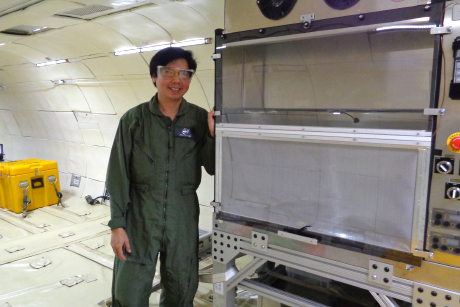
Apollo Arquiza

Postdoctoral research associate Apollo Arquiza shows what the galley
(kitchen) looks like in the zero gravity G-Force 1 space simulator plane.
And they have many other tests planned as well:
The project is part of a larger investigation by Hunter’s lab into scientific and social aspects of food in space, including a simulated Mars mission in Hawaii to test resource use, menu fatigue and the benefits of home cooking in an enclosed environment, and a bed rest study to test the effects of simulated weightlessness on smell and taste perception.
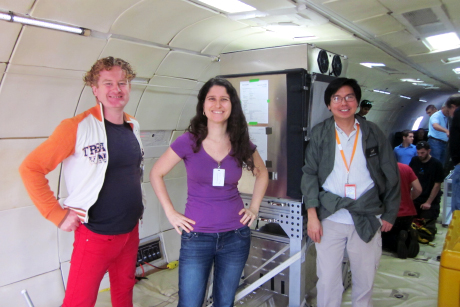
Bryn Caldwell, Susana Carranza, Apollo Arquiza

From left, Cornell researcher Bryan Caldwell, Makel Engineering researcher
Susana Carranza and Cornell researcher Apollo Arquiza conduct low
gravity cooking experiments aboard the G-Force 1 space simulator plane.

The Space Show this week

The guests and topics on The Space Show this week:

1. Monday, August 11, 2014: 2-3:30 PM PDT (5-6:30 PM EDT, 4-5:30 PM CDT): We welcome DR. MARTIN ELVIS  to the program to discuss his research that estimates the potential number of asteroids of value for mining.

2. Tuesday, August 12, 2014:,7-8:30 PM PDT (10-11:30 PM EDT, 9-10:30 PM CDT): OPEN LINES discussion. All space, STEM and first time callers are welcome.

3. Friday, August 15, 2014, 9:30 -11 AM PDT (12;30-2 PM EDT; 11:30-1 PM CDT): Due to recent conference travels, this is a TBD program for now as I am waiting for people from AIAA to respond. Watch the website newsletter for details later this week as that is where I will post the guest information for this program.. .

4. Sunday, August 17, 2014, 12-1:30 PM PDT (3-4:30 PM EDT, 2-3:30 PM CDT). We welcome both JOE CASSADY and CHRIS CARBERRY of Explore Mars to the show for new information with the organization plus new programming.

See also:
/– The Space Show on Vimeo – webinar videos
/– The Space Show’s Blog – summaries of interviews.
/– The Space Show Classroom Blog – tutorial programs

The Space Show is a project of the One Giant Leap Foundation.

100 Year Starship symposium in Houston in September

The 100 year Starship organization is holding its 2014 Public Symposium in Houston, Texas over Sept. 18-21. Here’s the agenda:

The 100 Year Starship’s purpose:

We exist to make the capability of human travel beyond our solar system a reality within the next 100 years. We unreservedly dedicate ourselves to identifying and pushing the radical leaps in knowledge and technology needed to achieve interstellar flight, while pioneering and transforming breakthrough applications that enhance the quality of life for all on Earth. We actively seek to include the broadest swath of people and human experience in understanding, shaping and implementing this global aspiration.

Taking up this task ignites not only our imagination, but the undeniable human need to push ourselves to accomplishments greater than any single individual.

Video: TMRO/Spacevidcast 7.24 – The Electron Rocket

The latest TMRO/Spacevidcast show is in the archive: The Electron Rocket – TMRO –

We are joined live by Rocket Labs USA Founder and CEO Peter Beck to talk about their Electron Rocket and what Rocket Labs is doing over in New Zealand.

In Space News we have: Rosetta reaches 67P, AsiaSat 8 Launches on a Falcon 9, SpaceX sets Brownsville as its new commercial launch site, ULA will likely get their RD-180 engines, a new view of the LDSD, ATK’s 5 segment Solid Rocket Booster and Orion sets a launch date.

Everyone can participate in space