Sci-Tech: Levitation for fun and profits

Here’s a survey of various cool techniques for levitating objects and the efforts to commercialize them : Can levitating appliances take off? – CNN.com

* One project is the Malloy hoverbike that I mentioned here the other day:

* Magnetic magic from CREALEV:

* A levitating speaker from Om Audio :

* Levitating arrays of small items with acoustic waves:


Mars One ‘Ticket To Rise’ campaign offers suborbital spaceflight prize

An announcement from Mars One:

Mars One Announces Chance To Win Two-Way Trip to Space 

Mars One launches the Ticket To Rise Campaign to aid the
2015 Earth mission and 2018 Mars missions.

Amersfoort, 4th September 2014 – Today Mars One announces their Ticket To Rise campaign (http://urgencynetwork.com/marsone) to give space-enthusiasts a chance to win a private trip to space. Participants earn entries into the space trip drawing in exchange for joining the campaign.

The campaign will provide funding for a 2015 Earth mission, which is a simulation project to replicate the future Mars human settlement here on Earth, as well as the 2018 Mars mission to Mars. 

The Mars One Ticket To Rise campaign will reside on the Urgency Network platform, in partnership with Motherboard, VICE Media’s science and tech channel. The Urgency Network provides campaign supporters opportunities to earn entries to win incredible experiences, purchase reward items, and complete actions like donating, watching videos, and sharing content.  

“We are enthusiastic about the Ticket To Rise campaign and the opportunity to send a lucky participant to space aboard the XCOR Lynx Mark II spacecraft”, commented Bas Lansdorp, Co-founder and CEO of Mars One. “This campaign fits well into our strategy of building awareness and momentum for space travel. Most importantly, it gives our passionate community a free chance to win a space flight and spread the word to others about our mission to the Red Planet.”

“We’ve always been motivated by projects that seek to accomplish the impossible,” added Urgency Network Co-founder, Brandon Deroche. “In our eyes, there is no greater opportunity on Earth than giving people the chance to leave it, so we’re honored to support Mars One’s mission to colonize the Red Planet through Ticket To Rise.”

Ticket To Rise will introduce brand new, never-before-seen Mars One gear and products throughout the campaign. To earn an entry into the contest, participants can visit http://urgencynetwork.com/marsone and choose to donate or purchase Mars One items. 

About Mars One

Mars One is a not-for-profit foundation that will establish permanent human life on Mars. Human settlement on Mars is possible today with existing technologies. Mars One’s mission plan integrates components that are well tested and readily available from industry leaders worldwide. The first footprint on Mars and lives of the crew thereon will captivate and inspire generations. It is this public interest that will help finance this human mission to Mars. For more information about Mars One, go to www.mars-one.com. 

About Urgency Network

The Urgency Network is an engagement platform where fans complete cause-benefitting actions to win once-in-a-lifetime experiences & other rewards. Since July 2013, Urgency Network has launched campaigns with influencers like Paul McCartney, Richard Branson, Hugh Jackman, and Thom Yorke, along with nonprofits such as Greenpeace, David Lynch Foundation, Carbon War Room & Music For Relief. For more general information about the Urgency Network, go to www.urgencynetwork.com.  

About Motherboard

Motherboard is an online magazine and video channel from VICE that explores technology and the intersection of culture technology. Through short and long-form documentaries, photography, editorial and community participation, Motherboard provides a refreshing voice in the tech media landscape, filling the gap between more sterile gadget review sites, and industry news. Whether it’s gaming, art, sports, or food, Motherboard is there telling the story of technology’s role. For more info visit www.Motherboard.vice.com. 
Video: Time lapse of launch campaign for Europe’s ATV-5 cargo module

Here’s an interesting time lapse video from the European Space Agency (ESA) showing the preparations up to the time of the launch of the last ATV module that delivered cargo to the International Space Station: ATV-5 Launch Campaign

Description:

This time-lapse video shows the ATV-5 Georges Lemaitre loading process and its integration on the Ariane 5 launcher before its transfer and launch to the International Space Station from Europe’s Spaceport in Kourou, French Guiana on 29 July 2014.

The fifth in the series of the largest spacecraft ever built in Europe is also the heaviest load an Ariane 5 has ever launched. ATV-5 is set to carry almost 6.6 tonnes of supplies to the orbital outpost, including a record amount of dry cargo: around 2682 kg.

Georges Lemaîtres will deliver experiments, equipment, spare parts, water, air and even artwork to the six astronauts living in space.

ESA astronaut Alexander Gerst will be responsible for docking and unloading the cargo when ATV arrives at its destination around two weeks after launch.

‘Moon Miners Manifesto’ – The Moon Society’s monthly publication

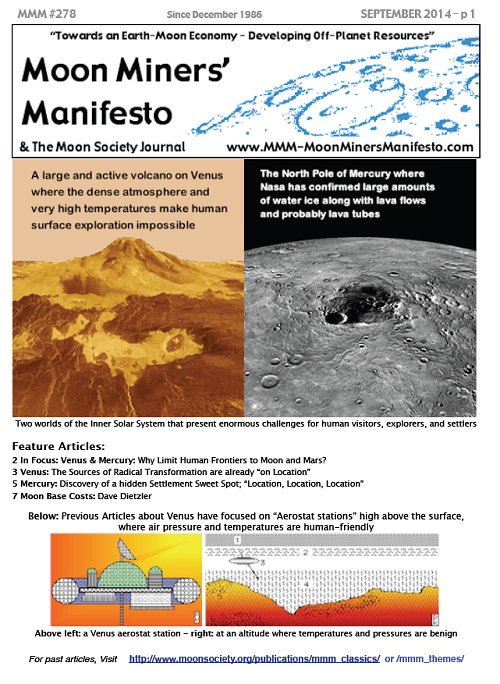
The Moon Society has published the Moon Miners Manifesto since  1986. Below is the cover of the latest issue. Membership is required to access recent issues. There is free access to the Moon Miners’ Manifesto Classics Volumes.

Sept2014CoverPage

ESO: Lupus 4 cloud will one day shine with new stars

An announcement from the European Southern Observatory (ESO):

Cosmic Forecast: Dark Clouds Will Give Way to Sunshine

Lupus 4, a spider-shaped blob of gas and dust, blots out background stars like a dark cloud on a moonless night in this intriguing new image. Although gloomy for now, dense pockets of material within clouds such as Lupus 4 are where new stars form and where they will later burst into radiant life. The Wide Field Imager on the MPG/ESO 2.2-metre telescope at ESO’s La Silla Observatory in Chile captured this new picture.

The Dark Cloud Lupus 4

The Wide Field Imager (WFI) on the MPG/ESO 2.2-metre telescope at the
La Silla Observatory in Chile captured this view of dark cloud Lupus 4
blotting out background stars. Lupus 4 is a dense pocket of gas and dust
where new stars are expected to form. The cloud is located about 400
light-years away from Earth, on the border between the constellations
of Lupus (The Wolf) and Norma (The Carpenter’s Square).

Lupus 4 is located about 400 light-years away from Earth, straddling the constellations of Lupus (The Wolf) and Norma (The Carpenter’s Square). The cloud is one of several affiliated dark clouds found in a loose star cluster called the Scorpius–Centaurus OB association. An OB association is a relatively young, yet widely dispersed grouping of stars [1]. The stars likely had a common origin in a gigantic cloud of material.

Because the association, and its Lupus clouds, form the closest such grouping to the Sun, they are a prime target for studying how stars grow up together before going their separate ways. The Sun, along with most stars in our galaxy, is thought to have started out in a similar environment.

American astronomer Edward Emerson Barnard is credited with the earliest descriptions of the Lupus dark clouds in the astronomical literature, back in 1927. Lupus 3, neighbour to Lupus 4, is the best studied, thanks to the presence of at least 40 fledgling stars formed over the last three million years, and which are on the cusp of igniting their fusion furnaces (eso1303). The main energy source in these adolescent stars, known as T Tauri stars, is the heat generated by their gravitational contraction. That is in contrast to the fusion of hydrogen and other elements which powers mature stars such as the Sun.

Zooming in on the dark cloud Lupus 4:

Loading player…

Observations of the cold darkness of Lupus 4 have turned up only a few T Tauri stars. Yet promisingly for Lupus 4 in terms of future star formation is a dense, starless core of material in the cloud. Given a few million years, that core should develop into T Tauri stars. Comparing Lupus 3 and Lupus 4 in this way suggests that the former is older than the latter, because its contents have had more time to develop into stars. How many stars might eventually start to shine within Lupus 4? It is hard to say, as mass estimates for Lupus 4 vary. Two studies agree on a figure of around 250 times the mass of the Sun, though another, using a different method, arrives at a figure of around 1600 solar masses. Either way, the cloud contains ample material to give rise to plenty of bright new stars. Rather as earthly clouds make way for sunshine, so, too, shall this cosmic dark cloud eventually dissipate and give way to brilliant starlight.

Notes
[1] The “OB” refers to the hot, bright, short-lived stars of spectral types O and B that are still shining brilliantly within the widely dispersed cluster as it travels through the Milky Way galaxy.

Links
Photos of the MPG/ESO 2.2-metre telescope
Other photos taken with the MPG/ESO 2.2-metre telescope
Photos of La Silla

Everyone can participate in space