The latest Space to Ground report from NASA on activities related to the International Space Station:
Latest views of Florence from the ISS:
=====
The latest Space to Ground report from NASA on activities related to the International Space Station:
Latest views of Florence from the ISS:
=====
The latest report from the NASA/ESA Hubble collaboration:
BUFFALO charges towards the earliest galaxies
New Hubble project provides wide-field view of the galaxy cluster Abell 370

Learning about the formation and evolution of the very first galaxies in the Universe is crucial for our understanding of the cosmos. While the NASA/ESA Hubble Space Telescope has already detected some of the most distant galaxies known, their numbers are small, making it hard for astronomers to determine if they represent the Universe at large.
Massive galaxy clusters like Abell 370, which is visible in this new image, can help astronomers find more of these distant objects. The immense masses of galaxy clusters make them act as cosmic magnifying glasses. A cluster’s mass bends and magnifies light from more distant objects behind it, uncovering objects otherwise too faint for even Hubble’s sensitive vision. Using this cosmological trick — known as strong gravitational lensing — Hubble is able to explore some of the earliest and most distant galaxies in the Universe.
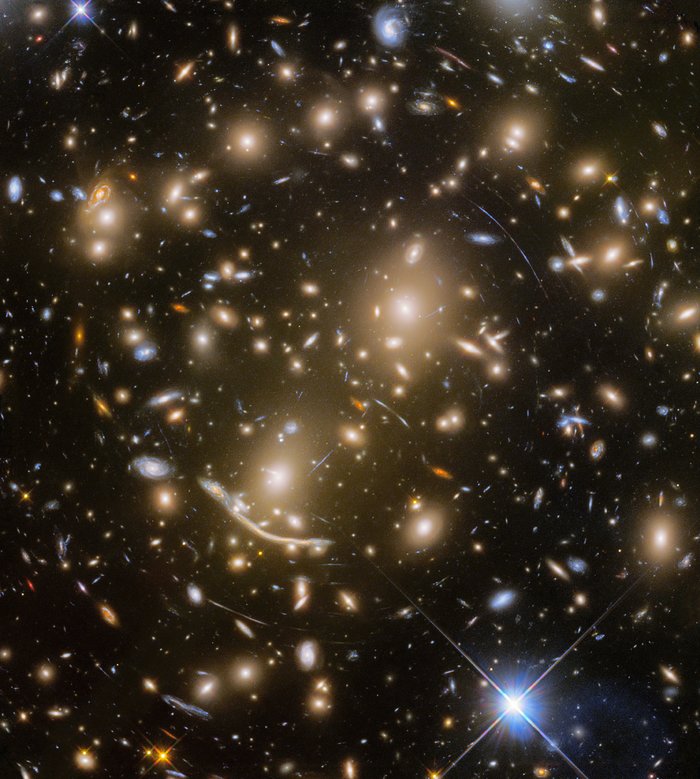
This image of Abell 370 and its surroundings was made as part of the new Beyond Ultra-deep Frontier Fields And Legacy Observations (BUFFALO) survey. This project, led by European astronomers from the Niels Bohr Institute (Denmark) and Durham University (UK), was designed to succeed the successful Frontier Fields project [1]. 101 Hubble orbits — corresponding to 160 hours of precious observation time — have been dedicated to exploring the six Frontier Field galaxy clusters. These additional observations focus on the regions surrounding the galaxy clusters, allowing for a larger field of view.
BUFFALO’s main mission, however, is to investigate how and when the most massive and luminous galaxies in the Universe formed and how early galaxy formation is linked to dark matter assembly. This will allow astronomers to determine how rapidly galaxies formed in the first 800 million years after the Big Bang — paving the way for observations with the upcoming NASA/ESA/CSA James Webb Space Telescope.
Driven by the Frontier Fields observations, BUFFALO will be able to detect the most distant galaxies approximately ten times more efficiently than its progenitor. The BUFFALO survey will also take advantage of other space telescopes which have already observed the regions around the clusters. These datasets will be included in the search for the first galaxies.
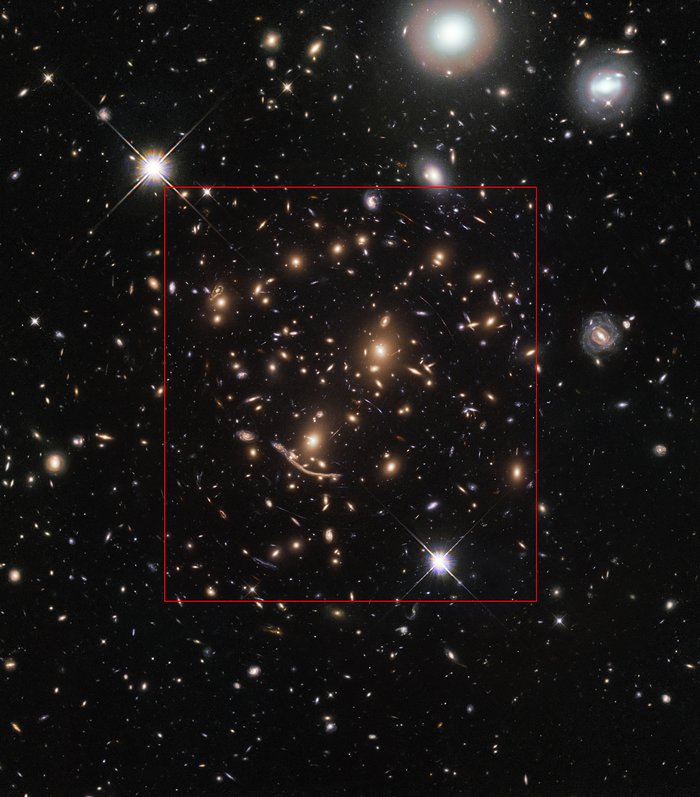
Notes
[1] Frontier Fields was a Hubble programme that ran from 2013 to 2017. Hubble spent 630 hours of observation time probing six notable galaxy clusters, all of which showed effects of strong gravitational lensing.
From Kiruna, Sweden comes this view of beautiful autumn aurora accompanied by a nice soundtrack (Daniel Birch – Attack Of The Birds):
====
The latest report from the European Southern Observatory (ESO):
A Galactic Gem
ESO’s FORS2 instrument captures stunning details of spiral galaxy NGC 3981
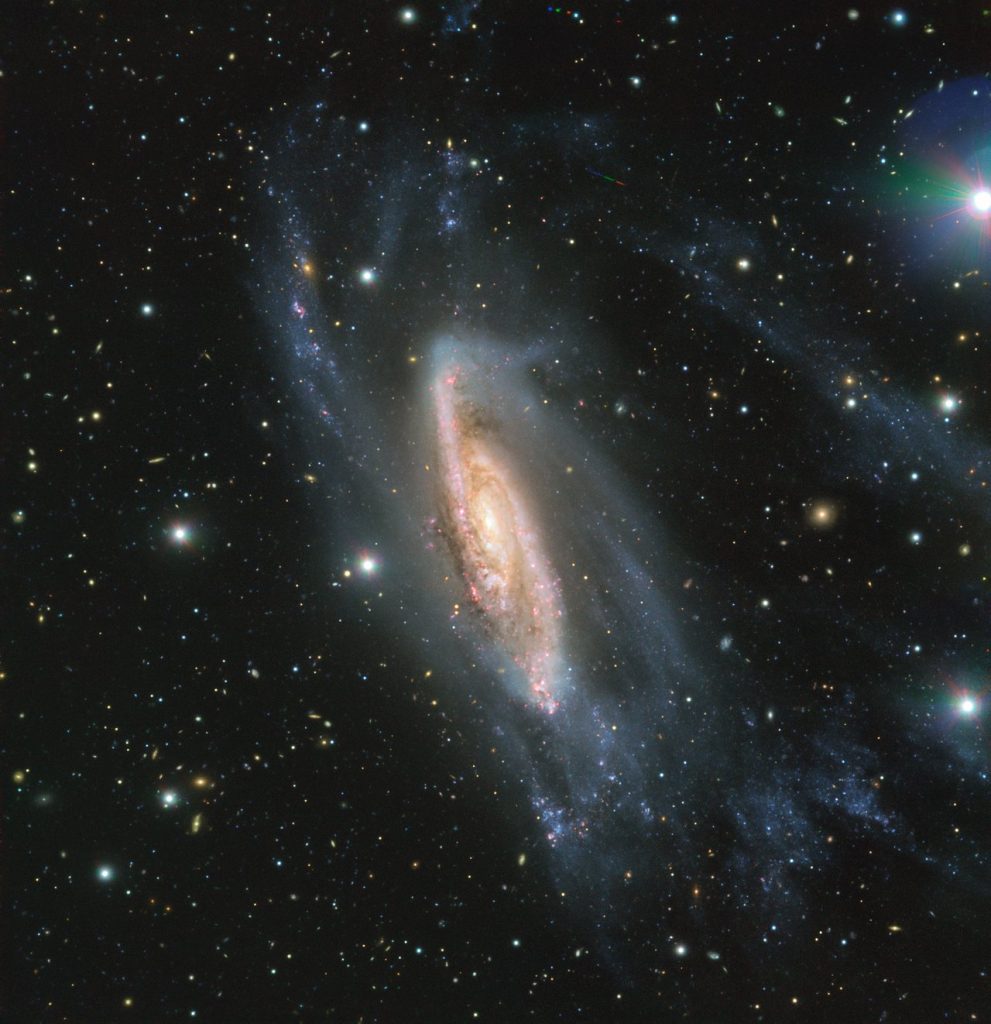
This wonderful image shows the resplendent spiral galaxy NGC 3981 suspended in the inky blackness of space. This galaxy, which lies in the constellation of Crater (the Cup), was imaged in May 2018 using the FOcal Reducer and low dispersion Spectrograph 2 (FORS2) instrument on ESO’s Very Large Telescope (VLT).
FORS2 is mounted on Unit Telescope 1 (Antu) of the VLT at ESO’s Paranal Observatory in Chile. Amongst the host of cutting-edge instruments mounted on the four Unit Telescopes of the VLT, FORS2 stands apart due to its extreme versatility. This ”Swiss Army knife” of an instrument is able to study a variety of astronomical objects in many different ways — as well as being capable of producing beautiful images like this one.
The sensitive gaze of FORS2 revealed NGC 3981’s spiral arms, strewn with vast streams of dust and star-forming regions, and a prominent disc of hot young stars. The galaxy is inclined towards Earth, allowing astronomers to peer right into the heart of this galaxy and observe its bright centre, a highly energetic region containing a supermassive black hole. Also shown is NGC 3981’s outlying spiral structure, some of which appears to have been stretched outwards from the galaxy, presumably due to the gravitational influence of a past galactic encounter.
NGC 3981 certainly has many galactic neighbours. Lying approximately 65 million light years from Earth, the galaxy is part of the NGC 4038 group, which also contains the well-known interacting Antennae Galaxies. This group is part of the larger Crater Cloud, which is itself a smaller component of the Virgo Supercluster, the titanic collection of galaxies that hosts our own Milky Way galaxy.
NGC 3981 is not the only interesting feature captured in this image. As well as several foreground stars from our own galaxy, the Milky Way, FORS2 also captured a rogue asteroid streaking across the sky, visible as the faint line towards the top of the image. This particular asteroid has unwittingly illustrated the process used to create astronomical images, with the three different exposures making up this image displayed in the blue, green and red sections of the asteroid’s path.
This image was taken as part of ESO’s Cosmic Gems programme, an outreach initiative to produce images of interesting, intriguing or visually attractive objects using ESO telescopes, for the purposes of education and public outreach. The programme makes use of telescope time that cannot be used for science observations. In case the data collected could be useful for future scientific purposes, these observations are saved and made available to astronomers through ESO’s science archive.