The two most recent Space to Ground reports from NASA on activities related to the International Space Station:
A brief video about research aboard the ISS
====
Einstein’s Monsters: The Life and Times of Black Holes

The two most recent Space to Ground reports from NASA on activities related to the International Space Station:
A brief video about research aboard the ISS
====
Einstein’s Monsters: The Life and Times of Black Holes
A sampling of links to recent space policy, politics, and government related space news and resource items that I found of interest:
Webcasts:
** Administrator Bridenstine Joins Washington Post Discussion: The New Space Age
The Washington Post hosted “Transformers: Space” which featured prominent speakers in the fields of space science and policy. The New Space Age discussion included NASA Administrator Jim Bridenstine, Planetary Society CEO Bill Nye and Dr. Heidi Hammel, Vice President of the Board of Directors of the Planetary Society. These speakers discussed the most important issues on the country’s space agenda including the future of the International Space Station, America’s plans to return to the Moon, and the search for life in the cosmos.
** NASA Administrator Talks Training, Future Missions with Newest Astronaut Class
NASA’s newest class of astronaut trainees joined agency Administrator Jim Bridenstine Sept. 27 at NASA headquarters, to talk about their experiences in the training program, hopes for future missions, and more, in a live episode of “Watch This Space”.
Astronaut candidates Zena Cardman, Jasmin Moghbeli, Jonny Kim, Frank Rubio, Matthew Dominick, Warren Hoburg, Kayla Barron, Bob Hines, Raja Chari, Loral O’ Hara and Jessica Watkins were joined by Canadian Space Agency astronaut candidates Joshua Kutryk and Jenni Sidey-Gibbons. The first U.S. astronauts, the “Original Seven,” were selected in 1959. Since then, NASA has selected 21 more groups of astronauts. This latest class, announced on June 7, 2017, includes a physician, biologist, geologist, military pilots and engineers.
Once their training is complete, they may be assigned to any of a variety of missions, including: performing research on the International Space Station, launching from American soil on spacecraft built by U.S. commercial companies, and departing for deep space missions on NASA’s new Orion spacecraft and Space Launch System rocket.
** October 23, 2018 Zimmerman/Batchelor podcast | Behind The Black
** The Space Show – Tue, 10/23/2018 – William Ketchum
Ketchum spoke about his new book, To The Moon On A Slide Rule, and “early ICBM and rocket history, early space program, Surveyor missions, lunar surface, nuclear propulsion, NASA, SLS, Gateway and much more”.
====
Chasing New Horizons: Inside the Epic First Mission to Pluto
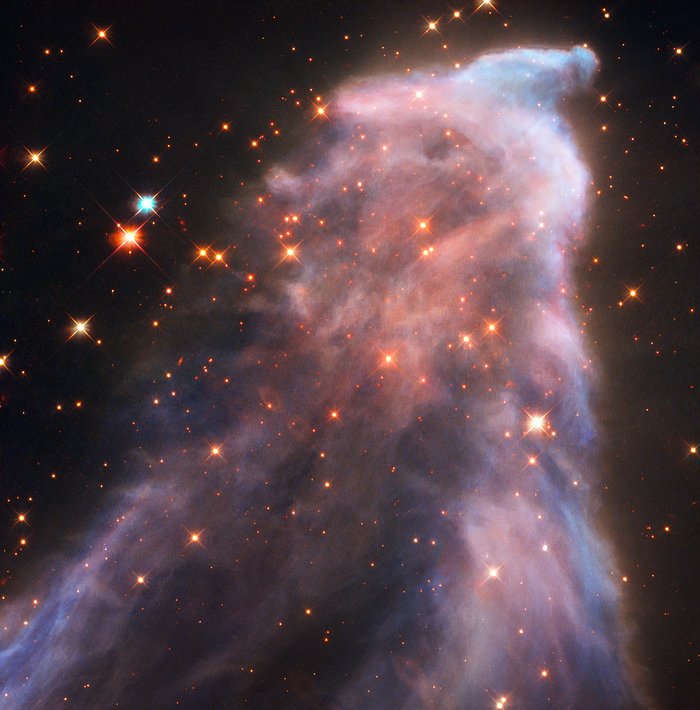
The Hubble space telescope offers a great view of the Ghost Nebula:
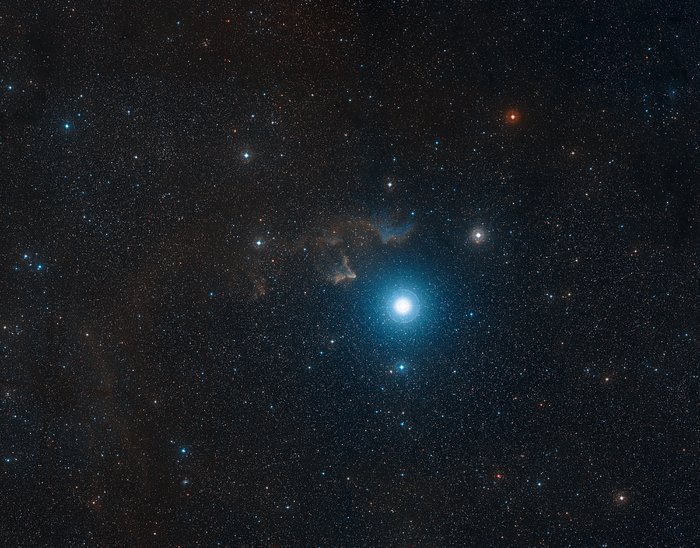
The constellation of Cassiopeia, named after a vain queen in Greek mythology, forms the easily recognisable “W” shape in the night sky. The central point of the W is marked by a dramatic star named Gamma Cassiopeiae.
This video zooms in on the emission and reflection nebula IC 63 — nicknamed the Ghost Nebula — about 550 light-years away. It starts with a view of the night sky as seen from the ground. It then zooms through observations from the Digitized Sky Survey 2, and ends with a view of the nebula obtained with the NASA/ESA Hubble Space Telescope. Credit: Hubble, Digitized Sky Survey 2, N. Risinger (skysurvey.org). Music: Astral Electronic.
The remarkable Gamma Cassiopeiae is a blue-white subgiant variable star that is surrounded by a gaseous disc. This star is 19 times more massive and 65 000 times brighter than our Sun. It also rotates at the incredible speed of 1.6 million kilometres per hour — more than 200 times faster than our parent star. This frenzied rotation gives it a squashed appearance. The fast rotation causes eruptions of mass from the star into a surrounding disk. This mass loss is related to the observed brightness variations.
The radiation of Gamma Cassiopeiae is so powerful that it even affects IC 63, sometimes nicknamed the Ghost Nebula, that lies several light years away from the star. IC 63 is visible in this image taken by the NASA/ESA Hubble Space Telescope.
This hydrogen-alpha radiation makes IC 63 an emission nebula, but we also see blue light in this image. This is light from Gamma Cassiopeiae that has been reflected by dust particles in the nebula, meaning that IC 63 is also a reflection nebula.
This colourful and ghostly nebula is slowly dissipating under the influence of ultraviolet radiation from Gamma Cassiopeiae. However, IC 63 is not the only object under the influence of the mighty star. It is part of a much larger nebulous region surrounding Gamma Cassiopeiae that measures approximately two degrees on the sky — roughly four times as wide as the full Moon.
This video pans across the nebula IC 63, often nicknamed the Ghost Nebula. This nebula is classified as both an emission and a reflection nebula. The hydrogen within IC 63 is being bombarded with radiation from the nearby star Gamma Cassiopeiae, causing its electrons to gain energy which they later emit as hydrogen-alpha radiation — visible in red in this image. The blue parts of IC 63 are created by dust particles in the nebula which reflect the light from Gamma Cassiopeiae. Credit: Hubble. Music: Johan B. Monell (www.johanmonell.com).
This region is best seen from the Northern Hemisphere during autumn and winter. Though it is high in the sky and visible all year round from Europe, it is very dim, so observing it requires a fairly large telescope and dark skies.
From above Earth’s atmosphere, Hubble gives us a view that we cannot hope to see with our eyes. This photo is possibly the most detailed image that has ever been taken of IC 63, and it beautifully showcases Hubble’s capabilities.
More information
The Hubble Space Telescope is a project of international cooperation between ESA and NASA.
Links
The latest report from the European Southern Observatrory (ESO):
The Pirate of the Southern Skies
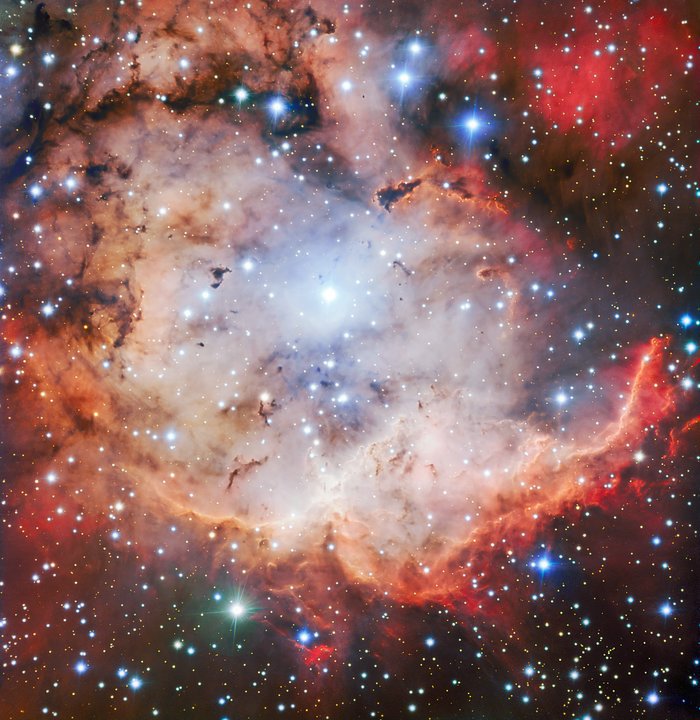
This zoom video starts with a wide view of the Milky Way and ends with a close-up look at a vivid picture of an active star forming region — NGC 2467, otherwise known as the Skull and Crossbones nebula. This image of dust, gas and bright young stars, gravitationally bound into the form of a grinning skull, was captured with the FORS instrument on ESO’s Very Large Telescope (VLT). Whilst ESO’s telescopes are usually used for the collection of science data, their immense resolving power makes them ideal for capturing images such as this — which are beautiful for their own sake. Credit: ESO/Digitized Sky Survey 2/N. Risinger (skysurvey.org). Music: astral electronic
This vivid picture of an active star-forming region — NGC 2467, sometimes referred to as the Skull and Crossbones Nebula — is as sinister as it is beautiful. This image of dust, gas and bright young stars, gravitationally bound into the form of a grinning skull, was captured with the FORS instrument on ESO’s Very Large Telescope (VLT). Whilst ESO’s telescopes are usually used for the collection of science data, they can also capture images such as this — which are beautiful for their own sake.
It is easy to see the motivation for the nickname Skull and Crossbones. This young, bright formation distinctly resembles an ominous hollow face, of which only the gaping mouth is visible here. NGC 2467 skulks in the constellation Puppis, which translates rather unromantically as The Poop Deck.
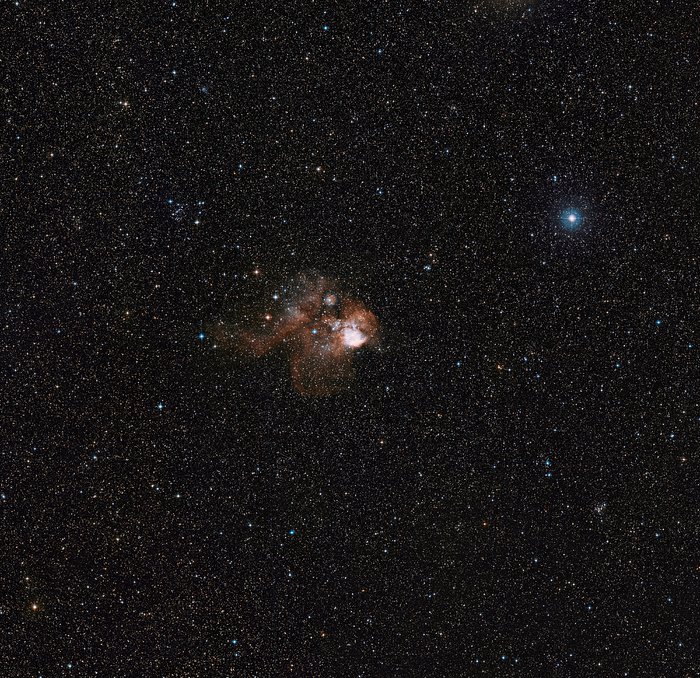
Puppis is one of three nautically named constellations that sail the southern skies, and which used to make up the single, giant Argo Navis constellation, named after the ship of the mythical Jason and the Argonauts. Argo Navis has since been divided into three: Carina (the keel), Vela (the sails) and Puppis, where this nebula finds its home. Whilst a heroic figure, Jason is most famous for his theft of the golden fleece, so NGC 2467 rests not only in the midst of a vast celestial ship, but amongst thieves — an appropriate abode for this piratical nebula.
This image was created as part of the ESO Cosmic Gems programme, an outreach initiative to produce images of interesting, intriguing or visually attractive objects using ESO telescopes, for the purposes of education and public outreach. The programme makes use of telescope time that cannot be used for science observations. All data collected may also be suitable for scientific purposes, and are made available to astronomers through ESO’s science archive.
This pan video explores a vivid active star forming region — NGC 2467, otherwise known as the Skull and Crossbones nebula. This image of dust, gas and bright young stars, gravitationally bound into the form of a grinning skull, was captured with the FORS instrument on ESO’s Very Large Telescope (VLT). Whilst ESO’s telescopes are usually used for the collection of science data, their immense resolving power makes them ideal for capturing images such as this — which are beautiful for their own sake. Credit: ESO. Music: Johan B. Monell (www.johanmonell.com)
Check out the latest Carnivals of Space:
====

