SpaceWarps citizen science boosted by BBC Two program

The BBC Two Stargazing LIVE program has been urging its viewers to participate in the project SpaceWarps, which is one of several citizen science projects sponsored by the Zooniverse organization. In SpaceWarps participants examine celestial images in search of the very rare cases where the gravitational effects of a distant galaxy can magnify the image of an even more distant galaxy directly behind it. This lensing effect was predicted by Einstein’s general theory of relativity.

The big increase in the number of participants has been a boon to the project and several candidate gravitational lenses have been found: Stargazing Live: The Results Are In –  Zooniverse

BBC Stargazing Live 2014 has been asking people to visit the Zooniverse’s Space Warps site to identify gravitational lenses: extremely rare events caused by one galaxy passing in front of another (very distant) galaxy. Tens of thousands of you have taken part and classified more than 6.5 million images.

Your classifications have already led to the discovery of more than 50 potential gravitational lenses! Amongst them are several beautiful and interesting discoveries. You can see a few of our favourite candidates above. For Stargazing Live’s third and final show we have focussed on the spectacular red arc/ring shown below, it has been nicknamed 9io9 by the team right now, because of it’s Zooniverse ID. You can see more of what our volunteers are saying about it here on Talk.

Credit: Jim Geach / VICS82

Credit: Jim Geach / VICS82

More info on SpaceWarps can be found at:

Images from Mars orbiter show Curiosity rover and its tracks

Check out the amazing new images from the HiRISE) camera on the Mars Reconnaissance Orbiter showing the both the tracks of the Curiosity rover but the rover itself as well:

Mars Orbiter Images Rover and Tracks in Gale Crater

NASA’s Curiosity Mars rover and its recent tracks from driving in Gale Crater appear in an image taken by the High Resolution Imaging Science Experiment (HiRISE) camera on NASA’s Mars Reconnaissance Orbiter on Dec. 11, 2013.

Excerpts from the large HiRISE observation are at:

http://photojournal.jpl.nasa.gov/catalog/PIA17755, showing the rover, and
http://photojournal.jpl.nasa.gov/catalog/PIA17754, showing tracks across a landscape in enhanced color.

The tracks show where the rover has zigzagged around obstacles on its route toward the lower slopes of Mount Sharp, its next major destination.

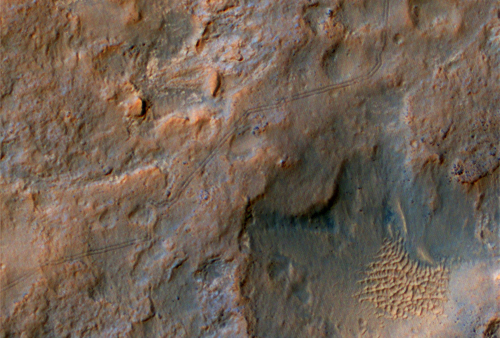
Curiosity Rover Tracks, Viewed from Orbit in December 2013
Two parallel tracks left by the wheels of NASA’s Curiosity Mars rover cross rugged
ground in this portion of a Dec. 11, 2013, observation by the High Resolution Imaging
Science Experiment (HiRISE) camera on NASA’s Mars Reconnaissance Orbiter.

The tracks show where the rover has zigzagged around obstacles on its route toward the lower slopes of Mount Sharp, its next major destination.

HiRISE first imaged the Mars Science Laboratory spacecraft while it was descending on a parachute to place Curiosity on Mars 17 months ago. Since then, it has provided updated views of the rover’s traverse, as seen from orbit.

Curiosity Trekking, Viewed from Orbit in December 2013
NASA’s Curiosity Mars rover and tracks left by its driving appear in this portion of
a Dec. 11, 2013, observation by the High Resolution Imaging Science
Experiment (HiRISE) camera on NASA’s Mars Reconnaissance Orbiter.

HiRISE is operated by the University of Arizona, Tucson. The instrument was built by Ball Aerospace & Technologies Corp., Boulder, Colo. The Mars Reconnaissance Orbiter project and Mars Science Laboratory project are managed for NASA’s Science Mission Directorate, Washington, by NASA’s Jet Propulsion Laboratory, a division of the California Institute of Technology in Pasadena.

For more information about HiRISE, see http://hirise.lpl.arizona.edu . For more information about the Mars Reconnaissance Orbiter, visithttp://www.nasa.gov/mro . For more information about Curiosity, visit http://mars.jpl.nasa.gov/msl/ .

Space policy roundup – Jan.9.14 [Updated]

Today’s selection of space policy/politics related links:

Update:

Update 2: Here’s a video of some speeches at the International Space Exploration Forum including White House Science and Technology Director John Holdren , who discussed the decision by the Obama Administration to extend operation of the International Space Station (ISS) until at least 2024.

[ Update 3: The text (pdf) of Holdren’s speech.]

ISS paper model from NASA

NASA offers a paper card model plan for the International Space Station: Build the Station Simulation – NASA Educator’s Guide

Audience: Educators
Grades: 5-8

With just a few materials, building a paper model of the International Space Station (ISS) can become an excellent group, troop, or class project. This publication contains a brief overview of the ISS, its parts, the science that occurs on board, instructions, and extensions for an interdisciplinary technology experience Discover more about the Station Explore fun facts, simulate building the Station, and learn about the international partners.

Build the Station Simulation Educator’s Guide [3.61MB PDF file]

Build the Station Simulation

Find more paper spacecraft models in the HobbySpace Modeling section.

Retired WISE spacecraft becomes reactivated NEOWISE asteroid hunter

NASA Jet Propulsion Laboratory reports on the initial results from an old spacecraft that has been reactivated:

Recently Reactivated NASA Spacecraft Spots Its First New Asteroid

NASA’s Near-Earth Object Wide-field Infrared Survey Explorer (NEOWISE) spacecraft has spotted a never-before-seen asteroid — its first such discovery since coming out of hibernation last year.

NEOWISE originally was called the Wide-field Infrared Survey Explorer (WISE), which had made the most comprehensive survey to date of asteroids and comets. The spacecraft was shut down in 2011 after its primary mission was completed. But in September 2013, it was reactivated, renamed and given a new mission, which is to assist NASA’s efforts to identify the population of potentially hazardous near-Earth objects (NEOs). NEOWISE also can assist in characterizing previously detected asteroids that could be considered potential targets for future exploration missions.

NEOWISE's New Find
The six red dots in this composite picture indicate the location of the first new
near-Earth asteroid seen by NASA’s Near-Earth Object Wide-field Infrared
Survey Explorer (NEOWISE) since the spacecraft came out of hibernation in
December 2013. The asteroid, called 2013 YP139, is the first of hundreds of
space-rock discoveries expected during its renewed mission. The inset shows
a zoomed-in view of one of the detections of 2013 YP139.
Image credit: NASA/JPL-Caltech 

NEOWISE’s first discovery of its renewed mission came on Dec. 29 — a near-Earth asteroid designated 2013 YP139. The mission’s sophisticated software picked out the moving object against a background of stationary stars. As NEOWISE circled Earth scanning the sky, it observed the asteroid several times over half a day before the object moved beyond its view. Researchers at the University of Arizona used the Spacewatch telescope at the Kitt Peak National Observatory southwest of Tucson to confirm the discovery. Peter Birtwhistle, an amateur astronomer at the Great Shefford Observatory in West Berkshire, England, also contributed follow-up observations. NASA expects 2013 YP139 will be the first of hundreds of asteroid discoveries for NEOWISE.

“We are delighted to get back to finding and characterizing asteroids and comets, especially those that come into Earth’s neighborhood,” said Amy Mainzer, the mission’s principal investigator from NASA’s Jet Propulsion Laboratory in Pasadena, Calif. “With our infrared sensors that detect heat, we can learn about their sizes and reflectiveness.”

2013 YP139 is about 27 million miles (43 million kilometers) from Earth. Based on its infrared brightness, scientists estimate it to be roughly 0.4 miles (650 meters) in diameter and extremely dark, like a piece of coal. The asteroid circles the sun in an elliptical orbit tilted to the plane of our solar system and is classified as potentially hazardous. It is possible for its orbit to bring it as close as 300,000 miles from Earth, a little more than the distance to the moon. However, it will not come that close within the next century.

WISE discovered more than 34,000 asteroids and characterized 158,000 throughout the solar system during its prime mission in 2010 and early 2011. Its reactivation in September followed 31 months in hibernation.

NEOWISE will continue to detect asteroids and comets. The observations will be automatically sent to the clearinghouse for solar system bodies, the Minor Planet Center in Cambridge, Mass., for comparison against the known catalog of solar system objects and to determine orbit if the object is not known. A community of professional and amateur astronomers will provide follow-up observations, establishing firm orbits for the previously unseen objects.

Infrared sensors, similar to the cameras on NEOWISE, are a powerful tool for discovering, cataloging and understanding the asteroid population. Some of the objects about which NEOWISE will be collecting data could become candidates for NASA’s announced asteroid initiative, which will be the first mission to identify, capture and relocate an asteroid for astronauts to explore. The initiative represents an unprecedented technological feat that will lead to new scientific discoveries and technological capabilities that will help protect our home planet and achieve the goal of sending humans to an asteroid by 2025.

JPL manages the project for NASA’s Science Mission Directorate in Washington. The Space Dynamics Laboratory in Logan, Utah, built the science instrument. Ball Aerospace & Technologies Corp. of Boulder, Colo., built the spacecraft. Science operations and data processing take place at the Infrared Processing and Analysis Center at the California Institute of Technology in Pasadena. Caltech manages JPL for NASA.

An image of asteroid 2013 YP139, taken by NEOWISE, is available at http://go.nasa.gov/1cNF9T7 .

More information about NEOWISE is available online at http://www.nasa.gov/wise .

Everyone can participate in space