FISO: Exploring earth’s minimoons

The latest presentation to the Future In-Space Operations (FISO) study group is now posted in the FISO Working Group Presentations Archive. There are slides and a video in a zip file plus an  audio file  (mp3) available for the talk, Minimoons: New Prospective Targets for Human Exploration, Bill Bottke, SWRI Boulder – Jan.15.14

Occasionally, near earth asteroids are captured temporarily in orbits around earth. Bottke calls these Minimoons:

MinimoonDef

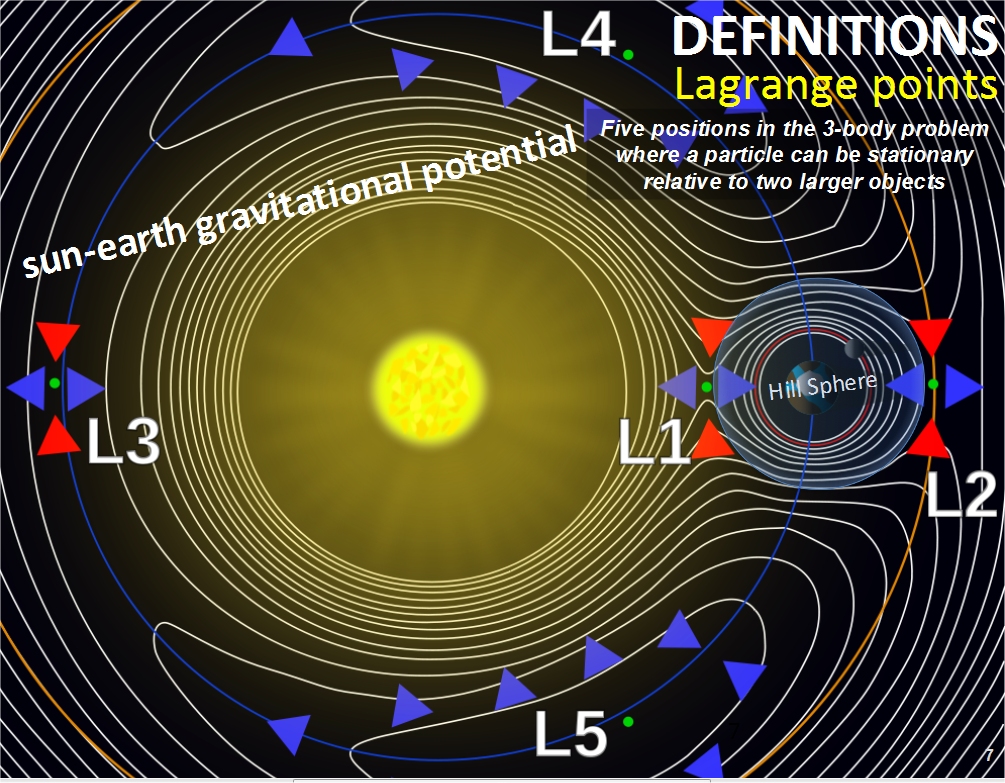
TheEarth-Sun Lagrange points minimum areas are of particular interest.

lagrangePts

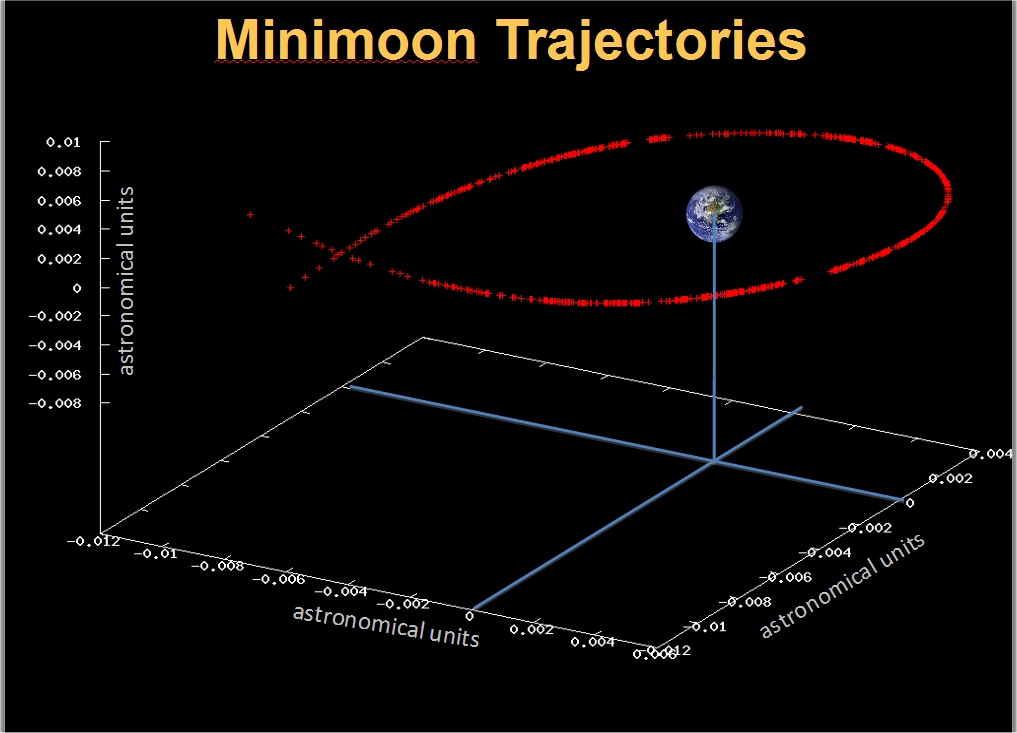
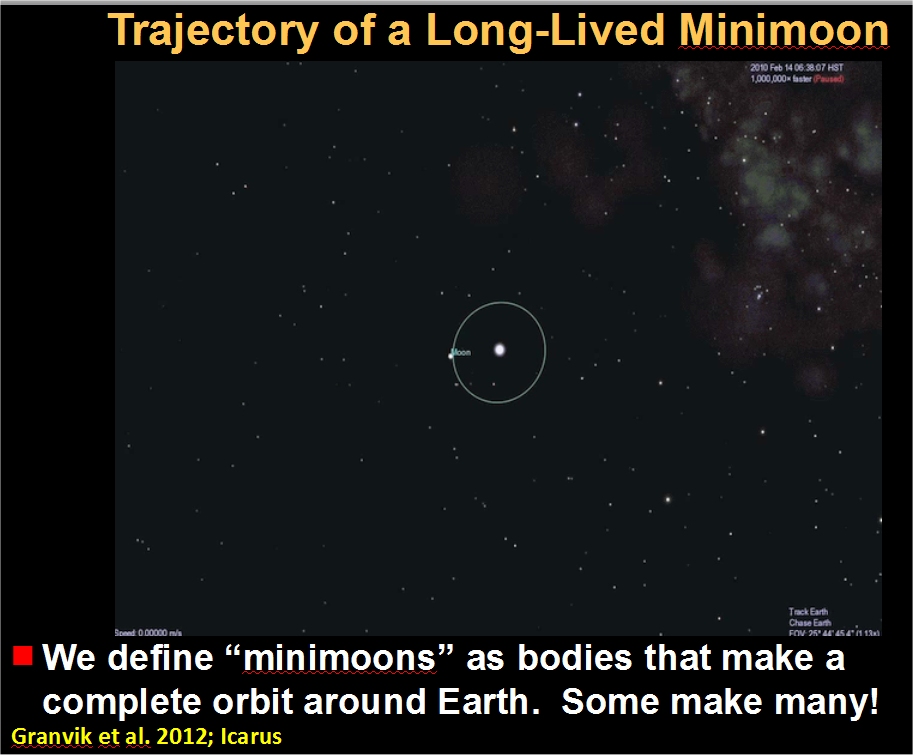
The objects can last for just one simple orbit –

MinimoonTraj1

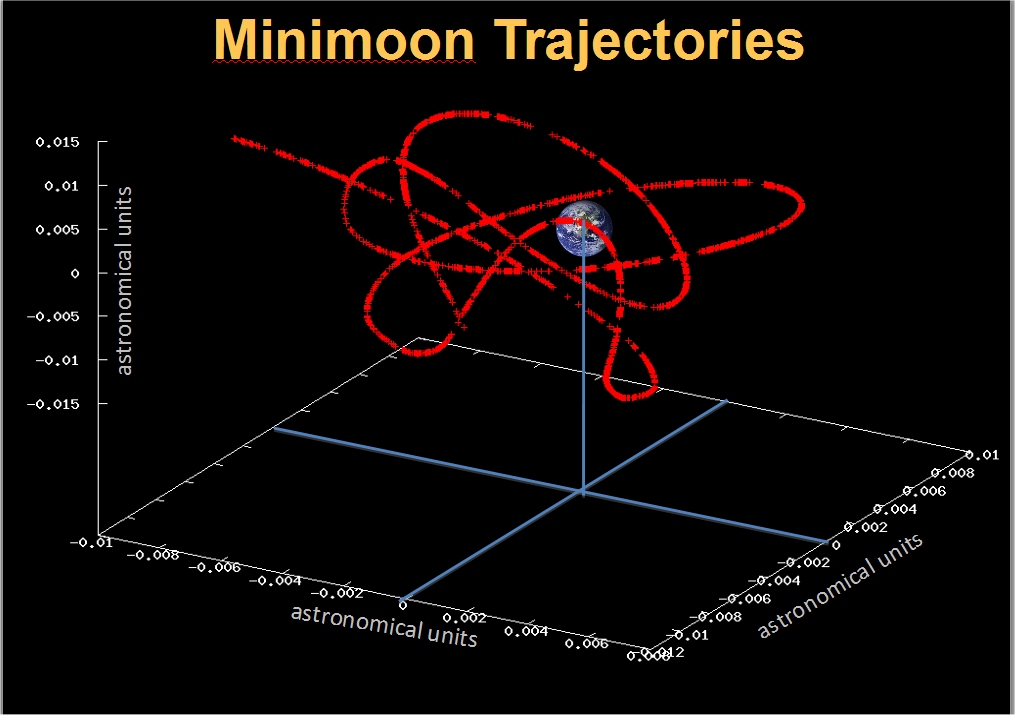
Or for many complex orbits:

MinimoonTraj2

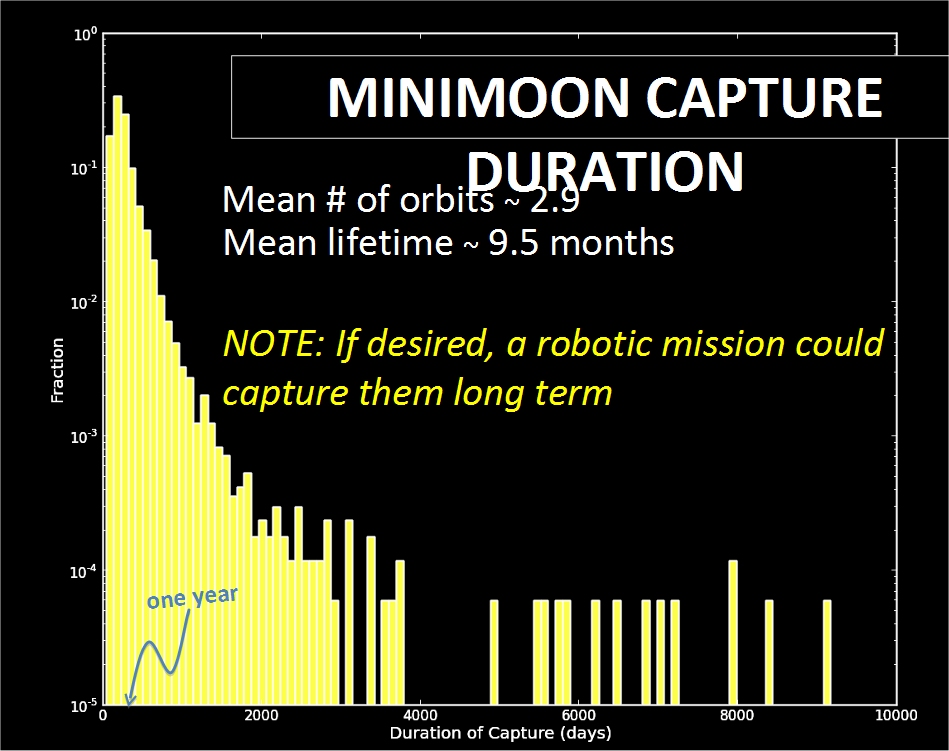
Lifetimes in the earth region can span many years:

MinimoonLifetime

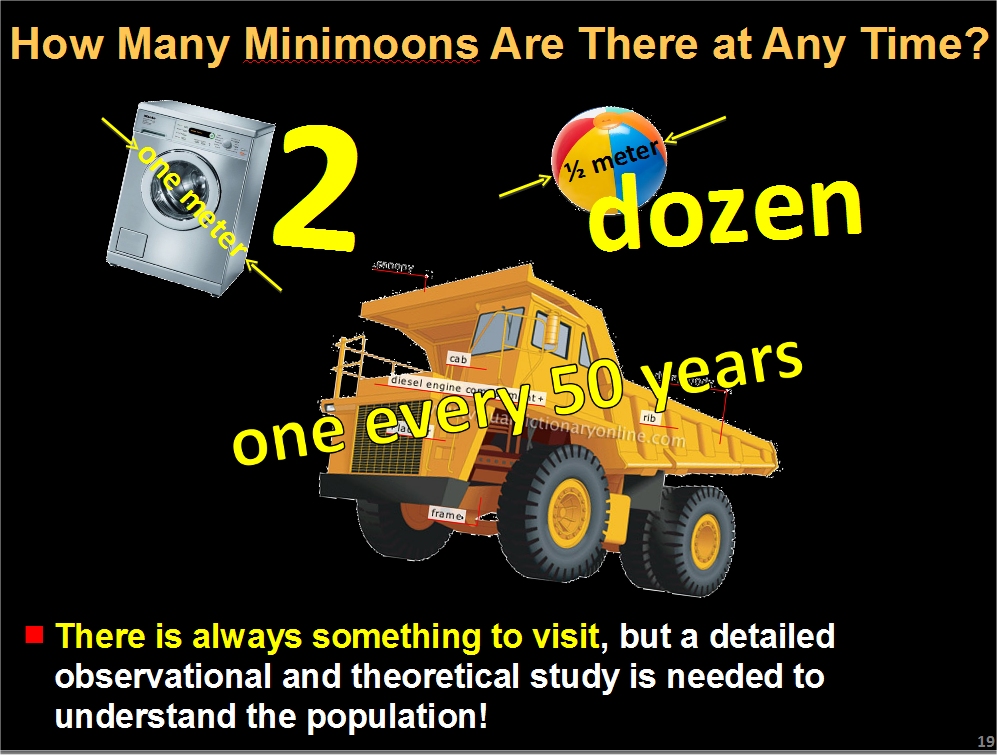
They estimate a couple of dozen such Minimoons are in orbit around earth at any given time:

MinimoonNum

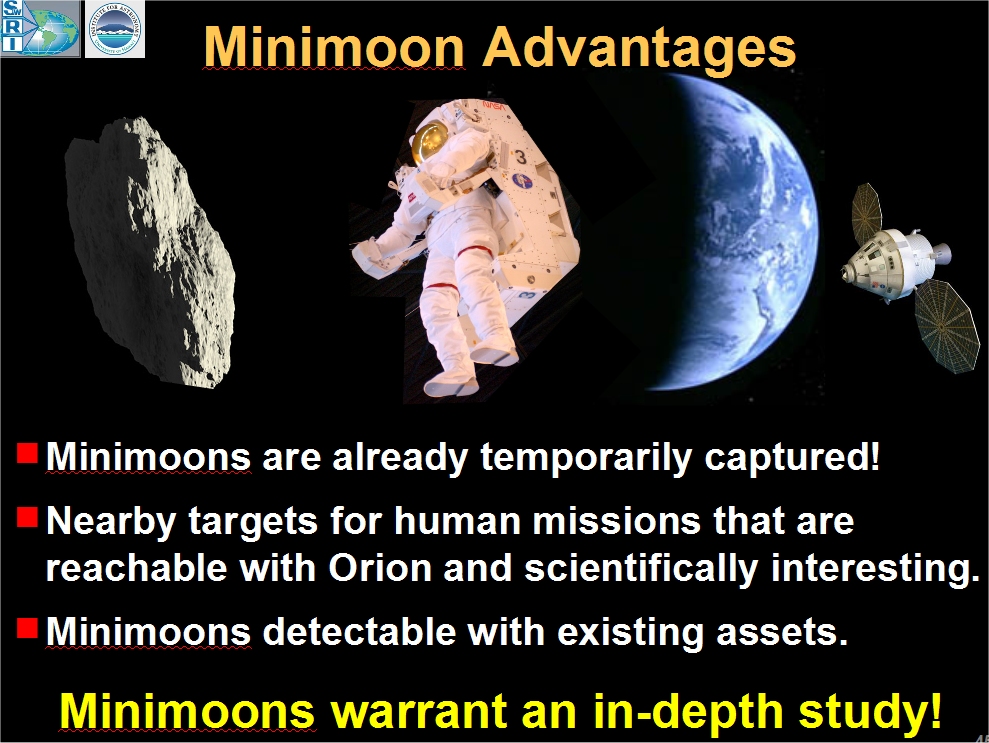
Bottke goes on to  discuss ideas for improving the detection of Minimoons and for targeting them for exploratory missions, including human missions.

MinimoonAdvantages

Space policy roundup – Jan.16.14 [Updated]

Space policy/politics related links today:

A couple of space policy related webcasts:

Update:

**************************

Space policy roundup – Jan.15.14

Today’s selection of space policy/politics related links

Update:

The NASA Aerospace Safety Advisory Panel once again shows that it judges the safety of a human spaceflight development program according to the degree that it looks like previous such programs at NASA. If it is not a top-down agency managed program with cost-plus subcontracting and ever escalating costs, then it simply must be less safe.

ASAP cannot, of course, specify any actual technical shortcomings in the commercial systems being developed. It can only point to superficial differences in the way the commercial crew program is  configured and the fact that its costs are low.

I see nothing in the report about the fact that the rockets used for the commercial crew spacecraft will have flown many times unmanned prior to crew flights and will continue to fly unmanned payloads in parallel with the crew program. ASAP had shown no reluctance to have NASA astronauts fly on an Ares I after just one test flight and they appear to have no qualms in crew flights on the SLS/Orion after just one test flight. Apparently, real world flight hardware experience is trivial to ASAP compared to stacks of paper studies and proper FAR procurement procedures.

More policy links:

Update 2:

**************************

Mars One: crowd-funding campaign update

Mars One urges participation in their Indiegogo crowd-funding campaign. They are currently at $172,533 towards their goal of $400,000 with 11 days left in the campaign.

Space Exploration for Everyone

Amersfoort, 15th January 2014 – For the first time in the history of humankind, economical participation in space exploration is a reality. With Mars One’s recent launch of a crowdfunding campaign, it’s now possible to send a personal item to distances far beyond your wildest dreams. For many, the Mars One mission is the gateway to a new era in man’s historic reach for the stars.

For about 50 years, government organizations have been funding and managing space exploration across the globe. Government run exploration, funded by public monies, has provided limited access to most citizens of those countries. In the last few years, private organizations such as Richard Branson’s Virgin Galactic and Eric Anderson’s Space Adventures have made space exploration possible for the mega-rich. A flight with Virgin Galactic 68 miles above Earth goes for a cool $250,000 while the potential 2017 flight to the moon from Space Adventures is rumored to cost an astronomical $150 million. There are others in between, but none as accessible as Mars One. Bas Lansdorp, co-founder of Mars One, has set his sights on involving the everyday man and woman in space exploration.

In April 2013, Mars One opened the doors to the masses by providing an open application process for the potential crew that will fly to Mars in 2025 to establish the human settlement. The response was overwhelming, with more than 200,000 people world-wide applying. Lansdorp is not shy about future promises to continue the trend. “From the beginning, this has always been humankind’s mission to Mars!”

The Mars One Foundation took another step toward this goal on December 10th, when they launched a crowdfunding campaign. The campaign, hosted by non-profit crowdfunding leader Indiegogo, is aimed at bringing Mars One and their goal of human settlement on Mars to the masses. Crowdfunding campaigns provide any person a chance to contribute financially to an organization’s fundraising efforts in exchange for what are called perks, or gifts created by the campaign owner. The perks included by Mars One provide what Lansdorp calls, “the first steps to affordable and accessible space exploration.”

The ‘crowd’ is invited to participate in Mars One first unmanned mission that will be launched in 2018. On the 10th of December 2013, Mars One announced that Lockheed Martin and SSTL were selected to perform the mission concept studies for the two spacecraft that will fly to Mars in 2018.

As an example, for just $25, you can send your electronic picture to Mars. In 2019, the Mars One communications satellite will pull up an image of your picture while in orbit and snap a shot of it with Mars in the background. Another popular perk provides any person the ability to create a personal message to be printed directly on the parachute which will be used to land the first Mars One spacecraft in 2019. “The Parachute Message to Mars is one of my personal favorites,” says Lansdorp. “Sending your physical message to Mars, all for just $95, seems outrageous. Think about it. Many times, that’s less than sending a package from Europe to the United States via FedEx or UPS!” These perks, plus others, will be offered until January 25th, when the campaign comes to a close.

About Mars One
Mars One is a not-for-profit foundation that will establish permanent human life on Mars. Human settlement on Mars is possible today with existing technologies. Mars One’s mission plan integrates components that are well tested and readily available from industry leaders worldwide. The first footprint on Mars and lives of the crew thereon will captivate and inspire generations. It is this public interest that will help finance this human mission to Mars.

Mars One’s Indiegogo Crowdfunding campaign can be found at: www.indiegogo.com/projects/mars-one-first-private-mars-mission-in-2018

Mars One team members and Ed Sedivy of Lockheed Martin comment on the 2018 Lander in this movie: http://youtu.be/icN29cdmw_s

ESO spots planet orbiting star similar to the sun in star cluster

Here’s an announcement from  ESO (European Southern Observatory):

First Planet Found Around Solar Twin in Star Cluster
Six-year search with HARPS finds three new planets in Messier 67

Astronomers have used ESO’s HARPS planet hunter in Chile, along with other telescopes around the world, to discover three planets orbiting stars in the cluster Messier 67. Although more than one thousand planets outside the Solar System are now confirmed, only a handful have been found in star clusters. Remarkably one of these new exoplanets is orbiting a star that is a rare solar twin — a star that is almost identical to the Sun in all respects.

Planets orbiting stars outside the Solar System are now known to be very common. These exoplanets have been found orbiting stars of widely varied ages and chemical compositions and are scattered across the sky. But, up to now, very few planets have been found inside star clusters [1]. This is particularly odd as it is known that most stars are born in such clusters. Astronomers have wondered if there might be something different about planet formation in star clusters to explain this strange paucity.

Loading player…

Anna Brucalassi (Max Planck Institute for Extraterrestrial Physics, Garching, Germany),
lead author of the new study, and her team wanted to find out more. “In the Messier 67
star cluster the stars are all about the same age and composition as the Sun. This
makes it a perfect laboratory to study how many planets form in such a crowded
environment, and whether they form mostly around more massive or less massive stars.”

The team used the HARPS planet-finding instrument on ESO’s 3.6-metre telescope at the La Silla Observatory. These results were supplemented with observations from several other observatories around the world [2]. They carefully monitored 88 selected stars in Messier 67 [3] over a period of six years to look for the tiny telltale motions of the stars towards and away from Earth that reveal the presence of orbiting planets.

Loading player…


This zoom sequence takes the viewer from a broad view of the entire night sky
into a close up view of the old star cluster Messier 67 in the constellation of Cancer
(The Crab). Observations using ESO’s HARPS instrument on the 3.6-metre telescope
at La Silla in Chile, along with other telescopes, have found three planets orbiting
stars in this cluster.

This cluster lies about 2500 light-years away in the constellation of Cancer (The Crab) and contains about 500 stars. Many of the cluster stars are fainter than those normally targeted for exoplanet searches and trying to detect the weak signal from possible planets pushed HARPS to the limit.

Three planets were discovered, two orbiting stars similar to the Sun and one orbiting a more massive and evolved red giant star. The first two planets both have about one third the mass of Jupiter and orbit their host stars in seven and five days respectively. The third planet takes 122 days to orbit its host and is more massive than Jupiter [4].

The first of these planets proved to be orbiting a remarkable star — it is one of the most similar solar twins identified so far and is almost identical to the Sun (eso1337) [5]. It is the first solar twin in a cluster that has been found to have a planet.

Two of the three planets are “hot Jupiters” — planets comparable to Jupiter in size, but much closer to their parent stars and hence much hotter. All three are closer to their host stars than the habitable zone where liquid water could exist.

“These new results show that planets in open star clusters are about as common as they are around isolated stars — but they are not easy to detect,” adds Luca Pasquini (ESO, Garching, Germany), co-author of the new paper [6]. “The new results are in contrast to earlier work that failed to find cluster planets, but agrees with some other more recent observations. We are continuing to observe this cluster to find how stars with and without planets differ in mass and chemical makeup.”

===

Find more videos and images here.  This is an artist impression of the

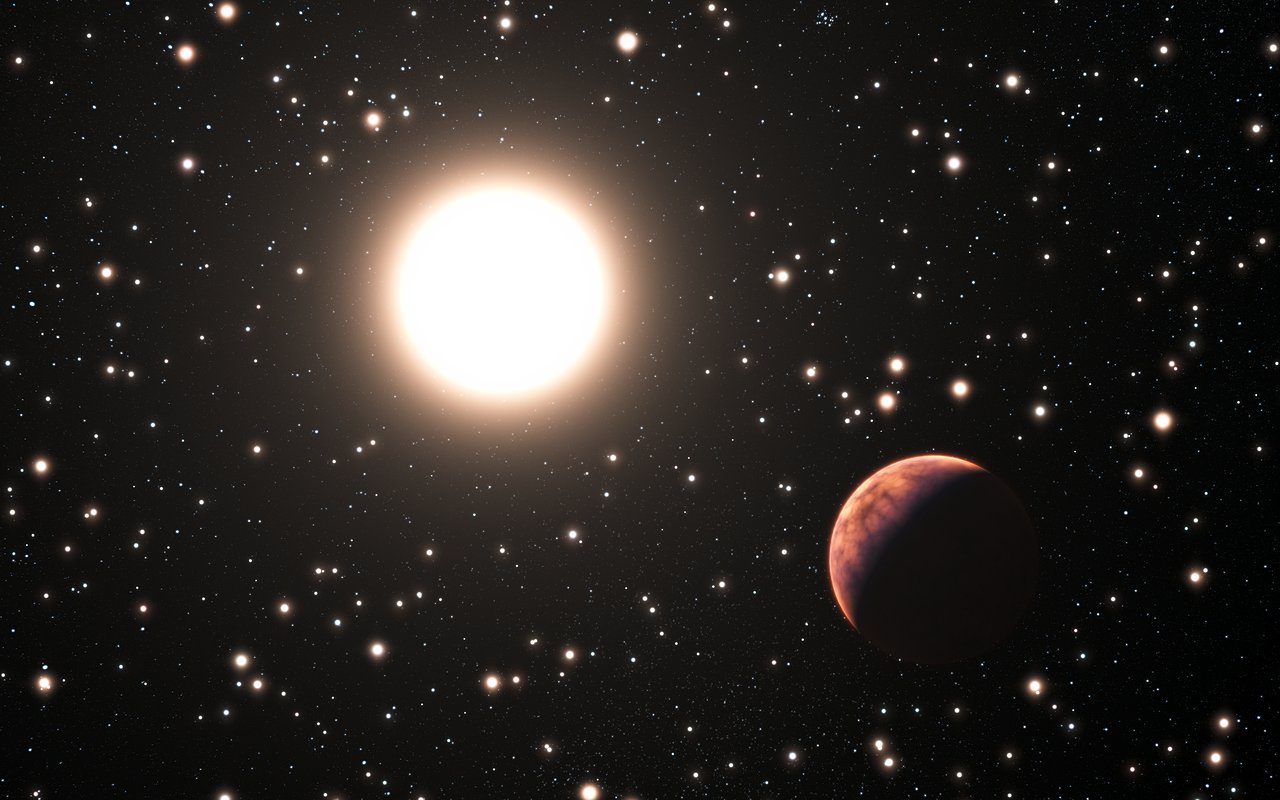
This artist’s impression shows one of the three newly discovered planets in the
star cluster Messier 67. In this cluster the stars are all about the same age and
composition as the Sun. This makes it a perfect laboratory to study how many
planets form in such a crowded environment. Very few planets in clusters are
known and this one has the additional distinction of orbiting a solar twin — a star
that is almost identical to the Sun in all respects.
Everyone can participate in space