Moon news: Yutu rover update + NASA lunar orbiter snaps photo of LADEE orbiter

The mechanical problem with the Chinese lunar rover may be serious, even fatal:  China’s Jade Rabbit rover may be victim of moon dust – New Scientist.

===

Pretty amazing for one lunar orbiter to capture an image of another one: NASA moon mission captures fleeting view of sister craft – Spaceflight Now.

Here’s the NASA release:

NASA’s LRO Snaps a Picture of NASA’s LADEE Spacecraft 

LRO image showing LADEE
LRO imaged LADEE, about 5.6 miles beneath it, at 8:11 p.m. EST on Jan. 14, 2014.
(LROC NAC image M1144387511LR. Image width is 821 meters, or about 898 yards.)
Image Credit: NASA/Goddard/Arizona State University

LADEE is in an equatorial orbit (east-­to-­west) while LRO is in a polar orbit (south-­to-­north). The two spacecraft are occasionally very close and on Jan. 15, 2014, the two came within 5.6 miles (9 km) of each other. As LROC is a push-broom imager, it builds up an image one line at a time, so catching a target as small and fast as LADEE is tricky. Both spacecraft are orbiting the moon with velocities near 3,600 mph (1,600 meters per second), so timing and pointing of LRO must be nearly perfect to capture LADEE in an LROC image.

LADEE passed directly beneath the LRO orbit plane a few seconds before LRO crossed the LADEE orbit plane, meaning a straight down LROC image would have just missed LADEE. The LADEE and LRO teams worked out the solution: simply have LRO roll 34 degrees to the west so the LROC detector (one line) would be in the right place as LADEE passed beneath.

close-up of LRO image of LADEE
This subsection of the LRO image, expanded four times, shows the
smeared view of LADEE. Image Credit: NASA/Goddard/Arizona State University

As planned at 8:11 p.m. EST on Jan. 14, 2014, LADEE entered LRO’s Narrow Angle Camera (NAC) field of view for 1.35 milliseconds and a smeared image of LADEE was snapped. LADEE appears in four lines of the LROC image, and is distorted right­to­left. What can be seen in the LADEE pixels in the NAC image?

Step one is to minimize the geometric distortion in the smeared lines that show the spacecraft. However, in doing so the background lunar landscape becomes distorted and unrecognizable (see above). The scale (dimension) of the NAC pixels recording LADEE is 3.5 inches (9 cm), however, as the spacecraft were both moving about 3,600 mph (1,600 meters per second) the image is blurred in both directions by around 20 inches (50 cm). So the actual pixel scale lies somewhere between 3.5 inches and 20 inches. Despite the blur it is possible to find details of the spacecraft, which is about 4.7 feet (1.9 meters) wide and 7.7 feet (2.4 meters) long. The engine nozzle, bright solar panel and perhaps a star tracker camera can be seen (especially if you have a correctly oriented schematic diagram of LADEE for comparison).

LADEE was launched Sept. 6, 2013. LADEE is gathering detailed information about the structure and composition of the thin lunar atmosphere and determining whether dust is being lofted into the lunar sky.

animation comparing LRO image of LADEE to LADEE artist concept
This animation compares the LRO image (geometrically corrected)
with a computer-generated image of LADEE.
Image Credit: NASA/Goddard/Arizona State University Larger image

LRO launched Sept. 18, 2009. LRO continues to bring the world astounding views of the lunar surface and a treasure trove of lunar data.

NASA’s Goddard Space Flight Center in Greenbelt, Md., manages the LRO mission. NASA’s Ames Research Center in Moffett Field, Calif., manages the LADEE mission.

Related Links
› NASA’s LRO website
› NASA’s LADEE website
› More on this story at ASU’s LROC website
EU project SR2S pursues magnetic radiation shield

I mentioned yesterday that radiation shielding material for in-space transports could one day be supplemented with magnetic shielding. By chance, Universe Today has a post linking to the EU sponsored project –  SR2S (Space Radiation Superconducting Shield) – which is investigating the use of toroidal coils with high-temp superconductors for shielding: Can A Mega-Magnetic Field Protect Astronauts From Radiation? – Universe Today.

Here is a video by the project leader:

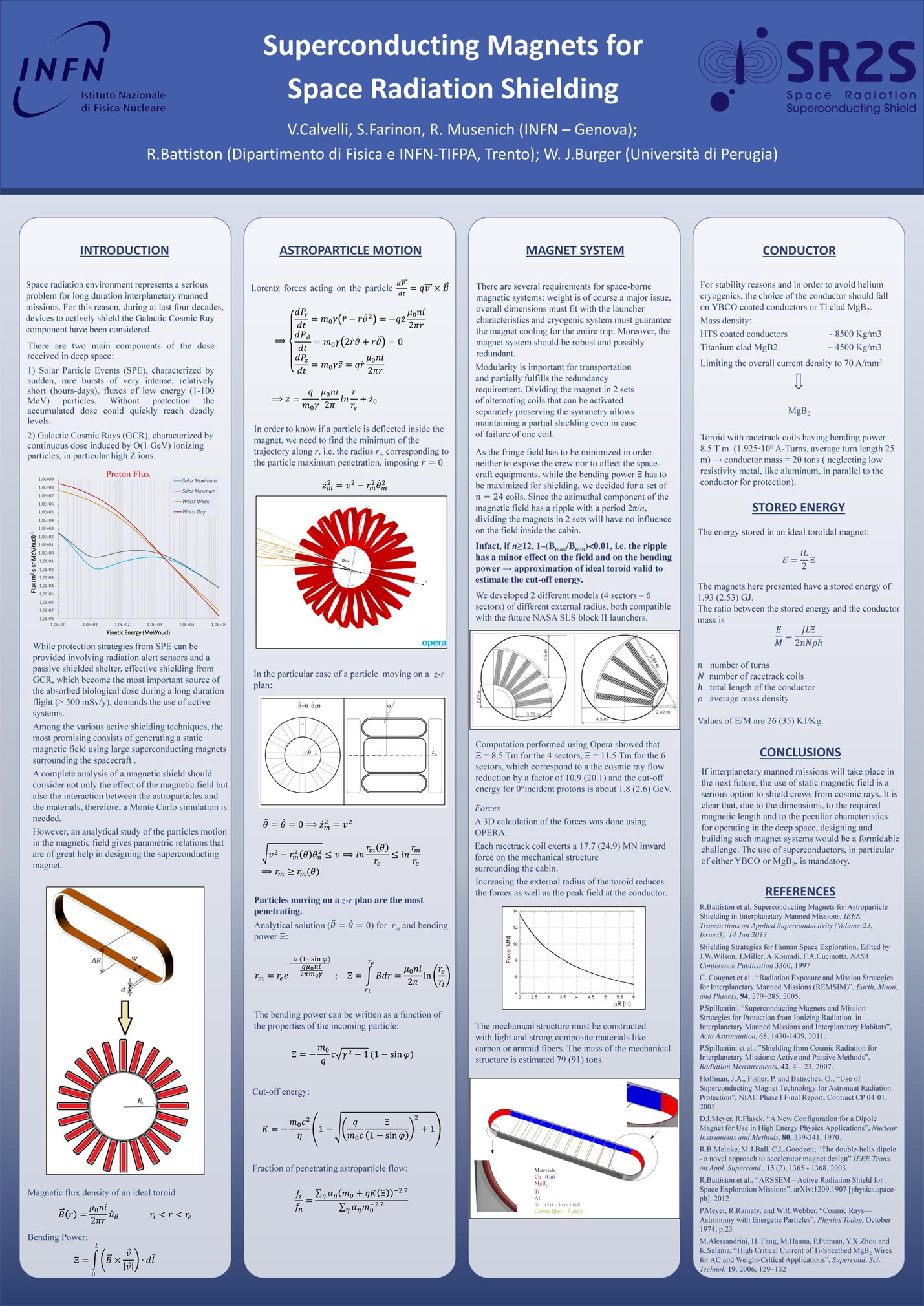
The site provides this poster:

sr2s_poster_13-09_largeClick for large image.

—-

Here is a description of the project on their site:

EU Space Project will allow astronauts to undergo deep space travel
Head of project says shield based on super conducting magnets will protect astronauts.

Head of EU Project Space Radiation Superconductive Shield (SR2S) Professor Roberto Battiston believes that the SR2S project will solve the issue of radiation protection in three years and has called on his fellow academics in space research to develop the technology to allow both male and female astronauts to undertake deep space missions. Battiston believes that there is no reason why space technology cannot be sufficiently developed to allow both genders to withstand a long duration stay in space and thus increasing the number of astronauts available to undertake missions.

Professor Battiston, Project Coordinator of SR2S said “We have already made significant progress since the beginning of the project and believe we will succeed in this goal of solving the radiation protection issue. In the last few months the international teams working at CERN have solved two major technical issues relevant to the superconducting magnets in space (i) how to make very long high temperature superconducting cables join together in a shorter segment without losing the superconducting properties and (ii) how to ensure protection of long high temperature cables from a quench. These developments open the way to larger and more effective space radiation shields and in turn facilitates deep space travel for female astronauts”

The SR2S superconducting shield will provide an intense magnetic field, 3,000 times stronger than the Earth’s magnetic field and will be confined around the space craft. The magnetic fields will extend to about 10 metres in diameter and ionizing particles will be deflected away. Only the most energetic particles will penetrate the superconducting shield but these will contribute the least to the absorbed radiation dose as their flux is negligible. This will address the issue of suitability of people for space travel as it will open up eligibility for space travel regardless of gender.

Professor Battiston continued “This situation is critical. According to our present knowledge only a very small fraction of NASA’s active astronauts are suitable to stay on the ISS for a one year mission regardless of the fact that the exposure to radiation is two times less than the exposure during deep space travel. Researchers must focus on both genders in current and future studies. The next exploration challenges, deep space travel to Near Earth Asteroids and long duration stay on Mars and on the moon, require an effective way to actively shield astronauts.”

The collaborative programme has a specialist team exploring the development of magnetic shield technology based on super conducting magnets to protect astronauts on deep space missions. The development of such technology would help further space science and exploration and enable long human permanence in space, the next stage in space travel, and enable more astronauts to travel, regardless of gender.

—

See also EU Space Project Team Announced – SR2S.

—

Find more resources about radiation shielding, including electrostatic and magnetic schemes, in the HobbySpace Living in Space section.

Space policy roundup – Jan.30.14 [Updated]

A selection of space policy/politics related links:

Update:


**************************

Copenhagen Suborbitals: Ballutes and a big engine test

Some recent posts from Kristian von Bengtson about developments at Copenhagen Suborbitals:

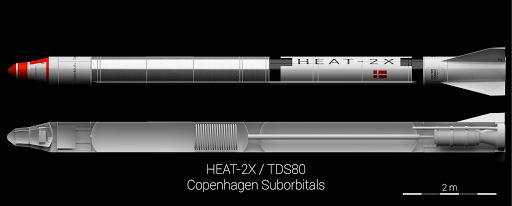
On March 1st they will test the 1st stage of the HEAT 2X rocket, which they plan to launch this summer: Raketmotortest – Denmark.

The danish space pioneers Copenhagen Suborbitals are again testing the worlds most powerful amateur rocket engine, and you have the chance to experience the test onsite !

This time we test the complete, stacked 16 meter tall HEAT 2X rocket stage with full load of 1,200 kg of propellant and full burn time. The test will be conducted in the new 160 ton VTC-3 test stand.

The rocket engine TM65LE will be releasing its full power in a test bench, strongly bolted down to the thick concrete at the former shipyard B&W dock area.

We guarantee an extraordinary experience, so come join us at this rare event !

HEAT2X_render

Video: Interview with SETI pioneer Frank Drake

Today the SETI Institute posted this interview of Frank Drake conducted during the June 2012 SETIcon by astronomy educator Andrew Fraknoi.

 The discussion ranged widely over Dr. Drake’s career and current thinking, and included reminiscences of Project OZMA, the very first experiment searching for signals from civilizations among the stars, and his current view of the Drake Equation (estimating the chances of intelligent life out there). He also reflects on a number of modern developments, including the discovery of numerous planets orbiting other stars and new ways of searching for extra-terrestrial civilizations.

Also from the caption:

Special Note: The audience at this special event received a reprint of Frank Drake’s personal history of the Drake Equation, published by the Astronomical Society of the Pacific in a series edited by Andrew Fraknoi. Because of its historical importance, this article is now available freely on the web at: http://www.astrosociety.org/wp-conten…

Everyone can participate in space