Video: NASA Morpheus rocket vehicle’s 5th free flight

NASA’s Project Morpheus flew their Armadillo Aerospace quad-style vertical takeoff and landing rocket vehicle today at Kennedy Space Center.

The multi-center Morpheus Team successfully completed Free Flight7 (FF7) at the Kennedy Space Center (KSC) Shuttle Landing Facility (SLF) on Monday, February 10, 2014. FF7, the 5th free flight of the Bravo vehicle, flew to 467 feet (142m), altitude and then traversed 637 feet (194m) in 30 seconds before landing in the hazard field. Initial data indicated a nominal flight meeting all test objectives. The vehicle flew its pre-planned trajectory flawlessly, reaching a max ascent velocity of 13 m/s, and landing with no appreciable deviation from its intended target 74 seconds after launch. 

The Astronomy Legacy Project – digitizing more than a century of astronomical photos

The Astronomy Legacy Project, supported by the nonprofit Pisgah Astronomical Research Institute (PARI), has opened an Indiegogo crowdfunding campaign to raise $60,000 to finance their program of digitizing stellar photographic films and plates:

Before the invention of digital cameras in the 1990’s, and for more than 120 years before that, astronomers put in several million telescope hours photographing the night sky – measuring star brightnesses, detecting comets, planets, nebulae, mapping our Galaxy, and building the foundations of our understanding of our Universe!  All of this raw beauty, and secrets yet to be discovered, are held as largely unexplored photographic images on thin, fragile pieces of glass.  Imagine digitizing these hundreds of thousands of photographic images with such high precision that the images appearing on your screen replicates the original. This digitization process is the heart of the Astronomy Legacy Project.

The Astronomy Legacy Project (ALP) will digitize the extensive and diverse set of twentieth century analog (photographic) astronomical data housed at the Astronomical Photographic Data Archive and make it available to the twenty-first century digital world.  Funding will help us to purchase the OPTEK 463 VSM, a highly precise scanning machine that we have chosen to do the digitizing. A staff member will receive 10% of the funding who is responsible for administration of the scanning process with volunteers.

Your donation will honor and preserve the legacy of generations of astronomers and inspire the next generation of space science enthusiasts and people everywhere who are inspired by the mystery and beauty of the night sky!

Exploration. Discovery. Inspiration. from Michael Castelaz, Ph.D. on Vimeo.

Mars : Slippery slopes + Names for old hills

A couple of Mars items today:

NASA Mars Orbiters See Clues to Possible Water Flows

Color-Coded Clues to Composition Superimposed on Martian Seasonal-Flow ImageThis image combines a photograph of seasonal dark flows on a Martian slope
with a grid of colors based on data collected by a mineral-mapping spectrometer
observing the same area. Image credit: NASA/JPL-Caltech/UA/JHU-APL
 › Full image and caption

NASA spacecraft orbiting Mars have returned clues for understanding seasonal features that are the strongest indication of possible liquid water that may exist today on the Red Planet.

The features are dark, finger-like markings that advance down some Martian slopes when temperatures rise. The new clues include corresponding seasonal changes in iron minerals on the same slopes and a survey of ground temperatures and other traits at active sites. These support a suggestion that brines with an iron-mineral antifreeze, such as ferric sulfate, may flow seasonally, though there are still other possible explanations.

Researchers call these dark flows “recurring slope lineae.” As a result, RSL has become one of the hottest acronyms at meetings of Mars scientists.

“We still don’t have a smoking gun for existence of water in RSL, although we’re not sure how this process would take place without water,” said Lujendra Ojha, a graduate student at the Georgia Institute of Technology, Atlanta, and lead author of two new reports about these flows. He originally discovered them while an undergraduate at the University of Arizona, Tucson, three years ago, in images from the High Resolution Imaging Science Experiment (HiRISE) camera on NASA’s Mars Reconnaissance Orbiter.

Ojha and Georgia Tech assistant professor James Wray more recently looked at 13 confirmed RSL sites using images from the same orbiter’s Compact Reconnaissance Imaging Spectrometer for Mars (CRISM) instrument. They searched for minerals that RSL might leave in their wake as a way of understanding the nature of these features: water-related or not?

Continue to article…

===

And Bill Dunford writes about some newly named hills on earth and includes several impressive images: New Hills, Old Secrets –  The Planetary Society

There is a new set of hills on Mars. Well, the hills themselves aren’t new, but they have a new name. In the past couple of months, the International Astronomical Union has officially designated names for dozens of craters, cliffs, seas, and mountains on four different worlds. They include places like Nakuru Lacuna on Saturn’s moon Titan, Neptunalia Dorsa on the asteroid Vesta, and Mercury’s Lennon Crater, named for John.

Continue…
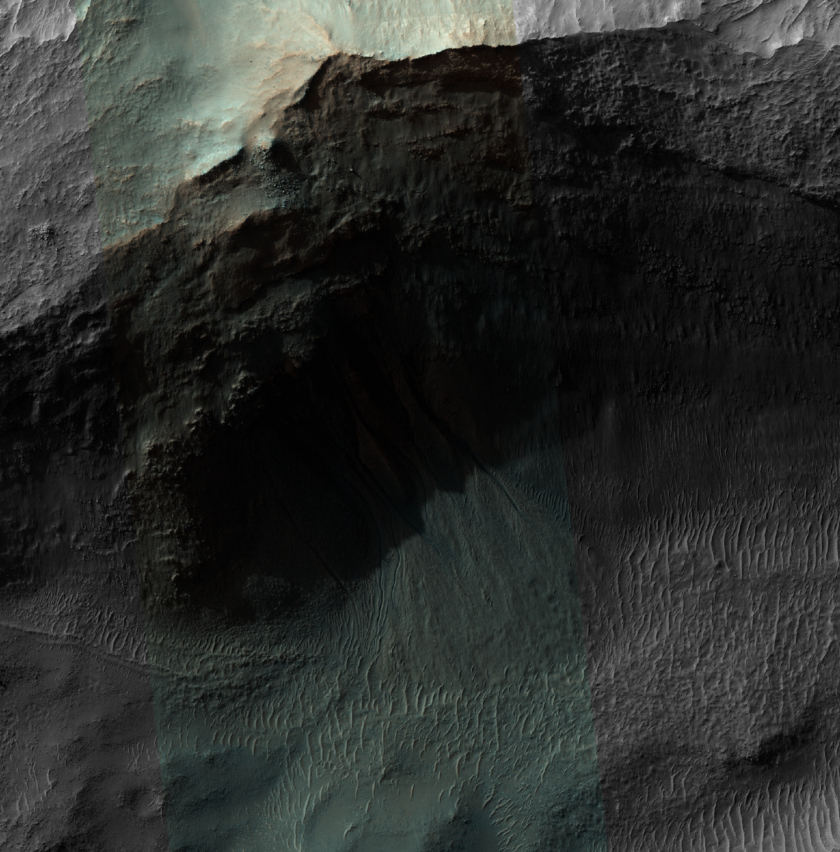
Hidden GulliesHidden Gullies: Overhanging cliffs near Simois Colles on Mars partially conceal
a set of gullies that appear to originate at specific rock layers. Imaged by the
HiRISE camera on board the Mars Reconnaissance Orbiter. The area shown
is approximately one kilometer wide. Credits: NASA / JPL / UA

Space policy roundup – Feb.10.14

A selection of space policy/politics related items:

Space tourism history + Video: Private Space Episode 1 – Space laws

Space historian Roger Launius recently posted two items about the history of space tourism:

===

Here’s is the first episode of the Private Space Web Series  from the photo/video production company LifeAssembled :

Everyone can participate in space