Space policy roundup – Apr.3.14 [Update]

Space policy/politics links:

[ Update:

]

Webcasts:

* Wed 4/2/14 Hr 1 | John Batchelor Show – Bob Zimmerman and  Anatoly Zak (RussianSpaceWeb.com) discuss NASA’s suspension of contacts with Russia except for ISS operations.

Saturn moon Enceladus holds a sea beneath its icy crust

The ESA/NASA Cassini Mission investigating the Saturn system has detected a large body of liquid water below a thick crust of ice on the moon Enceladus:

Icy moon Enceladus has underground sea

Saturn’s icy moon Enceladus has an underground sea of liquid water, according to the international Cassini spacecraft.
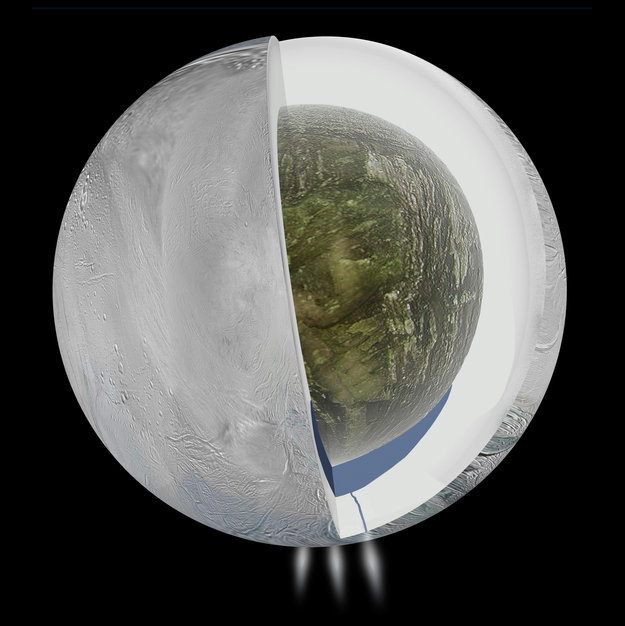
Inside Enceladus

Understanding the interior structure of 500 km-diameter Enceladus has been a top priority of the Cassini mission since plumes of ice and water vapour were discovered jetting from ‘tiger stripe’ fractures at the moon’s south pole in 2005.

Subsequent observations of the jets showed them to be relatively warm compared with other regions of the moon and to be salty – strong arguments for there being liquid water below the surface.

But planetary scientists have now been able to investigate the interior of the enigmatic moon directly, using Cassini’s radio science experiment.


Enceladus plumes

On three separate occasions in 2010 and 2012, the spacecraft passed within 100 km of Enceladus, twice over the southern hemisphere and once over the northern hemisphere.

During the flybys, Cassini was pulled slightly off course by the moon’s gravity, changing its velocity by just 0.2–0.3 millimetres per second.

As tiny as these deviations were, they were detectable in the spacecraft’s radio signals as they were beamed back to Earth, providing a measurement of how the gravity of Enceladus varied along the spacecraft’s orbit. These measurements could then be used to infer the distribution of mass inside the moon.


Enceladus’ craters and complex, fractured terrains

For example, a higher-than-average gravity ‘anomaly’ might suggest the presence of a mountain, while a lower-than-average reading implies a mass deficit.

On Enceladus, the scientists measured a negative mass anomaly at the surface of the south pole, accompanied by a positive one some 30-40 km below.

“By analysing the spacecraft’s motion in this way, and taking into account the topography of the moon we see with Cassini’s cameras, we are given a window into the internal structure of Enceladus,” says Luciano Iess, lead author of the results published in Science.

“The perturbations in the spacecraft’s motion can be most simply explained by the moon having an asymmetric internal structure, such that an ice shell overlies liquid water at a depth of around 30–40 km in the southern hemisphere.”

While the gravity data cannot rule out a global ocean, a regional sea extending from the south pole to 50ºS latitude is most consistent with the moon’s topography and high local temperatures observed around the tiger stripes.

“This experiment provides a crucial new piece of information towards understanding the formation of plumes on this intriguing moon,” says Nicolas Altobelli, ESA’s Cassini project scientist.

—

More information

“The gravity field and interior structure of Enceladus,” by L. Iess et al, is published in Science, 4 April 2014.

The Cassini–Huygens mission is a cooperative project of NASA, ESA and ASI, the Italian space agency. NASA’s Jet Propulsion Laboratory, a division of the California Institute of Technology in Pasadena, manages the mission for NASA’s Science Mission Directorate, Washington.

Music videos: Cosmos & Rocking Sun – Digital Stories Music

Dima Filippov at Digital Stories Music pointed me to two new videos with music from his album “Cosmos EP” on FutuRekords, which will be released on April 12th, i.e. Yuri’s Night.

Virtual SpaceTV 3D – March/April 2014

Here is the latest episode of The Virtual SpaceTV 3D show with Amanda Bush. The programs are created by BINARY SPACE (www.binary-space.com) with story content from HobbySpace.com.

In this show, Amanda Bush talks about the following topics:
01:27 — 04:05 Satellites assist the Malaysian Airliner Search
04:06 — 06:05 Seeing a Gravity Wave and all around the Milky Way
06:06 — 07:16 Weightless Bikinis and Parabolic Competition
07:17 — 07:59 A new Gulley on Mars
08:00 — 09:32 The first Mars War over naming Craters


Other Virtual SpaceTV 3D shows are available on the  HobbySpace Youtube Channel.

These videos are intended as educational programs and as demonstrations of an experimental technique for generating animated presentations. The show was generated autonomously by software according to a text script. The project is described in the Virtual Producer whitepaper (Release 1.1, Oct.2013, pdf). For further information contact info@binary-space.com.

SpaceUnited – a humanitarian space agency

David Livingston recently interview Adam Brinckerhoff about the SpaceUnited project: Adam Brinckerhoff, Friday, 3-28-14 – Thespaceshow’s Blog

SpaceUnited is described as “your nonprofit humanitarian space agency. Explore for good.” They define a “humanitarian space agency” as follows:

It’s a organization that helps people on Earth and beyond through the use of space technologies. Today, this help comes in the form of satellite imagery, improved housing, life-support systems, and science and education programs. Tomorrow it could mean interstellar Internet access; Mars and Moon aid; or a million other things.

Their primary goals currently appeared to be implementing Humanitarian Space Missions. Here are three current missions –

ExploraLab – Would you like to send something to the stratosphere? ExploraLab is your rocket-shaped experiment payload carrier. Simply create an experiment, put it into an ExploraLab, and drop it in the mail. We’ll make sure that it flies high and then gets delivered back to you!

SHIM-1 – SHIM-1 is a mission about saving lives. We’re working to purchase real-time satellite photos for humanitarian efforts, such as emergency relief organizations and international human rights watchdogs. Discover how you can help.

HOME-1 – HOME stands for Human Optimized Modular Environment. The mission of the HOME program is to improve human life by improving housing. We’re working on building HOMEs for on and off-Earth use. Check out this awesome project.

Two completed missions are BalloonSat-1 and BalloonSat-2.

You can follow their activities and progress at the SpaceUnited Blog. Also, SpaceUnited executives Troy Dunn and Adam Brinckerhoff present Google+ Hangouts every Tuesday at 11:30 AM MT in which they

discuss the humanitarian space exploration topic of the week, interview a guest, and answer your questions live!”

Here is a recent Hangout in which they discussed  “How To Do Space Exploration Yourself” :  SpaceUnited Hangout 3-18-14 – SpaceUnited –

Everyone can participate in space